
Last updated: July 15, 2026 · Reviewed by TopNation Immigration Services’ licensed RCIC team, regulated by the CICC. Processing-time figures on this page are drawn from the IRCC processing-times tool and the IRCC LMIA exemption codes manual, and reviewed regularly.
LMIA-Exempt Work Permit Processing Times at a Glance (updated July 2026)
LMIA-exempt work permits in 2026 move in weeks, not months — but the timeline depends on which exemption code applies and where the worker applies from. The employer’s Offer of Employment through the IRCC Employer Portal is typically confirmed in 1–3 business days once the $230 compliance fee is paid. Global Talent Stream work permits carry a published 2-week service standard. CUSMA professional permits are usually issued at the port of entry within a single visit. Employer-specific work permits filed from outside Canada currently run about 6–12 weeks depending on the visa office, while in-Canada applications typically complete in 3–6 weeks. Francophone Mobility (C16) files from Africa often add 2–4 weeks for biometrics and medical exams. Sources: IRCC processing-times tool and the IRCC Foreign Worker Manual (exemption codes).
July 2026 note: IRCC’s published processing-times tool updates weekly and shows current live estimates by country of application. The ranges below are drawn from that tool as of mid-July 2026 and from operational IRCC guidance. Individual files vary with biometric enrolment, medical exam scheduling, and visa-office backlog. Treat these as planning ranges and always confirm the current live estimate for the worker’s specific country of residence before quoting a date.
LMIA-EXEMPT PROCESSING TIMES 2026
The International Mobility Program (IMP) — the LMIA-exempt half of Canada’s temporary foreign worker system — is the pathway most Alberta employers should be measuring their timelines against in 2026. IRCC has expanded IMP work-permit capacity to roughly 170,000 spots this year while cutting the LMIA-based TFWP to 60,000. That means for the majority of employer-specific hires, the fastest legal way to get a foreign worker on the job is the LMIA-exempt route. But “LMIA-exempt” is not one timeline. It is at least four distinct sub-timelines: the employer’s Offer-of-Employment step, the worker’s work-permit application, biometrics and medicals, and the visa-office decision. This guide breaks each one down with the current IRCC service standards and the operational ranges we see in our Edmonton practice.
The Four Clocks Inside an LMIA-Exempt Work Permit
Employers often ask “how long does an LMIA-exempt work permit take?” expecting a single number. In reality, four separate processes run in sequence (or partial parallel), and each has its own IRCC service standard. Understanding the split is the difference between quoting a candidate a realistic start date and being months late.
- Employer step — Offer of Employment via the IRCC Employer Portal. The employer submits the Offer of Employment (form IMM 5802 equivalent) through the Employer Portal, pays the $230 employer compliance fee, and receives an Offer of Employment number (starts with “A”) that the worker uses in their work-permit application. This step typically confirms in 1–3 business days.
- Worker step — Work-permit application to IRCC. The worker files the employer-specific work-permit application referencing the Offer of Employment number. Processing time varies by category and country of residence.
- Biometrics and medical exam. Biometrics enrolment at a Visa Application Centre (VAC) typically takes 2 to 4 weeks depending on VAC availability. An upfront medical exam (required for workers in healthcare, childcare, or those from designated countries) adds another 2 to 4 weeks.
- Visa-office decision and permit issuance. The final decision timeline follows IRCC’s per-country processing standard. For port-of-entry issuance (CUSMA, visa-exempt nationals under certain categories), this can be a single day.
The employer often controls only step 1. Steps 2 through 4 are IRCC-controlled and vary by exemption code and worker location. The tables below map each category to its current ranges.
LMIA-Exempt Work Permit Processing Times by Category — Current 2026 Service Standards
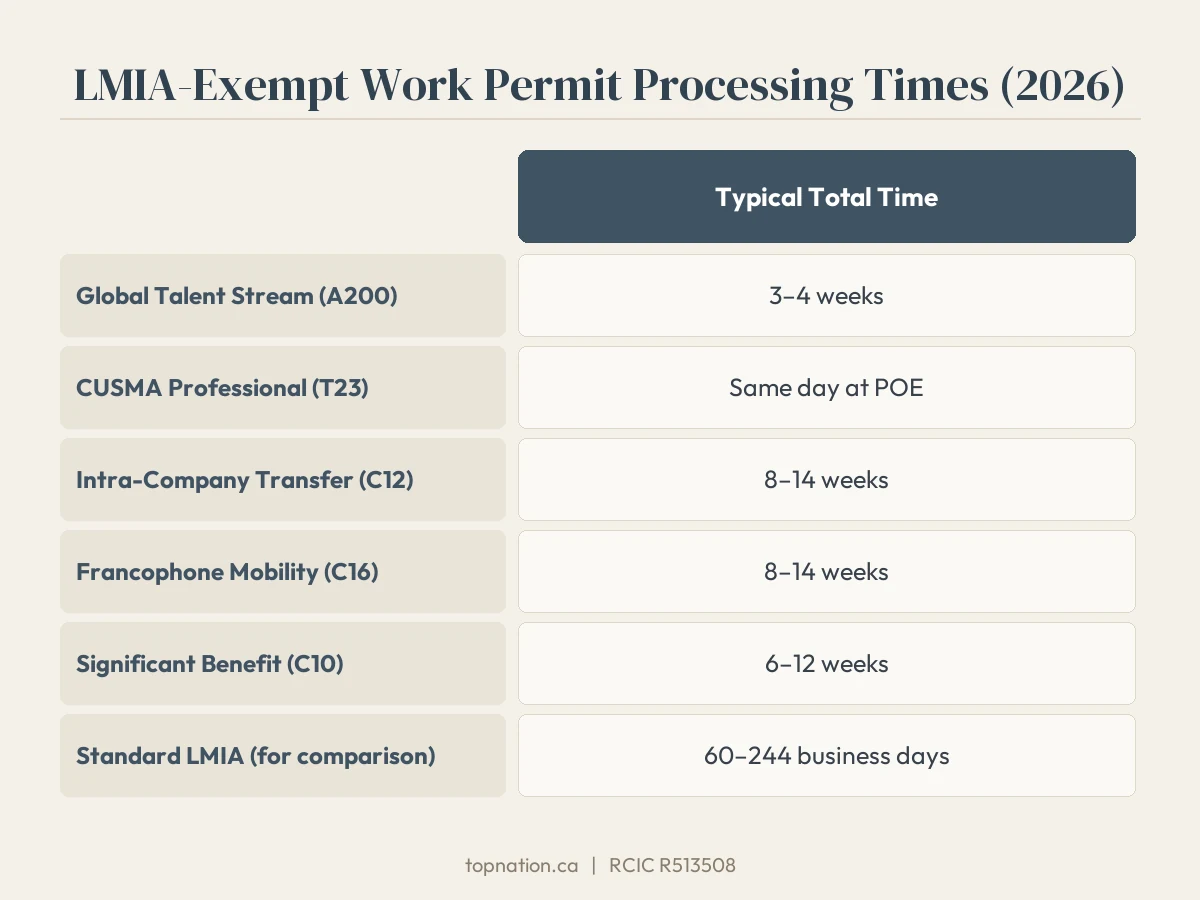
The table below summarizes typical end-to-end processing time (from Offer-of-Employment submission to work permit issued) for the most common IMP exemption categories. Ranges reflect the IRCC processing-times tool as of mid-July 2026 combined with operational experience across visa offices we file through.
| Exemption Code & Category | Employer Portal Step | Work Permit Processing | Typical Total |
|---|---|---|---|
| A200 — Global Talent Stream (Cat. A/B) | 1–3 business days | 2 weeks (IRCC service standard) | 3–4 weeks (fastest) |
| T23 — CUSMA Professional (US/Mexico) | Not required (POE) | Same day at port of entry | Same day (with valid documents) |
| T33 — CUSMA Intra-Company Transferee | 1–3 business days | Same day at POE / 2–4 weeks online | Same day (POE) or 3–5 weeks |
| C12 — Intra-Company Transferee (non-CUSMA) | 1–3 business days | 6–12 weeks (outland) | 8–14 weeks |
| C16 — Francophone Mobility | 1–3 business days | 6–10 weeks (Africa VOs) | 8–14 weeks incl. biometrics |
| C10 — Significant Benefit to Canada | 1–3 business days | 4–10 weeks | 6–12 weeks |
| C11 — Entrepreneurs / Self-Employed | Not required (self-employed) | 8–14 weeks (outland) | 8–14 weeks |
| C13 — Provincial Nominee (bridging concept) | 1–3 business days | 3–6 weeks (inland renewal) | 4–7 weeks |
| C61 — Reciprocal Employment (general) | 1–3 business days | 6–10 weeks | 8–12 weeks |
| PGWP-to-Employer (bridging) | Not required (open permit) | N/A — already work-authorized | Immediate (start day one) |
The pattern is consistent: the fastest LMIA-exempt hires are those that either bypass the Employer Portal entirely (CUSMA at POE, PGWP holders) or ride a dedicated priority stream (Global Talent A200). Everything else clusters at 6 to 14 weeks — still dramatically faster than the 60 to 244 business days ESDC now needs for a standard LMIA. Compare our full LMIA processing times 2026 breakdown to see the gap.
The Employer Portal Offer of Employment — What Actually Happens

The Employer Portal step is the piece most Alberta employers underestimate. It is not just paperwork — it is a compliance filing that triggers a two-year window in which your business can be inspected by ESDC and IRCC. Here is what the timeline looks like for a well-prepared file.
Portal Registration (First-Time Employers)
If your business has never used the IRCC Employer Portal, initial registration takes 1 to 2 business days. You will need the CRA business number, an authorized signatory, and a corporate email that will receive all future compliance correspondence. Register once at the IRCC Employer Portal and reuse the account for every future filing.
Offer of Employment Submission
Complete the Offer of Employment form inside the portal with the worker’s full name, passport details, NOC code, wage, hours, worksite address, and the specific IMP exemption code you are claiming. Pay the $230 compliance fee by credit card. The portal will generate an Offer of Employment number (format: A + 8 digits) within 1 to 3 business days — often within the same business day if submitted before noon Eastern.
The Number Is the Trigger
Nothing on the worker’s side can move until you send them the Offer of Employment number. This is the single most common cause of avoidable delay in LMIA-exempt files — employers assume the worker can file their permit application while they prepare the offer. They cannot. Every day the offer sits undrafted is a day added to the total timeline.
Global Talent Stream (Code A200) — The Two-Week Standard
The Global Talent Stream is the fastest LMIA-exempt category in 2026 with a published 2-week IRCC service standard for work-permit processing. Both Category A (referred by a designated partner) and Category B (occupations on the Global Talent Occupations List, including senior software developers, information systems analysts, computer engineers, database analysts, and specific TEER 0/1 tech roles) qualify. Combined with 1 to 3 days for the Employer Portal step, total end-to-end timeline typically completes in 3 to 4 weeks. See the official Global Talent Stream page for the current occupation list.
Two catches to know: (1) the GTS technically requires an LMIA at the employer end (submitted to ESDC, which processes it in a published 12-business-day standard) — the “LMIA-exempt” treatment applies to the worker’s permit under a priority processing regime, not to the employer step; (2) the employer must sign a Labour Market Benefits Plan (LMBP) committing to specific benefits for the Canadian labour market. Employers filing their first GTS should budget 2 to 3 weeks to prepare the LMBP before submission.
CUSMA Professionals (T23) — Same-Day at the Port of Entry
US and Mexican nationals in the 63 CUSMA-listed professions can have their employer-specific work permit issued the same day at any Canadian port of entry — land border or airport. No Employer Portal filing is required because the CUSMA treaty exempts the employer from the compliance regime. The worker presents a job offer letter, proof of profession-relevant credentials (degree or licence), and their passport at primary inspection. The permit is printed in secondary inspection, typically within 30 to 90 minutes.
This is the fastest legal path to putting a foreign professional to work in Canada. For qualifying US/Mexican professionals, the total time from job-offer signing to first day on the job can be under 72 hours. The most common qualifying roles for Alberta employers: engineers, computer systems analysts, management consultants, accountants, hotel managers, and scientific technicians/technologists.
Francophone Mobility (C16) — The Overlooked Alberta Advantage
The C16 Francophone Mobility exemption lets any Alberta employer hire a French-speaking foreign worker for a job outside Quebec without an LMIA, without a labour-market test, and without a mandatory advertising period. In 2026 IRCC removed the previous TEER 0–3 restriction, so C16 now covers all NOC skill levels — including cooks, truck drivers, construction labourers, and hospitality staff who previously required an LMIA.
End-to-end timing runs 8 to 14 weeks in our practice, dominated by two factors: (1) visa-office processing for the country of residence — Rabat, Dakar, and Abidjan generally publish 6 to 10 weeks for standard permits, while Paris and Montreal (for in-Canada Francophone applicants) run 3 to 6 weeks; (2) biometrics enrolment at the local VAC, which adds 2 to 4 weeks unless the worker’s biometrics are already on file from a prior visa. For most Morocco- and Tunisia-based candidates recruited to Alberta, 10 to 12 weeks is a realistic planning figure. See our LMIA exemption codes guide for full C16 eligibility criteria.
Inland vs Outland — The Location Multiplier
Where the worker files their application — from inside Canada (inland) or from outside Canada (outland) — can double or halve the timeline. IRCC operates separate processing queues for each stream.
Inland Applications (Worker Already in Canada)
Workers already in Canada on a valid status (visitor, student, other work permit) can apply online to change conditions or extend to a new employer-specific LMIA-exempt permit. IRCC’s current processing-times tool shows inland employer-specific work permit applications completing in 3 to 6 weeks for most categories in 2026. Implied benefit orders (formerly “bridging”) let the worker continue working under the previous permit’s conditions while the new one processes, provided the extension was filed before the current permit expired.
Outland Applications (Worker Outside Canada)
Outland processing depends heavily on the visa office responsible for the country of residence. As of mid-July 2026, IRCC publishes country-specific work-permit processing times on the check processing times tool. Representative current ranges for LMIA-exempt employer-specific permits from countries that supply significant Alberta labour: India (New Delhi VO) 8–12 weeks; Philippines (Manila) 6–10 weeks; Morocco (Rabat) 6–10 weeks; Tunisia (Tunis via Rabat/Paris) 8–12 weeks; UK (London) 3–5 weeks; US (New York/Los Angeles) 2–4 weeks; UAE (Abu Dhabi) 4–8 weeks.
Port-of-Entry (POE) Applications
Visa-exempt nationals (US citizens plus a defined list including UK, Ireland, most EU, Australia, New Zealand, Japan, Korea) whose exemption category permits POE issuance (CUSMA, ICT, C10, C11, C12) can bypass the visa-office queue entirely and have the permit issued on arrival. POE issuance is the single biggest timeline hack available for eligible workers — effectively same-day, provided the file is airtight.
Country of Residence — Why Two C16 Files Take Different Amounts of Time
Two Francophone workers with identical qualifications can experience wildly different timelines depending on where they apply from. The visa office responsible for the country of residence handles the file, and each office has its own current queue. IRCC updates its country-specific times weekly.
Operational patterns we see across the visa offices that matter most for Alberta hiring in 2026:
- Rabat (serves Morocco, Tunisia, Algeria, Mauritania, Libya): 6–10 weeks for standard employer-specific permits; add 2 weeks if medical exam required.
- Dakar (serves Senegal, Guinea, Mali, Cape Verde, Gambia, Sierra Leone): 8–12 weeks; biometrics VAC availability is the usual bottleneck.
- Accra (serves Ghana, Nigeria via Lagos, Liberia, Togo, Benin): 10–16 weeks; heavy volume, expect the higher end.
- Manila (serves Philippines): 6–10 weeks; medical exam very common (Philippines is a designated country).
- New Delhi (serves India, Nepal, Bhutan): 8–12 weeks; consistently high volume for tech and skilled trades.
- Mexico City (serves Mexico): 4–8 weeks for non-CUSMA files; CUSMA T23 files bypass VO entirely at POE.
Medical exams add 2 to 4 weeks for workers from any designated country or working in a listed occupation (healthcare, childcare, primary/secondary education). Filing the upfront medical (before the permit application) trims 2 to 3 weeks off the total.
What Actually Slows Down an LMIA-Exempt File

The category-level ranges above assume a complete file. In our Edmonton practice the four most common causes of avoidable delay on LMIA-exempt files are:
1. Wrong Exemption Code Selected
If the wrong exemption code is claimed on the Offer of Employment, the officer will either return the file for correction (adding 2 to 6 weeks) or refuse. Common mistakes: filing C10 “significant benefit” when C11 self-employed or C12 intra-company transferee is the correct fit; claiming C16 Francophone Mobility for a worker whose French test scores do not meet the operational threshold. Use the LMIA exemption codes guide alongside the IRCC exemption codes manual to confirm before filing.
2. Biometrics Not Enrolled Promptly
The worker has 30 days from the Biometric Instruction Letter to enrol at a VAC. If the VAC in the country of residence has no appointments within that window, the file waits. Our team pre-books the biometrics appointment window before the permit application is submitted for high-volume countries (India, Nigeria, Philippines).
3. Missing or Late Medical Exam
For workers from designated countries or in listed occupations, the medical exam adds 2 to 4 weeks if requested after submission. Filing the upfront medical before or at the same time as the permit application eliminates this delay.
4. Offer of Employment Mismatched to Permit Application
The wage, NOC code, hours, and worksite on the Offer of Employment must match the worker’s permit application exactly. Even minor mismatches (different postal code, slightly different job title) trigger clarification requests that add 2 to 4 weeks. Cross-check the two filings before submission.
Comparing LMIA-Exempt to LMIA — The Timeline Gap in 2026
Set against the current LMIA numbers from our LMIA processing times 2026 analysis, the LMIA-exempt route is faster by a wide margin for every category except tightly-scoped LMIA streams like Global Talent (12 business days) and Agricultural (19 business days). A representative comparison:
| Situation | LMIA Route | LMIA-Exempt Route |
|---|---|---|
| Alberta hotel hiring a Moroccan cook (French-speaking) | Low-wage LMIA blocked (Edmonton CMA >6% unemployment) + PR-stream 244 days | C16 Francophone Mobility: 8–12 weeks |
| Calgary tech startup hiring US software developer | Global Talent Stream LMIA: 12 business days + permit | T23 CUSMA at POE: same day |
| Edmonton construction firm hiring PGWP holder | High-wage LMIA: 60 business days | Already work-authorized: start day one |
| Multinational transferring senior manager from UK | High-wage LMIA: 60 business days + permit 3–5 weeks | C12 ICT (London VO): 5–7 weeks total |
The decision rule for most Alberta employers in 2026: if the worker or the role qualifies for any LMIA-exempt category, that route is faster, cheaper ($230 vs $1,000 government fee), and requires no advertising period. See our full LMIA vs LMIA-exempt work permit comparison for the eligibility decision framework.
What to Do While You Wait
The 3-to-14-week LMIA-exempt total timeline is short enough that most employers can plan around it precisely. The moves that make the wait productive:
- Book biometrics the day the permit application is submitted. Do not wait for the instruction letter — check VAC availability in the country of residence and pre-schedule.
- File the upfront medical exam if the worker is from a designated country or applying for a healthcare/childcare/education role. Saves 2 to 3 weeks vs waiting for IRCC to request it.
- Prepare the worker’s arrival logistics. Housing, first-week schedule, banking (SIN card can be obtained same-day on arrival), payroll set-up.
- Confirm employer compliance records are current — wage justification, worksite address, occupational health & safety documentation. IRCC can inspect any Employer Portal filing for up to two years.
- Track the permit application weekly via the worker’s IRCC Secure Account. Movement is usually visible within 5 business days of any status change.
Frequently Asked Questions
How long does an LMIA-exempt work permit take in 2026?
Total end-to-end time ranges from same-day (CUSMA T23 at port of entry) to 14 weeks (C16 Francophone Mobility from West Africa with biometrics and medical). The Employer Portal Offer of Employment confirms in 1 to 3 business days; the work-permit application processing varies by exemption code and the visa office responsible for the worker’s country of residence. Global Talent Stream A200 carries a published 2-week IRCC service standard.
Do I need to file an Offer of Employment through the IRCC Employer Portal?
For employer-specific LMIA-exempt work permits, yes — with two exceptions. CUSMA professionals (T23) at the port of entry do not require an Employer Portal filing, and open-work-permit holders (PGWP, spousal open, IEC) can start work without any employer-side filing. Every other IMP category requires the Offer of Employment submission and $230 compliance fee before the worker can apply for the permit.
How long does the Global Talent Stream work permit take?
IRCC publishes a 2-week service standard for Global Talent Stream (A200) work permit processing. Combined with 1 to 3 business days for the Employer Portal step and the ESDC 12-business-day LMIA processing at the employer end, total end-to-end timeline typically completes in 3 to 4 weeks. Employers must also sign a Labour Market Benefits Plan, which adds 2 to 3 weeks of preparation for first-time filers.
What is the fastest LMIA-exempt category for a French-speaking worker?
C16 Francophone Mobility. It applies to any French-speaking foreign worker hired for a job outside Quebec, requires no labour-market test or advertising, and in 2026 covers all NOC skill levels including TEER 4 and 5 roles. Total end-to-end timeline typically runs 8 to 14 weeks, dominated by visa-office processing (Rabat, Dakar, Accra) and biometrics enrolment at the local Visa Application Centre.
Do CUSMA professionals need to apply from outside Canada?
No. US and Mexican nationals in the 63 CUSMA-listed professions can have the work permit issued the same day at any Canadian port of entry — land border or airport. The worker presents a job offer letter, proof of profession-relevant credentials, and their passport at primary inspection. No Employer Portal filing is required. This is the fastest LMIA-exempt pathway available in 2026.
Can an LMIA-exempt work permit be issued at the port of entry?
Yes, for visa-exempt nationals whose exemption category permits port-of-entry issuance. This includes CUSMA (T23, T33), Intra-Company Transferee (C12), Significant Benefit (C10), and Entrepreneurs (C11) for citizens of the United States, United Kingdom, Ireland, most EU member states, Australia, New Zealand, Japan, and Korea. The permit is printed in secondary inspection, typically within 30 to 90 minutes.
Does my worker’s country of residence affect processing time?
Yes — significantly. IRCC operates country-specific visa offices, each with its own queue. As of mid-July 2026, employer-specific LMIA-exempt permits typically process in 2 to 4 weeks from the US, 3 to 5 weeks from the UK, 6 to 10 weeks from Morocco or the Philippines, 8 to 12 weeks from India or Tunisia, and 10 to 16 weeks from Nigeria via the Accra visa office. Always check the live IRCC processing-times tool for the current country-specific estimate before quoting a candidate a start date.
How do I check the status of an employer-specific LMIA-exempt work permit?
Log into the worker’s IRCC Secure Account using their application number and unique client identifier. The account shows current status (e.g., “In Progress”, “Biometrics Received”, “Medical Received”, “Decision Made”) and updates within 5 business days of any change. Employers cannot check the worker’s permit status directly, but can verify the Offer of Employment status inside the IRCC Employer Portal.
Get Your Worker on the Job in Weeks, Not Months — Talk to a Licensed RCIC
Our Edmonton team files LMIA-exempt work permits across every IMP category — Francophone Mobility, CUSMA, Intra-Company Transferee, Global Talent Stream, and Significant Benefit. We match the right code to the file, prepare the Employer Portal Offer of Employment, and shepherd the worker’s permit through to arrival.
| 📞 Call 587-400-0077 | Alberta Employer Services → |
Licensed RCIC firm regulated by the CICC | Edmonton, Alberta | Alberta employer immigration since 2013
Last updated: July 15, 2026. Processing times reflect the latest published IRCC service standards and the IRCC processing-times tool. Individual file timing varies by visa office, biometrics, and medical requirements; consult a licensed RCIC for case-specific guidance.