MPNP Program Closure Alert
On June 12, 2026, the Manitoba Provincial Nominee Program (MPNP) abruptly retired its Career Employment Pathway (CEP). This change affects thousands of international graduates who were planning their permanent residence strategy around this specific stream, creating an urgent need to pivot to new immigration pathways.
MPNP UPDATE — JUNE 12, 2026

The recent closure of the Manitoba Career Employment Pathway (CEP) has sent a wave of uncertainty through the international graduate community. For many, the CEP was a clear and direct route to permanent residence after completing their studies in Manitoba. This sudden policy shift, effective June 12, 2026, means that your planned immigration journey needs a new map. This guide is designed to be that map. We will not just list alternatives; we will strategically compare five viable PR pathways across Canada, providing the data-driven insights and practical advice you need to make a confident and informed decision about your future.
Understanding the Impact of the Career Employment Pathway (CEP) Closure
Before exploring alternatives, it’s crucial to understand what the CEP offered and why its closure requires immediate strategic realignment. The Career Employment Pathway was specifically designed for post-secondary graduates from Manitoba institutions who secured long-term, full-time employment in an in-demand occupation directly related to their field of study. It was a highly attractive stream because it offered a direct path to a provincial nomination without needing to meet the higher points thresholds of other MPNP streams.
Who is Most Affected by This Change?
The primary group impacted includes recent graduates from Manitoba Designated Learning Institutions (DLIs) who are currently on a Post-Graduation Work Permit (PGWP). This also affects prospective students who chose Manitoba specifically for the CEP, and graduates who were in the process of gathering documents to apply. The core challenge is that the timeline for a PGWP is finite. Without the CEP, you must now qualify for a different program, which may have entirely different requirements for work experience, job offers, or language proficiency, all before your legal status in Canada expires.
Alternative 1: Alberta Advantage Immigration Program (AAIP)
For many graduates looking for a robust economy and clear PR pathways, Alberta presents a compelling alternative. The Alberta Advantage Immigration Program (AAIP) offers several streams that are well-suited for those with Canadian education and work experience. The province’s growing tech, healthcare, and trades sectors provide ample opportunities that align with provincial immigration priorities.

Alberta Opportunity Stream (AOS)
The AOS is a primary option for PGWP holders working in Alberta. It requires a job offer in your field, but it is not tied to a specific list of in-demand occupations in the same way the CEP was. The key is that the employment must be related to your field of study if you are a PGWP holder.
Eligibility hinges on having a full-time job offer from an Alberta employer, meeting language requirements (typically CLB 4 or 5 depending on occupation), and having the appropriate work status. Based on our firm’s Q1-Q2 2026 data, AAIP nominations for straightforward AOS files from PGWP holders are being issued in approximately 60-75 days, which is significantly faster than many other PNPs.
Alberta Express Entry Stream & Accelerated Tech Pathway
If you have an active Express Entry profile, the Alberta Express Entry stream could invite you to apply for nomination with a Comprehensive Ranking System (CRS) score as low as 300, provided you have strong ties to the province (like a job offer or previous study). For those in the tech sector, the Accelerated Tech Pathway offers expedited processing for candidates with an Alberta job offer in one of 38 specified tech occupations.
Alternative 2: Ontario Immigrant Nominee Program (OINP)
Ontario, as Canada’s largest province, offers sophisticated pathways for international graduates, particularly those with advanced degrees. While the competition is higher, the opportunities are vast. The OINP has specific streams that do not even require a job offer, making them highly attractive.
Master’s and PhD Graduate Streams
These are two of the most popular OINP streams. If you have graduated with a Master’s or PhD degree from an eligible Ontario university within the last two years, you can apply for a provincial nomination without a job offer. This is a significant advantage. However, these streams are extremely popular and operate on an Expression of Interest (EOI) system. A high EOI score is critical.
Common Mistake We See: A frequent error with the OINP Master’s Graduate stream is misinterpreting the residency requirement. Applicants must prove they have resided in Ontario for at least one of the two years preceding their application. We’ve seen applications returned because the applicant provided a lease agreement but their bank statements showed significant activity in another province, undermining their claim of Ontario residency.
Human Capital Priorities Stream
This stream is aligned with the federal Express Entry system. Ontario scans the Express Entry pool and invites candidates who meet specific criteria, often targeting those in tech, healthcare, or skilled trades. You don’t apply directly; you must have an active Express Entry profile and wait for a Notification of Interest (NOI) from Ontario.
Alternative 3: British Columbia Provincial Nominee Program (BC PNP)
British Columbia’s strong economy and high demand for skilled workers make its PNP a viable option. The BC PNP offers dedicated streams for international graduates that are integrated into their Skills Immigration Registration System (SIRS), a points-based invitation system.
International Graduate Stream
To be eligible for this stream, you must have graduated from an eligible Canadian post-secondary institution and accepted a full-time, indeterminate job offer from a B.C. employer in a skilled occupation (NOC TEER 0, 1, 2, or 3). The wage offered must be competitive with B.C. wage rates for the occupation.
International Post-Graduate Stream
Similar to Ontario, B.C. offers a pathway for those with a master’s or doctoral degree from an eligible B.C. institution in the natural, applied, or health sciences. Crucially, this stream does not require a job offer, allowing you to apply directly for nomination upon graduation.
Alternative 4: Federal Express Entry – Canadian Experience Class (CEC)
For many graduates, the most direct path may not be a PNP at all, but the federal Canadian Experience Class (CEC). This program is designed for individuals who have already gained skilled work experience in Canada. The closure of the CEP in Manitoba doesn’t affect your eligibility for CEC in any way.
Core Requirements for CEC
The foundation of a CEC application is work experience. You need at least one year of full-time (or equivalent part-time) skilled work experience in Canada in a NOC TEER 0, 1, 2, or 3 occupation within the three years before you apply. This experience must have been gained while you had legal authorization to work in Canada (e.g., on a PGWP). You also need to meet the minimum language proficiency (CLB 7 for TEER 0/1, CLB 5 for TEER 2/3).
Strategy for Graduates
Your primary goal after the CEP closure should be to secure a full-time, skilled job and begin accumulating the required 1,560 hours of work experience. This makes your PGWP your most valuable asset. Unlike some PNPs, CEC does not require your job to be related to your field of study, offering more flexibility. The key is to ensure the job duties align with the lead statement and main duties of a skilled NOC code. We regularly advise clients on how to properly document this experience to satisfy IRCC requirements.
Alternative 5: Atlantic Immigration Program (AIP)
The Atlantic Immigration Program is a unique federal program designed to attract and retain skilled immigrants in Canada’s four Atlantic provinces: New Brunswick, Nova Scotia, Prince Edward Island, and Newfoundland and Labrador. It is a job-offer-driven program with specific streams for international graduates.

AIP for International Graduates
To qualify as an international graduate, you must have a degree, diploma, or certificate from a publicly funded institution in an Atlantic province. You must have lived in one of the Atlantic provinces for at least 16 months in the 2 years before getting your credential. The key component is a full-time, non-seasonal job offer from a designated employer in an Atlantic province. While this requires relocating, the program benefits from lower competition and strong employer support. Many designated employers are actively seeking the talent that international graduates bring.
Strategic Comparison of Your Top 5 PR Pathway Alternatives
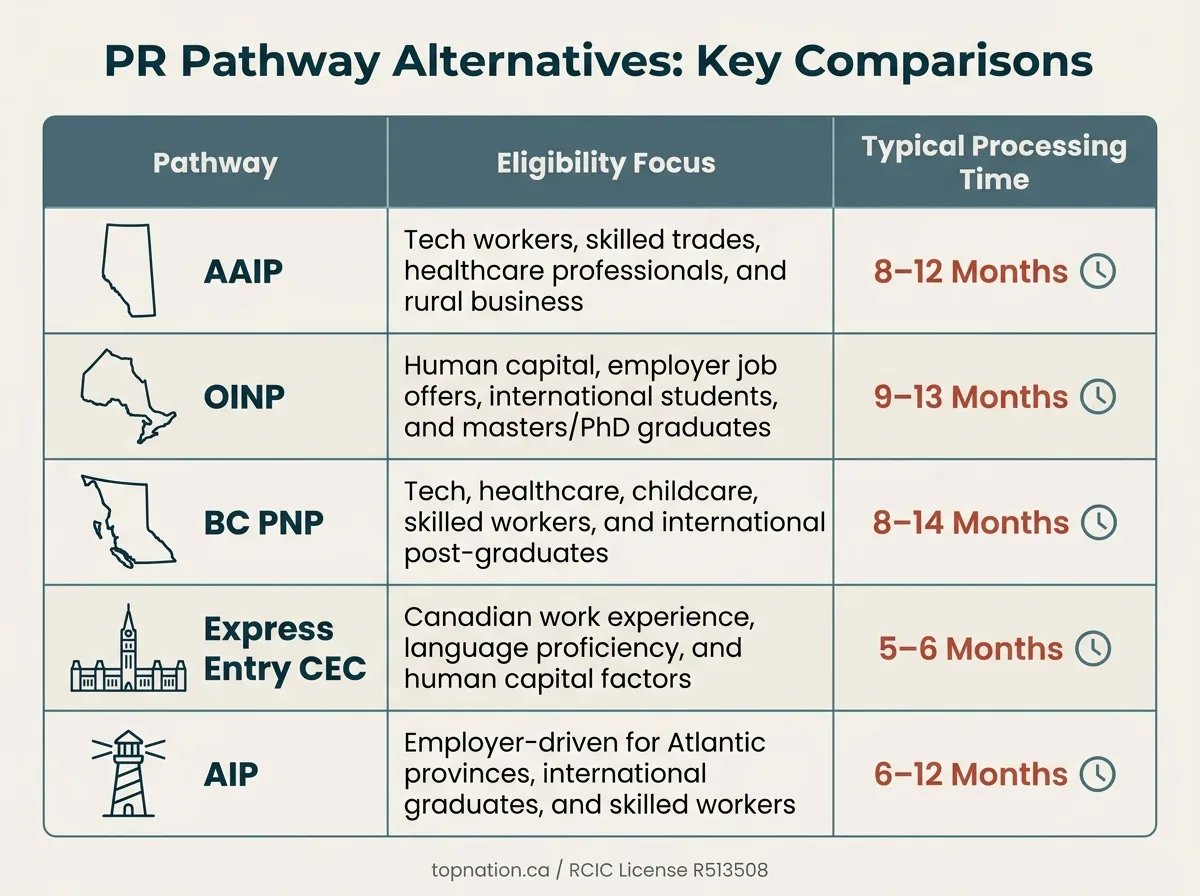
Choosing the right path after the CEP closure depends entirely on your unique profile: your education, work experience, career goals, and willingness to relocate. The table below provides a high-level comparison to help you identify which streams are the best fit for your situation.
| Pathway | Job Offer Required? | Work Experience | Key Advantage |
|---|---|---|---|
| Alberta (AAIP-AOS) | Yes, in Alberta | Typically 6 months | Fast processing, strong economy |
| Ontario (OINP-Masters) | No | Not required | No job offer needed |
| BC (BC PNP-Int’l Grad) | Yes, in B.C. | Not required | Direct path with a job offer |
| Federal (Express Entry-CEC) | No | 1 year skilled Canadian work | Not province-dependent |
| Atlantic (AIP) | Yes, from designated employer | Not required | High employer support |
Critical Factors in Choosing Your New Pathway
Beyond the basic eligibility criteria, your decision should be guided by a deeper strategic assessment. Your PGWP is a ticking clock, and making the right choice quickly is paramount.
Your Willingness to Relocate
The first and most important question is whether you are willing to move from Manitoba. If you are, options in Alberta, B.C., Ontario, and the Atlantic provinces open up immediately. If you wish to remain in Manitoba, you must now pivot to other MPNP streams, such as the Skilled Worker in Manitoba stream, which has different and often more stringent work experience requirements than the CEP had.
The Nature of Your Job Offer
If you already have a job offer in Manitoba, your task is to see if it qualifies for another MPNP stream. If you do not have an offer, or your offer is not sufficient, your job search becomes national. Focus on provinces where your occupation is in demand. For example, a software developer will find strong prospects in the tech hubs of Vancouver, Toronto, and Calgary, aligning well with the BC PNP, OINP Human Capital, and AAIP Accelerated Tech pathways.
Your Long-Term Career Goals
Don’t choose a province solely for an easier PR path if it doesn’t align with your long-term career aspirations. Research the job market in your target province. Is there room for growth? Are there multiple employers in your industry? A provincial nomination is a means to an end—permanent residence—but you will be building your life and career in that province for years to come. Ensure it’s a place where you can thrive professionally. Some graduates may even consider options like spousal sponsorship if they have a partner who is a Canadian citizen or permanent resident, which can be a more direct route than any economic program.
Your Path to PR Changed. Your Goal Doesn’t Have To.
The MPNP CEP closure is a setback, but it’s not the end of your Canadian dream. Let our licensed RCICs assess your profile against these new options.
| Call 587-400-0077 | Book a Strategy Session |
RCIC Licensed | Serving All of Canada
Last updated: June 2026. This guide reflects the immigration landscape following the closure of the MPNP Career Employment Pathway. Immigration programs and policies change frequently — contact a licensed RCIC for advice specific to your situation.