Program Update: Navigating the 2026 Application Cap
Immigration, Refugees and Citizenship Canada (IRCC) has implemented an annual cap on Start-Up Visa applications. For 2026, this means only a limited number of applications will be processed, making a strong, well-prepared submission more critical than ever. Entrepreneurs must secure a Letter of Support from a designated organization before applying.
START-UP VISA PROGRAM — 2026 GUIDE
For global entrepreneurs with an innovative business idea, Canada’s Start-Up Visa (SUV) Program offers a unique and direct path to permanent residence. Unlike traditional investment migration pathways, the SUV program focuses on the potential of your business concept rather than your personal net worth. This comprehensive guide for 2026 details the intricate requirements, the crucial role of designated organizations, and the strategic steps necessary to transform your entrepreneurial vision into a Canadian reality. Navigating this competitive program requires precision, a compelling business case, and a deep understanding of the criteria set by both the Canadian government and its approved investment partners.

An Introduction to the Canada Start-Up Visa Program 2026
The Canada Start-Up Visa (SUV) Program is a federal immigration pathway designed to attract innovative entrepreneurs from around the world. Its primary objective is to recruit individuals who have the potential to build businesses in Canada that are innovative, can create jobs for Canadians, and can compete on a global scale. Launched as a pilot in 2013 and made permanent in 2018, the program stands out because it connects immigrant entrepreneurs with experienced private sector organizations in Canada—specifically, designated venture capital funds, angel investor groups, and business incubators. The endorsement from one of these organizations is the cornerstone of the application, validating the business concept’s viability to immigration authorities.
Unlike provincial entrepreneur streams, the SUV program does not require a minimum personal net worth or a conditional temporary status. Successful applicants and their families receive permanent residence upon arrival, allowing them to build their business and their new life in Canada with long-term stability. The program allows for up to five co-founders to apply for permanent residence under a single business venture, provided each meets the specific ownership and eligibility criteria. As we move into 2026, understanding the nuances of recent program updates, including application caps, is essential for any prospective applicant.
Key Eligibility Requirements for the Canada Start-Up Visa 2026
Meeting the eligibility criteria for the Start-Up Visa program is a multi-faceted process that goes beyond just having a good idea. IRCC has established a clear set of five core requirements that every applicant, including all co-founders on the application, must satisfy to be considered. These requirements are designed to ensure that the business is genuine, the applicants are well-prepared for life in Canada, and the venture has the support it needs to succeed. Failure to meet any one of these criteria will result in the refusal of the application.
The Qualifying Business Venture
At its heart, the business itself must be the central qualifying element. At the time you receive a commitment from a designated organization, you must demonstrate that your proposed venture is a new business you intend to operate in Canada. It cannot be the purchase of an existing Canadian business. A significant part of the business operations must be conducted within Canada, and the company must be incorporated in Canada. This ensures that the economic benefits, such as job creation and innovation, are realized domestically.
The Letter of Support from a Designated Organization
This is arguably the most critical and challenging requirement. Before you can even submit an immigration application, you must secure the support of a venture capital fund, angel investor group, or business incubator that has been officially designated by the Minister of Immigration, Refugees and Citizenship. This organization will assess your business plan and its potential for success. If they decide to support you, they will issue a formal Letter of Support, which you must include with your application. This letter serves as evidence to IRCC that a credible Canadian business entity has vetted and endorsed your venture.
Language Proficiency Requirements
All applicants under the SUV program must demonstrate a minimum proficiency in either English or French. You must take a language test from an approved agency (such as IELTS or CELPIP for English) and achieve a minimum score equivalent to the Canadian Language Benchmark (CLB) 5 in all four abilities: speaking, listening, reading, and writing. The test results must be less than two years old when you submit your application. This requirement ensures that you can effectively communicate, network, and manage your business within the Canadian economic landscape.
Sufficient Settlement Funds
Entrepreneurs must prove they have enough money to support themselves and their families after they arrive in Canada. The amount required is determined by the size of your family and is based on 50% of the Low Income Cut-Off (LICO) totals. It is crucial to note that this money cannot be borrowed from another person. These settlement funds are distinct from any investment you receive from a designated organization; the investment capital is for the business, while the settlement funds are for your personal living expenses. You will need to provide official letters from banks or other financial institutions as proof of these unencumbered, transferable funds.

The Pivotal Role of Designated Organizations
Designated organizations are the gatekeepers of the Start-Up Visa Program. They are the bridge between an entrepreneur’s innovative idea and the formal immigration process. These private sector entities have been vetted and approved by the Canadian government based on their track record and expertise in working with start-ups. Their mandate within the SUV program is to identify high-potential business ventures founded by foreign entrepreneurs and provide the necessary support—whether through funding, mentorship, or resources—to help them launch and scale in Canada.
What is Their Assessment Process?
Each designated organization has its own intake and assessment process. Generally, they evaluate a business proposal based on several key factors: the innovativeness of the product or service, the scalability of the business model, the strength and experience of the founding team, market analysis, and the overall potential for commercial viability. Entrepreneurs typically need to submit a detailed business plan, a pitch deck, and financial projections. This is often followed by interviews and a rigorous due diligence process where the organization’s experts will scrutinize every aspect of the proposed venture. Their goal is to invest in or support businesses that they genuinely believe will succeed in the Canadian market.
The Commitment Certificate and Letter of Support
Once a designated organization decides to support a start-up, they formalize this commitment in two key documents. First, they complete a Commitment Certificate, which is sent directly to IRCC. This document outlines the details of the agreement between the organization and the entrepreneurial team. Second, they provide the applicants with a Letter of Support. This letter is the official document that the entrepreneurs must submit with their permanent residence application. It confirms to the immigration officer that the business venture has met the due diligence requirements of a designated entity, significantly strengthening the application’s credibility.
Types of Designated Organizations and Their Requirements
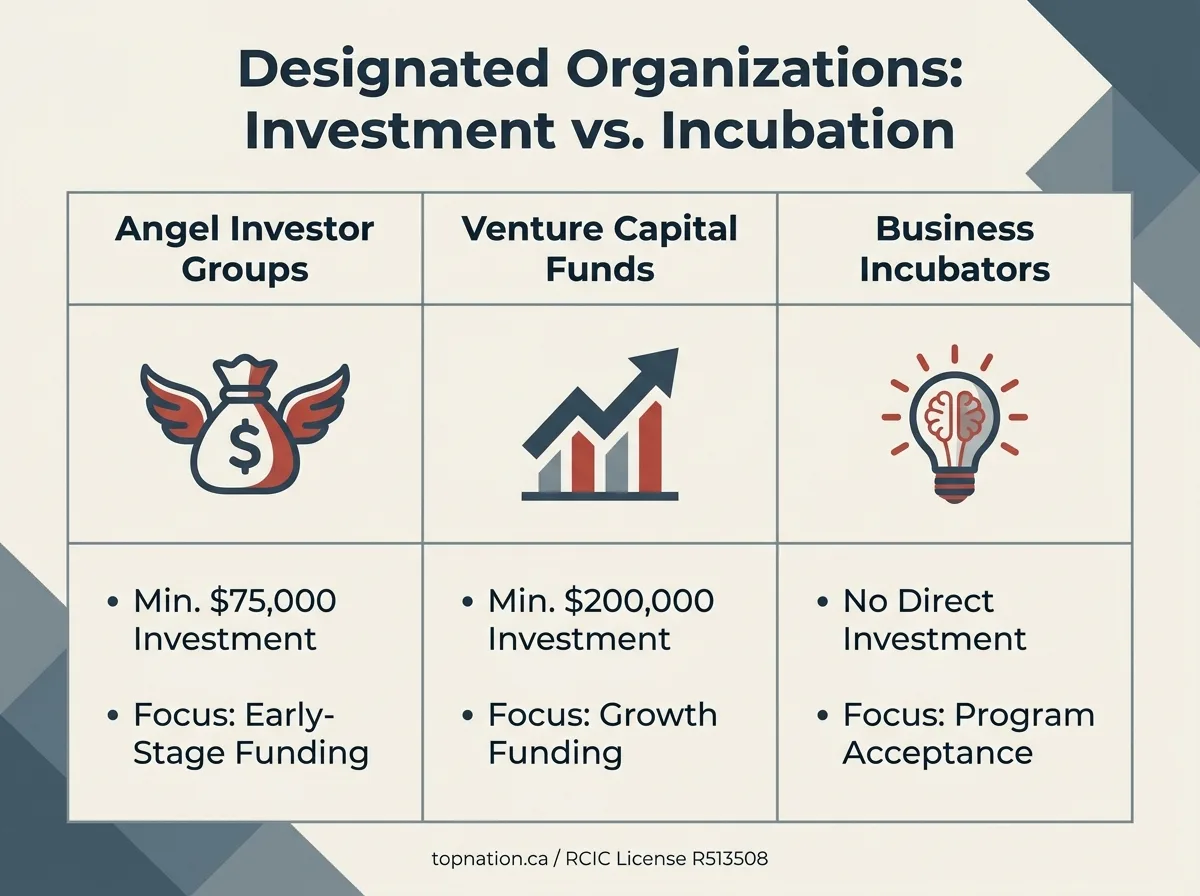
The Start-Up Visa Program features three distinct types of designated organizations, each with different investment thresholds and support models. Choosing which type of organization to approach depends heavily on the stage of your business, your funding needs, and the nature of your product or service. Understanding these differences is crucial for crafting a targeted and effective pitch.
Designated Venture Capital (VC) Funds
Venture capital funds are firms that manage pooled money from investors seeking private equity stakes in start-ups and small to medium-sized enterprises with strong growth potential. For the SUV program, a designated VC fund must commit to a minimum investment of $200,000 into the qualifying business. VCs typically look for businesses with a proven concept, some market traction, and the potential for exponential growth and a significant return on investment. They often take a substantial equity stake and play an active role on the company’s board. Pitching to a VC requires a highly polished business plan, robust financial models, and a clear path to profitability.
Designated Angel Investor Groups
Angel investor groups are networks of high-net-worth individuals who provide capital for business start-ups, usually in exchange for convertible debt or ownership equity. Under the SUV program, a designated angel investor group must commit to a minimum investment of $75,000. Angels often invest at an earlier stage than VCs, sometimes at the pre-seed or seed stage. They are often experienced entrepreneurs themselves and can provide valuable mentorship and industry connections. While the investment threshold is lower, securing funding from an angel group is still highly competitive and requires a compelling pitch that demonstrates a strong team and a large market opportunity.
Designated Business Incubators
Business incubators are organizations designed to help start-up companies grow by providing services such as management training, office space, and access to a network of mentors and potential investors. Unlike VCs and angel groups, designated business incubators are not required to invest any money in the start-up. Instead, their commitment is demonstrated by accepting the start-up into their incubation program. This makes them an excellent option for very early-stage companies that need mentorship and structural support more than immediate capital. The application process for incubators is rigorous, and they look for innovative ideas, coachable founders, and businesses that align with their program’s focus, which might be sector-specific (e.g., tech, biotech, cleantech).
| Feature | Venture Capital Fund | Angel Investor Group | Business Incubator |
|---|---|---|---|
| Minimum Commitment | $200,000 investment | $75,000 investment | Acceptance into program (no financial minimum) |
| Typical Business Stage | Early growth, scaling stage | Pre-seed, seed stage | Concept, idea stage |
| Primary Focus | High-growth potential, large ROI | Strong founding team, market validation | Founder development, business model refinement |
| Support Provided | Capital, strategic guidance, board participation | Capital, mentorship, industry network | Training, resources, networking, office space |
Detailed Breakdown of Core Requirements
Beyond the high-level overview, a successful SUV application hinges on meticulously meeting the detailed specifications of each requirement. Small errors or misinterpretations in language scores, settlement funds, or ownership structure can lead to delays or refusals. This section provides a deeper dive into these critical components.
Language Proficiency In-Depth: Understanding CLB 5
The requirement of Canadian Language Benchmark (CLB) 5 is non-negotiable. It is not enough to be conversational in English or French; you must prove it with a standardized test. CLB 5 represents a functional proficiency, indicating that you can participate in basic conversations, understand simple instructions, and write short, routine texts. For the popular IELTS General Training test, a CLB 5 is equivalent to a score of 5.0 in reading, writing, and speaking, and a 5.0 in listening. For the CELPIP-General Test, it requires a score of 5 in all four abilities. It is vital to prepare for these tests, as even native speakers can be caught off guard by the specific formats and time constraints.
Settlement Funds Explained for 2026
The amount of settlement funds required is updated annually by IRCC. For 2026, you must consult the official government table to confirm the exact amount based on your family size (including yourself, your spouse or partner, and any dependent children). For example, a single applicant might need approximately $14,690, while a family of four could require around $27,099. These funds must be liquid and readily available. They can be in a chequing or savings account, or in investments that can be easily converted to cash, like stocks or bonds. Property or other non-liquid assets do not count. You must obtain an official letter from your financial institution detailing your account balances, account numbers, and the date each account was opened. This proof must be recent and reflect your financial situation at the time of application.
Ownership and Management Requirements
The structure of your founding team is strictly regulated. Up to five individuals can apply as owners of a single business venture. When the commitment is made by the designated organization, each of the applicants must hold at least 10% of the voting rights in the new Canadian corporation. Furthermore, the group of applicants and the designated organization must jointly hold more than 50% of the total voting rights. This ensures that the founding team retains significant control over the company’s direction, while also giving the supporting organization a meaningful stake. It is crucial to properly structure your corporation’s share classes and shareholder agreement to reflect these requirements from the outset.
The Application Process: From Business Idea to Permanent Residence
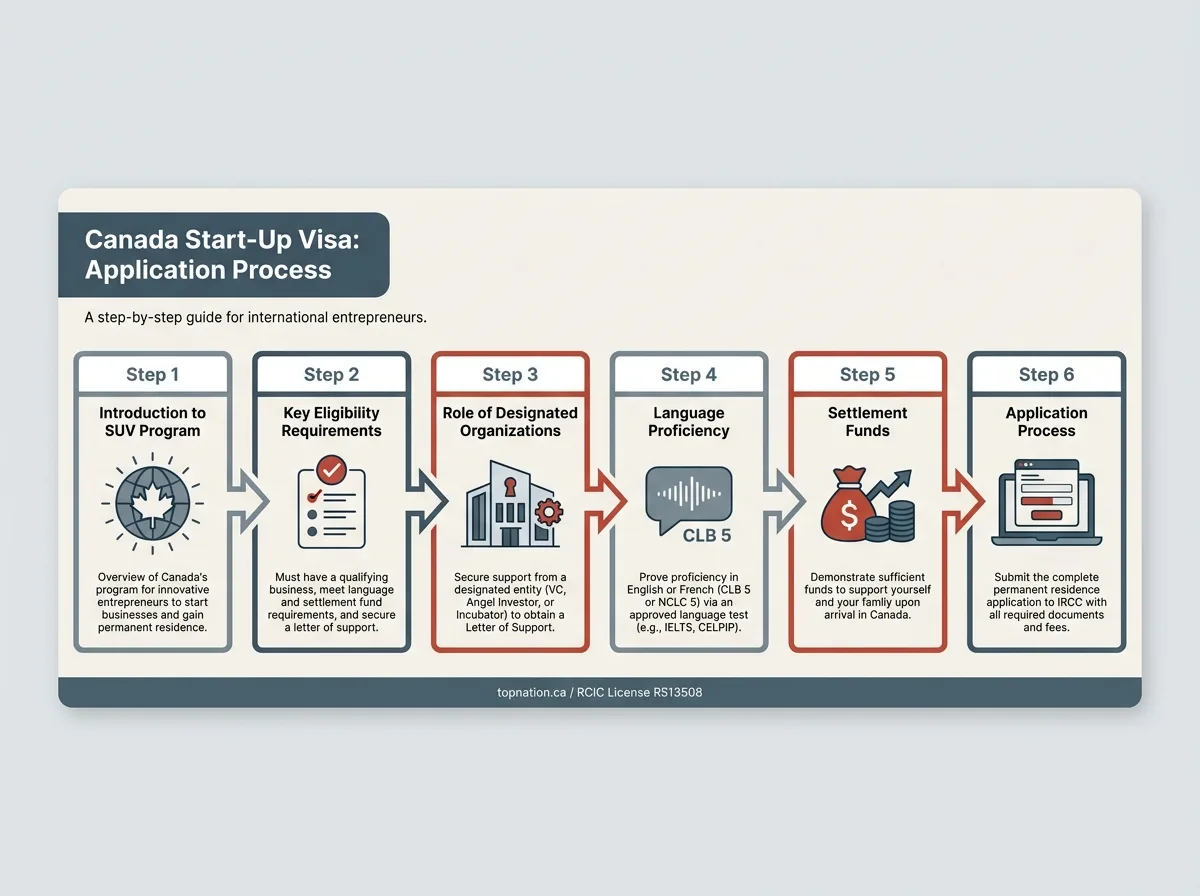
The journey through the Start-Up Visa program is a sequential process that requires careful planning and execution at each stage. It begins long before any immigration forms are filled out and culminates with you and your family landing in Canada as permanent residents. Understanding this timeline and its key milestones is essential for managing expectations and preparing a successful application.
Step 1: Develop Your Business Concept and Secure Support
This is the foundational and often longest phase. It involves refining your innovative idea, developing a comprehensive business plan, creating a compelling pitch deck, and researching and identifying suitable designated organizations. You will then need to actively pitch your idea, network, and undergo the due diligence process of the VCs, angel groups, or incubators. Once you successfully secure a commitment, you will receive your Letter of Support, which unlocks the next stage.
Step 2: Submit Your Permanent Residence Application
With the Letter of Support in hand, you can prepare and submit your application package for permanent residence to IRCC. This package includes the completed application forms, the Letter of Support, language test results, proof of settlement funds, police clearance certificates, and other supporting documents for yourself and all accompanying family members. The application must be complete and accurate, as any missing information can cause significant delays. It is highly recommended to work with a licensed immigration consultant, like an RCIC, to ensure the package is prepared to the highest standard.
Step 3: The Optional Work Permit Application
Waiting for a permanent residence application to be processed can take a considerable amount of time. To allow entrepreneurs to come to Canada and start working on their business sooner, the SUV program includes a provision for a short-term work permit. You can apply for this work permit at the same time as, or after, you submit your PR application. This permit is specific to your start-up and allows you to be in Canada, building your company, while your PR application is in the queue. This is a highly recommended step for most applicants.
Step 4: Final Processing and Landing
Once your application is deemed complete, it will be placed in the processing queue. An immigration officer will review all the documentation to ensure you meet all eligibility and admissibility requirements. This includes medical examinations and biometrics for you and your family members. If everything is in order, you will receive a Confirmation of Permanent Residence (COPR) document. You can then travel to Canada, and upon arrival at a port of entry, an officer will officially grant you permanent resident status.
Navigating the 2026 SUV Application Cap and Processing Times
A significant development for the Start-Up Visa Program in recent years has been the introduction of an annual processing cap. For 2026, IRCC will only accept a set number of applications for processing. This measure was introduced to manage inventory and improve processing times, but it has made the program more competitive. It is no longer enough to simply meet the criteria; applications must be submitted promptly and perfectly to secure a spot before the cap is reached.
Understanding the Cap’s Impact
The annual cap means that the program operates on a first-come, first-served basis. Once the target number of complete applications is received, IRCC will not accept any more for the remainder of the year. This creates a sense of urgency for entrepreneurs who have secured a Letter of Support. Any delay in preparing the PR application package could mean missing the window for the current year. Therefore, having all your documents—language tests, settlement funds proof, police certificates—ready to go is more important than ever.
Current Processing Times for 2026
While IRCC aims to improve processing times, the Start-Up Visa program remains a lengthy process. As of late 2025, the estimated processing time from the submission of a complete PR application to a final decision is approximately 32 to 37 months. These are only estimates and can vary based on the complexity of the case and the applicant’s country of origin. The optional work permit, however, is processed much faster, typically within a few months, allowing founders to get to Canada and begin operations while waiting for the final PR decision. Applicants should factor these long timelines into their personal and business planning.

Comparing SUV to Other Canadian Business Immigration Pathways
The Start-Up Visa is just one of several options for entrepreneurs looking to immigrate to Canada. Provincial Nominee Program (PNP) Entrepreneur Streams and the federal Self-Employed Persons Program offer alternative routes. Understanding how the SUV program compares to these other pathways is key to determining the best strategy for your specific profile and business goals.
| Program Feature | Start-Up Visa (SUV) | PNP Entrepreneur Stream | Self-Employed Persons Program |
|---|---|---|---|
| Key Requirement | Letter of Support from a Designated Organization | Minimum net worth, business investment, and job creation | Relevant experience in cultural activities or athletics |
| Immigration Status | Direct Permanent Residence | Initially a Work Permit; PR after meeting business milestones | Direct Permanent Residence |
| Net Worth Minimum | None (only settlement funds) | Varies by province (e.g., $250k – $600k) | None (must show ability to be self-supporting) |
| Geographic Restriction | None; can settle anywhere in Canada (outside Quebec) | Must reside and operate business in the nominating province | None; can settle anywhere in Canada |
When is a PNP Entrepreneur Stream a Better Fit?
Provincial streams are often better suited for entrepreneurs with significant business management experience and personal net worth who wish to buy an existing business or start a more traditional enterprise (like a restaurant, retail store, or consultancy). These programs use a points-based system to rank candidates based on factors like age, education, language skills, net worth, and business experience. If your business idea is not necessarily innovative or scalable in the way a venture capital fund would require, but is a solid, viable business that will create local jobs, a PNP stream might be a more appropriate path. To learn more, you can explore other investment-based immigration options.
Is the Start-Up Visa Right for You? A Balanced View
While the SUV program is an attractive pathway, it is not suitable for every entrepreneur. A realistic assessment of its advantages and challenges is necessary before committing to this long and demanding process. The program is designed for a specific type of business and founder, and understanding this is key to a successful outcome.
Key Advantages of the SUV Program
The primary advantage of the Start-Up Visa is that it leads directly to permanent residence, offering stability from day one. Unlike many PNP streams, the PR status is not conditional on the business achieving specific performance metrics after you arrive. Once you land as a permanent resident, your status is secure, even if the business unfortunately fails later on. The program also has no age limit and no minimum net worth requirement, focusing instead on the quality of the business idea. The ability to apply as a team of up to five founders is another significant benefit, allowing you to immigrate with your key business partners.
Key Considerations and Challenges
The greatest challenge is securing the mandatory Letter of Support. Designated organizations receive thousands of proposals and support only a small fraction. Your business idea must be truly innovative and well-researched to stand out. The process is highly competitive. Furthermore, the long processing times for permanent residence can be a significant drawback, although the option of a work permit helps mitigate this. Finally, you must be genuinely committed to launching and running your business in Canada. The program is not a passive investment route; it requires your active management and presence in the country.
Partnering with TopNation for Your SUV Application
Navigating the complexities of the Start-Up Visa program requires more than just a great idea; it demands a flawless immigration strategy. At TopNation Immigration, our team of licensed Regulated Canadian Immigration Consultants (RCICs) specializes in guiding entrepreneurs through every stage of this intricate process. We provide the expertise and meticulous attention to detail needed to maximize your chances of success.
Business Plan Review and Strategy
We work with you to refine your business plan and pitch deck, ensuring they not only present a compelling business case but also align with the specific expectations of designated organizations and IRCC’s requirements for a qualifying business. Our strategic review helps identify potential weaknesses and strengthen your narrative.
Designated Organization Matching
With dozens of designated organizations, each with its own investment thesis and industry focus, finding the right fit is critical. We help you research and identify the most suitable VCs, angel groups, or incubators for your specific venture, and we guide you on the best approach for making contact and presenting your pitch.
Meticulous Application Preparation
Once you secure your Letter of Support, our work intensifies. We manage the entire permanent residence and work permit application process, from gathering all necessary documents to completing the forms with precision. We ensure your application is complete, accurate, and professionally presented to avoid unnecessary delays or refusals. If you are based in Alberta, our role as your Edmonton immigration consultant provides local, hands-on support.
Frequently Asked Questions about the Canada Start-Up Visa
The Start-Up Visa Program often raises many specific questions for prospective applicants. Here are answers to some of the most common inquiries we receive from entrepreneurs.
What happens if my start-up fails after I get permanent residence?
Your permanent resident status is not conditional on the success of your business. Once you have been granted PR, it is unconditional. The government recognizes that start-ups are inherently risky ventures and not all will succeed. As long as your application was truthful and you intended to operate the business at the time of application, the failure of the business later on will not impact your immigration status.
Can I bring my family with me on the Start-Up Visa?
Yes. A significant benefit of the SUV program is that when you apply, you can include your spouse or common-law partner and your dependent children in the same application. They will also receive permanent residence at the same time as you. You must include them in your application from the beginning and prove you have sufficient settlement funds for your entire family.
Do I have to live in a specific province in Canada?
No. The Start-Up Visa is a federal program, which means you are not tied to a specific province or territory (with the exception of Quebec, which has its own business immigration programs). You have the flexibility to establish your business and reside anywhere in Canada that makes the most sense for your company and your family. This is a key advantage over the more restrictive PNP entrepreneur streams.
What is the difference between an ‘essential’ and ‘non-essential’ applicant?
Within a founding team, some members may be deemed ‘essential’ to the business venture. If an essential applicant’s permanent residence application is refused for any reason, the applications of all other co-founders on the same business venture will also be refused. A non-essential applicant’s refusal, however, would not impact the other applications. The designated organization indicates on the Commitment Certificate whether it considers each applicant to be essential. In most cases, all co-founders are considered essential to the business’s success.
Your Innovative Idea Deserves a Canadian Launchpad.
Our licensed RCICs can assess your business concept and founder profile against the strict 2026 SUV criteria.
RCIC Licensed | Serving All of Alberta
Last updated: October 2024. This guide reflects the requirements and policies for the Canada Start-Up Visa Program as anticipated for 2026. Immigration rules change frequently — contact a licensed RCIC (R513508) for advice specific to your situation.