CEC-Specific Draw Invites 2,000
Immigration, Refugees and Citizenship Canada (IRCC) recently held a targeted Express Entry draw for the Canadian Experience Class, issuing 2,000 Invitations to Apply (ITAs). This draw underscores the program’s vital role in transitioning skilled workers already in Canada to permanent residence.
CANADIAN EXPERIENCE CLASS — 2026 GUIDE

For thousands of temporary foreign workers and international graduates, Canada is more than a temporary workplace or school—it’s home. The Canadian Experience Class (CEC) is the primary pathway designed by the Canadian government to recognize this reality. It offers a direct route to permanent residence for individuals who have already demonstrated their ability to integrate into the Canadian labour market. Unlike other Express Entry system programs that assess foreign experience or educational credentials from abroad, the CEC places the highest value on one key factor: skilled work experience gained right here in Canada. This guide provides a comprehensive overview of the CEC program in 2026, detailing every requirement, nuance, and strategic consideration for applicants on a Post-Graduation Work Permit (PGWP) or other valid work authorization.
What is the Canadian Experience Class (CEC)?
The Canadian Experience Class (CEC) is one of three federal economic immigration programs managed under the Express Entry system, alongside the Federal Skilled Worker (FSW) Program and the Federal Skilled Trades Program (FSTP). Its specific purpose is to facilitate the transition from temporary to permanent residence for individuals with recent skilled work experience in Canada. Launched in 2008, the CEC was created based on a simple, evidence-backed premise: immigrants with Canadian work experience are well-positioned for long-term economic success and integrate more seamlessly into Canadian society.
Candidates who meet the CEC eligibility criteria can create an Express Entry profile. In the profile, they are assigned a Comprehensive Ranking System (CRS) score based on factors like age, education, language proficiency, and Canadian work experience. IRCC then holds regular Express Entry draws, inviting candidates with scores above a certain threshold to apply for permanent residence. Because the CEC program values in-Canada experience so highly, it has become the most popular route for international graduates and temporary foreign workers to secure their future in Canada.
Who is the Ideal Candidate for the CEC Program in 2026?
While the CEC is open to anyone who meets the minimum requirements, certain profiles are exceptionally well-suited for this pathway. These individuals have already overcome many of the initial settlement challenges and have proven their value to Canadian employers. Understanding these ideal candidate profiles can help you assess if the CEC is the right program for your permanent residency goals.
The International Graduate on a PGWP
This is perhaps the most common and ideal candidate for the CEC. After completing a program of study at a Designated Learning Institution (DLI) in Canada, they obtain a Post-Graduation Work Permit (PGWP). This open work permit allows them to work for nearly any employer in Canada. The ideal PGWP holder spends at least 12 months working in a skilled position (TEER 0, 1, 2, or 3), gaining the exact type of experience the CEC program is designed to reward. Their Canadian education often provides additional CRS points, and their time in Canada has already helped them build professional networks and adapt to the workplace culture.
The Temporary Foreign Worker on an LMIA-Based Work Permit
This individual came to Canada to fill a specific labour market need, validated by a positive Labour Market Impact Assessment (LMIA). They have been working for a Canadian employer in a skilled occupation for at least one year. Their experience is directly relevant and demonstrates a clear contribution to the Canadian economy. Often, their employer is supportive of their permanent residency application, which can be a significant advantage. If they have a valid job offer supported by an LMIA, they can also claim an extra 50 or 200 CRS points, substantially increasing their chances of receiving an Invitation to Apply (ITA).
The Professional on an LMIA-Exempt Work Permit
This category includes professionals working in Canada under international agreements like CUSMA (formerly NAFTA) or CETA, or as Intra-Company Transferees. These individuals are typically highly skilled and have been brought to Canada for their specialized knowledge. After accumulating one year of full-time Canadian work experience, they become prime candidates for the CEC. Their high skill level (often TEER 0 or 1) and strong language abilities usually translate into a very competitive CRS score.
The common thread among these ideal candidates is their demonstrated integration. They have paid Canadian taxes, contributed to the economy, and built lives here. The CEC program acknowledges this by offering a streamlined path that, critically, does not require proof of settlement funds, unlike the Federal Skilled Worker program.
CEC Eligibility Requirements: A Detailed Checklist
To qualify for the Canadian Experience Class, you must meet several specific requirements. Failure to meet even one of these criteria will result in your Express Entry profile being deemed ineligible for the program or your final application being refused. It is crucial to review each point carefully.
Requirement 1: Skilled Canadian Work Experience
This is the cornerstone of the CEC program. You must have at least 12 months of full-time (or an equal amount in part-time) skilled work experience in Canada within the three years before you apply. We will explore this requirement in greater depth in the next section, but the key elements are:
- Duration: At least 1,560 hours.
- Timing: Gained within the last 36 months.
- Location: Experience must have been gained in Canada.
- Authorization: You must have been legally authorized to work in Canada (e.g., on a valid work permit).
- Skill Level: The work must be classified under TEER 0, 1, 2, or 3 of the National Occupational Classification (NOC).
Work experience gained while you were a full-time student (such as on a co-op permit) or during periods of self-employment does not count towards this requirement.
Requirement 2: Language Proficiency
You must demonstrate a minimum level of proficiency in either English or French by taking an approved language test. The required score depends on the skill level of your Canadian work experience.
- For occupations under TEER 0 or 1, you must achieve a minimum Canadian Language Benchmark (CLB) level of 7 in all four abilities (reading, writing, listening, speaking).
- For occupations under TEER 2 or 3, you must achieve a minimum CLB level of 5 in all four abilities.
Your test results must be less than two years old when you submit your Express Entry profile and when you submit your final application for permanent residence. It is critical to note that meeting the minimum is often not enough to be competitive. Higher language scores are one of the most effective ways to improve your CRS score.
Requirement 3: Place of Residence
There is no requirement to be living in Canada at the time of your application. You can apply for the CEC from abroad, provided you meet the work experience requirement (i.e., you gained it within the last three years). However, the program is not open to applicants who plan to reside in the province of Quebec. Quebec has its own distinct immigration programs.
Requirement 4: Admissibility
Like all applicants for Canadian permanent residence, you must be admissible to Canada. This means you must not have any serious criminal, security, or medical issues that would make you inadmissible under Canada’s Immigration and Refugee Protection Act (IRPA). You will be required to undergo a medical examination and provide police certificates as part of your application process after receiving an ITA.
Deep Dive: The 12-Month Canadian Work Experience Requirement
The work experience requirement is the most critical and often the most misunderstood part of the CEC application. Getting this wrong is a common reason for refusal. Let’s break down each component in detail to ensure your experience qualifies.
Defining “Skilled Work” under the NOC TEER System
Canada uses the National Occupational Classification (NOC) system to categorize jobs. For immigration purposes, “skilled work” refers to occupations falling under the Training, Education, Experience and Responsibilities (TEER) categories 0, 1, 2, or 3.
- TEER 0: Management occupations (e.g., restaurant manager, marketing director).
- TEER 1: Occupations usually requiring a university degree (e.g., software engineer, financial analyst).
- TEER 2: Occupations usually requiring a college diploma, apprenticeship training of 2+ years, or supervisory roles (e.g., web technician, medical laboratory technologist).
- TEER 3: Occupations usually requiring a college diploma, apprenticeship of less than 2 years, or more than 6 months of on-the-job training (e.g., baker, dental assistant).
Experience in TEER 4 or 5 occupations (e.g., cashier, cleaning staff) does not count towards the CEC work experience requirement. It is essential to correctly identify your NOC code and ensure your job duties align with the lead statement and main duties listed in the official NOC description.
Calculating Your 1,560 Hours
The 12-month requirement is quantified as 1,560 hours of work. IRCC provides flexibility in how you can accumulate these hours:
- Full-time: Working 30 hours per week for 12 months (30 hours/week x 52 weeks = 1,560 hours). Any hours worked above 30 per week are not counted.
- Part-time Equivalent: You can combine multiple part-time jobs or work part-time for a longer period. For example, working 15 hours per week for 24 months (15 hours/week x 104 weeks = 1,560 hours). Or, working two part-time jobs simultaneously at 15 hours/week each for 12 months.
The work experience does not need to be continuous. You can have gaps in your employment. As long as you accumulate a total of 1,560 hours of skilled work in Canada within the three-year window before applying, you meet the requirement.
What Does NOT Count as Canadian Work Experience for CEC?
This is a critical area where many applicants make mistakes. IRCC is very strict about the following types of work experience, which are explicitly excluded:
| Type of Experience | Reason for Exclusion |
|---|---|
| Self-Employment | The program is designed for experience gained as an employee. IRCC cannot easily verify the duties and hours of self-employed individuals. |
| Work During Full-Time Study | This includes co-op placements or part-time work done while you were a full-time student. This experience is considered part of your educational program, not professional work. |
| Unauthorized Work | Any work performed without a valid work permit or outside the conditions of your permit (e.g., working more hours than allowed) is illegal and will not be counted. |
Proving Your Work Experience: The Importance of the Reference Letter
You cannot simply state that you worked in a particular job. You must provide concrete proof, and the most important piece of evidence is a detailed reference letter from each employer. An officer will refuse your application if this letter is missing or incomplete. The letter must be printed on company letterhead, signed by your supervisor or an HR representative, and include:
- Your full name.
- The company’s contact information (address, phone number, email).
- Your job title.
- The exact dates you were employed.
- Your annual salary plus any benefits.
- The number of hours you worked per week.
- A detailed list of your main duties and responsibilities.
It is crucial that the duties listed in the letter align with the lead statement and main duties of the NOC code you are claiming. You should also be prepared to submit supporting documents like T4 slips, Notices of Assessment (NOA), and pay stubs.
Language Proficiency for CEC: CLB Requirements by TEER
Your ability to communicate effectively is a key predictor of your success in the Canadian economy. For the CEC program, this is measured using the Canadian Language Benchmark (CLB). You don’t take a “CLB test”; rather, you take an IRCC-designated language test (like IELTS or CELPIP for English, or TEF or TCF for French), and your scores are converted to a CLB level.
Minimum CLB Levels Required
The minimum language requirement is directly tied to the skill level of your primary Canadian work experience.
| NOC TEER Category of Work Experience | Minimum CLB Level Required |
|---|---|
| TEER 0 or TEER 1 | CLB 7 in all four abilities (Listening, Reading, Writing, Speaking) |
| TEER 2 or TEER 3 | CLB 5 in all four abilities (Listening, Reading, Writing, Speaking) |
Beyond the Minimum: Language Scores and Your CRS Score
While meeting the minimum CLB level makes you eligible, it rarely results in a competitive CRS score. Language proficiency is one of the most heavily weighted factors in the CRS calculation. For example, a candidate with CLB 9 in all four abilities earns significantly more points than someone with CLB 7. Achieving a high language score is often the single most effective strategy for increasing your chances of receiving an ITA. Many candidates study and retake their language tests multiple times to maximize their points. Your test results must be valid (less than two years old) throughout the entire Express Entry process.
Step-by-Step Guide: How to Apply for PR through the CEC
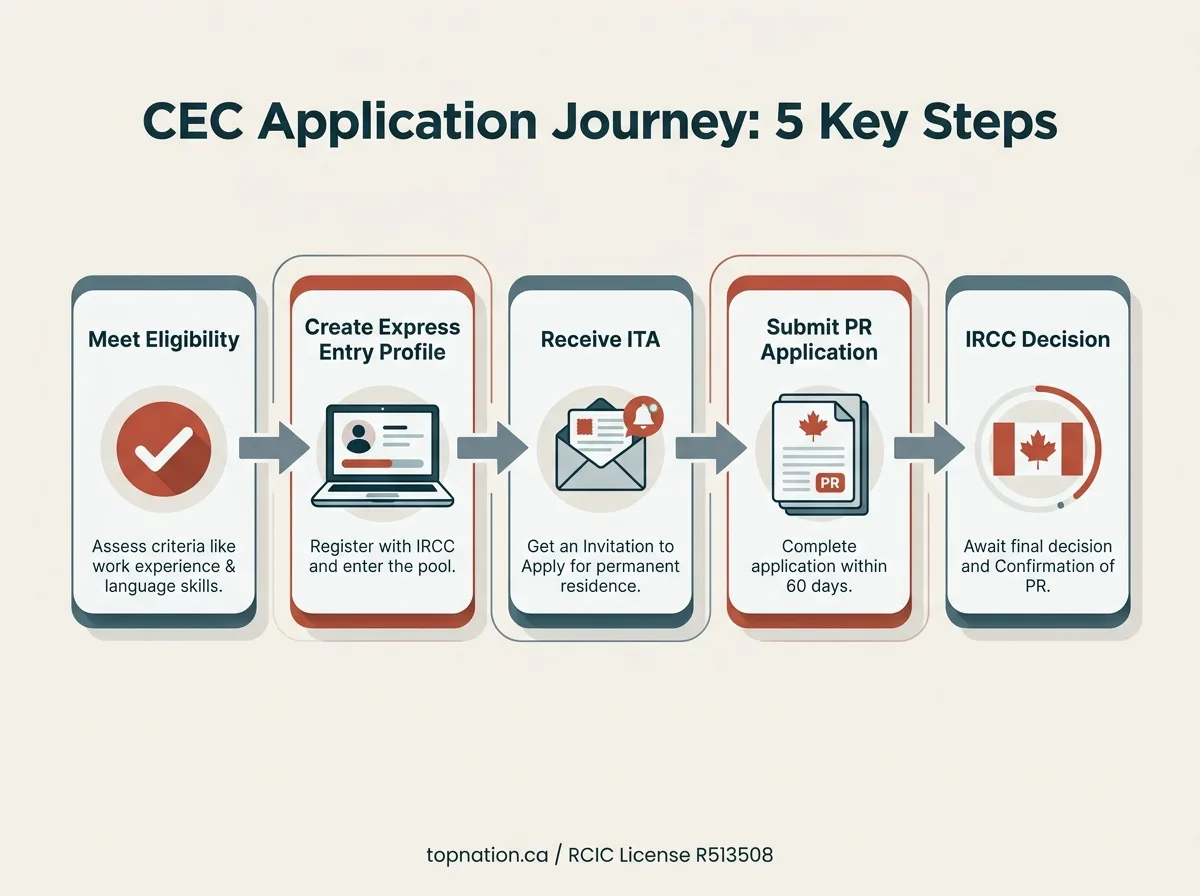
Navigating the Express Entry system for the first time can seem daunting. Here is a simplified, step-by-step breakdown of the journey from eligibility to permanent residence through the Canadian Experience Class.
Step 1: Confirm Your Eligibility and Gather Documents
Before you do anything else, meticulously review the CEC eligibility criteria. Ensure your work experience qualifies, calculate your hours, and confirm your NOC code. Begin gathering key documents like your passport, work permits, and start requesting your employment reference letters early, as they can take time to obtain.
Step 2: Take Your Language Test
Book and complete an approved language test (IELTS General Training or CELPIP-General for English; TEF Canada or TCF Canada for French). You will need the test report number and results to create your Express Entry profile. Aim for the highest score possible.
Step 3: Create Your Express Entry Profile
Go to the official IRCC website and use the online tool to create your Express Entry profile. You will be asked a series of questions about your age, education, work experience, and language skills. The system will use your answers to determine which program(s) you are eligible for (e.g., CEC, FSW) and calculate your initial CRS score. There is no fee to create a profile.
Step 4: Enter the Express Entry Pool
Once your profile is successfully submitted, you will be placed into the Express Entry pool of candidates. Your profile is valid for 12 months. During this time, you can update it if your circumstances change (e.g., you gain more work experience or get a new language test result). You will be ranked against other candidates based on your CRS score.
Step 5: Receive an Invitation to Apply (ITA)
IRCC conducts regular Express Entry draws, typically every few weeks. In these draws, they invite candidates with CRS scores above a certain cut-off to apply for permanent residence. If your score is high enough, you will receive an ITA in your IRCC account. Sometimes, IRCC holds program-specific draws, such as one exclusively for CEC candidates, which can result in a lower CRS cut-off score.
Step 6: Submit Your Electronic Application for Permanent Residence (e-APR)
Receiving an ITA is a major milestone, but the work isn’t over. You have only 60 days from the date you receive the ITA to submit a complete and accurate e-APR. This involves uploading all required supporting documents (reference letters, police certificates, medical exam confirmation, etc.) and paying the government fees. This is a strict deadline, and no extensions are granted.
Step 7: Awaiting a Decision and Next Steps
After you submit your e-APR, an IRCC officer will review your application. They will verify all the information and documents you provided. If your work permit is set to expire soon, you may be eligible to apply for a Bridging Open Work Permit (BOWP) after submitting your e-APR, allowing you to continue working legally in Canada while you wait for a final decision. Once a decision is made, you will receive a Confirmation of Permanent Residence (COPR) if approved.

CEC vs. Federal Skilled Worker (FSW): Key Differences You Must Know
Many candidates in the Express Entry pool are eligible for both the CEC and the FSW program. While they both lead to permanent residence, their requirements are fundamentally different. Understanding these differences is key to positioning your profile correctly.
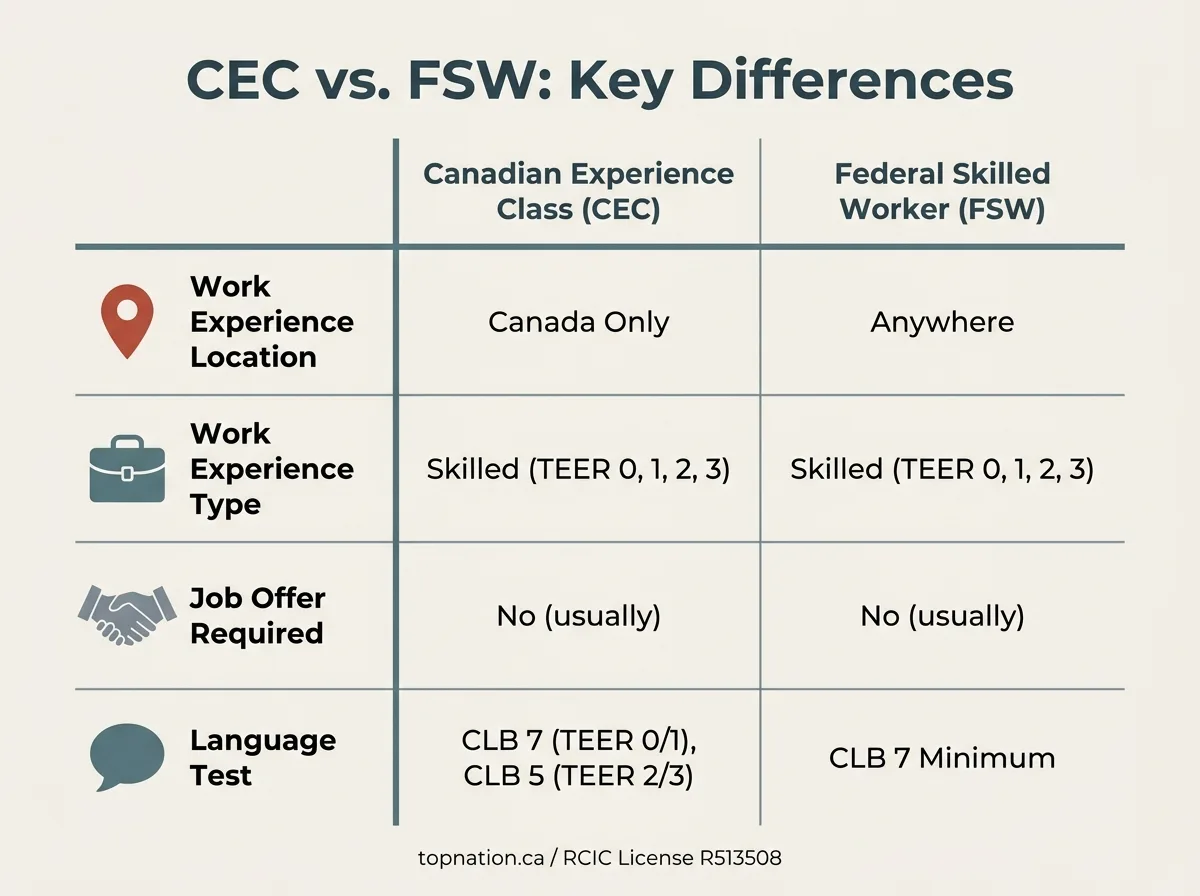
| Factor | Canadian Experience Class (CEC) | Federal Skilled Worker (FSW) |
|---|---|---|
| Work Experience | Requires at least 1 year of skilled Canadian work experience in the last 3 years. | Requires at least 1 year of continuous skilled foreign work experience in the last 10 years. |
| Proof of Funds | Not required. IRCC assumes you are already established in Canada. | Mandatory, unless you have a valid Canadian job offer. You must show you have sufficient funds to support yourself and your family. |
| Education | No minimum education requirement. However, you get CRS points for your education, and a Canadian credential boosts your score. | Minimum of a Canadian high school diploma or its equivalent. Foreign credentials must be assessed with an Educational Credential Assessment (ECA). |
| Initial Eligibility Grid | Does not use a points grid for initial eligibility. You either meet the work/language requirements or you don’t. | You must score at least 67 out of 100 points on the FSW selection grid based on factors like age, education, experience, and adaptability. |
The primary advantage of the CEC for in-Canada applicants is its simplicity and directness. It eliminates the need for proof of funds and the complex FSW points grid, focusing solely on what matters most: your proven ability to succeed in the Canadian labour market.
Common Reasons for CEC Application Refusal (And How to Avoid Them)
Receiving a refusal after waiting months for a decision can be devastating. Most refusals are not due to ineligibility but to preventable errors in the application. Understanding these common pitfalls is the first step to avoiding them.
Miscalculation of Work Experience
This is the number one reason for CEC refusals. Applicants might incorrectly count experience gained while a student, miscalculate their part-time hours, or claim a NOC code that doesn’t match their actual duties. To avoid this, create a spreadsheet to track your work hours meticulously. Double-check that all experience was gained while on valid work authorization and that it falls under a TEER 0, 1, 2, or 3 occupation.
Incomplete or Vague Reference Letters
An application can be refused if a reference letter is missing any of the mandatory components outlined by IRCC. A letter that simply confirms your employment is not enough. It must detail your job duties. To avoid this, provide your employer or supervisor with a template or a checklist of everything the letter must include. Politely review the letter before they sign it to ensure it’s complete.
Expired Documents
Your language test results and passport must be valid throughout the application process. A language test is valid for two years. If it expires after you submit your profile but before you get an ITA, your profile becomes ineligible. If it expires after you submit your e-APR, your application can be refused. Always track the expiry dates of your key documents and plan to renew them well in advance.
Misrepresentation
This is the most serious error. Misrepresentation occurs when you provide false information or withhold relevant facts, whether intentionally or not. This can lead not only to a refusal but also a five-year ban from applying to come to Canada. Be completely honest and transparent in your application. If you are unsure about how to declare something (like a previous visa refusal), it is always best to seek professional advice.
CEC Processing Times and Application Fees in 2026
Understanding the expected timeline and costs is essential for planning your immigration journey.
Processing Times
IRCC aims to process 80% of Express Entry applications (including CEC) within six months from the day a complete e-APR is submitted. However, processing times can fluctuate based on application volume and IRCC’s operational capacity. You can check the most current processing time estimates on the official IRCC website. The clock starts when your complete application is submitted, not when you enter the Express Entry pool.
Application Fees
The fees for a CEC application are paid in Canadian dollars and are subject to change. As of early 2026, the primary fees are:
- Processing Fee: $950 CAD per adult.
- Right of Permanent Residence Fee (RPRF): $575 CAD per adult. This fee is paid before you become a permanent resident and is refundable if your application is refused.
- Including a Spouse/Partner: An additional $950 (processing) + $575 (RPRF).
- Including a Dependent Child: $260 CAD per child.
- Biometrics Fee: $85 CAD for a single applicant or $170 CAD for a family (2 or more people).
Other costs to consider include language tests, medical exams, and fees for obtaining police certificates.
Frequently Asked Questions about the CEC Program
Can I use self-employed work experience for CEC?
No. IRCC explicitly states that periods of self-employment do not count towards the minimum work experience requirement for the Canadian Experience Class. The experience must have been gained as an employee.
What happens if my work permit expires while my CEC application is processing?
If you submitted your e-APR before your current work permit expired, you are eligible to apply for a Bridging Open Work Permit (BOWP). A BOWP allows you to continue working legally in Canada for any employer while you wait for a final decision on your permanent residence application. This maintains your legal status and ability to support yourself.
Is an Educational Credential Assessment (ECA) required for the CEC?
An ECA is not a mandatory eligibility requirement for the CEC program itself. However, if you want to claim CRS points for your foreign education, you must have an ECA report. It is highly recommended to get an ECA, as the education points can significantly boost your CRS score and improve your chances of receiving an ITA.
Can I combine experience from different NOC codes?
Yes, you can combine skilled work experience from different TEER 0, 1, 2, or 3 occupations to meet the 1,560-hour requirement. For example, you could have 8 months of experience as a Graphic Designer (TEER 2) and 6 months of experience as a Marketing Coordinator (TEER 1). As long as the total hours reach 1,560, the experience is valid.
How an RCIC Can Strengthen Your Canadian Experience Class Application
While the CEC pathway is more straightforward than other programs, the stakes are incredibly high. A single mistake on your application can lead to a refusal, costing you time, money, and potentially your future in Canada. Working with a Regulated Canadian Immigration Consultant (RCIC) provides a layer of professional oversight and strategic guidance.
An experienced immigration consultant in Edmonton can help you accurately determine your NOC code, ensure your reference letters meet IRCC’s strict standards, and strategically plan your application to maximize your CRS score. They can identify potential red flags in your profile and advise on how to address them before you submit. From creating the initial Express Entry profile to submitting the final e-APR, an RCIC manages the details so you can have peace of mind. At TopNation, our licensed consultants (RCIC #R513508) have helped countless temporary workers and graduates successfully navigate the Canadian Experience Class and achieve their dream of becoming permanent residents.
Turn Your Canadian Experience into Permanent Residence.
Our licensed RCICs will assess your profile against the latest CEC requirements and build a clear strategy for your PR application.
RCIC Licensed | Serving All of Alberta
Last updated: April 2026. This guide reflects the Canadian Experience Class requirements as of the date of publication. Immigration rules change frequently — consult a licensed RCIC for advice specific to your situation.