Quick Answer
IRCC held a new French language Express Entry draw on May 28, 2026, issuing 4,500 invitations to apply with a CRS cut-off of 409. The cut-off increased from 400 in the previous French round, but French-language draws remain far below recent Canadian Experience Class cut-offs.
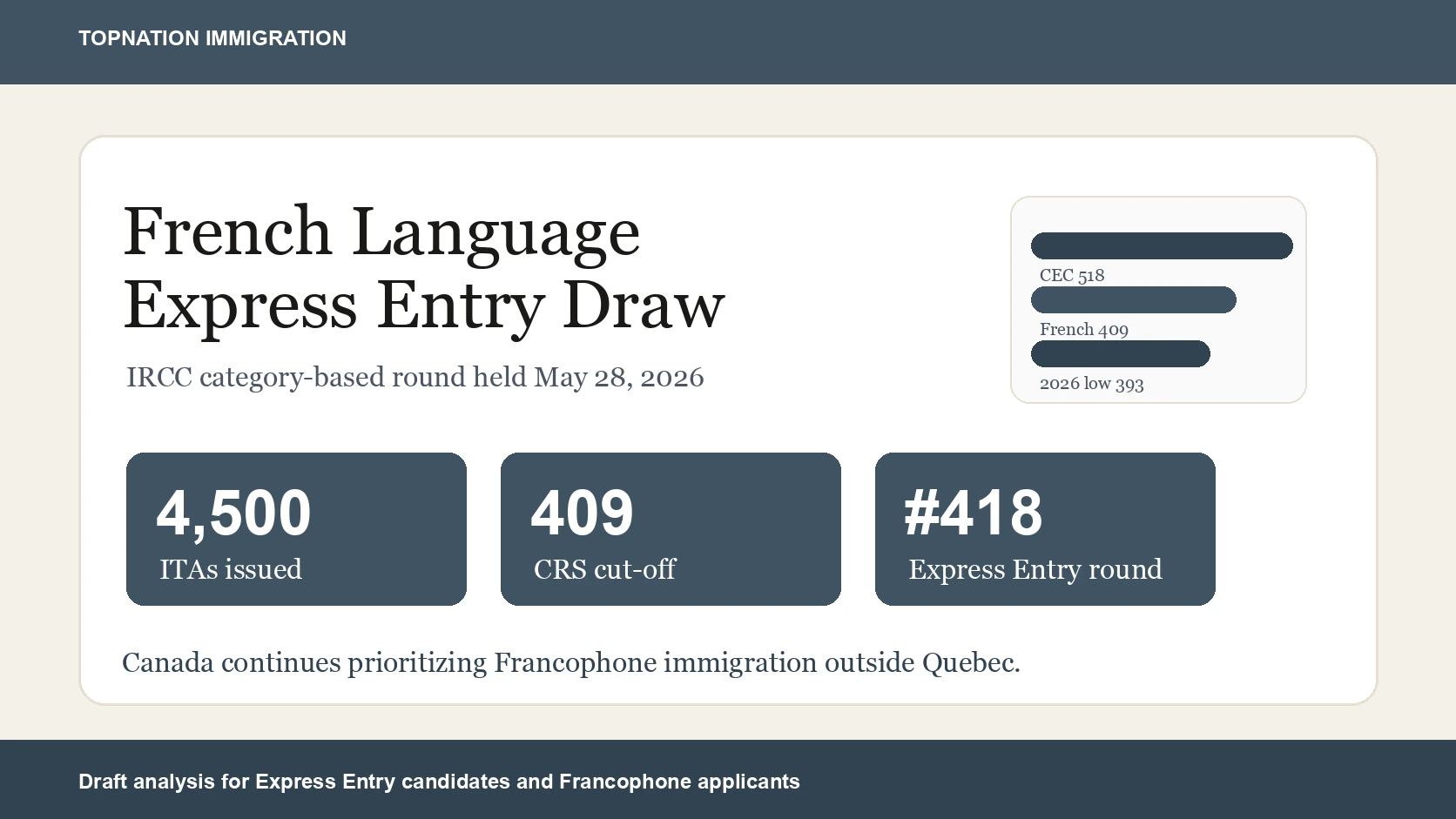
IRCC issued 4,500 invitations in the latest French language Express Entry draw on May 28, 2026. The Comprehensive Ranking System cut-off was 409, and the tie-breaking rule was April 29, 2026 at 22:20:00 UTC. In plain terms, candidates needed to meet the French-language category requirements, have a CRS score of at least 409, and, if they were exactly at 409, have submitted their Express Entry profile before the tie-break time.
This was Express Entry round #418. According to IRCC’s official rounds data, the round was listed as “French-Language proficiency 2026-Version 2” and covered candidates eligible under the Federal Skilled Worker Program, Canadian Experience Class, or Federal Skilled Trades Program (IRCC rounds data, May 28, 2026).
The result matters because French-language proficiency continues to be one of the strongest advantages in Express Entry in 2026. While recent Canadian Experience Class rounds have stayed above 500 CRS, French-language category rounds have stayed between 393 and 419 so far this year. For many candidates outside Quebec, French is not just a bonus. It may be the difference between waiting in the pool and receiving an invitation to apply.
French language Express Entry draw: May 28 results
The May 28 round was slightly larger than the previous three French-language draws, which each issued 4,000 invitations. The CRS cut-off also rose nine points from the April 29 French draw, where IRCC invited 4,000 candidates at CRS 400.
| Draw detail | May 28, 2026 result |
|---|---|
| Express Entry round | #418 |
| Category | French-Language proficiency 2026-Version 2 |
| Invitations issued | 4,500 |
| CRS cut-off | 409 |
| Date and time | May 28, 2026 at 10:52:36 UTC |
| Tie-break | April 29, 2026 at 22:20:00 UTC |
The tie-break matters only for candidates at the exact CRS cut-off. If two or more candidates have the lowest invited score, IRCC uses the date and time the Express Entry profile was submitted to decide who ranks ahead.
Why did the French language Express Entry draw cut-off increase?
The CRS increase from 400 to 409 is not surprising. Four weeks passed between the April 29 French-language draw and the May 28 round. During that gap, more candidates had time to enter the pool, improve language results, update education credentials, add work experience, or receive additional CRS points.
The May 28 draw was also larger than the previous three French rounds. A larger draw can lower pressure, but it does not always lower the CRS score if the eligible candidate pool has grown quickly. In this case, IRCC invited 500 more candidates than in the April 15, April 29, and March 18 French draws, yet the cut-off still moved up.
That movement should not be read as a collapse of the French-language pathway. A 409 cut-off is still far below the May 27 Canadian Experience Class cut-off of 518. For candidates who qualify under the French category, the French language Express Entry draw gap is still meaningful.
French-language draws are still far below CEC cut-offs
IRCC has issued 30,500 French-language invitations across six French-language rounds in 2026. By comparison, Canadian Experience Class rounds have issued 37,250 invitations across nine rounds so far in 2026. The volume is close, but the CRS levels are very different.
| 2026 French round | Invitations | CRS cut-off |
|---|---|---|
| February 6, 2026 | 8,500 | 400 |
| March 4, 2026 | 5,500 | 397 |
| March 18, 2026 | 4,000 | 393 |
| April 15, 2026 | 4,000 | 419 |
| April 29, 2026 | 4,000 | 400 |
| May 28, 2026 | 4,500 | 409 |
So far in 2026, French-language Express Entry cut-offs have ranged from 393 to 419 (IRCC rounds data, 2026). That range is much lower than the latest CEC result of 518 on May 27, 2026.
For candidates in the 390 to 430 range, this is why French-language eligibility deserves serious attention. A candidate who is not competitive in a general or CEC draw may still be competitive if they meet the French-language category requirements.
Who qualifies for the French-language category?
For category-based selection, IRCC says candidates must still meet the minimum criteria for one of the Express Entry programs. French-language category eligibility is not a separate immigration program by itself. It is a selection category inside Express Entry.
For the French-language category, candidates must have French test results showing a minimum level 7 in all four language abilities under the Niveaux de competence linguistique canadiens. IRCC’s category page confirms that candidates must meet the round instructions as well as the category requirements (IRCC category-based selection, 2026).
Approved French tests include TEF Canada and TCF Canada. Because language test results are time-sensitive, candidates should check the validity of their results before relying on them in an Express Entry profile. If a test expires before the invitation or before submission, it can create serious problems.
If you received an ITA on May 28
If you received an invitation in the May 28 French language Express Entry draw, the next step is not to rush. You normally have 60 days to submit a complete permanent residence application after receiving an invitation. That window can move quickly, especially if police certificates, medical exams, proof of funds, employment letters, travel history, or family documents are not ready.
A French language Express Entry draw invitation should be treated like a full legal file, not just a score result. Before submission, every point claimed in the profile should be supported by documents that match IRCC’s program rules.
Before accepting the invitation, confirm that your CRS score was accurate on the date of the round. You should verify your language test results, work experience dates, education credential assessment, job offer details if applicable, marital status, dependent information, and proof of funds requirements. A small scoring error can become a refusal risk if it changes whether you met the 409 cut-off.
It is also important to confirm which Express Entry program you were invited under. The May 28 French-language category could include candidates from the Federal Skilled Worker Program, Canadian Experience Class, and Federal Skilled Trades Program. Each program has different eligibility rules, so the category invitation does not erase the underlying program requirements.
If you missed the French language Express Entry draw
If you missed the May 28 draw, the main question is whether you missed because of CRS, French eligibility, profile timing, or document validity. Each problem has a different solution.
If your score is below 409, the fastest improvement may be language. Higher French results can help you qualify for the category, and strong French can also increase CRS points. If your French is already strong, review whether your education, spouse factors, Canadian work experience, foreign work experience, or job offer points are entered correctly.
If your profile was created after the tie-break time, you may have been behind other candidates at the same score. That does not mean the profile is weak. It simply means timing mattered at the cut-off score. Keep the profile updated, but avoid making unnecessary changes that could create errors.
If you are in Alberta or planning to work in Alberta, you should also compare your Express Entry strategy with provincial options. A provincial nomination can add 600 CRS points, but it has its own rules, timing, employer requirements, and stream-specific criteria. You can start with TopNation’s Express Entry Canada 2026 guide and the Francophone immigration to Alberta guide.
Why Canada is prioritizing Francophone immigration outside Quebec
French-language Express Entry draws are part of Canada’s broader push to increase Francophone immigration outside Quebec. In the May 28 ministerial instruction, IRCC states that the economic goal of the category is “economic growth through Francophone immigration outside of Quebec.”
This is why French-language proficiency is not only a language factor. It is a policy priority. Canada wants more French-speaking permanent residents in provinces such as Alberta, Ontario, Manitoba, New Brunswick, Nova Scotia, and others outside Quebec.
For Alberta employers, the same policy direction also matters for hiring. Francophone Mobility can allow eligible employers outside Quebec to hire French-speaking foreign workers without an LMIA. That work permit strategy can later connect with Canadian work experience, Express Entry, or provincial nomination planning. We explain the employer side in our guide on how to hire foreign workers without LMIA in Canada.
What candidates should do now
Candidates who are already French speakers should treat the May 28 draw as a signal to prepare documents now. Do not wait for the next draw before checking test validity, ECA details, work history, proof of funds, and family documents. If an invitation arrives, the 60-day clock is short.
Candidates who are close to NCLC 7 should consider whether retaking TEF Canada or TCF Canada is realistic. However, do not build a permanent residence strategy on language assumptions. Use actual test results, not practice scores, when calculating CRS and category eligibility.
Candidates below CRS 500 should also compare pathways instead of watching only CEC draws. French-language category selection, provincial nominee programs, employer-supported work permits, and Canadian work experience can all interact. The right strategy depends on your country of residence, work history, education, language results, job offer, and province.
Express Entry Review
Not sure if the French draw changes your strategy?
TopNation can review your CRS score, French-language eligibility, Express Entry profile, and Alberta pathway options before you make your next move.
| Book a Consultation | Call 587-400-0077 |
FAQ: French language Express Entry draw
Sources: IRCC Express Entry rounds of invitations; IRCC category-based selection; IRCC apply for permanent residence after an ITA.