PGP Intake Uncertain for 2026
With the Parents and Grandparents Program (PGP) facing high demand and an unpredictable lottery system, thousands of Canadian families are seeking reliable alternatives. The Super Visa remains the primary strategic option, requiring sponsors to meet specific income thresholds and applicants to secure private medical insurance with a minimum coverage of $100,000.
FAMILY REUNIFICATION — 2026 UPDATE
For many Canadian citizens and permanent residents, reuniting with parents and grandparents is a top priority. While the Parents and Grandparents Program (PGP) offers a path to permanent residence, its lottery-based system and limited intake quotas create significant uncertainty. As we look at the landscape for 2026, understanding the alternatives is not just helpful—it’s essential for strategic family planning. The Super Visa has emerged as the most stable and accessible pathway for bringing family members to Canada for extended periods, offering a clear set of requirements and predictable processing times that stand in stark contrast to the PGP’s unpredictability.
The Parents and Grandparents Program (PGP): A 2026 Reality Check
The PGP is the most well-known route for sponsoring parents and grandparents for permanent residence in Canada. However, its structure and overwhelming demand present significant challenges for prospective sponsors.
What is the PGP? A Brief Overview
The Parents and Grandparents Program allows Canadian citizens and permanent residents to sponsor their parents and/or grandparents to become permanent residents of Canada. Once approved, they receive all the benefits of PR status, including access to provincial healthcare and the ability to work in Canada without restrictions. The sponsor must commit to a financial undertaking, promising to support their sponsored family members for a period of 20 years.
The Lottery System: Unpredictability and High Demand
In recent years, Immigration, Refugees and Citizenship Canada (IRCC) has used a lottery system to manage the immense interest in the PGP. Prospective sponsors first submit an “Interest to Sponsor” form online. IRCC then randomly selects a limited number of potential sponsors from this pool and invites them to submit a full application. In the 2023 intake, for example, over 200,000 potential sponsors were in the pool, with only about 15,000 invitations issued, illustrating the low probability of selection.
Managing Expectations: The Statistical Reality of PGP Selection
The odds of being selected in the PGP lottery are slim. This unpredictability makes it difficult for families to plan. Many sponsors submit an interest form year after year without ever receiving an invitation. This reality check is crucial: relying solely on the PGP is a high-risk strategy for family reunification.
Introducing the Super Visa: Your Most Viable PGP Alternative
Given the challenges of the PGP, the Super Visa stands out as a practical and reliable alternative. It is not a program for permanent residence, but it provides a unique opportunity for long-term family visits.
What Exactly is a Super Visa?
A Super Visa is a multi-entry temporary resident visa specifically for parents and grandparents of Canadian citizens or permanent residents. It allows them to visit Canada for extended periods. Unlike a standard visitor visa, which typically permits a stay of up to six months, a Super Visa holder can stay in Canada for up to five years at a time upon initial entry, with the option to extend their stay while in Canada.
Key Benefits: Long-Term Stays and Multiple Entries
The primary advantage of the Super Visa is the duration of stay it permits. The visa itself can be valid for up to 10 years, allowing for multiple entries during that period. This flexibility enables parents and grandparents to spend significant, uninterrupted time with their families in Canada without the need for frequent renewals or re-applications that a standard visitor visa would require.
Core Eligibility Requirements for a Super Visa
The Super Visa application process involves proving the relationship and demonstrating that the sponsor in Canada has the financial capacity to support their visiting family members. The requirements are clear and objective, removing the element of chance present in the PGP lottery.
The Sponsor’s Role: Canadian Citizen or Permanent Resident
The person inviting their parent or grandparent to Canada (the sponsor) must be a Canadian citizen or a permanent resident. They must provide documentation proving their status in Canada, such as a passport, PR card, or citizenship certificate.
The Applicant’s Role: Parent or Grandparent
The individual applying for the Super Visa must be the parent or grandparent of the Canadian sponsor. Spouses or common-law partners of the parent or grandparent can be included on the application, but other dependents (like siblings of the sponsor) cannot.
The Letter of Invitation: A Critical Document
The sponsor must write a formal letter of invitation. This letter is not merely a casual note; it is a legal document in the context of the application. It must include details about the applicant, the sponsor, a promise of financial support, the purpose and duration of the visit, and information on where the parent or grandparent will live in Canada.
Decoding the 2026 LICO: Financial Requirements Explained
The most critical eligibility factor for the sponsor is meeting the Low Income Cut-Off (LICO) requirement. This is IRCC’s method for ensuring the sponsor can financially support their visiting family without relying on social assistance.
What is the Low Income Cut-Off (LICO)?
LICO represents the income threshold below which a family is likely to devote a larger share of its income to necessities like food, shelter, and clothing than the average family. For Super Visa purposes, the sponsor must prove their income meets or exceeds the LICO for their family size. IRCC uses the LICO figures from the most recent tax year, which are published by Statistics Canada.
How LICO is Calculated for Super Visa Applications
To calculate the required LICO, you must count the total number of people in your household. This includes yourself, your spouse or partner, your dependent children, and the parents or grandparents you are inviting. For example, a couple with one child who is inviting both parents would have a total family size of five.
| Total Number of Persons | Minimum Necessary Income (Projected 2026) |
|---|---|
| 1 person (the sponsor) | $29,340 |
| 2 persons | $36,525 |
| 3 persons | $44,904 |
| 4 persons | $54,529 |
| 5 persons | $61,855 |
| 6 persons | $69,798 |
| 7 persons | $77,741 |
| If more than 7 persons, for each additional person, add | $7,943 |
Note: These figures are projections for illustrative purposes. Always consult the official IRCC website for the currently applicable LICO table.
Common Mistake: Miscalculating Your Family Size for LICO
A frequent error we see in refused applications is an incorrect calculation of family size. Sponsors often forget to include themselves, their spouse, or dependent children who are not part of the application. It is critical to count every person who is financially dependent on the sponsor’s income, plus the individuals being invited. Consulting with an immigration consultant can prevent this simple but costly mistake.
Mandatory Canadian Medical Insurance: A Non-Negotiable Requirement
Unlike sponsored permanent residents who gain access to provincial healthcare, Super Visa holders are temporary residents and must have private medical insurance. This is a strict requirement of the program.
Why is Specific Insurance Required?
The Canadian government requires this insurance to ensure that Super Visa holders do not place an undue burden on Canada’s publicly funded healthcare system. The policy must be from a Canadian insurance company and covers healthcare, hospitalization, and repatriation (return to their home country in case of death).
Minimum Coverage Requirements: $100,000 CAD
The policy must provide a minimum of $100,000 in coverage. While this is the minimum, applicants may consider purchasing a policy with a higher coverage amount, especially for older individuals or those with pre-existing conditions.
Duration of Coverage: At Least One Year
Proof must be provided that the medical insurance has been paid for a minimum of one full year from the date of entry into Canada. You cannot pay on a monthly basis; the full premium for the first year must be paid upfront. This is a significant financial outlay that must be factored into the application budget.
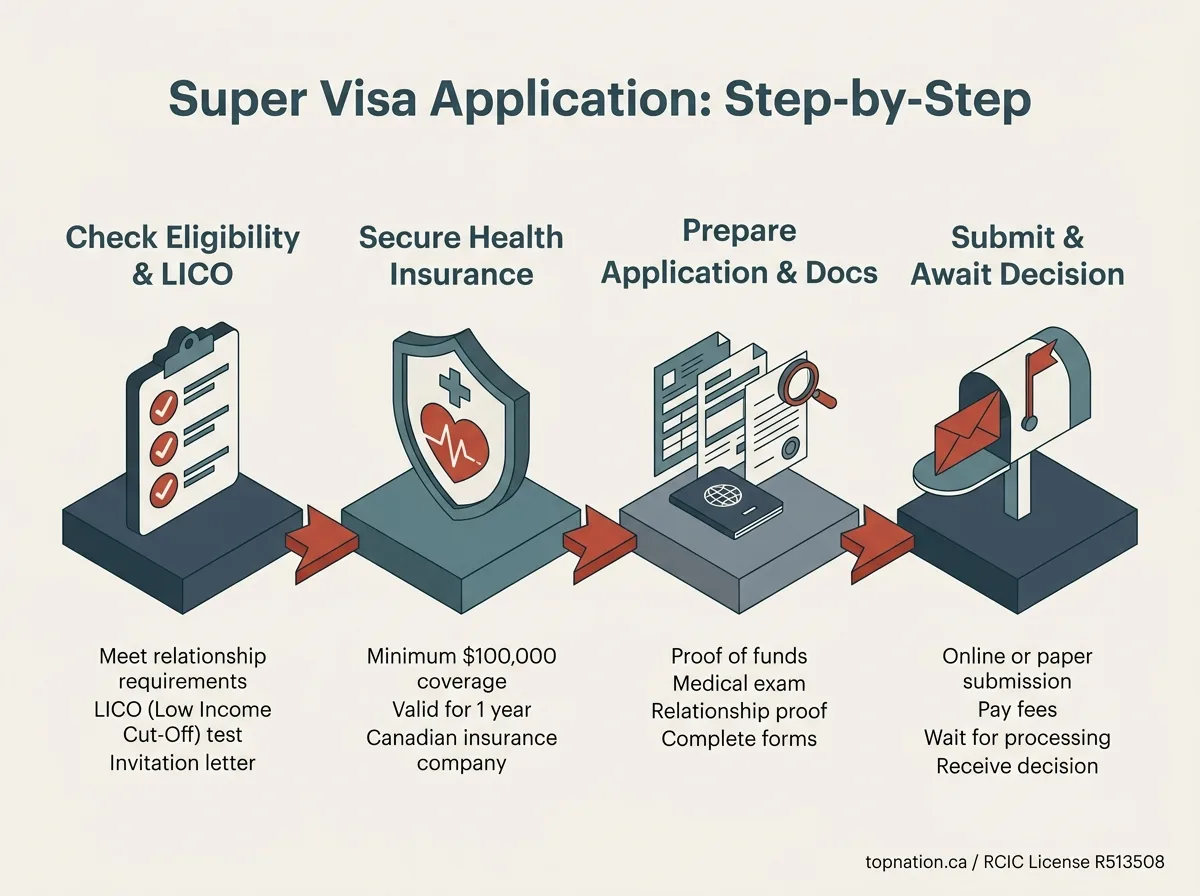
The Super Visa Application Process: A Step-by-Step Guide
The application is typically submitted online through the IRCC portal. It requires careful preparation of documents from both the applicant and the sponsor.
Step 1: Gather Sponsor Documents (Proof of Status, LICO)
The sponsor in Canada must collect their proof of citizenship or permanent residence, as well as financial documents like a Notice of Assessment (NOA) from the Canada Revenue Agency, T4 slips, and employment letters to prove they meet the LICO.
Step 2: The Applicant Gathers Their Documents
The parent or grandparent must provide their valid passport, passport-sized photos, and proof of their relationship to the sponsor (e.g., birth certificates). They will also need to undergo an immigration medical exam.
Step 3: The Sponsor Writes a Letter of Invitation
The sponsor prepares the detailed letter of invitation, formally promising financial support for the entire duration of the stay in Canada.
Step 4: Purchase the Required Medical Insurance
Once you are confident of eligibility, purchase the qualifying one-year medical insurance policy from a Canadian provider and obtain the policy confirmation document.
Step 5: Complete the Application Forms and Pay Fees Online
Fill out the required application forms for a Temporary Resident Visa and the supplementary Super Visa forms. Pay the application and biometrics fees online.
TopNation’s Insight on Processing Times
While IRCC posts average processing times, our firm’s data (RCIC #R513508) shows that well-prepared applications from countries with Visa Application Centres (VACs) that have efficient biometric processing can sometimes see decisions in as little as 4-6 weeks, faster than the published average. In contrast, incomplete applications or those from regions with backlogs can take several months.
PGP vs. Super Visa: A Strategic Comparison
Choosing between waiting for the PGP and applying for a Super Visa depends on your family’s immediate and long-term goals.
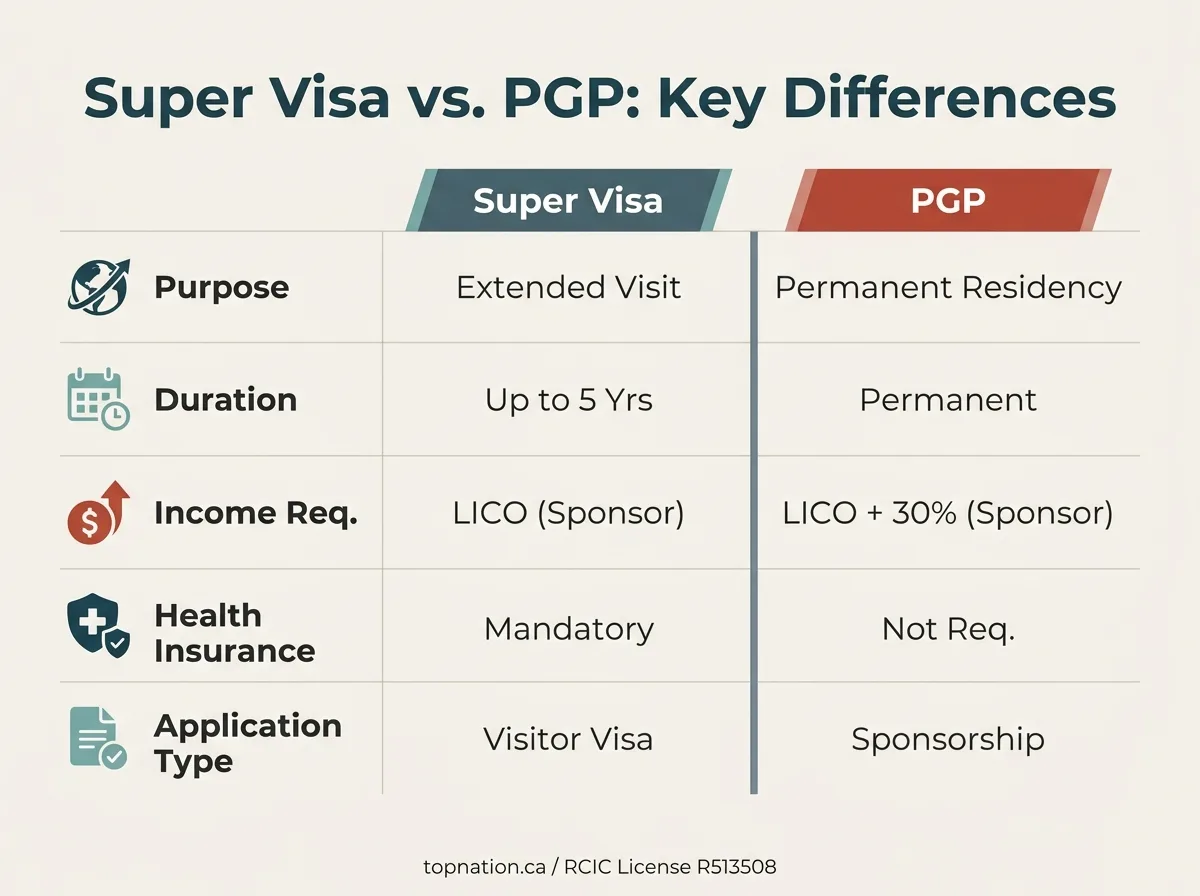
| Feature | Parents and Grandparents Program (PGP) | Super Visa |
|---|---|---|
| Status in Canada | Permanent Resident | Temporary Resident (Visitor) |
| Path to PR | Direct path to PR | No direct path to PR |
| Application Certainty | Very low (lottery-based) | High (if eligibility is met) |
| Processing Time | 20-24 months after invitation | A few weeks to a few months |
| Healthcare | Provincial healthcare coverage | Mandatory private Canadian insurance |
When to Pursue a Super Visa While Waiting for PGP
The best strategy for most families is to apply for a Super Visa immediately, even if they plan to enter the PGP pool. This allows for family reunification in the short term. Your parents can be with you in Canada while you wait for the slim chance of a PGP invitation. The two applications are processed independently and having a Super Visa does not negatively impact a future PGP application.
Are There Other, Less Common Pathways?
While the Super Visa is the primary alternative, a few other niche options exist, though they are rarely applicable.
Visitor Visas (TRV): The Short-Term Option
A standard visitor visa is an option for short trips, typically up to six months. However, it does not offer the long-term stability of a Super Visa and may be more difficult to obtain for applicants from certain countries, as they must prove strong ties to their home country to satisfy the officer they will leave Canada at the end of their stay.
Humanitarian and Compassionate (H&C) Grounds
Applying for permanent residence on H&C grounds is an exceptional measure reserved for cases with compelling, unusual circumstances. It is not a standard alternative to the PGP and has a very high refusal rate. Relying on H&C grounds is not a viable immigration plan.
Common Questions About the Super Visa in 2026
Navigating the specifics of the Super Visa can be complex. Here are answers to some frequently asked questions.
Can my parents work in Canada on a Super Visa?
No. A Super Visa is a type of visitor visa. It does not grant the holder the right to work in Canada. To work, they would need to apply for and be approved for a separate work permit, which is very difficult to obtain in this situation.
What happens if my income drops after the Super Visa is issued?
The LICO requirement is assessed at the time of application. However, if your parents wish to extend their stay in Canada after their initial period, you may need to provide updated proof of income demonstrating you still meet the threshold.
Can I include dependents in my parents’ Super Visa application?
You cannot include other dependents, such as your siblings, in their application. The Super Visa is strictly for parents and grandparents, and their spouses or common-law partners may be included.
How long is the Super Visa valid for?
The visa sticker in the passport can be valid for up to 10 years (or until the passport expires). Each entry to Canada can be for a period of up to five years. This is a significant advantage over a regular visitor visa.
Reunite Your Family in Canada. Let’s Build the Right Strategy.
Our RCICs can assess your LICO, review your documents, and determine the best path forward for your parents or grandparents.
| Call 587-400-0077 | Book a Consultation |
RCIC Licensed | Serving All of Alberta
Last updated: October 2023. This guide reflects the Super Visa and PGP rules as of the last program update. Immigration rules change frequently — consult a licensed RCIC for advice specific to your situation.