The 60-Day Countdown is On
Receiving an Invitation to Apply (ITA) for Express Entry is a major milestone. But the clock starts now: you have just 60 days to submit a perfect and complete application for permanent residence. One of the most common hurdles is securing police certificates on time, a non-negotiable requirement that can derail your entire application if mishandled.
EXPRESS ENTRY — ITA GUIDE
The moment an Invitation to Apply (ITA) lands in your Express Entry profile is one of celebration. Yet, it also marks the beginning of an intense 60-day period dedicated to compiling a flawless permanent residence application. For many applicants, the single biggest source of stress is the police clearance certificate (PCC). An `express entry police certificate delay` is not just an inconvenience; it’s a critical risk that can lead to application rejection. This guide provides a strategic framework for ITA recipients to proactively manage this requirement, handle unexpected delays, and effectively communicate with Immigration, Refugees and Citizenship Canada (IRCC) to keep their Canadian dream on track.

Understanding the Critical 60-Day Express Entry Deadline
When you receive an ITA, IRCC grants you a strict 60-day window to submit your electronic Application for Permanent Residence (e-APR). This is not a soft deadline. Failure to submit a complete application, including all mandatory supporting documents, within this timeframe typically results in the expiry of your ITA. You would then have to re-enter the Express Entry pool and hope for another invitation, with no guarantee of success. The 60-day period is designed to be challenging, testing an applicant’s organizational skills and preparedness.
The police certificate requirement is particularly time-sensitive. Unlike documents such as passports or birth certificates, which are static, police certificates must be obtained from every country where you (and your accompanying family members over 18) have lived for six months or more in a row since the age of 18. The processing times for these documents can vary wildly from a few days to several months, making them the primary cause of last-minute panic and incomplete submissions.
Why Police Certificates Are Mandatory for Canadian Immigration
IRCC’s mandate includes ensuring that individuals admitted to Canada do not pose a risk to Canadian society. Police certificates are a fundamental tool for assessing a candidate’s admissibility. They serve as official proof of a person’s criminal record, or lack thereof, from law enforcement authorities in the countries where they have resided.
Admissibility Screening
An IRCC officer reviews these certificates to screen for any criminal history that might render an applicant inadmissible under the Immigration and Refugee Protection Act (IRPA). This includes serious criminality, organized crime, or security risks. Without a clean certificate from every required jurisdiction, an officer cannot complete this crucial background check, and the application will be deemed incomplete and likely refused.
Global Background Verification
For candidates who have lived, worked, or studied in multiple countries, this process becomes exponentially more complex. Each country has its own unique procedure, issuing authority, and processing timeline. This requirement ensures a comprehensive global background check, maintaining the integrity of Canada’s immigration system. It’s not enough to be clear in your current country of residence; your entire adult history is under review.
Proactive Measures: Requesting Police Certificates Before Your ITA
The single most effective strategy to avoid an `express entry police certificate delay` is to apply for them *before* you receive an ITA. Many candidates hesitate, fearing the cost and the possibility that the certificate will expire before they can use it. However, the benefits of this proactive approach far outweigh the risks, especially for candidates with a competitive Comprehensive Ranking System (CRS) score who are likely to receive an invitation soon.
IRCC generally considers police certificates valid for one year from the date of issue. However, if you have not returned to the country that issued the certificate since it was obtained, it may remain valid indefinitely. The key is to obtain the certificate for your current country of residence last, as that is the one most likely to expire if you remain there.
| Strategy | Proactive Approach (Pre-ITA) | Reactive Approach (Post-ITA) |
|---|---|---|
| Timing | Apply as soon as your CRS score is competitive. You have months to gather documents calmly. | Apply immediately after receiving ITA. You have less than 60 days to navigate multiple bureaucracies. |
| Risk Level | Low. The worst case is a small financial loss if a certificate expires. | High. Any delay from a foreign government directly threatens your entire PR application. |
| Outcome | A complete, ready-to-submit application package, often within days of receiving the ITA. | Potential need for a Letter of Explanation (LOE), risk of incompleteness, and high stress. |
Country-Specific Guidance for Obtaining Police Certificates
Navigating the bureaucracy of different countries is a significant challenge. Each has its own process, and what works in one will not work in another. Based on our experience with thousands of applications, certain countries consistently present longer processing times. It is crucial to research the specific requirements for your circumstances on the official IRCC website and the relevant country’s government portal well in advance.
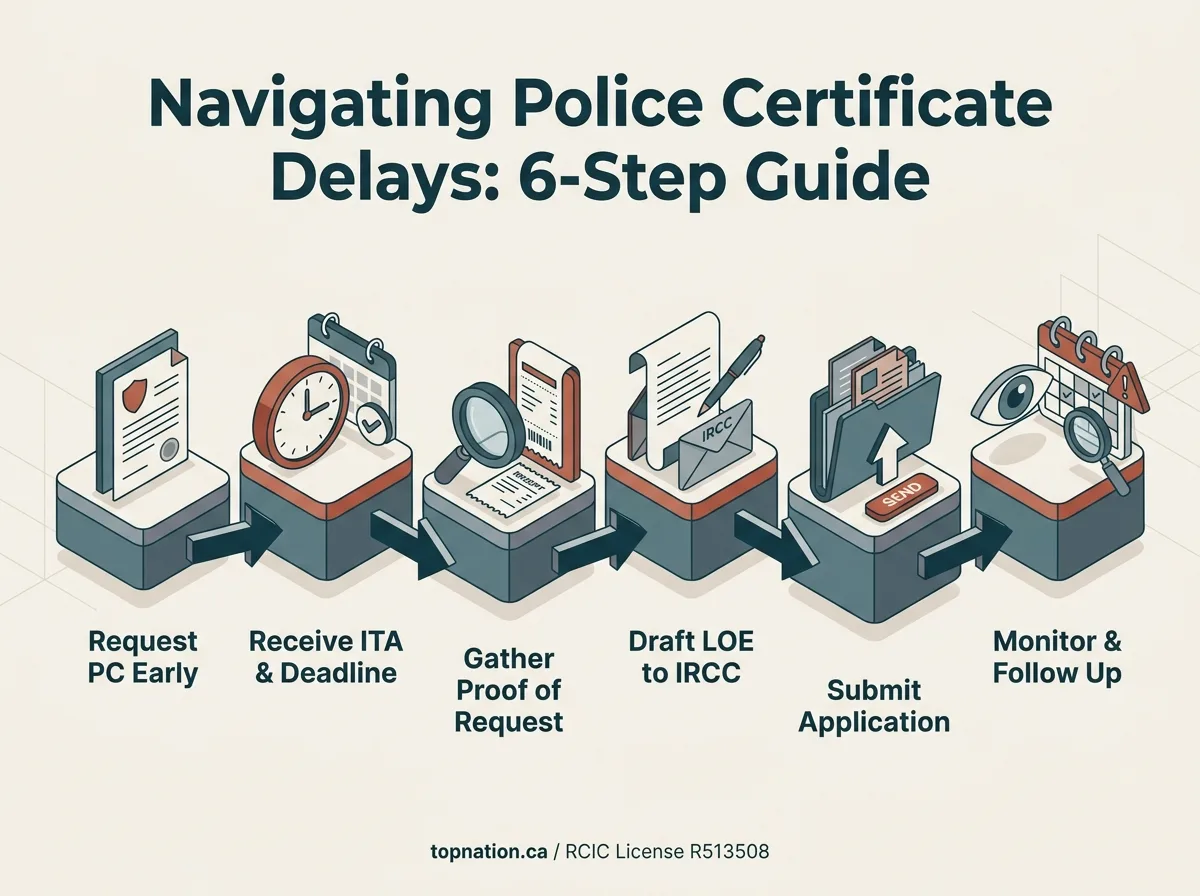
Here is a brief overview of the process for three common countries from which applicants require certificates. Note that these are general guidelines, and processing times can change without notice.
Police Certificate Checklist: Key Countries and Procedures
| Country | Issuing Authority & Process | TopNation Pro-Tip |
|---|---|---|
| India | Inside India: Passport Seva Kendra (PSK). Requires online application and in-person appointment. Outside India: Indian Embassy/Consulate via BLS International. Process varies by location. |
If applying from within Canada, the process can take 4-8 weeks. Start immediately. Ensure all addresses listed on your passport are accurate, as discrepancies trigger manual police verification in India, causing major delays. |
| Philippines | National Bureau of Investigation (NBI). Requires a ‘Multi-Purpose Clearance Certificate’. Can be applied for online, but requires biometrics appointment. | If you have a common name, expect a ‘HIT,’ which requires extra processing time. Apply through the Philippine consulate if outside the country, but be prepared for a 2-3 month wait. Do this pre-ITA. |
| UAE | Ministry of Interior (MOI) or local police headquarters (e.g., Dubai Police). Online application is efficient if you still have a valid Emirates ID. | If you are outside the UAE without a valid Emirates ID, the process is much harder. You will need to get fingerprints taken at a UAE embassy or a designated center in your current country and courier them. This can take over 8 weeks. |
What to Do If You Face an Express Entry Police Certificate Delay
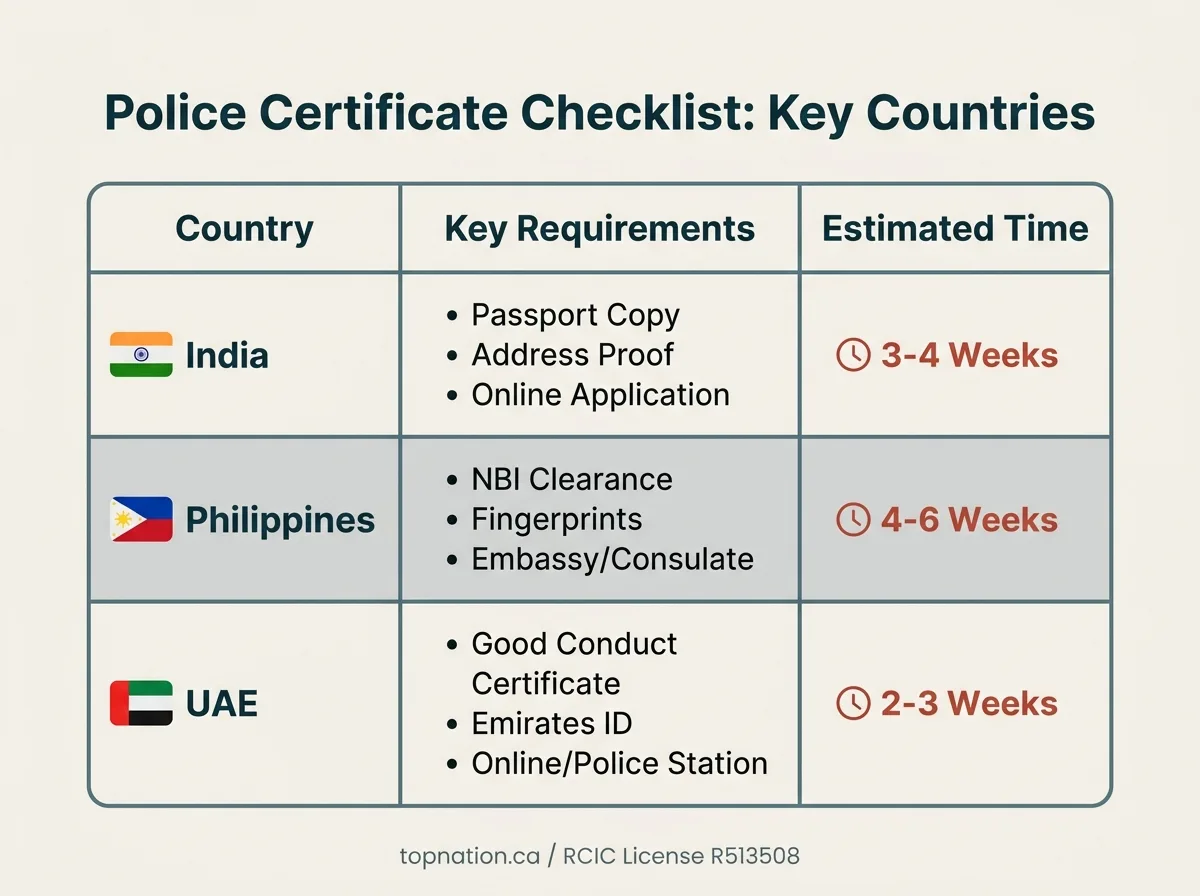
Even with proactive planning, delays can happen. A government office may be backlogged, a document may get lost in the mail, or an unexpected administrative hurdle may arise. If you find yourself approaching the 60-day deadline without a required police certificate, do not panic and do not let your ITA expire. The correct procedure is to submit your application on time with a detailed Letter of Explanation (LOE) and proof that you have applied for the certificate.
Submitting an LOE is not a guarantee of acceptance. The IRCC officer has the discretion to either accept your explanation and wait for the document, or return your application as incomplete. The strength of your LOE and the evidence you provide are paramount.
Drafting a Robust Letter of Explanation (LOE) for IRCC
An effective LOE is not simply a note saying, “I couldn’t get it on time.” It is a formal, factual, and evidence-based submission that demonstrates you have made every reasonable effort to comply with IRCC’s requirements. It should be clear, concise, and professional.
Essential Components of an Effective LOE
Your LOE must be structured to give the visa officer a clear picture of the situation. It should be uploaded in the document slot for the missing police certificate. A single PDF should contain the LOE as the first page, followed by all supporting evidence.
- 1. Clear Identification: Start with your full name, date of birth, and Express Entry profile number. State clearly which police certificate is missing (e.g., “Police Clearance Certificate from India”).
- 2. Timeline of Events: Detail the exact date you applied for the certificate. Provide a chronological list of your actions. For example: “Applied online on [Date],” “Completed biometrics on [Date],” “Followed up with the consulate on [Date].”
- 3. Proof of Application: This is the most critical component. You must include copies of application forms, payment receipts, courier tracking numbers, and any official correspondence or reference numbers from the issuing authority. A screenshot of a submitted online form is good; an official receipt is better.
- 4. Explanation of Delay: Briefly explain why the certificate is delayed, if you know. For example, cite official processing times from the authority’s website or mention a specific known backlog. Avoid making excuses or complaining.
- 5. Commitment to Provide the Document: End by stating that you will upload the certificate via the IRCC web form as soon as you receive it.

LOE Language: Proving Your Police Certificate Request to IRCC
When writing your LOE, use formal and direct language. Instead of saying “I am trying to get my police certificate,” use active and precise phrasing. Here is a guide to the type of language that strengthens your case:
Subject Line: Letter of Explanation – Missing Police Certificate for [Your Name] – EE Profile [Your Number]
Opening: “Dear Immigration Officer, Please accept this letter as an explanation for the temporary absence of the Police Clearance Certificate from [Country] in my e-APR submission. I have made all reasonable efforts to obtain this document within the 60-day timeframe following my ITA on [Date of ITA].”
Body Paragraph with Evidence: “As evidence of my timely application, please see the attached documents: (a) A copy of the completed application form submitted to the [Issuing Authority] on [Date], (b) The official payment receipt, reference number [Reference #], dated [Date], and (c) A screenshot from the application portal showing the status as ‘In Process’. The official processing time stated by the [Issuing Authority] is [Number] weeks, which extends beyond my submission deadline of [Your Deadline Date].”
Closing: “I undertake to provide the certificate to IRCC via the web form as soon as it is issued. I respectfully request your consideration and await a request for this document should my application proceed to the next stage. Thank you for your understanding.”
Common Mistakes to Avoid During the 60-Day Submission Period
Navigating the post-ITA phase is fraught with potential errors. At TopNation, we frequently see applicants make preventable mistakes that jeopardize their applications. Awareness is the first step to avoidance.
Mistake 1: Submitting an LOE Without Any Proof
A letter alone is insufficient. Without documentary evidence that you’ve actually applied for the PCC (receipts, application copies), an officer is very likely to return your application as incomplete. The burden of proof is on you.
Mistake 2: Waiting Too Long to Apply for the Certificate
Applying for a notoriously slow police certificate 45 days into your 60-day window shows a lack of diligence. An officer may view this negatively. Your LOE is strongest when you can show you applied within the first few days of receiving your ITA.
Mistake 3: Forgetting Family Members
The police certificate requirement applies to the principal applicant and all accompanying family members aged 18 or over. A common oversight is forgetting to secure a certificate for a spouse or an 18-year-old child for a country they lived in previously.
Mistake 4: Obtaining the Wrong Type of Document
Ensure you are requesting the correct document for Canadian immigration purposes. Some countries offer different levels of police checks (e.g., local vs. federal). IRCC’s website specifies the exact type of certificate required from each country. Getting the wrong one will lead to rejection.
Next Steps After Submitting Your Application with an LOE
Once you have submitted your e-APR with the LOE, your work is not done. You must continue to diligently follow up with the authority issuing the police certificate. As soon as you receive the document, you should upload it to IRCC using the web form, referencing your application number.
Do not wait for IRCC to ask for it. Proactively providing the document shows continued diligence and helps the officer process your file faster once they open it. If the officer begins reviewing your file before you’ve uploaded the certificate, they will typically issue a request letter giving you a new deadline (often 30 days) to provide it. Responding to this request promptly is essential.
Expert Guidance for Navigating Complex Express Entry Situations
The Express Entry system is efficient but unforgiving. Small mistakes in documentation can have significant consequences. While this guide provides a solid framework, every applicant’s situation is unique. You may have lived in a country with a collapsed government, have a minor record you need to address, or be dealing with unresponsive bureaucracies. In these complex cases, seeking professional advice is a wise investment.
An experienced Edmonton immigration consultant can help you formulate the strongest possible strategy, draft a compelling LOE, and ensure your application is positioned for success. From navigating the complexities of a spousal sponsorship application to understanding the nuances of the Alberta Advantage Immigration Program, professional guidance can make all the difference.
Your 60-Day Deadline is Not Negotiable. Your Strategy Should Be.
If you’re facing a police certificate delay or have a complex case, don’t risk your ITA. Let our licensed RCICs review your file.
| Call 587-400-0077 | Book a Consultation |
RCIC Licensed | Serving All of Alberta
Last updated: June 2024. This guide provides general information for Express Entry applicants. Immigration rules and processing times change frequently — consult a licensed RCIC (CICC #R513508) for advice specific to your situation.