2026 Update — IMP Now Has Nearly 3x More Spots Than TFWP
The federal government has made its position unmistakable. For 2026, the International Mobility Program targets 170,000 LMIA-exempt work permits while the Temporary Foreign Worker Program has been slashed to just 60,000 LMIA-based permits. That is a nearly three-to-one ratio in favour of the LMIA-exempt route. If you are a Canadian employer still defaulting to the LMIA process, this article breaks down exactly when each pathway applies, what each one costs, and which route gets workers through your door fastest.
LMIA Explained: What It Is and How It Works
A Labour Market Impact Assessment is a document from Employment and Social Development Canada (ESDC) that proves no Canadian citizen or permanent resident is available for a specific job. Employers must obtain an approved LMIA before a foreign worker can apply for a work permit under the Temporary Foreign Worker Program. The entire purpose of the assessment is to protect the domestic labour market — and the entire weight of proving that protection falls on the employer.
For business owners who have never gone through it, the process sounds manageable on paper. In practice, it consumes months of time, thousands of dollars, and significant administrative bandwidth from your HR team. Here is the step-by-step reality.
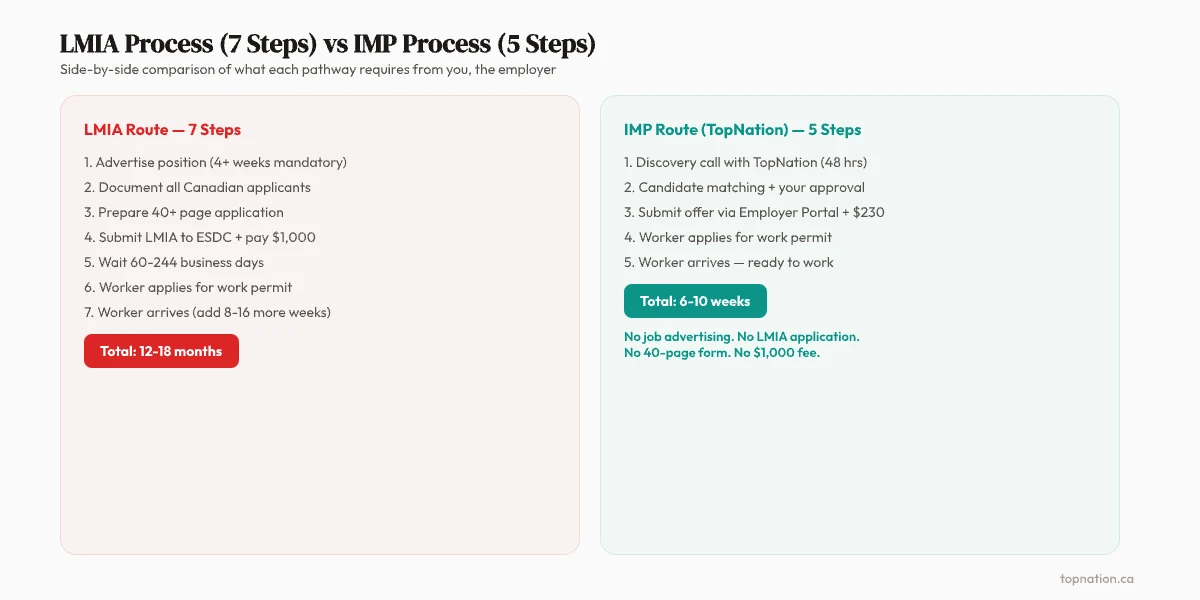
The 7-Step LMIA Process
Step 1: Determine the wage stream. ESDC classifies LMIA applications into two streams based on the offered wage. If the wage meets or exceeds the provincial or territorial median hourly wage, it falls under the high-wage stream. Below that threshold, it falls under the low-wage stream, which carries additional requirements including caps tied to the regional unemployment rate. As of March 2026, the low-wage LMIA stream remains effectively closed in regions where the unemployment rate exceeds 6%.
Step 2: Advertise the position. You must advertise the job on the Government of Canada’s Job Bank and at least two additional recruitment platforms for a minimum of four consecutive weeks. The advertisements must include the job title, duties, wage, work location, and employment terms. You are required to keep documentation of every single platform used and the exact dates the ads ran.
Step 3: Document your recruitment efforts. During the advertising period, you must track every Canadian applicant who applies, conduct interviews where appropriate, and document specific reasons for rejecting each one. ESDC wants to see that you made genuine, sustained efforts to hire domestically before turning to foreign labour. Vague reasons for rejection will get your application returned.
Step 4: Prepare the transition plan. For high-wage positions, employers must submit a transition plan describing how they will reduce reliance on temporary foreign workers over time. This might include training Canadian employees, investing in automation, or adjusting wages to attract domestic workers. The plan must be specific and measurable — generic statements about “ongoing recruitment” will not suffice.
Step 5: Compile and submit the application. The LMIA application itself requires the completed ESDC application form, proof of business legitimacy (business licence, CRA documents, proof of active operations), all recruitment documentation, the transition plan, a copy of the job advertisement, and the $1,000 application fee per position. Missing a single document can result in a return letter that resets your timeline.
Step 6: Wait for processing. Current processing times vary dramatically by stream. High-wage LMIA applications average 60 business days — roughly three calendar months under ideal conditions. Applications connected to permanent residence streams have ballooned to 244 business days, which translates to nearly a full calendar year. These timelines do not include the work permit processing that follows an approved LMIA.
Step 7: Worker applies for the work permit. Only after receiving a positive LMIA can the foreign worker submit their work permit application to IRCC. Work permit processing adds another two to eight weeks depending on the worker’s country and application method. From the day you decide to hire a foreign worker through LMIA to the day that person starts work, the total timeline typically spans eight to twelve months.
What ESDC Requires From Employers
Beyond the seven steps above, ESDC imposes ongoing obligations. Employers must pay the prevailing wage for the occupation and region. They must provide working conditions consistent with what was described in the LMIA application. And they are subject to compliance inspections for six years after the worker’s start date.
In the 2024-2025 fiscal year, ESDC and IRCC issued $4.88 million in penalties against employers found to be non-compliant — double the previous year. Thirty-six employers were banned outright from hiring foreign workers. One employer received a $1 million fine and a 10-year ban from the program. Compliance is not optional.
International Mobility Program: What It Is and How It Works
The International Mobility Program is Canada’s framework for issuing work permits without requiring an LMIA. Instead of proving that no Canadian is available for the job, the employer demonstrates that the hire serves Canada’s broader economic, social, or cultural interests — or that it falls under an international agreement or reciprocal arrangement.
While the TFWP operates on a position-by-position labour market test, the IMP operates on a category-based system. If your situation fits a recognized exemption category, the entire LMIA process is bypassed. No job advertising, no recruitment documentation, no transition plan.
Key IMP Categories for Employers
Employer-specific LMIA-exempt work permits. This is the broadest category. Employers submit an offer of employment through the IRCC Employer Portal, and the work permit is tied to a specific employer and position. The employment must provide a “significant benefit” to Canada, which IRCC interprets broadly — filling documented labour shortages, supporting regional economic development, or bringing specialized skills all qualify.
Francophone Mobility (C16). Any employer outside Quebec can hire French-speaking workers without an LMIA. This single exemption opens access to 29 Francophone countries and is one of the most underused pathways in the immigration system. We cover this in its own section below.
Intra-Company Transfers. Multinational companies can transfer executives, senior managers, and specialized knowledge workers from a foreign affiliate to their Canadian operations. The worker must have been employed by the related entity for at least one year within the previous three years.
International trade agreements. CUSMA (formerly NAFTA) covers over 60 professional categories for U.S. and Mexican nationals. CETA provides similar provisions for European Union professionals. These agreements are most relevant for engineering, consulting, technology, and professional services firms.
Reciprocal employment (C20). This applies when Canadian workers receive reciprocal employment opportunities abroad. It is most commonly used in tourism, hospitality, and specialized exchange programs.
The 5-Step IMP Process
Step 1: Confirm your exemption category. Before filing anything, verify that your specific hire falls under a recognized IMP category. The position, the worker’s nationality, and the nature of the employment must align with the exemption requirements. An experienced immigration advisor can confirm eligibility within a single consultation.
Step 2: Set up your Employer Portal account. You need an account on the IRCC Employer Portal, which requires your CRA business number and basic company details. Account activation typically takes one to two business days.
Step 3: Submit the offer of employment. Through the portal, you submit the formal offer including the job title, NOC code, wage, work location, employment duration, and working conditions. This generates a unique offer of employment number that the worker needs for their work permit application. Accuracy is critical — mismatches between the offer and the actual job can trigger compliance action.
Step 4: Pay the $230 employer compliance fee. The fee is paid through the portal when you submit the offer. It is non-refundable even if the work permit is ultimately denied. At $230 per position, it represents less than a quarter of the $1,000 LMIA fee — with no advertising costs attached.
Step 5: Worker applies for the work permit. Using the offer of employment number, the worker submits their work permit application to IRCC. Processing typically takes two to eight weeks depending on the worker’s country and application method. Workers already in Canada on valid status may see faster turnaround.
IMP Processing Timeline
From the day you submit the offer of employment to the day your worker starts, the typical IMP timeline runs three to ten weeks. The employer-side steps (portal setup, offer submission, fee payment) take one to three days. The worker’s permit processing accounts for the remaining time. Compare that to the eight-to-twelve-month LMIA timeline and the efficiency gap becomes staggering.
The Complete Side-by-Side Comparison
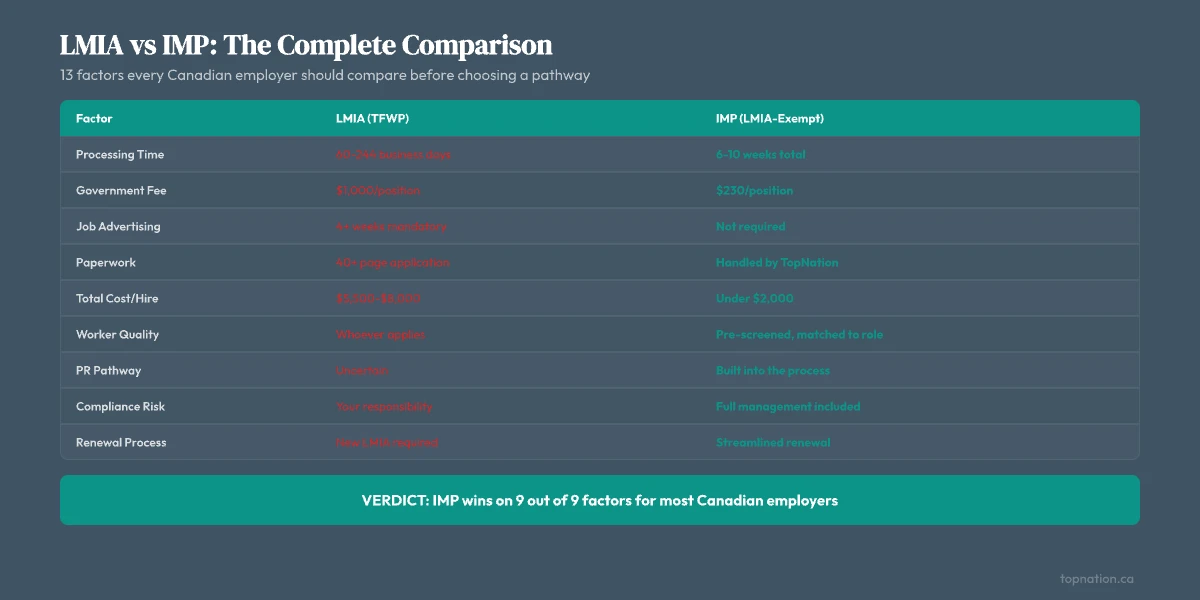
This is the table every Canadian employer needs when deciding between the LMIA and IMP pathways. It covers every factor that affects your timeline, your costs, and your compliance obligations. Bookmark this.
| Factor | LMIA (TFWP) | IMP (LMIA-Exempt) |
|---|---|---|
| Processing Time | 60-244 business days (LMIA only) + 2-8 weeks (work permit) | 2-8 weeks total (work permit only) |
| Total Timeline to Worker Start | 8-12 months | 3-10 weeks |
| Government Fee | $1,000 per position (LMIA fee) | $230 per position (employer compliance fee) |
| Job Advertising Required | Yes — 4 weeks minimum on Job Bank + 2 other platforms | No advertising required |
| Paperwork Burden | High — recruitment records, transition plan, rejection logs, business documents | Moderate — offer of employment through Employer Portal |
| Labour Market Test | Required — must prove no Canadian is available | Not required |
| Employer Eligibility | Any legitimate Canadian employer with a valid business number | Must qualify under a recognized exemption category |
| Worker Source Countries | Any country (no restrictions based on nationality) | Depends on category — some tied to trade agreements, Francophone Mobility covers 29 countries |
| Wage Requirements | Must meet or exceed prevailing wage; low-wage stream has unemployment rate caps | Must meet or exceed prevailing wage for the occupation and region |
| Duration of Work Permit | Typically 1-2 years; low-wage capped at 1 year | Typically 1-2 years; some categories allow up to 3 years |
| PR Pathway for Worker | Canadian Experience Class, PNP | Canadian Experience Class, PNP, Express Entry + bonus CRS points for Francophone candidates |
| Compliance / Audit Risk | Subject to inspection for 6 years; penalties up to $1M and 10-year ban | Subject to inspection for 6 years; same penalty framework |
| Renewal Process | Full new LMIA application required for renewal | New offer of employment + $230 fee; no advertising or labour market test |
| Total Cost per Hire | $5,500-$8,000 (fees + advertising + legal + admin time) | Under $2,000 (compliance fee + basic admin) |
The data paints a clear picture. On virtually every metric that matters to an employer — speed, cost, administrative burden, and renewal simplicity — the IMP outperforms the LMIA route. The sole constraint is eligibility: your hire must fit a recognized exemption category. Given that the government has allocated 170,000 IMP spots versus 60,000 TFWP spots for 2026, the eligibility criteria are far broader than most employers expect.
When LMIA Is Your Only Option
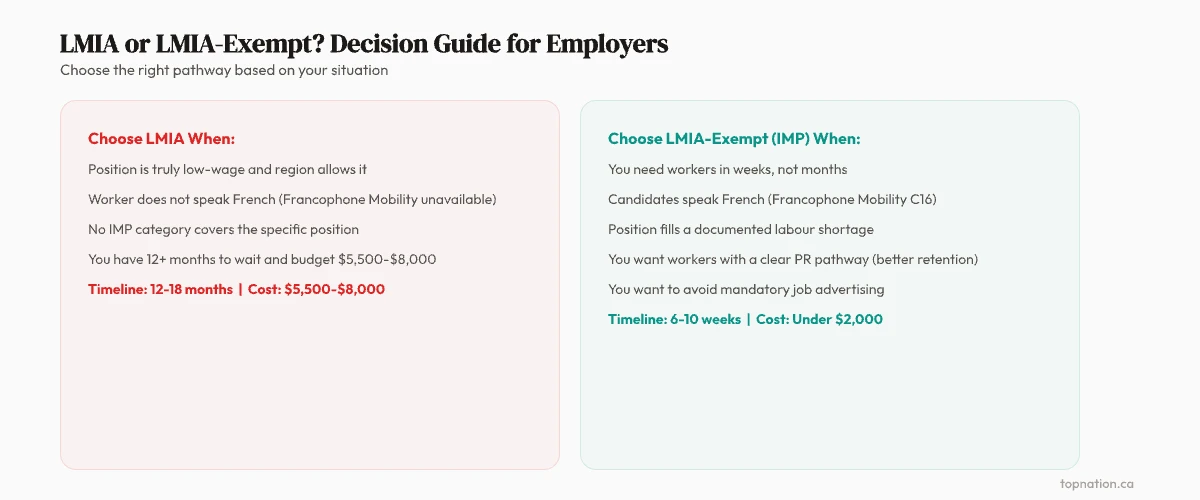
Despite the IMP’s advantages, there are specific situations where the LMIA route remains necessary. Understanding when you must go through the Temporary Foreign Worker Program prevents wasted time pursuing an exemption that does not apply to your situation.
Positions That Do Not Fit Any IMP Category
The IMP is category-based. If your specific hire does not fall under Francophone Mobility, an intra-company transfer, a trade agreement, reciprocal employment, or the “significant benefit” umbrella, then the LMIA is your only federally sanctioned pathway. This is most common when hiring non-Francophone workers for positions in regions that are not experiencing documented labour shortages — situations where it is difficult to articulate a “significant benefit” beyond filling a vacancy.
Low-Wage Positions in Specific Regions
If the offered wage falls below the provincial median hourly wage, the position is classified as low-wage under the TFWP. While the low-wage LMIA stream has been severely restricted in 2026 — applications are effectively frozen in regions where unemployment exceeds 6% — it remains the only route in areas where unemployment is lower and the position does not qualify for an IMP exemption.
However, be aware that the low-wage cap was reduced from 20% to 10% of an employer’s workforce in most sectors, and to 0% in census metropolitan areas with unemployment above 6%. For many employers, the low-wage LMIA is no longer a realistic option regardless of desire.
When the Employer Cannot Demonstrate “Significant Benefit”
The IMP’s employer-specific category requires that the employment provide a “significant benefit” to Canada. IRCC evaluates this broadly, but it is not automatic. An employer in a region with low unemployment, filling a position that is not in documented shortage, for a worker who does not bring specialized skills or Francophone language ability, may struggle to meet the threshold. In those circumstances, the LMIA process — with its built-in labour market test — is the available path.
Situations Requiring a Formal Labour Market Test
Certain provincial nominee programs and permanent residence streams require a positive LMIA as part of the application, even if the worker could theoretically enter through the IMP on a temporary basis. If your long-term strategy depends on a specific PR pathway that mandates an LMIA, you may need to go through the process regardless of whether a temporary LMIA-exempt option exists.
Before defaulting to LMIA, get a professional eligibility assessment
Many employers assume they need an LMIA because they have always done it that way or because a colleague told them it was the only option. In reality, a significant percentage of positions that employers submit LMIAs for would qualify for an IMP exemption. TopNation’s free workforce assessment identifies your fastest pathway in 48 hours →
When IMP Is the Better Choice (Most Situations)
For the majority of Canadian employers hiring foreign workers in 2026, the International Mobility Program is the superior pathway. Here is why.
Speed: Weeks Instead of Months
The single most compelling advantage of the IMP is timeline. Where the LMIA route takes eight to twelve months from application to worker arrival, the IMP compresses that to three to ten weeks. For a restaurant with empty stations, a construction company watching a project deadline approach, or an automotive shop turning away customers, that difference is measured in lost revenue — not just lost time.
Every month a position sits vacant costs the average Canadian employer between $3,500 and $7,000 in lost productivity, overtime for remaining staff, and missed business opportunities. Over the eight-month LMIA wait, that adds up to $28,000 to $56,000 per vacant position. The IMP eliminates most of that loss.
Cost: A Fraction of the LMIA Route
The IMP compliance fee is $230 per position compared to the LMIA’s $1,000 government fee. But the government fee is only the beginning of the cost gap. Because the IMP requires no mandatory advertising, no recruitment documentation, and no transition plan, the total employer cost per hire drops from $5,500-$8,000 (LMIA) to under $2,000 (IMP). For an employer filling five positions, that represents savings of $17,500 to $30,000.
No Mandatory Job Advertising
The LMIA requires four weeks of advertising on three or more platforms, plus documentation of every applicant received and reasons for rejection. The IMP requires none of this. You identify your candidate, submit the offer through the portal, and the process begins immediately. There is no four-week holding pattern while you prove that Canadians cannot or will not do the job.
Broader Eligibility Through Francophone Mobility
Francophone Mobility alone covers virtually any occupation in any province outside Quebec, provided the worker speaks French. This single exemption category serves hospitality, construction, automotive, manufacturing, healthcare, and skilled trades. Given that 29 countries produce French-speaking workers across these industries, the talent pool is substantial and largely untapped by Canadian employers.
Stronger Permanent Residence Pathway
Workers hired through the IMP accumulate Canadian work experience that counts toward permanent residence through Express Entry (Canadian Experience Class) and provincial nominee programs. Francophone workers receive additional Comprehensive Ranking System (CRS) points for French language proficiency — up to 50 bonus points under the category-based selection system. This means your worker is more likely to obtain PR, which means they stay longer and your return on the hiring investment multiplies.
Simpler Renewal Process
When a worker’s LMIA-based work permit expires, the employer must submit an entirely new LMIA application — another $1,000, another round of advertising, another three-to-twelve-month wait. Under the IMP, renewal requires a new offer of employment and the $230 compliance fee. No advertising. No transition plan. The process that took months the first time through LMIA takes days through the IMP.
Francophone Mobility: The IMP Category Most Employers Miss
If you take one thing from this article, let it be this: Francophone Mobility is the most powerful and most underused immigration pathway available to Canadian employers outside Quebec. It eliminates the LMIA entirely, it works for nearly every occupation, and most of your competitors have never heard of it.
How the C16 Exemption Works
Under IRCC exemption code C16, any employer in any province or territory other than Quebec can hire a French-speaking foreign worker without an LMIA. The worker must demonstrate French language ability, typically through a TEF (Test d’evaluation de francais) or TCF (Test de connaissance du francais) score. The position can be in virtually any occupation and at any skill level.
The policy exists because the federal government has committed to increasing French-speaking immigration outside Quebec to 6% of all admissions. Francophone Mobility is one of the primary mechanisms for reaching that target, which is why the program continues to expand rather than contract.
Why It Works Anywhere Outside Quebec
This is the detail that surprises most employers. Francophone Mobility is not limited to Ontario or New Brunswick — provinces with established Francophone communities. It applies in Alberta, British Columbia, Saskatchewan, Manitoba, and every other jurisdiction outside Quebec. Whether you run a restaurant in Calgary, a construction company in Vancouver, or an auto shop in Winnipeg, Francophone Mobility applies to your operation.
Alberta employers benefit from an additional advantage. The Alberta Advantage Immigration Program (AAIP) gives nomination priority to Francophone candidates, creating a dual pathway: faster hiring through the IMP plus a stronger route to permanent residence through the AAIP. That combination drives retention rates that employers using the LMIA route rarely see.
29 Source Countries and Counting
Francophone Mobility opens access to skilled workers across 29 countries where French is an official or widely spoken language.
North Africa: Morocco, Tunisia, Algeria
West Africa: Senegal, Ivory Coast, Cameroon, Guinea, Mali, Burkina Faso, Togo, Benin, Niger, Democratic Republic of Congo, Republic of Congo
Central Africa: Gabon, Chad, Central African Republic
Europe: France, Belgium, Switzerland, Luxembourg
Caribbean: Haiti
Indian Ocean: Madagascar, Mauritius, Comoros
Southeast Asia: Vietnam, Cambodia, Laos
Middle East: Lebanon
Morocco and Tunisia are among the most active source countries for Canadian employers. Workers from these countries frequently hold professional certifications in culinary arts, electrical work, automotive repair, welding, and hospitality management. The vocational training systems in North Africa produce graduates with hands-on skills that align directly with Canada’s labour market needs.
Perfect for High-Demand Industries
Francophone Mobility is not limited to white-collar professions. It covers the exact industries where Canadian employers face the most acute shortages.
Hospitality: Cooks, sous chefs, bakers, food service supervisors, hotel front desk agents, housekeeping managers. If you operate a restaurant or hotel, see how TopNation places hospitality workers in 6-10 weeks →
Automotive: Service technicians, auto body repair specialists, automotive painters, parts advisors. TopNation connects you with certified automotive professionals →
Construction: Carpenters, electricians, welders, heavy equipment operators, concrete finishers, plumbers. Get skilled tradespeople on your site in weeks →
Manufacturing: Machine operators, quality control technicians, industrial mechanics, production supervisors. These roles qualify when the employer operates outside Quebec and the worker demonstrates French proficiency.
Cost Breakdown: LMIA Route vs IMP Route
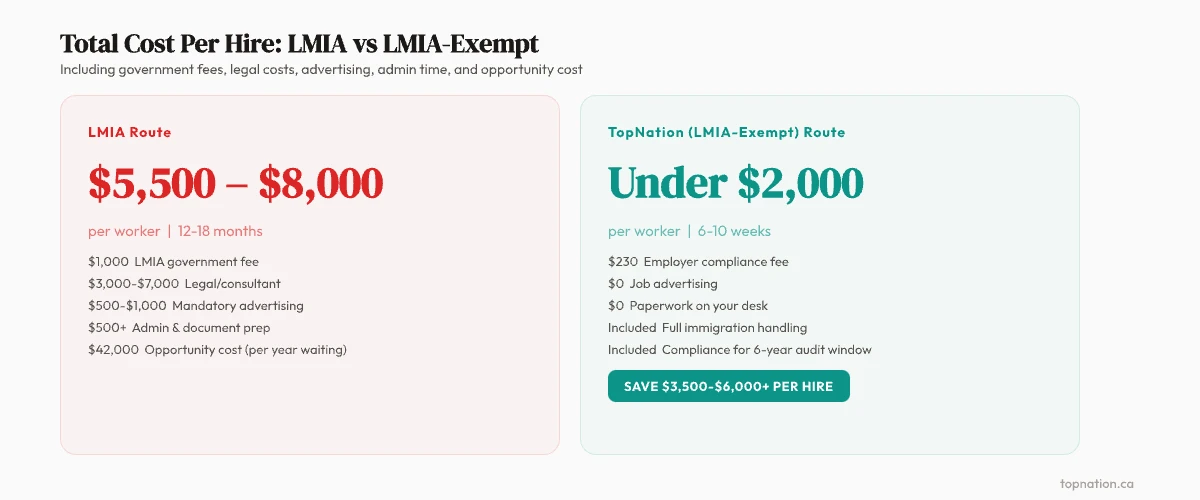
Cost is ultimately what drives most employer decisions. Here is a granular breakdown that accounts for every dollar and every hour — not just the government fees that get quoted on most immigration websites.
| Cost Item | LMIA Route | IMP Route |
|---|---|---|
| Government Application / Compliance Fee | $1,000 | $230 |
| Mandatory Job Advertising (4 weeks, 3+ platforms) | $500-$1,500 | $0 |
| Immigration Consultant / Lawyer for LMIA Application | $3,000-$5,000 | $0 (no LMIA application required) |
| Recruitment Documentation and Record-Keeping | $300-$800 (staff time to track applicants, document rejections) | $0 |
| Transition Plan Preparation | $200-$500 (staff time or consultant fee) | $0 (not required) |
| Document Preparation and Translation | $500-$1,000 | $300-$500 |
| Work Permit Application Fee (Worker Pays) | $155 | $155 |
| Employer Administrative Hours | 20-40 hours | 5-10 hours |
| Opportunity Cost of Waiting (per month of vacancy) | $3,500-$7,000 x 8-12 months = $28,000-$84,000 | $3,500-$7,000 x 1-2 months = $3,500-$14,000 |
| Total Direct Cost per Hire (Excluding Opportunity Cost) | $5,500-$8,800 | $530-$730 |
| Total True Cost per Hire (Including Opportunity Cost) | $33,500-$92,800 | $4,030-$14,730 |
When you include opportunity cost — the revenue lost while a position sits empty — the gap between the two routes is not just significant. It is enormous. An employer filling five positions through LMIA faces a true cost between $167,500 and $464,000. The same five positions filled through the IMP cost between $20,150 and $73,650. That is a savings of up to $390,000 per five-worker hiring cycle.
Direct costs alone make the case, but opportunity cost seals it
Most immigration comparisons ignore the cost of waiting. They should not. A construction company with an empty welder position is losing project bids. A restaurant with an empty kitchen station is turning away reservations. An auto shop with an empty service bay is watching customers drive to a competitor. The LMIA’s eight-to-twelve-month timeline does not just cost you fees — it costs you revenue every single day the position remains unfilled.
How to Switch from LMIA to IMP
If you are currently in the LMIA process and wondering whether you can pivot to the IMP, the short answer is yes — but the details depend on where you are in the process and the specific circumstances of your hire.
If Your LMIA Application Is Still Pending
You can withdraw a pending LMIA application at any time by contacting ESDC in writing. There is no penalty for withdrawal. However, the $1,000 application fee is non-refundable — once submitted, that money is gone regardless of the outcome. If you have a strong IMP pathway available and your LMIA is still early in processing, withdrawing and switching to the IMP may still be the financially sound decision when you factor in the months of waiting you avoid.
Calculate it this way: if the LMIA has been processing for two months and the estimated completion is another four months out, switching to the IMP could save you four months of vacancy cost ($14,000 to $28,000). The sunk $1,000 LMIA fee becomes irrelevant against those numbers.
If You Have an Approved LMIA
An approved LMIA is valid for six months from the date of issuance. During that window, the worker can use it to apply for a work permit. If you already have the approval in hand, there is no reason to switch mid-stream — use the LMIA and plan to go IMP for your next hire.
That said, if the approved LMIA is about to expire and the worker has not yet applied for the permit, switching to the IMP (if eligible) can be faster than requesting a new LMIA.
Transitioning Existing Workers from LMIA to IMP
Workers currently in Canada on an LMIA-based work permit can transition to an IMP-based permit at the time of renewal. When the current permit expires, instead of filing a new LMIA application, the employer submits a new offer of employment through the Employer Portal under the appropriate IMP category, pays the $230 fee, and the worker applies for a new work permit citing the LMIA exemption.
This is particularly straightforward for employers whose workers have developed French language proficiency or who qualify under Francophone Mobility. A worker who entered on an LMIA-based permit but speaks French can renew under the C16 exemption — no new LMIA needed, no advertising, no transition plan.
Planning Future Hires Through IMP
If you currently hire through LMIA by default, the transition does not require an overnight overhaul. Start by assessing your next hire against the IMP categories. If the worker speaks French or comes from a Francophone country, Francophone Mobility likely applies. If the role addresses a documented regional shortage, the employer-specific IMP category may work. If the worker is transferring from an international affiliate, intra-company transfer is available.
The most efficient approach is to request a free workforce assessment from TopNation →. We evaluate your current and planned hires against every available pathway and recommend the fastest, most cost-effective route for each position.
Frequently Asked Questions
Which is faster — LMIA or IMP?
The IMP is dramatically faster. The LMIA route takes eight to twelve months from application to worker arrival, including LMIA processing (60-244 business days) plus work permit processing (two to eight weeks). The IMP route takes three to ten weeks total because there is no LMIA stage — the employer submits the offer of employment, pays the $230 fee, and the worker applies directly for the work permit. For employers in urgent need, that time savings translates directly into reduced vacancy costs and faster revenue recovery.
Is IMP cheaper than LMIA?
Significantly cheaper. The IMP’s government fee is $230 per position compared to the LMIA’s $1,000. But the real savings come from eliminating mandatory advertising ($500-$1,500), legal fees for the LMIA application ($3,000-$5,000), and the administrative hours spent on recruitment documentation and transition plans. Total direct employer cost for the LMIA route runs $5,500 to $8,800 per hire. The IMP route comes in at $530 to $730. When you factor in the opportunity cost of a vacant position over eight to twelve months, the IMP saves employers tens of thousands of dollars per hire.
Can I use both LMIA and IMP for different positions?
Yes. There is no rule preventing an employer from using both pathways simultaneously. You might use the IMP for a Francophone cook hired under the C16 exemption while pursuing an LMIA for a non-Francophone warehouse worker who does not fit any IMP category. Each position is assessed independently. Many employers start with the IMP for their most urgent hires and use the LMIA process only for positions where no exemption applies.
Does the IMP work for low-wage positions?
The IMP does not use the same wage-stream classification as the TFWP. There is no “low-wage IMP” or “high-wage IMP” — the exemption categories are based on the nature of the employment, not the wage level. However, the offered wage must still meet or exceed the prevailing wage for the occupation and region as determined by ESDC. You cannot use the IMP to pay below-market wages. As long as the wage is at or above the prevailing rate and the position qualifies under an IMP category, the wage level itself does not disqualify you.
Which pathway gives workers a better route to permanent residence?
Both pathways allow workers to accumulate Canadian work experience that counts toward permanent residence through Express Entry and provincial nominee programs. However, the IMP has a notable advantage for Francophone workers. Candidates hired under Francophone Mobility receive additional CRS points for French language proficiency — up to 50 bonus points under category-based selection rounds. This makes them significantly more competitive in Express Entry draws. Provincial programs like Alberta’s AAIP also prioritize Francophone nominees. The result: IMP workers, especially those hired through Francophone Mobility, typically have a faster and more certain path to PR than their LMIA-route counterparts.
Is one pathway more “legitimate” than the other?
No. Both the TFWP (LMIA route) and the IMP are federal government programs administered under the Immigration and Refugee Protection Act and Regulations. Neither is a loophole, a workaround, or a shortcut. The IMP exists because the government has determined that certain categories of hiring benefit Canada without requiring a position-by-position labour market test. In fact, the government’s decision to allocate 170,000 IMP spots versus 60,000 TFWP spots for 2026 demonstrates that the IMP is the pathway Ottawa is actively expanding. Employers using the IMP are not cutting corners — they are using the route the government has designed for their situation.
For a deeper overview of all LMIA-exempt pathways available in 2026, read our companion guide: How to Hire Foreign Workers Without LMIA in Canada →
Not Sure Which Pathway Is Right for Your Business?
TopNation’s free workforce assessment evaluates your positions against every available pathway and tells you exactly which route will get workers to your door fastest. No obligation. No cost. Just a clear plan.
Workers Placed
Retention Rate
Weeks Average
Assessment Cost
Hiring Francophone Workers in Alberta?
Canada's Francophone Mobility program (C16) lets Alberta employers hire French-speaking workers without an LMIA — government fee just $230, workers arrive in 6 weeks. See our specialized program for Francophone cooks and chefs, or explore all Francophone immigration pathways to Alberta.