2026 Alberta Workforce Report — 57% of Employers Cannot Find Enough Workers
Last updated: July 15, 2026 · Reviewed by TopNation Immigration Services’ licensed RCIC team, regulated by the College of Immigration and Citizenship Consultants (CICC). All statistics cited from Statistics Canada, the Government of Alberta, BuildForce Canada, and IRCC.
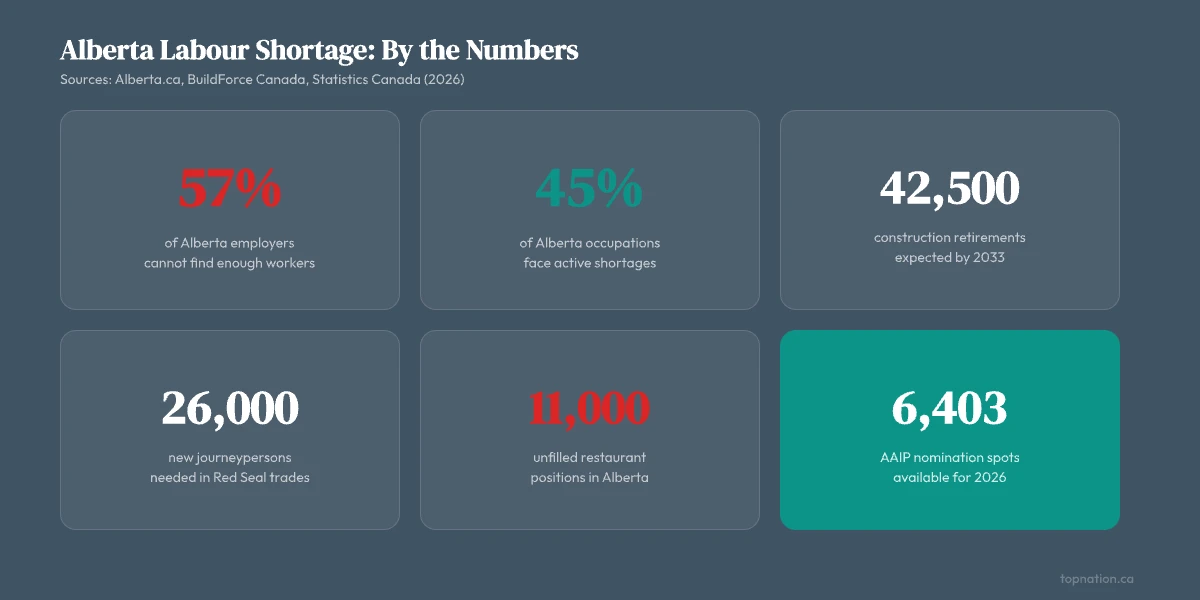
Alberta’s economy is booming. Construction cranes dot skylines from Calgary to Fort McMurray. Restaurants are booking out weeks in advance. Auto shops have three-week wait times for basic service. And yet, behind every one of these success stories is a business owner staring at empty positions they cannot fill. According to Alberta’s Short-Term Employment Forecast, 45% of all provincial occupations are expected to face notable or mild labour shortages through 2026. That is 232 out of 515 tracked occupations — and for employers on the ground, the numbers feel even worse.
This is not a temporary post-pandemic blip. This is a structural workforce crisis driven by retirements, population growth that outpaces labour supply, and a national immigration system that was not built for speed. If you run a business in Alberta, the labour shortage is already affecting your bottom line. The question is no longer whether to act — it is how fast you can move.
Alberta’s Workforce by the Numbers
The scale of Alberta’s labour shortage becomes clear when you look at the data from multiple angles. Every major source — Statistics Canada, the Government of Alberta, BuildForce Canada, and the Canadian Apprenticeship Forum — points in the same direction: demand for workers is growing faster than the province can supply them domestically.
Here are the numbers that matter most for employers in 2026.
| Metric | Stat | Source |
|---|---|---|
| Occupations Facing Shortages | 232 of 515 (45%) | Alberta Short-Term Employment Forecast 2024-2026 (PDF) |
| New Journeypersons Needed | 26,000 by 2026 | Canadian Apprenticeship Forum |
| New Apprentices Needed (Top 15 Red Seal Trades) | 51,000 by 2026 | Canadian Apprenticeship Forum |
| Construction Retirements by 2033 | 42,500 workers (23% of workforce) | BuildForce Canada |
| Construction Recruiting Gap by 2033 | 22,000 additional workers needed | BuildForce Canada |
| Unfilled Restaurant Positions (Province-wide) | 11,000 open positions | Restaurants Canada |
| Hiring Managers Reporting Difficulty | 82%+ nationally | Robert Half 2025 Survey |
| Alberta Population (July 1, 2025) | 5,029,346 (fastest-growing province, 14 consecutive quarters) | Statistics Canada, Q4 2025 population estimates |
That final row is the paradox at the heart of Alberta’s labour crisis. The province is growing faster than anywhere else in Canada — leading interprovincial migration for fourteen consecutive quarters as of late 2025. However, this population growth is not translating into filled positions. Newcomers tend to be younger and take time to integrate into the workforce. Meanwhile, experienced workers in trades, healthcare, and hospitality continue to retire at a pace the incoming labour pool cannot match.
In the fourth quarter of 2025, Alberta recorded a net interprovincial migration gain of 3,684 people — down from 4,993 in the same quarter of 2024. The trend line is slowing. At the same time, Canada’s total non-permanent resident population fell by 171,296 between October 2025 and January 2026 as federal immigration policies tightened. For Alberta employers counting on a steady flow of new workers, the math is not encouraging.
The bottom line: Alberta needs workers, and the domestic pipeline is not large enough to deliver them at the rate employers require.
The Hardest-Hit Industries in Alberta
Not every sector is affected equally. Some industries face vacancy rates that threaten their ability to operate, while others deal with chronic understaffing that erodes quality, safety, and profitability over time. Here is where the shortage hits hardest.
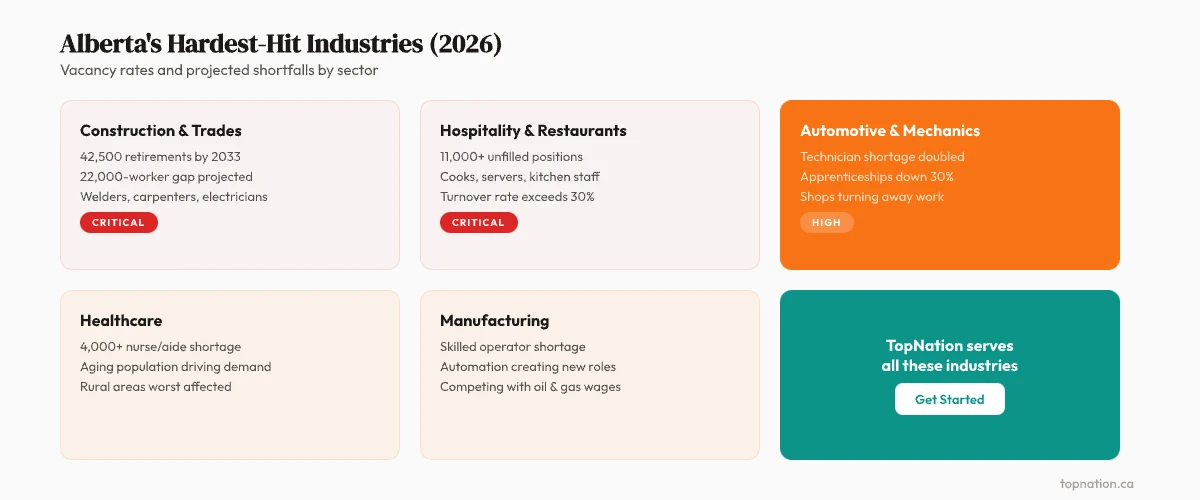
| Industry | Estimated Vacancy Pressure | Avg. Time to Fill Roles | Primary Impact |
|---|---|---|---|
| Construction & Skilled Trades | Critical — 22,000-worker gap by 2033 | 60-120+ days | Project delays, cost overruns |
| Hospitality & Restaurants | Severe — 11,000 unfilled positions | 45-90 days | Reduced hours, closed sections |
| Automotive & Mechanics | High — retirement outpacing new entrants | 60-90 days | Empty service bays, lost revenue |
| Healthcare | Critical — 4,000+ nurse shortage forecast | 90-180 days | Wait times, burnout, service cuts |
| Manufacturing | High — steady growth, flat workforce | 45-90 days | Missed production targets |
| Maintenance & Facilities | Moderate-High — consistent domestic shortfall | 30-60 days | Deferred maintenance, safety risks |
Construction and Skilled Trades
Construction is the sector where Alberta’s labour shortage is most acute and most consequential. According to BuildForce Canada, the province will need to replace an estimated 42,500 construction workers — 23% of its entire 2023 labour force — who are expected to retire by 2033. While approximately 41,100 new workers under age 30 are projected to enter the industry from the local population, growth-driven hiring needs push the total recruiting gap to roughly 22,000 additional workers.
The shortage is not hypothetical. It is showing up on job sites right now. Welders, electricians, millwrights, heavy equipment operators, carpenters, and concrete finishers are all classified as priority shortage occupations. Major infrastructure projects across the province — from the Trans Mountain expansion to municipal transit builds — are competing for the same shrinking pool of qualified tradespeople.
Making matters worse, new registrations in Alberta’s 25 largest construction trade programs declined by 57% between 2014 and 2019. Even though apprenticeship numbers have rebounded somewhat since then, the gap created during that five-year decline will take a generation to close through domestic training alone.
If you are a construction employer watching project timelines slip, TopNation places skilled tradespeople in Alberta in as little as 6 weeks →
Hospitality and Restaurants
Alberta’s hospitality sector has made progress since the worst of the post-pandemic staffing crisis, but the recovery is uneven and incomplete. As of mid-2025, 11,000 restaurant positions remained unfilled across the province, according to Restaurants Canada. The accommodation and food services sector added 8,500 jobs between April 2024 and April 2025 — a positive sign, but one that barely scratches the surface of total demand.
In urban centres like Calgary, staffing levels have improved. In rural areas and resort communities like the Bow Valley, the shortage remains severe. Housing costs are a compounding factor — the average asking rent for a one-bedroom apartment in Canmore reached $2,401 per month in early 2025, pricing out the very workers that hotels and restaurants need.
Cooks, line cooks, food service supervisors, housekeeping staff, and front-of-house workers are the most consistently difficult positions to fill. For restaurant owners running skeleton crews, every unfilled position means reduced hours, closed dining sections, and customers lost to competitors who managed to staff up.
International hiring has become the primary strategy for hospitality employers who cannot afford to wait. See how Alberta restaurants are filling kitchen positions in 6 weeks →
Automotive and Mechanics
The automotive service industry in Alberta faces a shortage that is quieter than construction or hospitality but equally damaging to the businesses affected. Automotive service technicians, truck and bus mechanics, and mechanical repairers (NOC 72410) are in steady demand, with the retirement rate outpacing new entrants into the trade.
Between January 21 and March 15, 2026, 181 job postings for automotive service technicians were collected in Alberta alone — and that number represents only the positions formally advertised. Many independent shops and dealerships recruit through word of mouth and still come up empty.
The economics are straightforward: an empty service bay generates zero revenue but still costs money in rent, insurance, and equipment depreciation. When a shop with six bays can only staff four, it loses a third of its earning capacity every single day. Rising vehicle prices and inflation are pushing consumers toward maintenance and repair rather than replacement, which increases demand for mechanics at precisely the moment supply is contracting.
Maintenance and Facilities
Building maintenance workers, industrial cleaners, janitors, and facilities management staff may not generate headlines, but they are essential to the operation of commercial real estate, hospitals, schools, manufacturing plants, and public infrastructure. These roles are consistently difficult to fill domestically because they compete with higher-paying construction and trades positions for the same labour pool.
For property management companies and facility operators, understaffing in maintenance leads to deferred repairs, safety hazards, tenant complaints, and regulatory risk. The shortage is particularly acute in northern Alberta, where the combination of remote locations and harsh working conditions makes domestic recruitment even harder.
Healthcare
Healthcare is Alberta’s most publicized shortage — and for good reason. The province’s job market forecasts identify registered nurses, registered psychiatric nurses, nurse aides, orderlies, and patient service associates among occupations with projected shortages exceeding 4,000 workers. Health care and social assistance employment grew by 10.1% (+34,300) from January 2025 to January 2026, but demand is growing even faster as Alberta’s population expands and ages.
Healthcare hiring involves additional credential recognition steps compared to other industries. However, the Alberta Advantage Immigration Program (AAIP) has designated healthcare as a 2026 priority sector, with dedicated Express Entry pathways for health care professionals that accelerate the path to permanent residence.
Manufacturing
Machine operators, industrial mechanics, quality control technicians, and production supervisors are all in short supply across Alberta’s manufacturing sector. The province’s manufacturing output has grown steadily, supported by energy-sector demand and diversification into food processing, petrochemicals, and advanced materials. The workforce has not kept pace.
Manufacturing is one of the AAIP’s designated priority sectors for 2026, which gives employers in this industry an advantage when sponsoring international workers for permanent residence — a critical retention tool that we will cover in detail later in this article.
Why Domestic Recruitment Alone Is Not Enough
If domestic hiring could solve Alberta’s workforce shortage, it would have done so already. Wages have risen, signing bonuses have appeared in industries that never offered them before, and training programs are expanding. These measures help at the margins. They do not close the structural gap. Here is why.
The Retirement Wave Is Accelerating
Baby boomers are leaving the workforce at a rate that younger generations cannot replace through natural entry. In construction alone, 23% of the workforce is expected to retire by 2033. The pattern is similar in automotive trades, healthcare, and manufacturing. For every experienced welder or nurse who retires, the province needs a fully trained replacement — and the training pipeline takes years, not months.
Fewer Young Canadians Are Entering Trades
Despite government efforts to promote skilled trades, enrolment in trade programs has not recovered to pre-2014 levels in many disciplines. The cultural preference for university education persists, and many young Canadians view trades work as a fallback rather than a first choice. Alberta saw a 57% decline in apprenticeship registrations across its largest trade programs between 2014 and 2019. The rebound since then has been real but insufficient to close the gap created during that contraction.
Interprovincial Migration Is Slowing
Alberta has led interprovincial migration for fourteen consecutive quarters, attracting workers from Ontario, British Columbia, and Atlantic Canada. However, the pace is decelerating. The province gained 3,684 net interprovincial migrants in Q4 2025, down from 4,993 in Q4 2024. As housing costs rise in Alberta and economic conditions improve in competing provinces, the flow of domestic workers into Alberta is becoming less reliable.
Competition from Other Provinces
Alberta is not the only province facing shortages. British Columbia, Ontario, and Saskatchewan are all competing for the same limited domestic workforce in construction, healthcare, and hospitality. When every province is fishing in the same pond, nobody catches enough.
Remote Work Is Pulling People Away from Physical Jobs
The rise of remote work has given knowledge workers options that did not exist five years ago. Canadians who might have taken an in-person supervisory or administrative role in hospitality, manufacturing, or construction can now earn comparable wages from home in customer service, tech support, or data entry. This shift does not directly reduce the supply of tradespeople, but it drains the broader labour pool that physical industries draw from for supervisory, clerical, and entry-level positions.
The cumulative effect of these five forces is clear. Domestic recruitment — higher wages, better benefits, more training — is necessary but not sufficient. For Alberta employers who need workers now, the only strategy that closes the gap at the required speed is international hiring.
The Real Cost of Unfilled Positions
An empty position on your organizational chart is not just an HR problem. It is a financial drain that compounds every week it remains unfilled. Most employers underestimate the true cost because they only think about the salary they are not paying. The actual damage runs much deeper.
Revenue Lost Per Vacancy
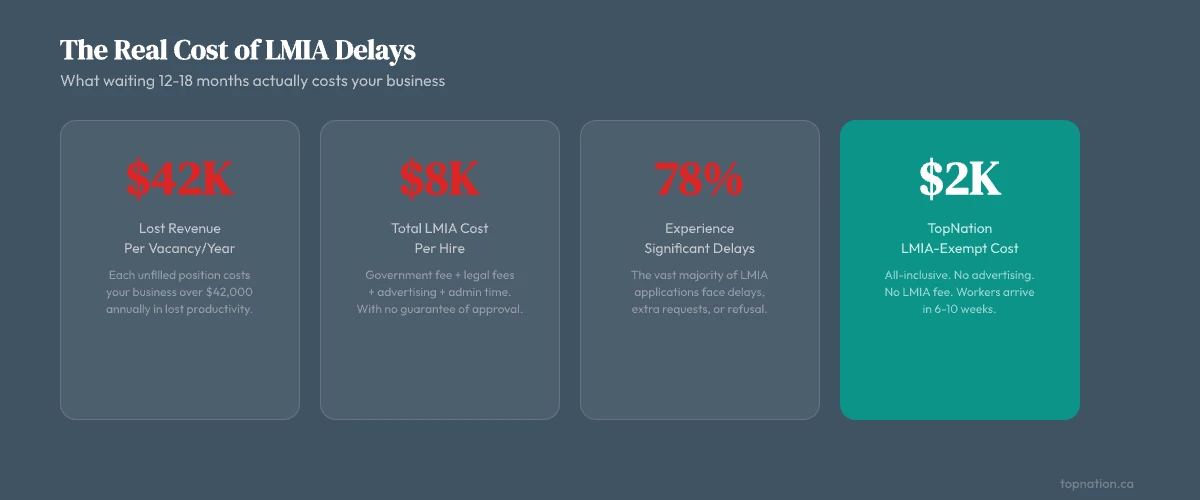
Industry estimates place the average annual cost of an unfilled position in Canada at approximately $42,000 when you factor in lost productivity, delayed work, and revenue that walks out the door. For skilled trades positions that directly generate billable work — mechanics, electricians, welders — the number is often higher because the revenue loss is directly measurable. An empty service bay at an auto shop losing $500 to $800 per day adds up to $130,000 to $208,000 per year in foregone revenue for a single position.
Lost Contracts and Turned-Away Customers
Construction companies that cannot staff a project lose the bid entirely. Restaurants that close sections during peak hours turn away customers who go to competitors and may never come back. Manufacturing plants that miss production deadlines pay contractual penalties and damage long-term client relationships. These are not theoretical costs — they are invoices that never get sent and contracts that go to someone else.
Overtime Costs and Staff Burnout
When positions go unfilled, the work does not disappear. It shifts to the employees who remain. Overtime wages add 50% or more to your labour costs per hour worked. More importantly, sustained overtime leads to burnout, which leads to turnover among your remaining staff — creating a vicious cycle where one vacancy becomes two, then three.
According to workforce research, employees who regularly work overtime are 61% more likely to experience workplace injury and significantly more likely to quit within 12 months. Every unfilled position is a retention risk for the staff you still have.
Quality and Safety Risks
Skeleton crews cut corners — not because they want to, but because there are not enough people to do the work properly. In construction, understaffing increases the risk of accidents and code violations. In restaurants, it increases the risk of food safety incidents. In healthcare, it increases the risk of medical errors. In manufacturing, it increases the risk of product defects. Every one of these outcomes carries potential liability that dwarfs the cost of hiring.
Reputation Damage
Delayed projects erode your reputation with clients. Inconsistent service erodes your reputation with customers. High turnover erodes your reputation as an employer. In a tight labour market, reputation matters more than ever because word travels fast. The employers known for being perpetually short-staffed are the last ones candidates want to work for — domestic or international.
The calculation every Alberta employer should make
Take the number of positions you cannot fill. Multiply by $42,000. That is the minimum annual cost of inaction. Now compare that to the cost of filling those positions through international hiring — typically under $2,000 per hire through LMIA-exempt pathways, with workers arriving in six to ten weeks. The math is not close. For a detailed breakdown of what international hiring costs versus what vacancies cost your business, read our complete guide to LMIA-exempt hiring →
How Alberta Employers Are Using Immigration to Fill the Gap
Forward-thinking Alberta employers are not waiting for the domestic labour market to fix itself. They are building immigration into their workforce strategy — and the federal and provincial governments are providing more pathways to do so than at any point in Canadian history.
Here are the three primary channels Alberta employers are using in 2026.
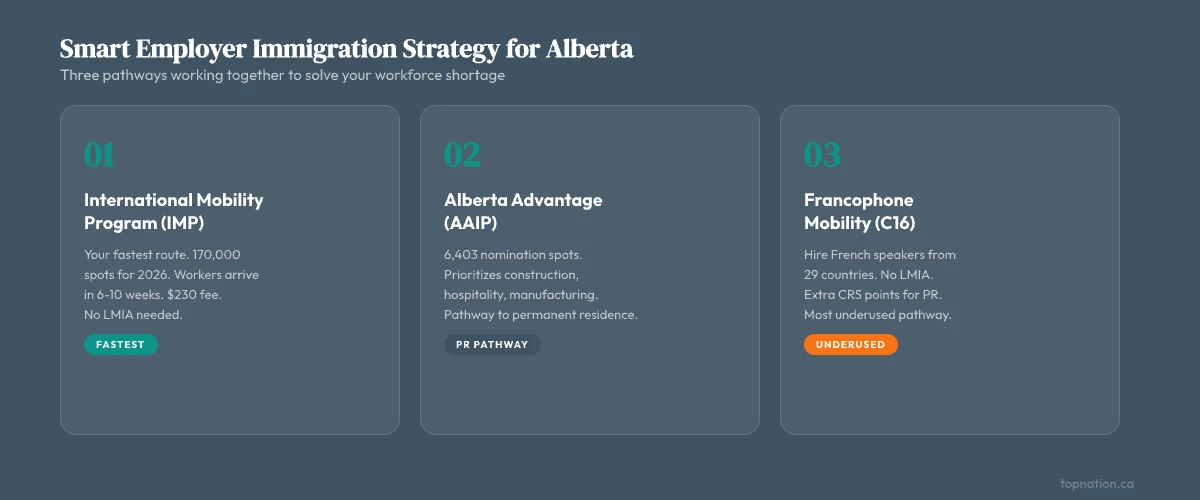
The International Mobility Program (IMP)
The International Mobility Program allows Canadian employers to hire foreign workers without a Labour Market Impact Assessment (LMIA). The federal government’s 2025-2027 Immigration Levels Plan allocates 170,000 LMIA-exempt IMP work-permit admissions for 2026 — down from 285,750 in 2025, but still nearly triple the 60,000 spots now available under the traditional LMIA-based Temporary Foreign Worker Program (itself cut 27% from the 2025 target of 82,000). For Alberta employers, LMIA-exempt pathways remain the fastest and largest route by a wide margin.
The message from Ottawa is clear: the future of employer-driven immigration runs through the IMP. The employer compliance fee is $230 per position (compared to $1,000 for LMIA), there is no mandatory advertising period, and processing takes weeks rather than months (see the current LMIA vs LMIA-exempt processing times for 2026). For employers filling multiple positions, the savings in time, cost, and administrative burden are substantial.
For a step-by-step walkthrough of how the IMP works from an employer’s perspective, see our complete LMIA-exempt hiring guide →
The Alberta Advantage Immigration Program (AAIP)
Alberta’s provincial nominee program — the AAIP — provides a pathway from temporary work permit to permanent residence. The federal government granted Alberta 6,403 nomination spots for 2026, with plans to more than double that allocation to 14,000 by 2027. This is the single most impactful workforce measure in the provincial budget.
For employers, the AAIP is primarily a retention tool. Workers who receive a provincial nomination have a clear path to permanent residence, which means they are far more likely to stay with the employer who brought them to Canada. The program prioritizes occupations in healthcare, technology, construction, manufacturing, aviation, agriculture, and tourism — aligning directly with the industries experiencing the worst shortages.
We break down each AAIP stream in the next section.
Francophone Mobility
This is one of the most underused immigration pathways in Alberta. Under the C16 Francophone Mobility exemption, any employer outside Quebec can hire a French-speaking foreign worker without an LMIA. The worker must demonstrate French proficiency, and the position must be outside Quebec. That is the core requirement.
Alberta has a growing Francophone community, and the federal government has committed to increasing the proportion of French-speaking immigrants outside Quebec to 6% of all admissions. This policy priority means Francophone Mobility is expanding, not contracting. For Alberta employers, it opens access to skilled workers from 29 Francophone countries — many with strong training in hospitality, construction, automotive trades, and manufacturing.
How These Programs Work Together
The real power of Alberta’s immigration framework comes from combining these pathways. Here is a common scenario: an employer hires a French-speaking cook from Morocco through Francophone Mobility (LMIA-exempt, six to ten weeks, $230 government fee). The worker arrives and begins contributing immediately. After gaining Canadian work experience, the worker applies for permanent residence through the AAIP’s Tourism and Hospitality Stream. The employer retains a trained, experienced employee long-term.
This is not a loophole or a workaround. It is exactly how the system was designed to function. Get a free workforce plan that maps the right pathway for your business →
The AAIP: Alberta’s Provincial Nominee Program
The Alberta Advantage Immigration Program is the province’s tool for attracting and retaining workers in industries that need them most. Understanding which stream applies to your situation is essential for building a workforce strategy that lasts beyond the first work permit.
Alberta Opportunity Stream
This is the largest stream, accounting for 53.5% of all AAIP nominations in 2026 — a total allocation of 3,425 spots. It is designed for foreign workers who are already living and working in Alberta with a valid work permit and a job offer from an Alberta employer.
To qualify, the candidate must meet minimum work experience, language, and education requirements. The position must be in an eligible occupation, and the employer must demonstrate that the offer is genuine and meets prevailing wage standards. For employers who have already hired a worker through the IMP or another work permit pathway, the Opportunity Stream is the natural next step toward permanent residence.
Alberta Express Entry Stream
This stream targets candidates who already have a profile in IRCC’s Express Entry pool and whose skills align with Alberta’s economic priorities. The province issues invitations to apply based on occupation, work experience, and alignment with priority sectors.
In 2026, the Express Entry Stream includes dedicated pathways for healthcare professionals, technology workers, and police occupations. For employers in these sectors, sponsoring a candidate who already has an Express Entry profile can significantly accelerate the path to permanent residence — often within six to eight months of nomination.
Rural Renewal Stream
Rural Alberta employers face an additional layer of difficulty: even when they can find workers willing to relocate, retention in smaller communities is challenging. The Rural Renewal Stream addresses this by allowing designated rural communities to recruit and retain newcomers specifically for their local labour needs.
Communities must apply for designation under the program, and once designated, they can endorse candidates for AAIP nomination. For employers in towns and counties outside the Edmonton-Calgary corridor, this stream offers a structured approach to building a stable workforce in areas that domestic recruitment consistently overlooks.
Tourism and Hospitality Stream
This stream is purpose-built for Alberta’s hospitality sector. Qualified candidates who live and work in Alberta with a full-time job offer from a tourism or hospitality employer can apply for nomination. It is the natural companion to Francophone Mobility for restaurant and hotel employers — the first program gets the worker here fast, and this stream provides the path to keeping them permanently.
How the AAIP Connects to Federal PR Pathways
A provincial nomination through the AAIP adds 600 Comprehensive Ranking System (CRS) points to a candidate’s Express Entry profile. Since the typical CRS cutoff for an invitation to apply for permanent residence sits between 470 and 530 points, a provincial nomination virtually guarantees an invitation. This is the mechanism that turns a temporary work permit into permanent residence — and it is the reason TopNation includes PR pathway planning in every placement.
2026 Priority Occupations
The AAIP has announced that 2026 draws and nominations within its worker streams will prioritize occupations in these key sectors:
Healthcare — registered nurses, nurse aides, lab technicians, personal support workers
Technology — software developers, IT analysts, cybersecurity specialists
Construction — carpenters, electricians, welders, heavy equipment operators
Manufacturing — machine operators, industrial mechanics, quality control technicians
Aviation — aircraft mechanics, avionics technicians
Agriculture — farm supervisors, agricultural equipment technicians
Rural Renewal — occupations designated by approved rural communities
If your business operates in any of these sectors, you have a structural advantage in 2026. The AAIP is actively looking for employers like you. Talk to TopNation about your eligibility →
What Smart Employers Are Doing Right Now
The Alberta employers who will come out of the labour shortage in the strongest position are the ones taking action today — not waiting for the market to self-correct. Here is what the most strategic employers are doing differently.
Building Immigration Into Their Workforce Strategy
Reactive hiring — posting a job and hoping someone applies — does not work in a market with 45% of occupations in shortage. Smart employers treat immigration as a permanent component of their workforce strategy, not a one-time fix. They identify which positions are chronically difficult to fill domestically, map those positions to immigration pathways, and build a pipeline that delivers candidates consistently.
This means having an immigration partner on retainer the same way you have an accountant or a lawyer. It means budgeting for international recruitment annually, not scrambling when a position has been empty for three months.
Partnering with Immigration Consultancies
The immigration system is complex, and it changes frequently. Employers who try to manage the process internally often make costly mistakes — wrong NOC codes, incomplete applications, missed deadlines, or compliance gaps that invite audits. Specialist consultancies like TopNation’s Edmonton-based CICC-regulated team handle the entire process: candidate sourcing, pathway selection, document preparation, employer portal submissions, work permit processing, and compliance management for the full six-year audit window.
The cost of professional support is a fraction of the cost of a single unfilled position. More importantly, it eliminates the timeline delays that come from learning the system through trial and error.
Planning for 2027 and Beyond
The AAIP’s nomination allocation is expected to grow from 6,403 in 2026 to 14,000 by 2027. Employers who begin building their immigration pipeline now will be positioned to take advantage of that expanded capacity. Those who wait until 2027 to start will be competing with every other employer who had the same idea.
Additionally, workers hired through immigration pathways today accumulate the Canadian work experience needed to qualify for permanent residence through the AAIP or Express Entry. An employee who arrives in mid-2026 could be on track for PR nomination by 2027 — locking in your investment in training and integration for the long term.
Retention Through Permanent Residence Pathways
The most effective retention strategy is not a higher wage or a signing bonus. It is a clear path to permanent residence. Workers who see that their employer is invested in their long-term future in Canada are far more likely to stay. TopNation’s clients achieve a 94% retention rate because every placement includes a PR pathway plan from day one.
Contrast that with the cost of turnover: recruiting, hiring, training, and losing a worker costs an estimated 50% to 200% of the position’s annual salary depending on the role. Building retention into your hiring strategy from the start is not altruism — it is sound financial management.
Frequently Asked Questions
How bad is the labour shortage in Alberta?
Alberta’s labour shortage is structural and widespread. According to the provincial government’s Short-Term Employment Forecast, 45% of all tracked occupations (232 out of 515) are expected to face notable or mild shortages through 2026. The hardest-hit sectors are construction, healthcare, hospitality, automotive, and manufacturing. BuildForce Canada projects a 22,000-worker recruiting gap in construction alone by 2033. Nationally, over 82% of hiring managers report difficulty finding skilled talent. For Alberta businesses, the shortage translates directly into lost revenue, delayed projects, and staff burnout.
Which Alberta industries have the worst shortages?
Construction and skilled trades face the most severe shortages, with 42,500 retirements expected by 2033 and a 22,000-worker gap even after accounting for new domestic entrants. Hospitality has 11,000 unfilled restaurant positions province-wide. Healthcare is projecting shortages of more than 4,000 nurses and nurse aides. Automotive trades are losing experienced technicians to retirement faster than new apprentices are entering the field. Manufacturing is growing but cannot find enough machine operators, industrial mechanics, and production staff to meet demand.
Can I hire foreign workers to fill positions in Alberta?
Yes. Canadian employers have multiple legal pathways to hire foreign workers, including the International Mobility Program (LMIA-exempt, 170,000 spots nationally in 2026), the traditional LMIA-based Temporary Foreign Worker Program, and provincial nominee programs like the AAIP. For most Alberta employers, the fastest and most cost-effective route is through LMIA-exempt pathways, where the government fee is $230 per position (versus $1,000 for LMIA), no advertising is required, and processing takes weeks rather than months. Request a free workforce assessment to find out which pathway fits your situation →
How fast can I get workers through immigration?
Through LMIA-exempt pathways like the International Mobility Program, the typical timeline from engagement to a worker starting on the job is six to ten weeks. This includes the Employer Portal submission, work permit processing, and travel arrangements. By comparison, the traditional LMIA route takes eight to twelve months on average. If your candidate is already in Canada on valid status, the timeline can be shorter. TopNation’s average placement time is six weeks. Contact our team for a timeline specific to your industry and location →
What is the AAIP?
The Alberta Advantage Immigration Program (AAIP) is Alberta’s provincial nominee program. It allows the province to nominate foreign workers for permanent residence based on Alberta’s economic needs. The federal government allocated 6,403 nomination spots to Alberta for 2026, with plans to increase that to 14,000 by 2027. The AAIP has multiple streams, including the Alberta Opportunity Stream, Express Entry Stream, Rural Renewal Stream, and Tourism and Hospitality Stream. For employers, the AAIP is primarily a retention tool — it gives your international hires a clear path to staying in Canada permanently, which dramatically reduces turnover.
Does this work for small businesses?
Absolutely. LMIA-exempt pathways and the AAIP are available to businesses of all sizes. You do not need to be a large corporation to sponsor a foreign worker. Many of TopNation’s clients are independent restaurants, small construction firms, family-owned auto shops, and regional manufacturers with five to fifty employees. The process is the same regardless of company size: submit an offer of employment through the Employer Portal, pay the $230 compliance fee, and the worker applies for a work permit. Small businesses often benefit the most because a single unfilled position represents a larger percentage of their total capacity. Get your free workforce plan — it takes 30 minutes and costs nothing →
WHY EMPLOYERS CHOOSE TOPNATION
500+
Workers Placed
94%
Retention Rate
6 Weeks
Average Placement
Don’t let worker shortages hold your business back. TopNation places skilled workers in Alberta businesses in 6 weeks.
Immigration Services Across Alberta
TopNation's RCIC-licensed consultants assist clients throughout Alberta — not just Edmonton. Whether you are in Fort McMurray, Red Deer, Calgary, or a rural community, we handle work permits, permanent residence, and employer compliance from start to finish. Book a consultation →
Hiring Francophone Workers in Alberta?
Canada's Francophone Mobility program (C16) lets Alberta employers hire French-speaking workers without an LMIA — government fee just $230, workers arrive in 6 weeks. See our specialized program for Francophone cooks and chefs, or explore all Francophone immigration pathways to Alberta.