Landmark Citizenship Law Update
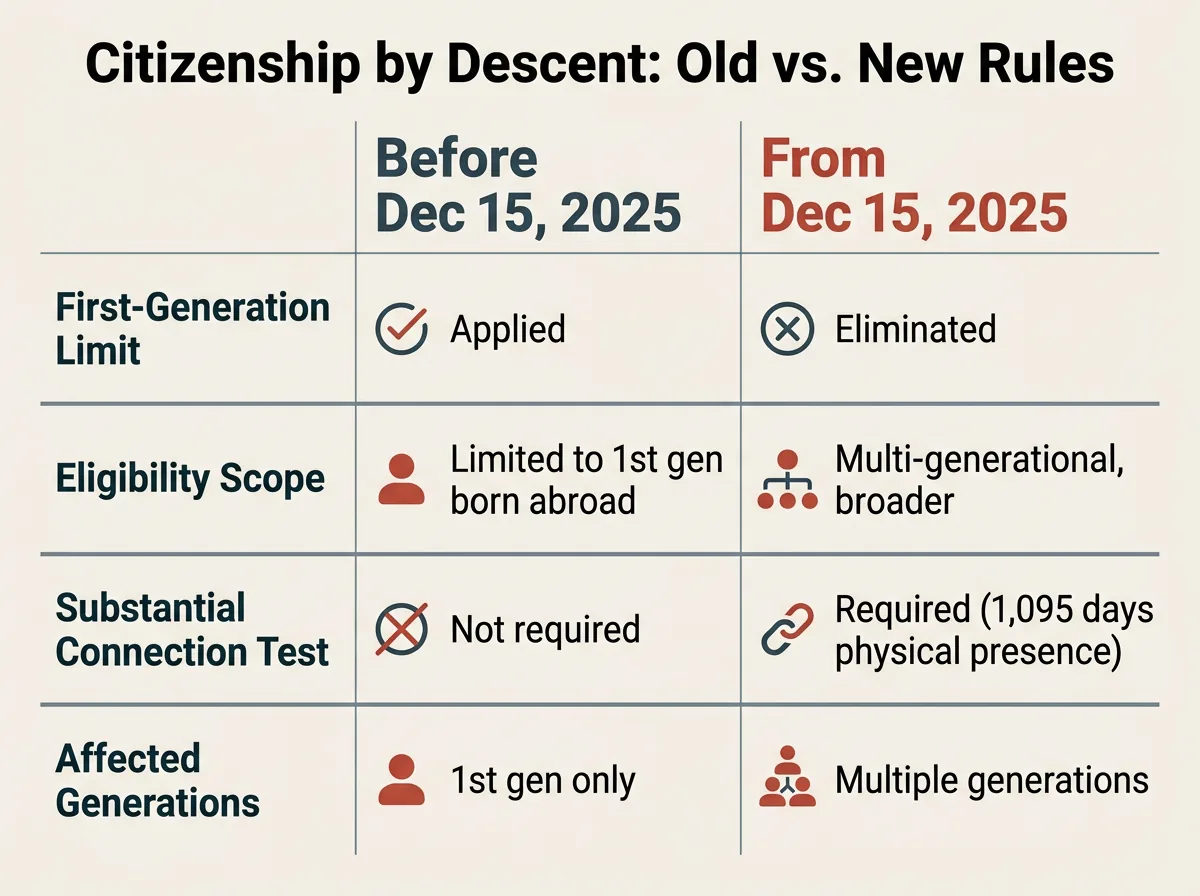
As of December 15, 2025, Canada has officially eliminated the ‘first-generation limit’ for citizenship by descent. This legislative change introduces a new pathway for individuals born abroad to a Canadian parent who was also born abroad, provided the parent can demonstrate a ‘substantial connection’ to Canada through at least 1,095 days of physical presence.
CITIZENSHIP ACT UPDATE — DECEMBER 2025
A significant barrier to Canadian citizenship has been removed. For years, a rule known as the “first-generation limit” prevented many individuals born abroad from claiming the Canadian citizenship of their parents if those parents were also born outside of Canada. Following a landmark court ruling and subsequent legislative action, this limitation is now a thing of the past. This guide provides an authoritative breakdown of this monumental change to the Citizenship Act, explaining the old rules, the new eligibility criteria, the critical ‘substantial connection’ test, and the precise process for applying for a Proof of Citizenship Certificate. This information is essential for Canadian expatriates, their children, and anyone with Canadian ancestry seeking to understand their newfound rights.

Understanding the Landmark Change to Canadian Citizenship by Descent
Canadian citizenship law is built on two core principles: jus soli (right of soil), which grants citizenship to nearly everyone born on Canadian territory, and jus sanguinis (right of blood), which allows citizenship to be passed down from a parent to a child born abroad. The recent amendment to the Citizenship Act represents the most significant shift in the application of jus sanguinis in over a decade.
In 2009, the Canadian government introduced the first-generation limit. The stated goal was to prevent citizenship from being passed down through endless generations of families with no meaningful connection to Canada. While the intention was to protect the value of Canadian citizenship, the rule had the unintended consequence of disenfranchising thousands of individuals with genuine ties to the country, whose only ‘fault’ was being the second or subsequent generation born abroad. This created complex family situations where some siblings might be Canadian citizens while others were not, based solely on their parent’s place of birth.
Years of advocacy and legal challenges culminated in a 2023 Ontario Superior Court of Justice ruling that declared the first-generation limit unconstitutional. The court found that it created a discriminatory two-tier system of citizenship. In response, the Government of Canada passed legislation in late 2025 to repeal the limit, effective December 15, 2025. This change does not grant automatic citizenship to everyone; instead, it replaces the arbitrary generational cut-off with a more nuanced and fair requirement: the ‘substantial connection’ test.
The Old Rule (Pre-December 2025): What Was the First-Generation Limit?
To fully appreciate the impact of the new law, it is crucial to understand the restrictive framework it replaced. The first-generation limit, in effect from April 17, 2009, to December 14, 2025, created a clear but often harsh dividing line for citizenship by descent.
Defining the First Generation Born Abroad
Under the old rules, you were considered a ‘first-generation’ Canadian born abroad if you were born outside Canada to at least one parent who was a Canadian citizen at the time of your birth, and that Canadian parent was either born in Canada or became a naturalized Canadian citizen. In this scenario, you automatically inherited Canadian citizenship. The transmission of citizenship was straightforward and did not depend on any connection your parent had to Canada beyond their own citizenship status.
The Citizenship Cut-Off Point
The chain of citizenship was severed at this point. If you were a Canadian citizen as a ‘first-generation born abroad,’ you could not automatically pass on your Canadian citizenship to your own children if they were also born outside Canada. Your child, the ‘second generation born abroad,’ was not eligible for citizenship by descent. This created a permanent end to the Canadian lineage for families living internationally, regardless of how connected they felt to Canada or how much time they had spent in the country.
Case Scenario: The Pre-2025 Limitation in Practice
Consider the example of the Chen family. David was born in Vancouver, making him a Canadian citizen by birth. He moved to Hong Kong for work, where he had a daughter, Emily. Emily was born a Canadian citizen—the first generation born abroad. Emily remained in Hong Kong, and years later, had a son named Leo. Under the old law, Leo was not a Canadian citizen. Emily’s Canadian citizenship could not be passed down to him because he was the second generation born abroad. The family’s Canadian connection, from a legal perspective, ended with Leo, despite his grandfather being born in Canada and his mother being a proud Canadian citizen.
Limited Exceptions Under the Old Law
The previous legislation contained very few exceptions to this rule. The primary exception was for children of Canadian parents working abroad as Crown servants—essentially, government employees, such as diplomats or members of the Canadian Armed Forces. In these specific cases, citizenship could be passed down to the second generation. For nearly everyone else, the cut-off was absolute.
The New Law (Post-December 2025): Who Is Now Eligible?
The legislation enacted in late 2025 fundamentally reshapes the landscape for citizenship by descent. It repeals the 2009 amendment, effectively erasing the concept of a first-generation limit and creating a new, more equitable pathway to citizenship for those born abroad.
The End of the Arbitrary Generational Limit
The most crucial change is the complete removal of the first-generation cut-off. Citizenship can now, in theory, be passed down through multiple generations born outside of Canada. The determining factor is no longer *which* generation you are, but whether your Canadian parent has a demonstrable, significant connection to Canada.
Introducing the ‘Substantial Connection’ Test
Instead of an automatic cut-off, the new law introduces a clear, objective standard: the ‘substantial connection’ test. To pass on citizenship to a child born abroad, a Canadian parent who was also born abroad must now prove that they have spent a significant amount of time physically present in Canada. This shifts the focus from an accident of birth geography to a tangible link to the country.
Who Benefits Most from This Change?
This legislative update opens the door to Canadian citizenship for several groups who were previously excluded. The primary beneficiaries are individuals born to a Canadian parent who was themselves born abroad. This includes people like Leo from our previous example. Others who may now be eligible include grandchildren of Canadian immigrants whose children were born abroad, and families who have lived internationally for multiple generations but have maintained strong ties to Canada, including spending significant time in the country.
Retroactive Application: A Second Chance at Citizenship
Critically, the new law is retroactive. This means it applies not only to children born after December 15, 2025, but also to anyone born before this date who would have been a citizen if these rules had always been in place. Individuals who were previously told they were not citizens because of the first-generation limit may now be eligible. They can apply for a Proof of Citizenship Certificate to have their status officially recognized, provided their Canadian parent meets the new substantial connection requirement.
Key Eligibility Requirement: The ‘Substantial Connection’ Test Explained
The cornerstone of the new citizenship law is the ‘substantial connection’ test. It is a precise, evidence-based requirement that replaces the previous arbitrary generational limit. Understanding its mechanics is essential for any potential applicant.
The 1,095-Day Physical Presence Rule
The legislation defines a ‘substantial connection’ in clear, numerical terms. The Canadian parent seeking to pass on citizenship must have accumulated at least 1,095 days of physical presence in Canada at any point before the birth of their child. This is the equivalent of three full years. This requirement ensures that the parent has a genuine, lived experience in Canada that forms the basis for the child’s citizenship claim.
How Physical Presence is Calculated
The calculation of these 1,095 days is cumulative, not consecutive. The Canadian parent does not need to have lived in Canada for three straight years. Every single day they were physically in Canada throughout their life—for any reason—counts toward the total. This includes time spent in Canada as a child, as a student on a study permit before becoming a citizen, as a visitor, or as a temporary worker. The individual’s immigration status during their time in Canada is irrelevant; only their physical presence matters for this calculation.
Proving Physical Presence: Primary Evidence
Immigration, Refugees and Citizenship Canada (IRCC) will require robust evidence to validate the 1,095 days. The strongest forms of proof are official documents that independently verify a person’s presence in Canada over time. These include:
- Canada Revenue Agency (CRA) Records: Notices of Assessment (NOAs) or T4 slips for multiple years are powerful evidence of residency and work.
- School Records: Official transcripts from Canadian elementary schools, high schools, colleges, or universities can establish presence for many years.
- Employment Records: Letters from Canadian employers detailing periods of employment, Records of Employment (ROEs), and official pay stubs.
- Provincial/Territorial Records: Records from provincial health authorities showing periods of coverage or official driving records.
Proving Physical Presence: Secondary and Supporting Evidence
In cases where primary evidence is sparse, a compelling application can be built using secondary evidence. While these documents carry less weight on their own, a large volume of consistent secondary evidence can be persuasive. Examples include:
- Residency Documents: Lease agreements, mortgage statements, property tax bills, and utility bills (hydro, gas, internet) in the parent’s name.
- Passport Stamps and Travel Records: While passport stamps show entry/exit, they don’t prove continuous presence. They are best used to supplement other evidence.
- Financial Records: Bank statements showing transactions in Canada.
- Sworn Affidavits: Legally sworn statements from credible individuals (family, friends, teachers, employers) who can attest to the parent’s presence in Canada during specific periods. These are considered the weakest form of evidence and should only be used to support stronger documentation.
| Evidence Tier | Examples | Weight with IRCC |
|---|---|---|
| Tier 1 (Primary) | CRA Notices of Assessment, Official School Transcripts, Provincial Health Records | Very High |
| Tier 2 (Strong Secondary) | Employment Letters, T4 Slips, Lease Agreements, University/College Records | High |
| Tier 3 (Supporting) | Utility Bills, Bank Statements, Passport Stamps, Affidavits | Moderate to Low |
How to Apply: A Step-by-Step Guide to Proving Your Citizenship
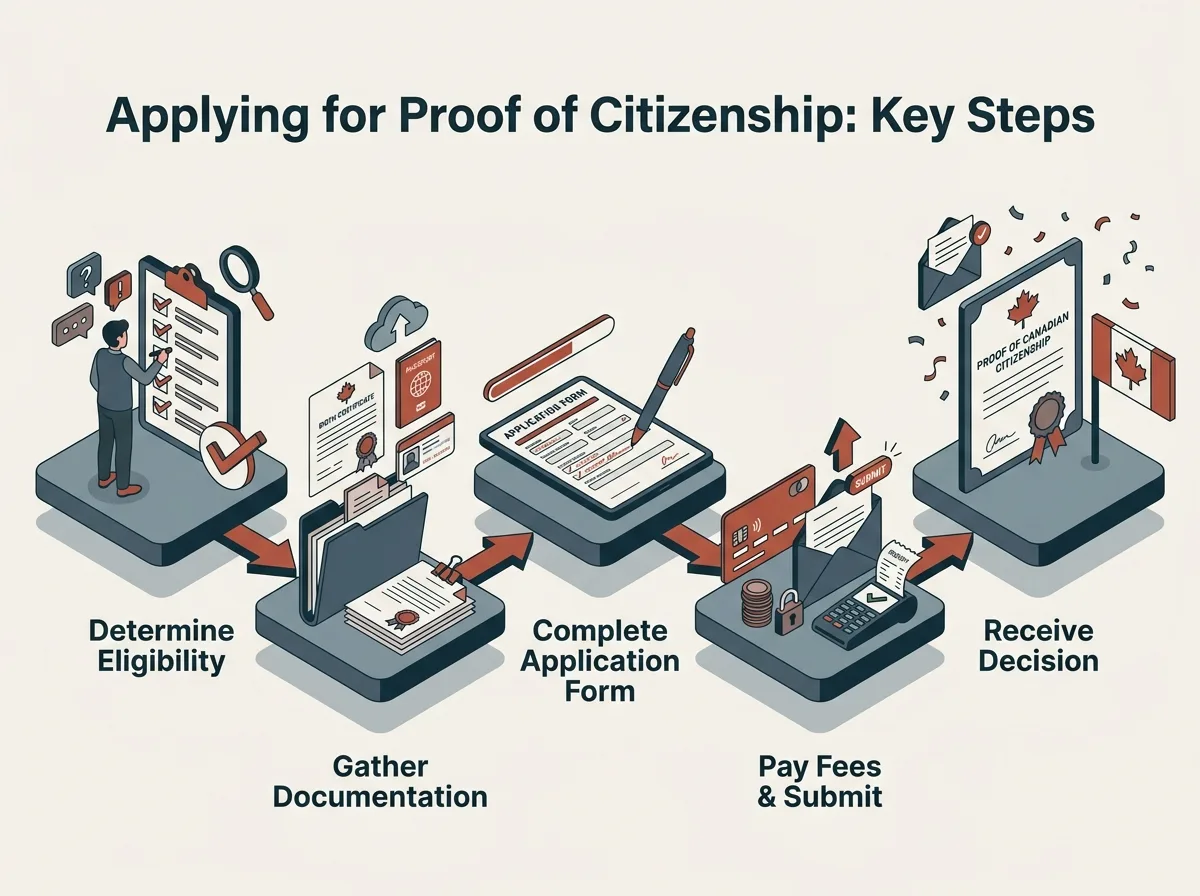
It is important to understand that under this new law, you are not ‘applying for citizenship’ in the same way a new immigrant would. If you meet the criteria, you are already considered a Canadian citizen by law. The application process is to obtain a Proof of Citizenship Certificate, the official document that recognizes and confirms your status. The burden of proof rests on the applicant to demonstrate their eligibility.
Step 1: Conduct a Preliminary Eligibility Assessment
Before gathering any documents, confirm your potential eligibility. You must be able to answer ‘yes’ to all of the following questions:
- Were you born outside of Canada?
- Was at least one of your biological or legal parents a Canadian citizen at the time of your birth?
- Was that Canadian parent also born outside of Canada?
- Can you gather sufficient evidence to prove that this Canadian parent was physically present in Canada for a cumulative total of at least 1,095 days before your birth?
If the answer to all four questions is yes, you have a strong basis for an application.
Step 2: Gather Your Core Identity Documents
The foundation of your application package will be your personal and your parent’s identity documents. This includes your original long-form birth certificate (which must list your parents’ names), your government-issued photo identification, and proof of your parent’s Canadian citizenship (such as their Canadian birth certificate, citizenship certificate, or card).
Step 3: Compile the ‘Substantial Connection’ Evidence Package
This is the most critical and labour-intensive part of the process. You must systematically collect and organize the documents that prove your parent’s 1,095 days of physical presence. Create a timeline of your parent’s life and match documents to each period they were in Canada. Use a combination of primary and secondary evidence to build a comprehensive and undeniable case. It is better to provide too much evidence than too little.
Step 4: Complete the Application for a Citizenship Certificate (Form CIT 0001)
The official application is done using the ‘Application for a Citizenship Certificate for Adults and Minors (Proof of Citizenship)’ form, also known as CIT 0001. This form must be filled out with extreme care and accuracy. Pay close attention to the sections that ask about your parent’s history and residency in Canada. Any inconsistencies between the form and your supporting documents can lead to delays or refusal.
Step 5: Pay the Government Processing Fees
All government applications require a processing fee. As of early 2026, the fee for a Proof of Citizenship Certificate is $75 CAD. This fee must be paid online through the IRCC portal, and you must include the payment receipt with your application package. Fees are subject to change, so always verify the current amount on the official IRCC website before submitting.
Step 6: Submit Your Complete Application Package
Once you have the completed form, all supporting documents, evidence of physical presence, and the fee receipt, you can submit your application. Most applications are now submitted through the IRCC online portal, which allows for faster transmission and easier tracking. Ensure all documents are scanned in high resolution. Keep digital and physical copies of everything you submit for your records.
Required Documentation: A Detailed Checklist
A successful application for a Proof of Citizenship Certificate hinges on a complete and well-organized documentation package. Missing or unclear documents are the most common cause of delays. Use this detailed checklist as a guide.
Category 1: Applicant’s Documents
- Completed Application Form (CIT 0001): Signed and dated.
- Long-Form Birth Certificate: Must show your full name, date and place of birth, and the full names of your parents. A short-form certificate is usually not sufficient.
- Two Pieces of Personal Identification: At least one must be a government-issued photo ID, such as a passport or driver’s license.
- Two Citizenship Photos: These must meet IRCC’s strict specifications regarding size, background colour, and facial expression. The name of the photo studio, the date, and your name must be on the back of one photo.
- Proof of Fee Payment: The official receipt from the IRCC online payment portal.
Category 2: Canadian Parent’s Documents
- Proof of Canadian Citizenship: This is a critical document. You must provide one of the following for the parent you are claiming citizenship through: a provincial or territorial birth certificate (if they were born in Canada), a Canadian citizenship certificate or card, or their Certificate of Naturalization.
- Parent’s Birth Certificate: To establish the parental link.
- Parent’s Marriage Certificate (if applicable): Required if your parents were married and your parent’s name changed.
Category 3: Evidence of Parent’s Substantial Connection (1,095 Days)
This is where you must be thorough. Organize the evidence chronologically to present a clear picture to the immigration officer.
- Official Government & School Records: CRA tax documents (NOAs) for multiple years, official transcripts from all Canadian educational institutions attended (from kindergarten to university), provincial health insurance statements.
- Employment and Financial Records: Letters from employers on company letterhead confirming dates of employment, pay stubs covering extended periods, Records of Employment (ROEs), and Canadian bank statements showing regular activity.
- Residency and Travel Records: A collection of apartment leases, property deeds, utility bills spanning several years, and passport pages showing entry stamps to Canada.
Translations and Certifications
Any document that is not in English or French must be accompanied by a certified translation. The translation must be done by a certified translator and must include a copy of the original document and an affidavit from the translator attesting to the accuracy of the translation. Do not translate documents yourself.

Processing Times and Government Fees (As of Early 2026)
Navigating the application process also means understanding the associated costs and timelines. While these figures are subject to change, this provides a realistic expectation based on current information.
Government Application Fees
The standard government processing fee for a Proof of Citizenship Certificate (CIT 0001) is currently $75 CAD per applicant. This fee is non-refundable, even if the application is refused. It is crucial to confirm the most up-to-date fee on the official IRCC website immediately before payment, as these amounts can be adjusted by the government.
Estimated Processing Times
Processing times for citizenship certificates can vary significantly. As of early 2026, IRCC’s published service standard for a routine application is approximately 10 to 15 months. However, due to the newness of this legislation and an anticipated surge in applications, these timelines could be extended. It is important to treat the published time as an estimate, not a guarantee.
Factors Affecting Your Application’s Timeline
Several factors can influence how quickly your application is processed:
- Application Completeness: A perfectly completed application with all required documents will be processed fastest. Incomplete applications may be returned or face significant delays.
- Strength of Evidence: Applications that rely heavily on primary, official documents (like CRA records and school transcripts) to prove the 1,095 days are typically processed more quickly than those that depend on a complex assortment of secondary evidence and affidavits, which require more scrutiny by the officer.
- Application Volume: High volumes of applications at a particular processing centre can create backlogs.
- Need for Additional Information: If an IRCC officer requires more information or clarification, they will issue a request, which puts a pause on processing until you respond.
How to Check Your Application Status
After you submit your application and receive an acknowledgement of receipt (AOR) with an application number, you can monitor its progress using the official ‘Check your application status’ tool on the IRCC website. This tool provides high-level updates, such as when your application is in process and when a decision has been made.
Navigating Complex Scenarios and Potential Issues
While the new law is more straightforward than the old one, many families will face unique or complex situations. Proactively addressing these issues is key to a successful application.
What if My Canadian Parent is Deceased?
You can still apply for proof of citizenship even if your Canadian parent has passed away. The eligibility requirements remain the same: you must prove they were a Canadian citizen and that they met the 1,095-day physical presence rule before your birth. The challenge, however, is practical. The burden of gathering decades-old documents falls entirely on you. This may involve contacting former schools, previous employers, government archives, and relatives to piece together the necessary evidence. The process is more difficult but absolutely possible with diligent research.
Addressing Gaps in Physical Presence History
It is common for a parent’s life history to have gaps in documentation. The key is to remember that the 1,095 days are cumulative. You do not need to account for every single day. Focus on proving solid blocks of time with strong evidence. For example, four years of high school transcripts (approx. 760 days, excluding summers) plus two years of T4 slips from a full-time job (730 days) would easily surpass the requirement, even if there are other undocumented years.
Adoption and Surrogacy Situations
Citizenship rules involving international adoption and surrogacy are highly complex. While this legislative change may affect some cases, the core rules governing legal parentage for citizenship purposes still apply. If you were adopted by a Canadian parent or born via surrogacy, the standard ‘substantial connection’ test will apply to your legal Canadian parent at the time of your birth. Due to the intricate nature of these cases, seeking professional legal advice from a regulated consultant is strongly recommended.
Previous Refusals Under the Old Law
If you or your child previously applied for a citizenship certificate and were refused solely because of the first-generation limit, you should now be eligible to re-apply under the new law. The previous refusal will not negatively impact your new application, as the legal basis for eligibility has fundamentally changed. You will need to submit a brand new, complete application package that includes all the necessary evidence for the substantial connection test.
| Scenario | Action Required |
|---|---|
| Parent is Deceased | Application is still possible. Applicant must gather historical documents on the parent’s behalf. This may require contacting archives and third-party institutions. |
| Previously Refused | Submit a completely new application under the new law. The previous decision is not binding as the legislation has changed. Focus on proving the 1,095-day rule. |
| Documentation Gaps | Focus on providing strong primary evidence for the periods you can document. The 1,095 days are cumulative, not consecutive, so you don’t need to cover every year. |
Frequently Asked Questions About the New Citizenship Rules
This major legislative change has generated many questions. Here are clear, factual answers to some of the most common inquiries.
Does time my parent spent in Canada as a visitor or student count towards the 1,095 days?
Yes, absolutely. The ‘substantial connection’ test is based on physical presence, not immigration status. Any day your parent was physically inside Canada counts towards the 1,095-day total, regardless of whether they were here as a visitor, a student on a study permit, a temporary foreign worker, a permanent resident, or even before they became a citizen themselves. The only thing that matters is their physical location.
I was born before December 15, 2025. Can I still apply under this new law?
Yes. The law has been made retroactive, which is one of its most powerful features. It is designed to correct past situations where individuals were denied citizenship due to the old first-generation limit. If you meet the new criteria (i.e., your Canadian parent, who was also born abroad, meets the 1,095-day presence rule), you can apply for your proof of citizenship now, regardless of your age or when you were born.
What if my Canadian parent has lost all their documents or cannot provide any?
This presents a significant challenge. An application without primary evidence of the parent’s physical presence is very difficult to get approved. It would require an extensive effort to gather secondary evidence and multiple, detailed, and corroborating sworn affidavits. This is a scenario where the assistance of a professional is almost essential. A Regulated Canadian Immigration Consultant can help you strategize on how to obtain replacement documents or build the strongest possible case from the available supporting information.
If I gain my citizenship this way, can my own children born abroad also become citizens?
Yes, and this is the key to the new multi-generational system. If you obtain your citizenship because your parent met the 1,095-day test, you are a Canadian citizen. To pass that citizenship on to your own child born abroad, you would then need to meet the same test. That is, you would need to accumulate your own 1,095 days of physical presence in Canada before your child is born. The chain of citizenship is no longer broken by generation, but by a lack of substantial connection.
Is there a deadline to apply for my proof of citizenship under the new law?
No. According to the law, if you meet the criteria, you are a Canadian citizen. There is no deadline or time limit to apply for the certificate that proves it. You can apply for your Proof of Citizenship Certificate at any time in your life. However, it is often wise to do so sooner rather than later, as documents can be easier to find and access while your parent is available to assist.
Does this change affect eligibility for spousal or common-law partner sponsorship?
This change to the Citizenship Act does not directly impact the rules for family sponsorship. The requirements for spousal or common-law partner sponsorship are entirely separate. However, once you are recognized as a Canadian citizen, you gain the right to sponsor eligible family members, including your spouse, partner, or dependent children, to come to Canada as permanent residents.
The Role of a Regulated Canadian Immigration Consultant (RCIC)
While the new citizenship rules are clearer than the old ones, the application process remains detail-oriented and evidence-heavy. The ‘substantial connection’ test requires building a persuasive case supported by a large volume of documentation. A mistake or omission can lead to long delays or a refusal, causing significant stress and disappointment.
Why Professional Guidance Matters
A Regulated Canadian Immigration Consultant (RCIC) is a licensed professional authorized by the College of Immigration and Citizenship Consultants (CICC) to provide expert advice and representation on Canadian immigration and citizenship matters. For an application based on the new descent rules, an RCIC provides invaluable assistance. They can assess your eligibility with precision, identify the strengths and weaknesses of your case, and create a clear strategy for success. For those with complex histories or missing documents, professional guidance is critical.
Building a Strong, Credible Case
An experienced RCIC from a firm like TopNation Immigration knows exactly what IRCC officers look for when adjudicating these files. We can help you identify the most powerful pieces of evidence you have and advise on how to obtain documents you may not have considered. We ensure your application form is flawless and prepare a detailed submission letter that outlines how you meet every legal requirement, presenting your case in the most compelling way possible. This professional presentation can significantly improve your chances of a smooth and timely approval.
Avoiding Common and Costly Pitfalls
Many self-represented applicants make common errors: submitting the wrong type of birth certificate, miscalculating the physical presence days, providing uncertified translations, or failing to include the payment receipt. These small mistakes can lead to your entire application being returned months later, forcing you to start over. An RCIC’s meticulous review process prevents these pitfalls, saving you time and frustration. If you’re looking for help from Regulated Canadian Immigration Consultants (RCICs) in Edmonton, our team is ready to assist.
Your Link to Canada May Be Stronger Than You Think. Let’s Prove It.
The new law has opened a door to citizenship for thousands. We assess your family’s history against the 1,095-day rule and build your case for you.
RCIC Licensed | Serving All of Canada
Last updated: April 2026. This guide reflects the provisions of the Citizenship Act as amended in December 2025. Immigration and citizenship laws change frequently—consult a licensed RCIC (#R513508) for advice specific to your situation.