FIRST-EVER MILITARY DRAW COMPLETE
On July 23, 2026, Immigration, Refugees and Citizenship Canada (IRCC) held the first-ever Express Entry draw for candidates with military experience, issuing 250 Invitations to Apply (ITAs). The minimum CRS score required was 395, highlighting a significant advantage for this new category.
MILITARY EXPERIENCE CATEGORY — JULY 2026
Canada has officially recognized the valuable skills and experience of military personnel by launching a dedicated category-based selection stream within Express Entry. This new pathway is designed for current and former service members from around the world whose training and duties align with specific Canadian occupations. For those with a background in defence, this represents a unique and targeted opportunity to transition to a civilian life and permanent residency in Canada. This guide provides a comprehensive overview of the eligibility criteria, application process, and strategic advice based on the inaugural draw and our firm’s experience with these complex files.

Introduction to Canada’s Express Entry Military Experience Category
In mid-2026, IRCC introduced six new category-based selection streams for Express Entry to target candidates with specific professional backgrounds or language abilities. Among these is the category for candidates with military experience. This initiative stems from a recognition that the skills acquired in military service—such as leadership, discipline, technical expertise, and the ability to perform under pressure—are highly transferable and beneficial to the Canadian labour market and society.
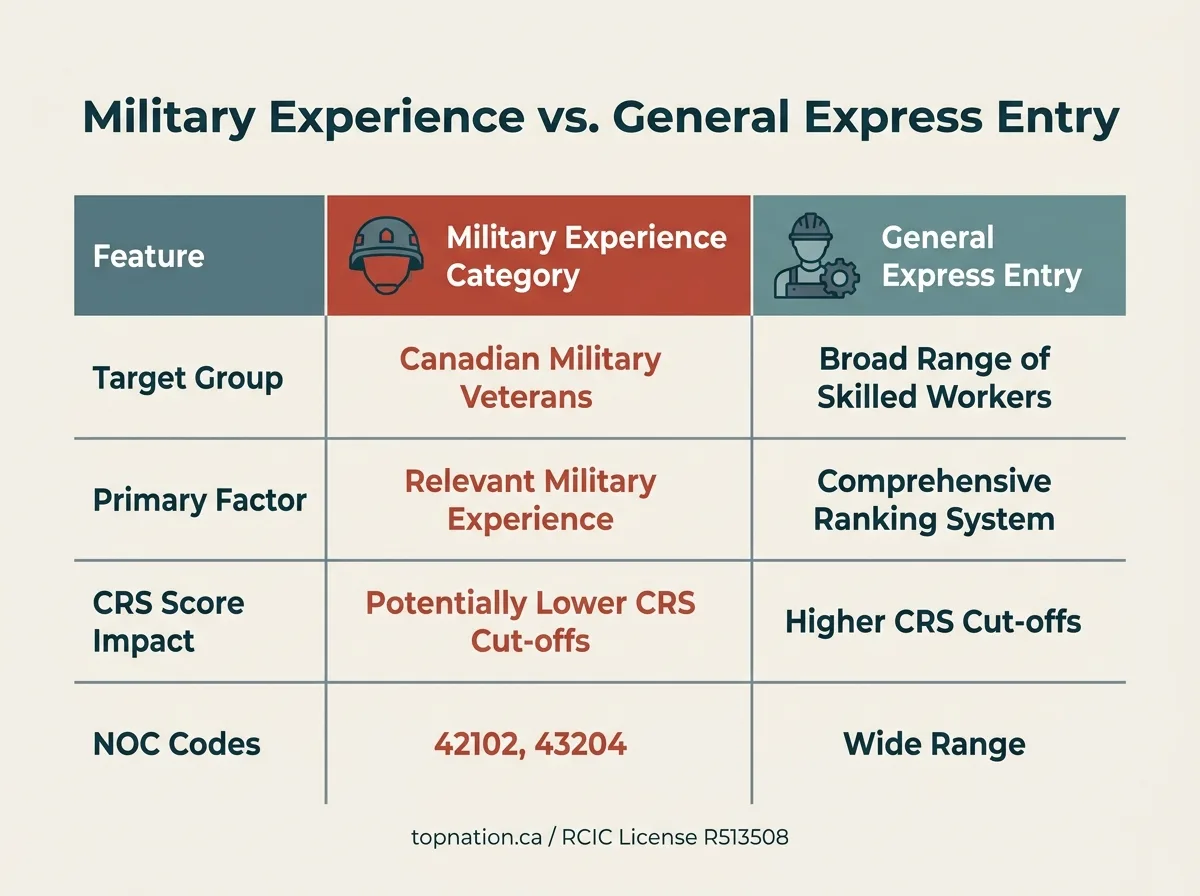
Unlike general Express Entry draws that primarily rank candidates based on their Comprehensive Ranking System (CRS) score, category-based draws prioritize candidates who have the specific experience Canada needs. This means that even if your CRS score isn’t high enough for an all-program draw, your military background could give you a direct path to an Invitation to Apply (ITA) for permanent residence.
The Inaugural Military Express Entry Draw: A Data-Driven Analysis
The first-ever draw for the military experience category on July 23, 2026, provides crucial insights for future applicants. Understanding these numbers is key to positioning your profile for success.
Key Statistics from the July 23, 2026 Draw
IRCC invited 250 candidates in this inaugural round. The minimum CRS score required to receive an ITA was 395. To put this in perspective, the average minimum CRS score for all-program draws in the second quarter of 2026 was approximately 480. This 85-point difference demonstrates the significant advantage this category provides. It allows candidates to be invited based on their relevant experience rather than competing solely on points for age, education, or Canadian work history.
TopNation’s Internal Data Observations
Based on the profiles we manage at TopNation, successful candidates in this first draw shared several characteristics. The average length of service among our clients who received an ITA was 8 years. Furthermore, nearly 70% of them had demonstrated high language proficiency, achieving a Canadian Language Benchmark (CLB) level of 9 or higher in all four English abilities. This suggests that while the category provides a crucial advantage, strong core human capital factors remain influential.
Understanding Eligibility for the Military Experience Category
To be eligible for this category, you must first meet the requirements of one of the three main Express Entry programs: the Federal Skilled Worker Program (FSWP), the Canadian Experience Class (CEC), or the Federal Skilled Trades Program (FSTP). Once you have an active Express Entry profile, you must also meet the specific criteria for the military experience category.
Core Requirements for the Category
The primary requirement is accumulated, within the last 3 years, at least 6 months of full-time, continuous work experience (or an equal amount of part-time work experience) in one of the specified military-related occupations. This experience can be from within Canada or abroad. It is crucial that the duties you performed in your military role align with the lead statement and main duties listed in Canada’s National Occupational Classification (NOC) for the eligible occupations.
| Criteria | General Express Entry (FSWP Example) | Military Experience Category (Additional) |
|---|---|---|
| Work Experience | Minimum 1 year continuous skilled work in the last 10 years. | Minimum 6 months continuous work in a target NOC in the last 3 years. |
| Occupation Relevance | Any NOC in TEER 0, 1, 2, or 3. | Must be one of the specified military-related NOCs. |
| Selection Factor | Primarily ranked by CRS score in all-program draws. | Eligible for targeted draws with potentially lower CRS cut-offs. |
Defining ‘Military Experience’ for IRCC: Relevant NOC Codes
IRCC has been highly specific about what constitutes ‘military experience’ for this category. It is not enough to have simply served in an armed force. Your duties must align with one of two specific NOC codes. This is a critical distinction that many applicants misunderstand.
NOC 42102: Non-commissioned ranks of the Canadian Armed Forces
This NOC covers a broad range of operational roles. While the title specifies the Canadian Armed Forces, IRCC uses this classification as a benchmark for equivalent experience from other countries’ military forces. It includes roles like infantry soldiers, naval combat operators, and air force weapon technicians. Your reference letters must detail duties related to operating military equipment, conducting patrols, and executing tactical operations.
NOC 43204: Commissioned officers of the Canadian Armed Forces
This NOC is for officers who plan, organize, command, and evaluate the activities of military personnel. This includes army, navy, and air force officers. Key duties involve developing and implementing military procedures, commanding units, and managing personnel and equipment. To qualify under this NOC, your experience must reflect leadership, strategic planning, and management responsibilities.
| NOC Code | Description | Example Military Roles |
|---|---|---|
| 42102 | Non-commissioned members responsible for operational duties. | Sergeant, Corporal, Petty Officer, Warrant Officer, Sapper, Gunner. |
| 43204 | Commissioned officers responsible for command and management. | Captain, Lieutenant, Major, Naval Commander, Air Force Squadron Leader. |
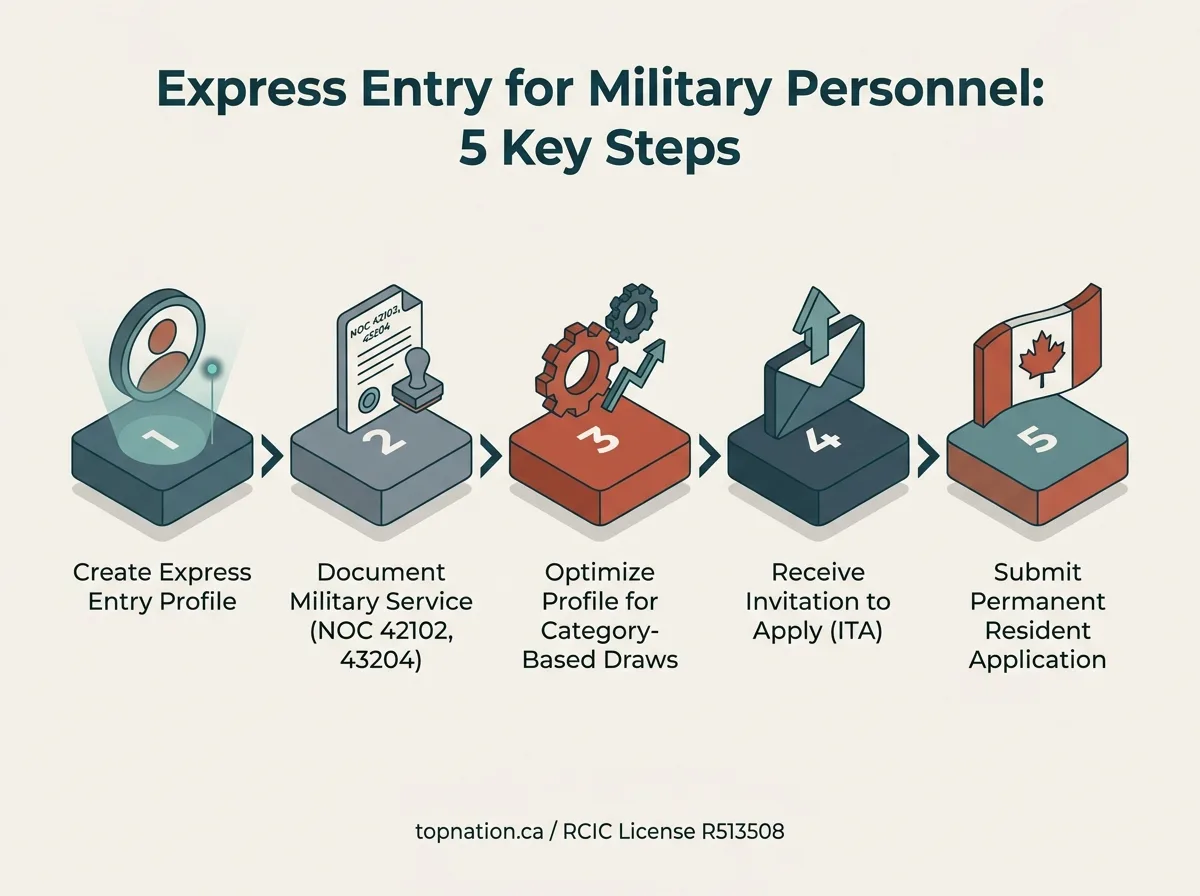
Documenting Your Military Service for an Express Entry Profile
Properly documenting your military experience is the most critical part of your application. Standard service records are often insufficient as they may not detail your day-to-day duties in a way that satisfies IRCC’s requirements. You must prove that your responsibilities match the NOC code you are claiming.
The Essential Reference Letter
You will need a detailed reference letter from your commanding officer or the appropriate military administrative body. This letter must be on official letterhead and include:
- Your full name and rank.
- The specific dates of your service.
- Your salary and benefits.
- Your hours worked per week.
- A detailed list of your duties and responsibilities, written to mirror the language of the chosen NOC code.
Common Mistake to Avoid: Vague and Undocumented Duties
A frequent error we see in refused applications is the submission of generic discharge papers or a reference letter that only states a rank and dates of service. For example, a letter stating “John Doe served as a Sergeant from 2018-2024” is not enough. An IRCC officer cannot assess eligibility based on this. A successful letter would state: “As a Sergeant, John Doe’s duties included planning and leading tactical patrols, training and supervising a section of 10 soldiers in weapons handling and fieldcraft, maintaining and operating advanced communications equipment, and preparing written operational reports.” This level of detail directly links the experience to the duties of NOC 42102 and is essential for a positive assessment. For complex cases, consulting a Regulated Canadian Immigration Consultant (RCIC) can prevent such critical errors.
Strategies for Optimizing Your Profile for an ITA
While meeting the category’s base requirements makes you eligible for selection, a higher CRS score always increases your chances. Your strategy should be two-pronged: ensure you qualify for the military category and maximize your overall CRS score.
Maximizing Your CRS Score
Focus on the core components of the CRS. Improving your language scores is often the fastest way to gain significant points. If you have a spouse or common-law partner, consider having them take a language test and get an Educational Credential Assessment (ECA) as well, as their qualifications can add valuable points to your profile. If you are considering further education, a Canadian credential can provide a substantial boost.
Declaring Your Experience Correctly
In your Express Entry profile, you must accurately declare your work experience under the correct NOC code. Ensure the 6 months of required experience is clearly listed. When the system asks if you have experience in a targeted category, you must select ‘Yes’ for the military experience stream. A simple administrative error in your profile can make you invisible to the system during a category-based draw.

Navigating Post-ITA Challenges for Military Applicants
Receiving an ITA is a major milestone, but several unique challenges can arise for military personnel during the permanent residence application stage.
Security Screening and Background Checks
Given the nature of military service, applicants can expect a more intensive security screening process. This is standard procedure. It is vital to be completely transparent and thorough when providing your personal history and service record. Any inconsistencies can lead to significant delays or refusal. You will need to provide detailed information about your service history, including locations of deployment.
Medical Admissibility
Military service can sometimes result in health conditions. Canada’s medical admissibility rules are in place to ensure that new immigrants will not place excessive demand on health or social services. If you have a service-related medical condition, it is crucial to provide comprehensive medical documentation, including reports from specialists that detail your prognosis and expected healthcare needs in Canada. Proactive documentation can help address potential concerns from the immigration medical officer. If you are bringing family, you may also want to research the process for spousal sponsorship to understand their requirements.
Why Professional Guidance is Crucial for Military Applicants
The military experience category is a nuanced and document-heavy pathway. The process involves translating unique military roles and responsibilities into the specific language of Canada’s immigration system. Errors in NOC selection, insufficient documentation, or misrepresentation can lead to refusal and a bar on re-applying.
How an RCIC Can Help
A licensed Regulated Canadian Immigration Consultant (RCIC) can provide invaluable assistance. At TopNation, our team can help you:
- Assess Your Eligibility: We can thoroughly review your service history to determine the most appropriate NOC and confirm your eligibility for the category.
- Optimize Your Profile: We ensure your Express Entry profile is created and managed flawlessly to maximize your chances in every draw.
- Prepare Your Documentation: We guide you on obtaining the specific, detailed reference letters and supporting documents that IRCC officers need to see.
- Navigate Complexities: We provide strategic advice on handling potential issues like medical admissibility or security screening.
This new stream offers a fantastic opportunity, but it requires a precise and well-prepared application. To ensure your profile is positioned for success, we recommend you contact a licensed RCIC for a detailed assessment of your case.
Your Service Can Lead to a Future in Canada. Let Us Guide You.
Our licensed team specializes in complex Express Entry cases. We’ll help translate your military experience into a successful PR application.
| Call 587-400-0077 | Book Your Consultation |
RCIC Licensed | Serving All of Alberta
Last updated: July 2026. This guide reflects IRCC’s category-based selection criteria for military personnel as of the inaugural draw. Immigration rules change frequently — consult a licensed RCIC for advice specific to your situation.