AAIP Targets Manufacturing Sector
The Alberta Advantage Immigration Program (AAIP) recently issued 743 Notifications of Interest to candidates in its Express Entry stream, with a significant focus on those with job offers in the manufacturing sector. This draw signals a clear and urgent demand for skilled professionals like welders, machinists, and industrial mechanics in the province.
ALBERTA PNP UPDATE — JUNE 2026
For skilled manufacturing professionals with an active Express Entry profile, Alberta is not just an option—it’s a high-priority destination. The province’s robust manufacturing industry is actively seeking talent, and the Alberta Advantage Immigration Program (AAIP) is the primary vehicle for connecting qualified workers with permanent residence. Recent draws confirm that if you have experience as a machinist, welder, production supervisor, or industrial mechanic, your skills are in critical demand. This guide provides a comprehensive roadmap to navigating the AAIP Express Entry stream, securing a qualifying job offer, and turning your manufacturing expertise into a Canadian permanent residency.
Why Alberta’s Manufacturing Sector Needs You
Alberta’s economy, while famous for its energy sector, boasts a diverse and rapidly expanding manufacturing industry. From fabricated metals and machinery to food processing and petrochemicals, the demand for skilled tradespeople and supervisors is outpacing the local labour supply. This gap creates a significant opportunity for foreign nationals with the right qualifications. The provincial government leverages the AAIP to specifically target and invite these workers, recognizing their vital role in sustaining economic growth and innovation.
The Economic Engine of the West
Alberta’s manufacturing sales consistently rank among the highest in Canada, contributing billions to the provincial GDP. This isn’t a temporary boom; it’s a sustained period of growth fueled by investment in technology, infrastructure, and a skilled workforce. Employers in cities like Edmonton, Calgary, and Red Deer are in constant need of professionals who can operate advanced machinery, manage production lines, and maintain industrial equipment. Your expertise is not just welcome; it is essential.
Government Support and Industry Growth
The Government of Alberta has identified manufacturing as a key pillar of its economic diversification strategy. This means dedicated funding, support for businesses, and streamlined immigration pathways like the AAIP to attract the necessary talent. For an aspiring immigrant, this translates to a stable job market, competitive wages, and a clear path to permanent settlement for you and your family.
Decoding the AAIP for Manufacturing Professionals
The Alberta Advantage Immigration Program (AAIP) is Alberta’s Provincial Nominee Program (PNP). It allows the province to nominate individuals with the skills and experience needed by the local economy for permanent residence. For manufacturing workers, the most direct pathway is typically the AAIP Express Entry Stream, which works in tandem with the federal Express Entry system.
How the AAIP Express Entry Stream Works
This stream allows Alberta to search the federal Express Entry pool for candidates who meet the province’s specific economic needs. If you have an active Express Entry profile and demonstrate skills in a high-demand occupation like manufacturing, Alberta may send you a Notification of Interest (NOI). Receiving an NOI is your invitation to apply for a provincial nomination. A successful nomination from Alberta grants you an additional 600 Comprehensive Ranking System (CRS) points, effectively guaranteeing an Invitation to Apply (ITA) for permanent residence in a subsequent federal Express Entry draw.
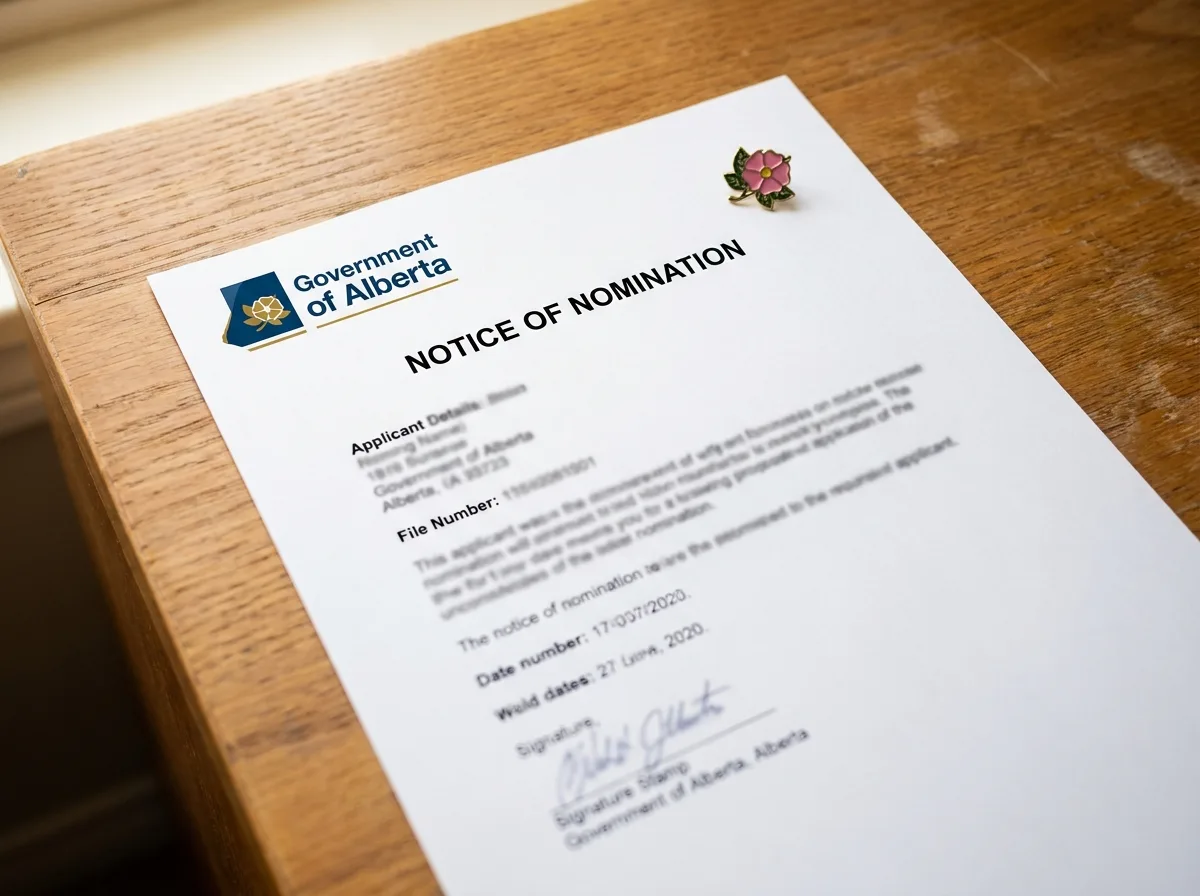
Eligibility Deep Dive: AAIP Express Entry Stream
To be considered for a Notification of Interest under the AAIP Express Entry stream as a manufacturing professional, you must first meet the minimum requirements of the federal system and then the specific criteria set by Alberta. It’s a two-stage process that requires careful attention to detail.
Federal Express Entry Requirements
Before Alberta can even see your profile, you must be eligible for one of the three federal economic immigration programs:
- Federal Skilled Worker Program (FSWP): Requires skilled work experience, language proficiency, and education, assessed on a points grid.
- Canadian Experience Class (CEC): Requires at least one year of skilled work experience in Canada.
- Federal Skilled Trades Program (FSTP): For qualified tradespersons with experience in specific trade groups and a job offer or certificate of qualification.
You must have an active and valid profile in the Express Entry pool. Without this, you are invisible to the AAIP.
Alberta’s Specific Criteria for Manufacturing Candidates
Once you are in the pool, Alberta applies its own lens. Key requirements include:
- Express Entry Profile: You must have an active profile in the federal Express Entry pool.
- Intention to Reside: You must state your interest in immigrating permanently to Alberta.
- Primary Occupation: Your primary occupation in your Express Entry profile should be one that supports Alberta’s economic development and diversification. Manufacturing occupations are a stated priority.
- CRS Score: While the minimum CRS score can be as low as 300, recent draws for manufacturing workers have targeted candidates with scores ranging from 310 to 400. A qualifying job offer is the most significant factor.
| Factor | Minimum Requirement | TopNation Recommendation for Manufacturing Applicants |
|---|---|---|
| CRS Score | 300 | Aim for 350+. A valid job offer is more critical than a high score alone. |
| Job Offer | Not mandatory, but highly prioritized. | Essential. Draws for manufacturing workers almost exclusively target candidates with a bona fide job offer from an Alberta employer. |
| Language (CLB) | CLB 7 for FSWP/CEC; CLB 5 for FSTP. | CLB 7+ demonstrates strong integration potential and adds valuable CRS points. |
| Work Experience | Minimum 1 year (CEC) or based on FSWP grid. | 3+ years of continuous experience in your declared manufacturing NOC. |
Top In-Demand Manufacturing NOCs in Alberta
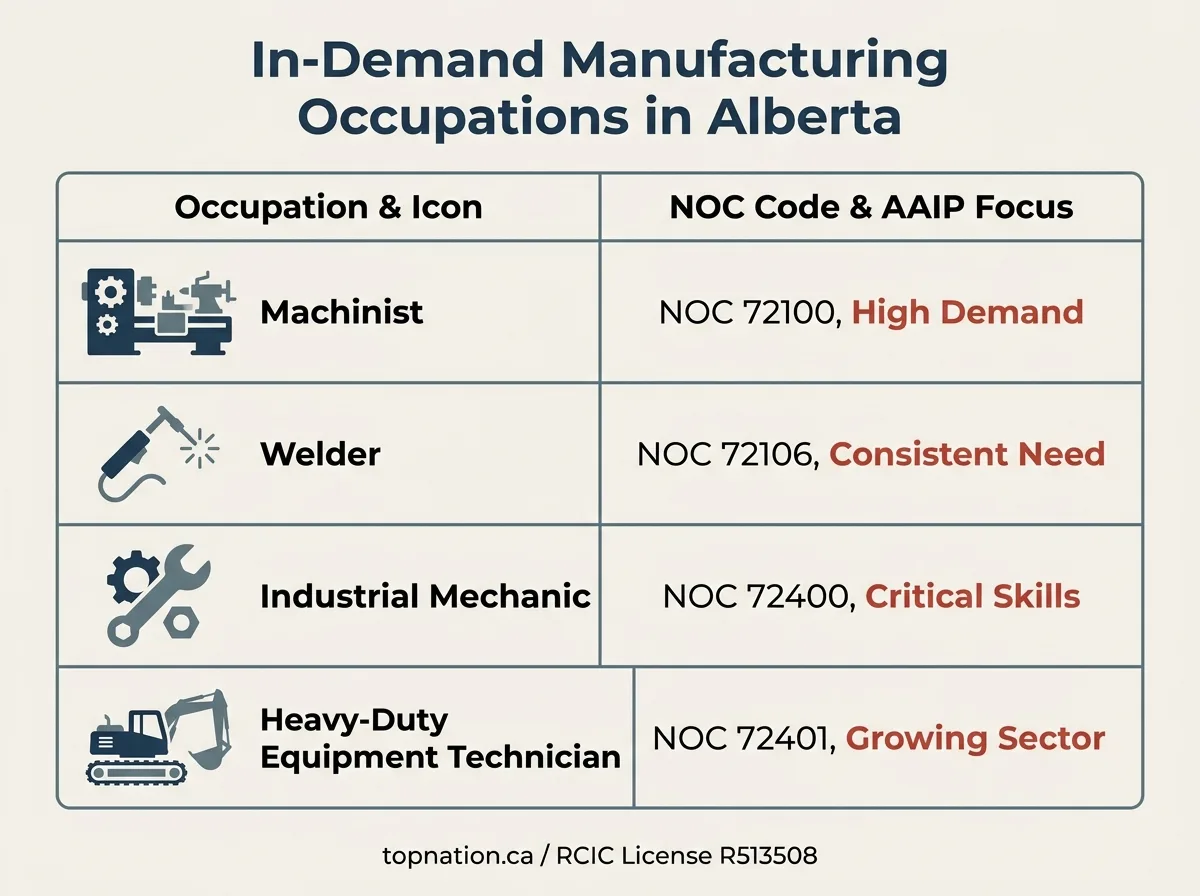
While many occupations can fall under the manufacturing umbrella, the AAIP has shown a clear preference for specific National Occupational Classification (NOC) codes that align with critical labour shortages. Focusing your job search and Express Entry profile on these codes significantly increases your chances of receiving an NOI.
Priority NOC Codes
Based on recent draws and provincial labour market data, the following NOCs are highly sought after:
- NOC 72100: Machinists and machining and tooling inspectors
- NOC 72101: Tool and die makers
- NOC 72104: Structural metal and platework fabricators and fitters
- NOC 72106: Welders and related machine operators
- NOC 92024: Supervisors, motor vehicle assembling
- NOC 94105: Metalworking and forging machine operators
It is crucial that the duties listed in your reference letters and job offer align precisely with the lead statement and main duties of the chosen NOC code. Any discrepancy can lead to a refusal. For assistance with this critical step, it’s best to connect with an Edmonton Immigration Consultant.
The Cornerstone: Securing a Valid Alberta Job Offer
For the AAIP Express Entry stream, a qualifying job offer is the single most important factor for manufacturing candidates. While technically not mandatory for entry into the pool, our internal data shows that over 95% of manufacturing professionals who received an NOI in 2026 had a valid job offer from an Alberta employer.
What Makes a Job Offer ‘Valid’ for AAIP?
Not just any job offer will do. It must meet strict criteria set by the AAIP:
- Full-time and Continuous: The offer must be for a minimum of 30 hours per week and must not be seasonal.
- Proper Wage: The wage offered must meet or exceed the provincial minimum wage and the wage rate set for your occupation in that specific region of Alberta, as determined by the Government of Canada Job Bank.
- Legitimate Employer: The offer must come from a legitimate Alberta employer incorporated or registered in Alberta.
- NOC Alignment: The duties described in the job offer must align with the NOC code you have selected in your Express Entry profile.
Many offers also require a Labour Market Impact Assessment (LMIA), though some positions may qualify for exemptions. Understanding these nuances is key, and our Guide to LMIA Exemptions for Canadian Immigration can provide further clarity.
Analysis of Recent Manufacturing-Focused AAIP Draws
The June 27, 2026 draw that invited 743 candidates provides a valuable case study. The draw specifically targeted candidates with a primary occupation in the manufacturing sector and a CRS score as low as 312. This tells us several things:
Key Takeaways from the Draw
- CRS is Secondary to Occupation: Alberta is willing to dip well below the typical federal CRS cut-off for candidates who fill a specific labour need. A score of 312 would almost never receive an ITA in a general federal draw, but with a targeted provincial nomination, it becomes a gateway to PR.
- Job Offers are Paramount: The program’s details confirmed these invitations were issued to individuals with a bona fide job offer from an Alberta employer. This reinforces that your job search is the most critical part of your immigration strategy.
- Consistency in Demand: This was not an isolated event. Throughout 2025 and 2026, AAIP has consistently held draws for priority sectors, including manufacturing, construction, and healthcare, demonstrating a long-term strategy rather than a one-time need.
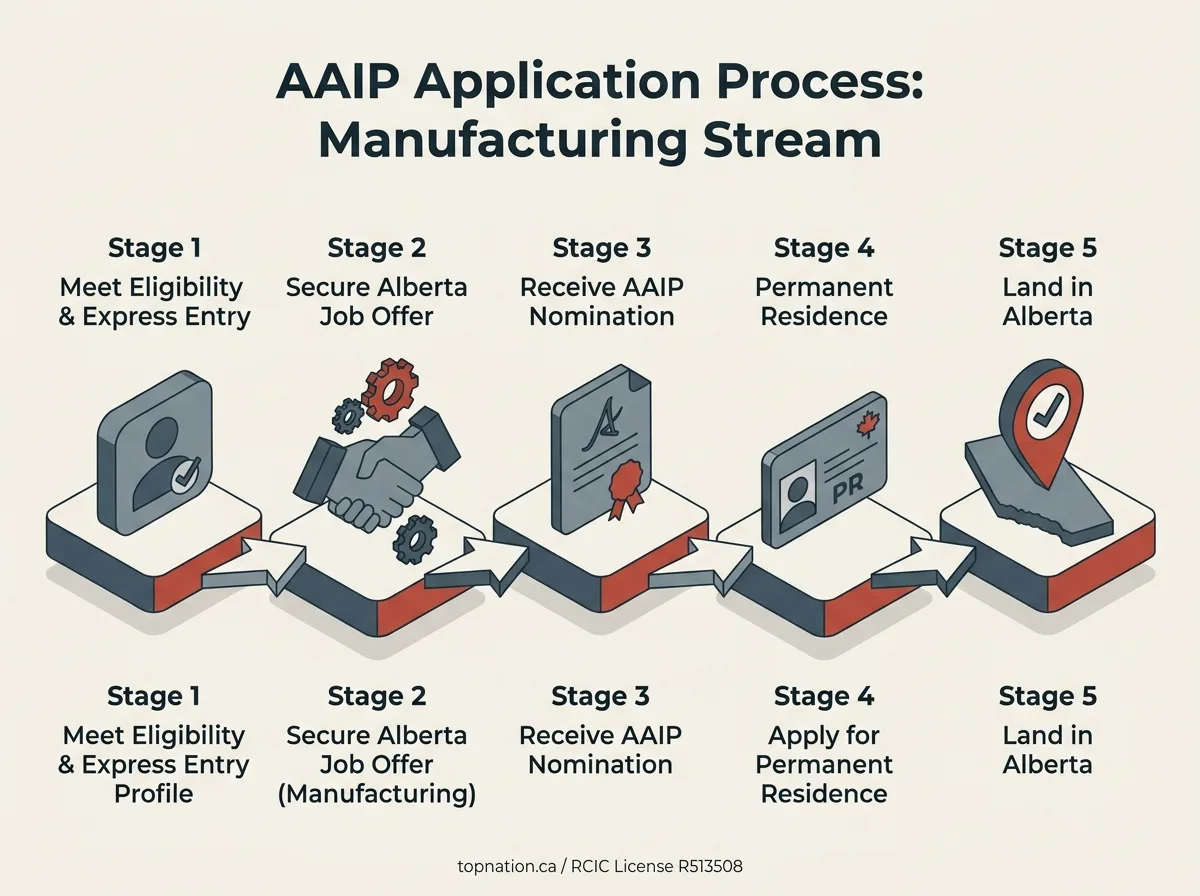
Your Step-by-Step AAIP Application Roadmap
Navigating the AAIP process requires a methodical approach. Here is a simplified roadmap from start to finish.
Phase 1: Preparation and Express Entry
- Assess Your Eligibility: Confirm you meet the criteria for FSWP, CEC, or FSTP.
- Gather Documents: Collect your language test results (IELTS/CELPIP), Educational Credential Assessment (ECA), and proof of work experience.
- Create Your Express Entry Profile: Submit your profile to the IRCC pool, ensuring you indicate Alberta as a province of interest.
- Begin Your Alberta Job Search: Actively apply for positions in your NOC with Alberta-based employers.
Phase 2: AAIP Nomination
- Receive a Notification of Interest (NOI): If your profile aligns with Alberta’s needs, you will receive an NOI in your IRCC account.
- Submit Your AAIP Application: You will have a limited time (usually 14 days) to submit a full application to the AAIP online portal, including your job offer and supporting documents. A non-refundable application fee is required.
- Assessment and Nomination: An AAIP officer will assess your application. Based on our firm’s recent files, a well-prepared application for a manufacturing professional can be processed in as little as 4-6 weeks. If approved, you receive a nomination certificate.
Phase 3: Permanent Residence Application
- Accept the Nomination: You must accept the nomination in your Express Entry profile.
- Receive 600 CRS Points: The 600 points are automatically added to your score.
- Receive an Invitation to Apply (ITA): In the next Express Entry draw, you will be guaranteed to receive an ITA for permanent residence.
- Submit PR Application: You have 60 days to submit your final application for permanent residence to IRCC.
| Stream Comparison | AAIP Express Entry Stream | Alberta Opportunity Stream (AOS) |
|---|---|---|
| Who is it for? | Foreign nationals with an Express Entry profile and skills in demand. | Temporary foreign workers already working full-time in Alberta. |
| Express Entry Profile | Mandatory | Not required |
| Job Offer Requirement | Strongly recommended and prioritized. | Mandatory; must be currently employed in an eligible occupation. |
| Processing Speed | Faster (aligned with federal Express Entry targets). | Generally slower due to direct paper/portal processing. |
Common Pitfalls and How to Avoid Them
Even the most qualified candidates can face refusal due to simple, avoidable errors. At TopNation, we see recurring issues that can jeopardize an otherwise strong application.
The Most Common Mistake: NOC Mismatch
A frequent reason for refusal is a mismatch between the job duties outlined in the employment reference letter and the main duties specified in the selected NOC code. For example, a candidate applies as a Welder (NOC 72106), but their reference letter describes duties that heavily involve fabricating and fitting metal parts. These duties more closely align with a Structural Metal Fabricator (NOC 72104). An AAIP officer will see this discrepancy and may refuse the application on the grounds that the applicant does not have the required experience in the declared occupation. We meticulously audit job descriptions against NOC duties to prevent this critical error.
Incomplete or Inconsistent Documentation
Every claim you make in your profile—every month of work experience, every educational credential—must be backed by perfect documentation. Missing reference letters, inconsistent job titles, or an ECA report that doesn’t match your claimed education level are all red flags. Create a checklist and ensure every document is present, accurate, and consistent before you submit.
Life After Nomination: From AAIP to Permanent Residence
Receiving your provincial nomination is a monumental achievement, but it’s not the final step. You must use that nomination to apply for permanent residence through the federal Express Entry system.
Maintaining Your Eligibility
It is crucial to maintain the conditions of your nomination throughout the federal processing stage. This means you should continue to work for your Alberta employer as specified in your job offer. Any significant changes to your employment or personal situation should be reported to both the AAIP and IRCC. Failure to do so could result in the revocation of your nomination and the refusal of your PR application.
Final Steps to Landing
Once your federal application is approved, you will receive your Confirmation of Permanent Residence (COPR) and a permanent resident visa. You can then officially land in Canada as a permanent resident, ready to begin your new life and career in Alberta’s dynamic manufacturing sector. If you have questions about this final stage, do not hesitate to contact a licensed RCIC for guidance.
Is Your Manufacturing Profile AAIP-Ready?
Our licensed RCICs can review your qualifications and job offer against the latest AAIP criteria to maximize your chances of nomination.
| Call 587-400-0077 | Get a Free Assessment → |
RCIC Licensed | Serving All of Alberta
Last updated: June 2026. This guide reflects our understanding of the Alberta Advantage Immigration Program as of the latest manufacturing-focused draws. Immigration policies change frequently—consult a licensed RCIC for advice specific to your situation.