Ontario Announces Three New PR Pathways
On June 26, 2026, the Ontario Immigrant Nominee Program (OINP) announced a major overhaul, introducing three new skilled worker streams. This move directly challenges established programs like the Alberta Advantage Immigration Program (AAIP) for top international talent.
OINP VS. AAIP ANALYSIS — JUNE 2026
The landscape for Canadian provincial immigration has shifted. Ontario’s introduction of three targeted Permanent Residence (PR) pathways on June 26, 2026, has created a new set of strategic choices for skilled workers, international graduates, and professionals worldwide. For years, the Alberta Advantage Immigration Program (AAIP) has been a leading destination, known for its clear criteria and rapid processing for in-demand occupations. Now, candidates must weigh the established strengths of Alberta against the fresh opportunities in Ontario. This guide provides a data-driven, side-by-side comparison to help you determine which provincial nomination program—Ontario’s new system or Alberta’s robust AAIP—offers the most direct route to your Canadian PR goal.

Understanding Ontario’s Three New PR Pathways
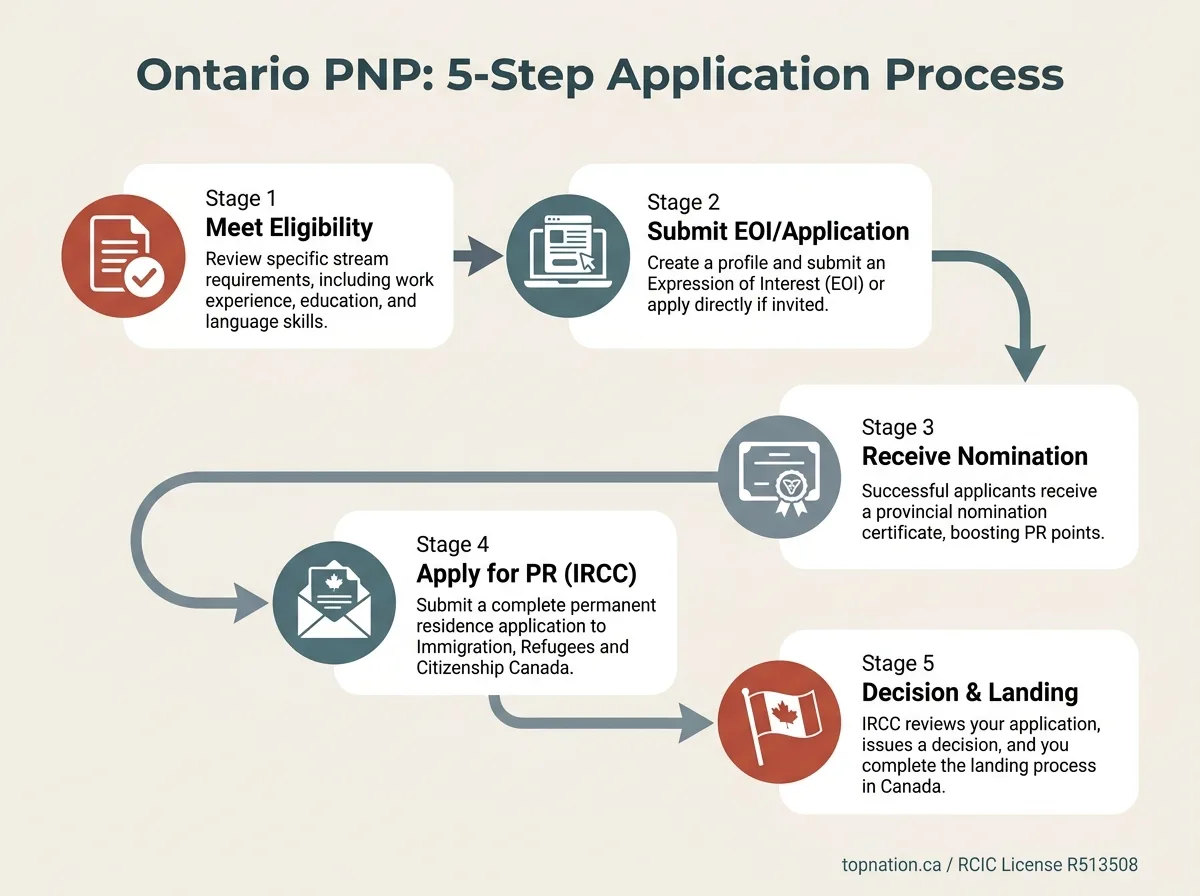
The OINP’s latest update replaces several older, broader streams with three specialized pathways designed to attract talent in critical sectors. This strategic pivot aims to address specific labour market shortages with greater precision. Each stream has a distinct set of eligibility criteria, target occupations, and application processes. Understanding these nuances is the first step in evaluating Ontario as a potential destination.
Pathway 1: Ontario Critical Skills Pathway (OCSP)
The OCSP is designed to fill urgent gaps in skilled trades, transportation, and manufacturing. It’s a job-offer-based stream, meaning a valid offer of employment from an Ontario employer is mandatory. The focus is less on high Express Entry scores and more on possessing the specific work experience Ontario’s core industries desperately need. The program targets occupations like industrial mechanics, transport truck drivers, and heavy equipment operators.
Pathway 2: Ontario Tech & Innovation Pathway (OTIP)
Aimed squarely at the tech sector, the OTIP is Ontario’s answer to Alberta’s Accelerated Tech Pathway. This stream is aligned with the federal Express Entry system and invites candidates with strong Comprehensive Ranking System (CRS) scores and experience in specified tech NOCs. Crucially, it does not always require a job offer, making it an attractive option for high-scoring tech professionals who can demonstrate strong potential to integrate into Ontario’s technology ecosystem. Invitations are issued based on CRS scores, targeted occupations, and other factors relevant to Ontario’s innovation economy.
Pathway 3: Ontario Healthcare & Community Pathway (OHCP)
The OHCP addresses the pressing need for healthcare professionals across the province, with a unique focus on encouraging settlement outside the Greater Toronto Area (GTA). This stream requires a job offer from an eligible healthcare provider, such as a hospital, long-term care home, or clinic. It targets a wide range of occupations from registered nurses and physicians to personal support workers and medical lab technologists. Applicants who commit to working in designated smaller communities may receive priority processing.

A Look at the Alberta Advantage Immigration Program (AAIP)
While Ontario’s programs are new, the AAIP represents a mature and predictable system. It offers several streams for skilled workers, graduates, and entrepreneurs, with a well-established reputation for efficiency, particularly in its tech-focused and Express Entry-aligned streams. For many candidates, AAIP’s stability is a significant advantage.
AAIP Alberta Express Entry Stream
This is Alberta’s primary mechanism for selecting candidates from the federal Express Entry pool. The stream allows Alberta to issue Notifications of Interest (NOIs) to candidates who have a profile in the pool and meet specific criteria. While the minimum CRS score can be as low as 300, Alberta prioritizes candidates with strong ties to the province (e.g., work experience, a job offer, or a degree from an Alberta post-secondary institution) and those in occupations that support Alberta’s economic development and diversification.
AAIP Accelerated Tech Pathway
A flagship program for tech workers, this pathway provides expedited processing for individuals with an Alberta job offer in one of 38 in-demand tech occupations. It operates under the Alberta Express Entry stream but offers a much faster route to nomination. Based on TopNation’s internal file data from Q1-Q2 2026, successful applicants through the Accelerated Tech Pathway received nominations in an average of just 35-45 days, a significant advantage for those with an urgent timeline.
Other Key AAIP Streams
Beyond the main Express Entry and Tech pathways, Alberta offers other valuable options. The Rural Renewal Stream empowers designated rural communities to recruit and nominate newcomers who can fill local labour needs. The Alberta Opportunity Stream is for qualified temporary foreign workers already working full-time in Alberta. Finally, the Designated Healthcare Pathway works similarly to the tech stream, offering expedited processing for healthcare professionals with a job offer from an Alberta Health Services (AHS) approved employer.
Direct Comparison: Ontario’s New Pathways vs. Alberta AAIP
Choosing between these two provinces requires a detailed look at how their programs stack up against each other. The best choice depends entirely on your individual profile, occupation, and career goals.
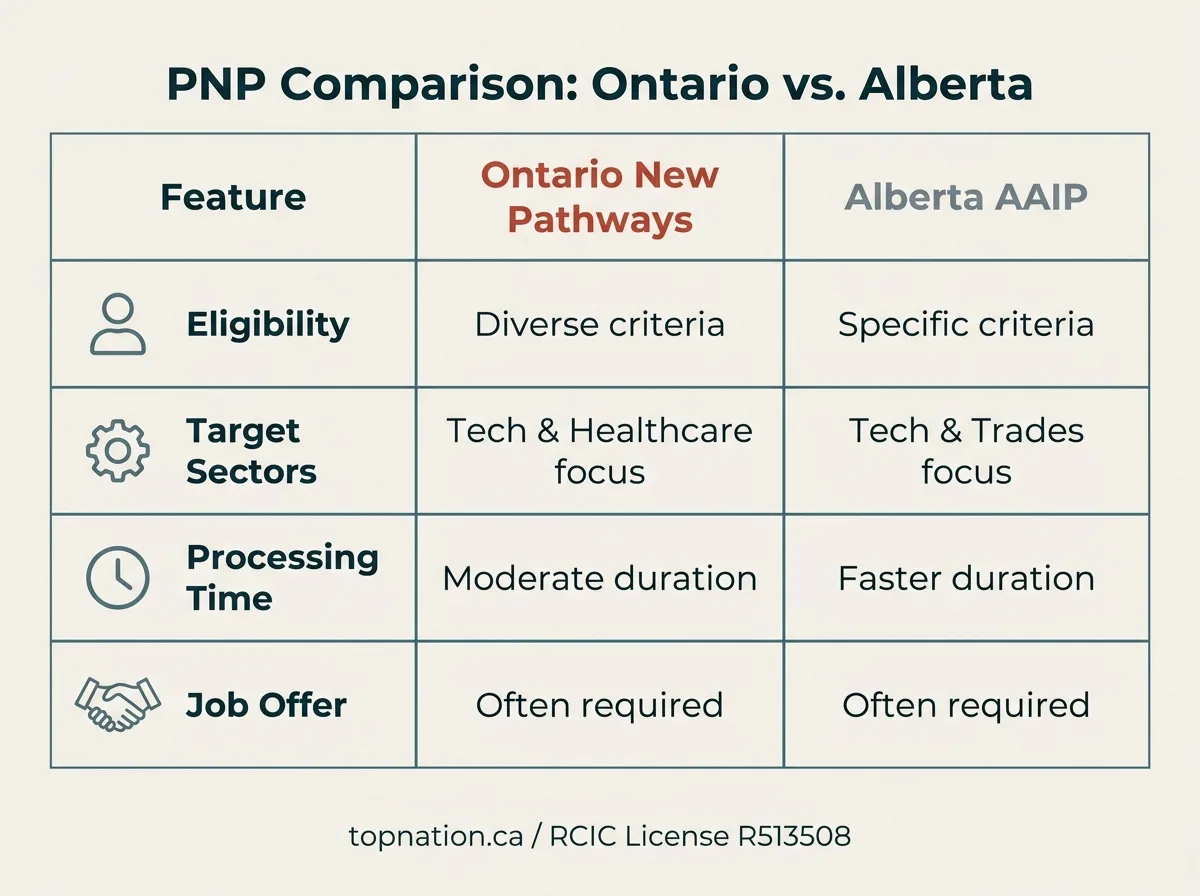
| Feature | New Ontario Pathways (OINP) | Alberta Advantage (AAIP) |
|---|---|---|
| Job Offer Requirement | Mandatory for OCSP & OHCP; Not always required for OTIP. | Often required for priority processing (e.g., Tech/Healthcare Pathways) but not mandatory for all Express Entry draws. |
| Express Entry Alignment | OTIP is fully aligned. OCSP and OHCP are base streams. | Primary stream is Express Entry aligned; separate streams exist for non-EE candidates. |
| CRS Score Focus | High importance for OTIP. Lower importance for job-offer streams. | Can invite as low as 300, but ties to Alberta are often more important than the score itself. |
| Language Requirement | Varies by stream (e.g., CLB 5 for OCSP, CLB 7+ for OTIP). | Generally CLB 4-5 for non-EE streams, CLB 7+ for Express Entry. |
Target Occupations: Where Each Province Excels
The strategic focus of each province’s program is most evident in their targeted occupations. Your profession is often the single most important factor in deciding which program offers a higher chance of success.
Ontario’s Sector-Specific Approach
Ontario’s new streams are highly specialized. The OTIP focuses on software developers, data scientists, cybersecurity analysts, and other high-tech roles. The OHCP is dedicated to nurses, physicians, therapists, and support staff. The OCSP targets industrial trades, construction, and transportation. If your NOC code falls squarely within one of these lists, Ontario has created a direct pathway for you.
Alberta’s Broader Economic Focus
Alberta casts a wider net. While its Accelerated Tech and Healthcare pathways are specific, the general Alberta Express Entry stream frequently invites candidates from a diverse range of sectors, including engineering, agriculture, hospitality, and finance. This flexibility can be advantageous for candidates whose occupations are not on Ontario’s specific target lists but are still in-demand in Alberta’s diversified economy.
Processing Times and Application Fees
Timelines and costs are critical practical considerations for any immigration applicant. Historically, Alberta has held an edge in processing speed, but Ontario’s new, streamlined approach aims to be more competitive.
Projected OINP Timelines
As the Ontario streams are new, official processing times are still being established. However, the OINP has stated an internal service standard of 60-90 days for nomination decisions for the new pathways. Application fees are expected to be in the range of $1,500 to $2,000 CAD.
Established AAIP Timelines
The AAIP is known for its efficiency. The Accelerated Tech and Designated Healthcare pathways often see nominations issued in under 2 months. The standard Alberta Express Entry stream typically processes applications within 3 to 4 months. The application fee for most skilled worker streams is currently $500 CAD, making it a more affordable option upfront. For expert guidance navigating these costs and timelines, it’s wise to speak with an immigration consultant in Edmonton who has direct experience with the AAIP.

Common Application Pitfalls to Avoid
Navigating these complex programs can be challenging, and simple mistakes can lead to costly delays or rejections. At TopNation, we regularly see applicants make preventable errors that jeopardize their applications.
The Job Offer Mismatch
A frequent mistake we encounter is a mismatch between the job offer and the program requirements. For example, an applicant for the AAIP Accelerated Tech Pathway might have a job offer as a “Project Manager” from a tech company. However, if the duties listed in the offer letter do not align with the lead statement and main duties of an eligible tech NOC, the application will be refused. It is critical that the job offer is drafted to precisely match the specific NOC being claimed.
Inaccurate Work Experience Calculation
Both provinces require a minimum amount of skilled work experience. Applicants often miscalculate this by including periods of self-employment that are not properly documented, part-time work that doesn’t meet the hourly threshold, or experience gained while on an implied status that is not eligible. Every week of experience must be verifiable and meet the program’s definition of full-time, paid work.
Strategic Scenarios: Which Province Fits Your Profile?
Let’s apply this information to a few common applicant profiles to illustrate the decision-making process.
Scenario 1: The Tech Professional
Profile: A Software Developer with 4 years of experience, a Master’s degree, and a CLB 9. CRS score is 485. No job offer.
Analysis: This candidate is a prime contender for Ontario’s new Tech & Innovation Pathway (OTIP). Without a job offer, their high CRS score and in-demand occupation make them a strong candidate for an invitation. While they could also wait for a general Express Entry draw, the OTIP provides a targeted provincial route. Alberta’s Accelerated Tech Pathway is not an option without a job offer.
Scenario 2: The Healthcare Worker
Profile: A Registered Nurse with 5 years of experience, a Bachelor’s degree, and a CLB 8. Has a job offer from a hospital in Edmonton.
Analysis: Alberta is the clear choice here. With a job offer from an approved employer, this nurse is eligible for the AAIP’s Designated Healthcare Pathway, which promises expedited processing. While they would also be eligible for Ontario’s OHCP if they had an Ontario job offer, the existing offer makes Alberta the most direct and fastest path to nomination.
Scenario 3: The Skilled Tradesperson
Profile: An Industrial Mechanic with 6 years of experience, a college diploma, and a CLB 6. Has a job offer from a manufacturing plant in Hamilton, Ontario.
Analysis: Ontario’s new Critical Skills Pathway (OCSP) is tailor-made for this profile. The program is specifically designed for individuals with job offers in the trades. The CLB 6 score is sufficient, and the focus is on the skilled work experience and the valid job offer rather than a high CRS score. Many employers in this sector may also be eligible for a specific type of work permit, which you can learn more about in our LMIA exemption guide.
The Role of a Regulated Canadian Immigration Consultant (RCIC)
The launch of new programs and the constant evolution of existing ones make the immigration landscape more complex than ever. An RCIC does more than just fill out forms; they provide a strategic roadmap. For instance, we can assess your profile against the unpublished selection criteria for both the OINP and AAIP, drawing on experience from thousands of past cases. We can help you frame your work experience to align perfectly with a target NOC and ensure your supporting documents tell a clear, consistent story. Whether you’re considering spousal sponsorship or complex investment migration, professional guidance removes the guesswork and maximizes your chances of success.
Ontario or Alberta? Get a Clear Path Forward.
Our licensed team will assess your profile against both OINP and AAIP criteria to find your optimal PR strategy.
| Call 587-400-0077 | Book a Strategic Assessment → |
RCIC Licensed | Serving All of Canada
Last updated: June 2026. This guide reflects the new OINP pathways announced on June 26, 2026, and current AAIP criteria. Immigration rules change frequently — consult a licensed RCIC (CICC #R513508) for advice specific to your situation.