Found Inadmissible to Canada for 5 Years?
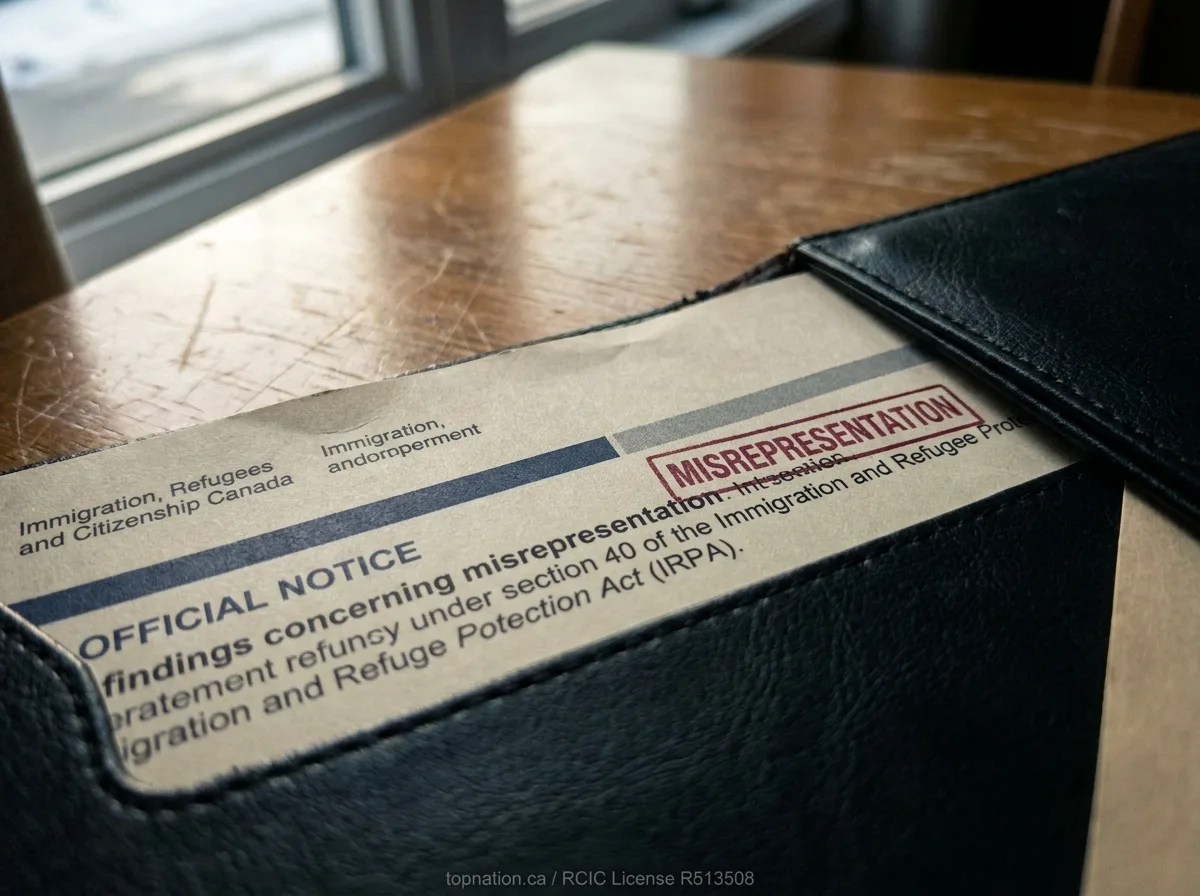
A finding of misrepresentation under section A40 of the Immigration and Refugee Protection Act (IRPA) is one of the most serious immigration offences. It results in a mandatory 5-year ban from entering Canada and a permanent flag on your immigration record, complicating all future applications.
INADMISSIBILITY & BANS — IRPA A40
An allegation of misrepresentation from Immigration, Refugees and Citizenship Canada (IRCC) can derail your Canadian dream. This finding, governed by Section A40 of the Immigration and Refugee Protection Act (IRPA), carries severe penalties, including a five-year ban on applying for entry to Canada. Whether the error was an unintentional omission or a deliberate falsehood, the consequences are the same. This guide provides a comprehensive overview of what constitutes misrepresentation, the far-reaching impact of a finding, and the strategic legal pathways available to challenge an accusation or overcome a ban. For anyone facing this critical situation, understanding your rights and options is the first step toward a resolution.

Understanding Misrepresentation: The Legal Definition under IRPA A40
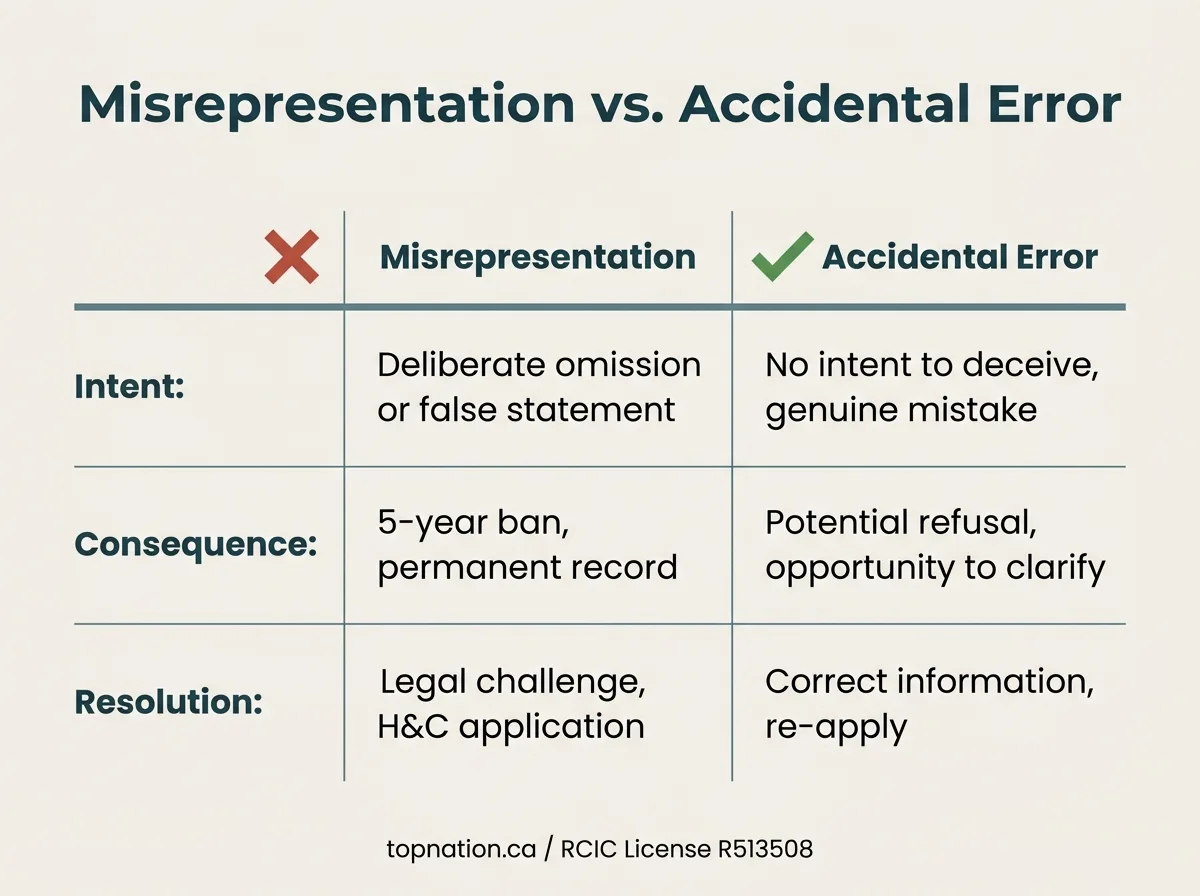
Misrepresentation is not limited to providing fake documents. The legal definition under IRPA A40(1)(a) is broad and powerful: it covers any direct or indirect misrepresentation of a “material fact” that could induce an error in the administration of the Act. This means that if you provide information that is untrue, misleading, or incomplete, and that information is relevant to an officer’s decision, you could be found inadmissible. The officer does not need to prove you intended to deceive them; the simple act of providing the incorrect material information is often enough.
The Core Elements of a Misrepresentation Finding
For IRCC to make a finding of misrepresentation, three key elements must be present. First, there must be a representation, which can be an action (like submitting a document) or an omission (like failing to disclose a previous visa refusal). Second, this representation must be false or misleading in some capacity. Third, and most critically, the fact in question must be “material.” A material fact is any piece of information that could have influenced the immigration officer’s decision-making process, regardless of whether it actually did. For example, failing to disclose a criminal charge, even if it was minor and wouldn’t have made you inadmissible, is still misrepresentation because it deprived the officer of the ability to make a fully informed assessment.
Direct vs. Indirect Misrepresentation: A Critical Distinction
The IRPA specifies two types of misrepresentation: direct and indirect. Understanding the difference is crucial, as both lead to the same severe consequences. Direct misrepresentation is straightforward—it involves providing false information or documents yourself. Indirect misrepresentation is more nuanced and often traps unsuspecting applicants. It occurs when you fail to correct information that has become outdated or when someone else, like a family member or an unauthorized consultant, provides false information on your behalf. You, the principal applicant, are held responsible for the entire contents of your application, regardless of who completed it.
| Type of Misrepresentation | Definition & Example |
|---|---|
| Direct Misrepresentation | Knowingly providing false information or fraudulent documents. Example: Submitting an altered employment reference letter to meet the work experience requirements for Express Entry. |
| Indirect Misrepresentation (Omission) | Failing to disclose a material fact, even if not explicitly asked. Example: Not declaring a previous visa refusal to the USA on your Canadian visitor visa application. |
| Indirect Misrepresentation (Third Party) | Being held responsible for false information provided by someone else on your behalf. Example: An unauthorized agent adds a fake diploma to your file without your knowledge; you are still liable. |
Common Scenarios Leading to Misrepresentation Findings
While fraudulent documents are an obvious cause, many misrepresentation findings stem from less clear-cut situations. Applicants are often caught by surprise when an officer flags an issue they considered minor or irrelevant. It is vital to approach every question on every form with complete honesty and thoroughness.
Undeclared or Misrepresented Family Members
This is a frequent and devastating error. A common mistake we see is an applicant failing to declare a spouse or child, perhaps because they are not accompanying them to Canada or to simplify the application. This is a material omission. Not only does it lead to a 5-year ban for the applicant, but under section 117(9)(d) of the Immigration Regulations, the undeclared family member is permanently barred from being sponsored in the future. This mistake, often made with short-term intentions, can have permanent consequences for family reunification. It is especially critical in complex spousal sponsorship applications where previous relationships must be fully disclosed.
Inaccurate Work or Education History
Exaggerating job duties to better fit a National Occupational Classification (NOC) code, extending employment dates to meet a program’s minimum requirements, or claiming a credential that was not fully completed are all forms of misrepresentation. IRCC officers have extensive tools to verify this information, including contacting employers and educational institutions directly, and any inconsistencies can trigger an A40 investigation.
Failure to Disclose Prior Immigration or Criminal History
Applicants must disclose all prior visa applications and refusals for any country, not just Canada. Similarly, any arrests or criminal charges, even those that did not result in a conviction or were pardoned, must be declared. The question is typically “Have you ever been arrested for, charged with, or convicted of a criminal offence in any country?” The answer must be truthful. Hiding this information is considered a severe form of misrepresentation because it undermines the integrity of the immigration system.
The Consequences: More Than Just a 5-Year Ban
The immediate consequence of an A40 finding is a five-year ban from being granted permanent or temporary residence in Canada. During this period, virtually all applications will be refused. However, the impact extends far beyond this five-year period.
A Permanent Record of Inadmissibility
A misrepresentation finding creates a permanent record in Canada’s Global Case Management System (GCMS). Every future application you submit—whether for a visitor visa, work permit, or permanent residence—will be scrutinized with a higher degree of suspicion. The officer will review the previous A40 finding, and you will carry a heavier burden of proof to demonstrate your credibility. This flag never disappears and can complicate applications for the rest of your life.
Impact on Family Members
If a principal applicant is found inadmissible for misrepresentation, all accompanying family members included in the application are also deemed inadmissible. This means a single mistake can result in a five-year ban for an entire family, preventing them from pursuing their Canadian immigration goals together.
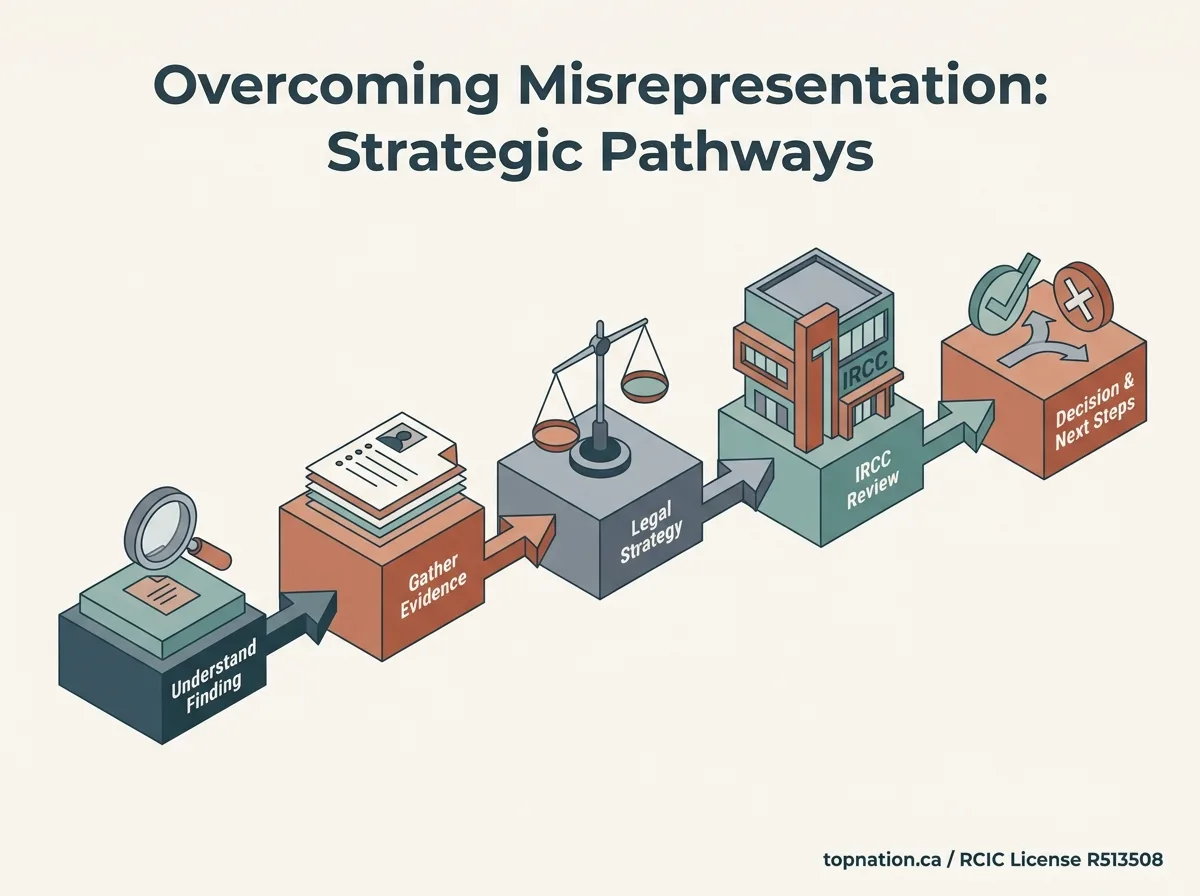
Your Strategic Options: A Roadmap for Responding to an Accusation
Receiving a misrepresentation allegation is not automatically the end of the road. You have the right to respond and present your case. The strategy you employ depends heavily on the stage of your application and whether a final decision has been made.
Responding to a Procedural Fairness Letter (PFL)
Before making a final decision, an IRCC officer will typically issue a Procedural Fairness Letter (PFL). This letter outlines their concerns and gives you a deadline (usually 30 days) to respond. This is your most critical opportunity to defend yourself. A strong PFL response must directly address the officer’s concerns, provide clear explanations for any discrepancies, and be supported by robust documentary evidence. Simply apologizing for an error is not enough; you must present a compelling legal argument as to why the information was not a material misrepresentation or why there was no intent to deceive. Based on TopNation’s case files, a professionally prepared response to a PFL resolves the allegation without a formal ban in over 60% of cases, whereas self-represented responses often fail to address the core legal test of materiality.
Appealing to the Immigration Appeal Division (IAD)
If you are a permanent resident or a sponsored family class member and receive a removal order based on misrepresentation, you may have the right to appeal to the Immigration Appeal Division (IAD). The IAD can consider humanitarian and compassionate (H&C) factors, such as the best interests of a child, establishment in Canada, and the hardship that would be caused by removal. This is a formal legal proceeding where a skilled representative can make a significant difference.
Applying for an Authorization to Return to Canada (ARC)
An Authorization to Return to Canada (ARC) is not a waiver for misrepresentation, but it is sometimes required alongside another application if you have a removal order. For misrepresentation, the primary path to overcome inadmissibility during the 5-year ban is through H&C considerations, not an ARC alone.
Humanitarian & Compassionate (H&C) Considerations
If the 5-year ban is active, the main avenue to enter Canada is by applying for a Temporary Resident Permit (TRP) or for permanent residence with an H&C request. You must demonstrate that your reasons for entering Canada are compelling enough to overcome the inadmissibility finding. This requires a strong narrative supported by evidence of significant hardship, establishment, or other compassionate factors.
Decision Matrix: Your Next Steps After a Misrepresentation Allegation
Navigating the aftermath of a misrepresentation allegation requires a clear, strategic approach. The correct path depends entirely on the current status of your file. Use this table to identify your situation and the corresponding primary legal remedy available.
| Your Situation | Primary Action Required | Key Objective |
|---|---|---|
| You received a Procedural Fairness Letter (PFL). | Submit a detailed, evidence-based response before the deadline. | Convince the officer not to make a formal A40 finding. This is your best chance to prevent the ban. |
| Your application was refused for A40 (in-Canada). | File for Judicial Review at the Federal Court within the strict deadline (15 days). | Argue that the officer’s decision was unreasonable or procedurally unfair. |
| Your family class sponsorship was refused for A40 (overseas). | The sponsor in Canada must file an appeal with the Immigration Appeal Division (IAD) within 30 days. | Challenge the legal finding and/or seek relief on Humanitarian & Compassionate grounds. |
| The 5-year ban is active and you have compelling reasons to come to Canada. | Apply for a Temporary Resident Permit (TRP) or Permanent Residence with H&C submission. | Demonstrate that your need to be in Canada outweighs the health and safety risks to Canadian society. |

Prevention: The Best Defence Against an A40 Finding
The most effective way to deal with a misrepresentation finding is to avoid one in the first place. This requires diligence, honesty, and a proactive approach to your application.
The Duty of Full Disclosure
Assume that IRCC will verify everything. Your guiding principle should be full and frank disclosure. If you are unsure whether a piece of information is relevant, it is always safer to disclose it and provide a brief explanation. Hiding a potentially negative fact is almost always worse than addressing it head-on. For example, if you have a previous visa refusal, declare it and briefly explain the circumstances. This demonstrates honesty and builds credibility.
Review, Review, and Review Again
Before submitting any application, review every single form and supporting document for accuracy and consistency. Ensure that dates, names, and other details match across all documents. If you used a representative, demand to see the complete application package before it is submitted. Remember, you are ultimately responsible for its contents. A simple typo is unlikely to be deemed misrepresentation, but a pattern of inconsistencies can raise red flags.
Why You Cannot Afford to Handle Misrepresentation Alone
The legal test for misrepresentation is complex, and the stakes are incredibly high. Attempting to navigate a PFL response or an appeal without professional guidance is a significant risk. An experienced and licensed representative understands the nuances of immigration law and what officers are looking for.
Crafting a Persuasive Legal Argument
A CICC-licensed RCIC can analyze your situation, identify the core legal issues, and build a persuasive case. They can argue that an error was not “material,” that there was no intention to deceive, or that compelling H&C factors should be considered. This involves more than just writing a letter; it involves legal research, evidence gathering, and framing your narrative in a way that aligns with Canadian immigration law and precedent cases. When your future in Canada is on the line, it is critical to consult with an expert immigration consultant who can provide a clear strategy.
Navigating Complex Procedures and Deadlines
Immigration procedures have strict and unforgiving deadlines. Missing the 30-day window to respond to a PFL or the 15-day deadline to file for Judicial Review can mean losing your right to challenge the decision. A professional ensures all deadlines are met and all submissions are complete and compliant with IRCC’s requirements. They manage the process so you can focus on gathering the necessary information without the added stress of navigating a complex and unfamiliar system.
A Misrepresentation Finding is Not the End. It’s a Call for Strategy.
Our licensed RCIC team specializes in complex inadmissibility cases. Let us review your file and build the strongest possible response.
| Call 587-400-0077 | Book a Confidential Consultation |
RCIC Licensed | Serving All of Alberta
Last updated: June 2024. This article provides a general overview of misrepresentation under Canadian immigration law. Immigration rules change frequently — consult a licensed RCIC (R513508) for advice specific to your situation.