New IRCC Policy Eases Work Permit Access
On June 15, 2026, Immigration, Refugees and Citizenship Canada (IRCC) announced a major policy update, creating a faster path for provincial nominees to secure employer-restricted work permits. This change is designed to help nominees and their spouses begin working in their nominating province sooner while awaiting a final decision on their permanent residence application.
PNP POLICY UPDATE — JUNE 2026
For provincial nominees in Canada, the period between receiving a nomination and obtaining permanent residence can be a stressful waiting game, particularly concerning work authorization. The landmark IRCC announcement on June 15, 2026, directly addresses this gap. This new policy provides a streamlined process for Provincial Nominee Program (PNP) candidates to obtain an employer-restricted work permit, enabling them to work for their supporting employer without the lengthy wait. This guide provides a tactical breakdown of the new rules, detailing how nominees and their spouses can leverage this change, with a specific focus on obtaining the critical work permit support letter from programs like the Alberta Advantage Immigration Program (AAIP).

Understanding Canada’s June 2026 Policy Shift for PNP Nominees
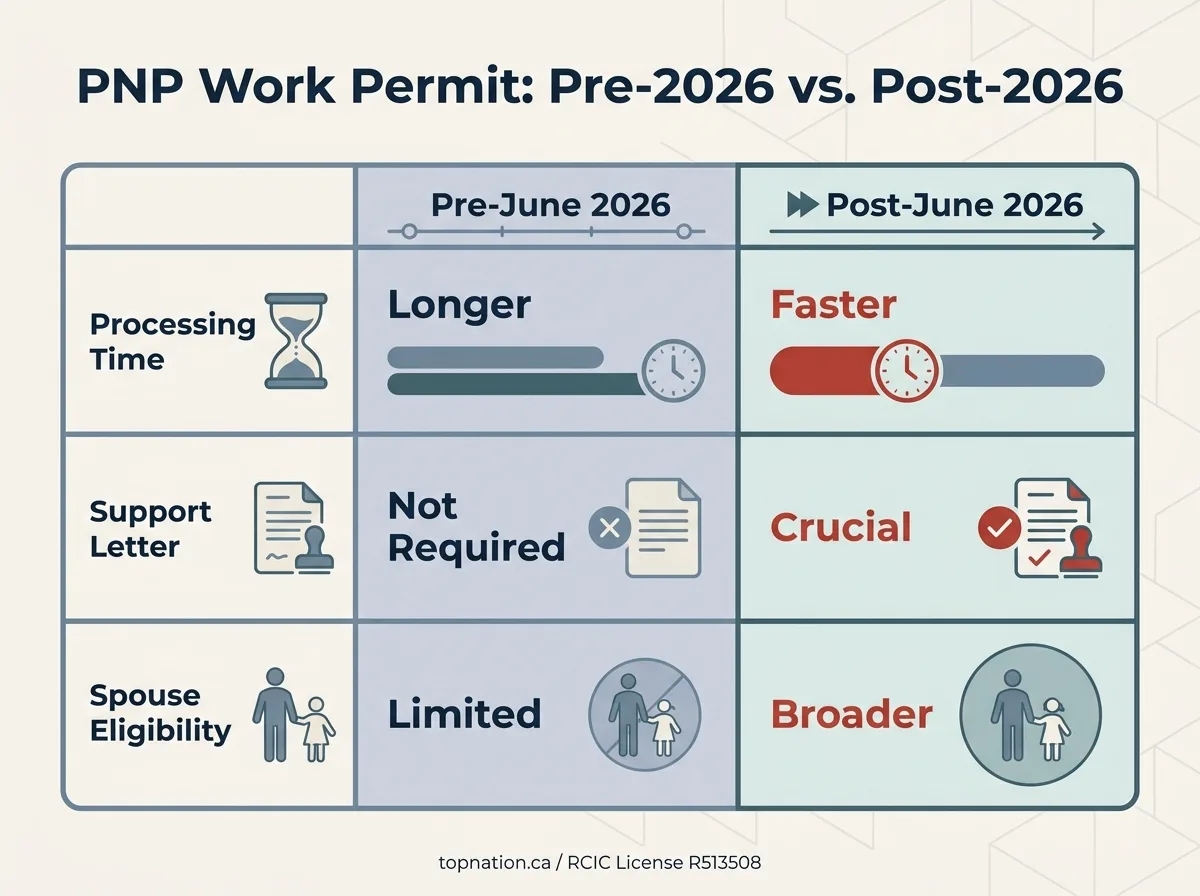
Prior to this update, many provincial nominees faced a precarious situation. If their existing work permit was expiring, they often had to apply for a Bridging Open Work Permit (BOWP), but eligibility for a BOWP is contingent on having submitted a complete permanent residence application and receiving an Acknowledgment of Receipt (AOR). This created a potential work authorization gap for those who had a nomination but hadn’t yet reached the AOR stage.
The June 2026 policy decouples the work permit process from the PR application’s AOR milestone for a specific group of nominees. It establishes a dedicated pathway for nominees with a valid job offer to secure a work permit based on their provincial nomination certificate and a supporting letter from that province. This is not a BOWP; it is a new employer-restricted work permit under the International Mobility Program’s LMIA exemption code T13.
Key Benefits: Why This Change Matters to You
This policy shift delivers tangible advantages for nominees, their families, and Canadian employers. It’s a strategic move by IRCC to improve nominee retention within provinces and address labour market needs more efficiently.
For Provincial Nominees
The primary benefit is continuity. You can start or continue working for your employer in the nominating province much sooner, providing financial stability and valuable Canadian work experience that strengthens your integration. It eliminates the anxiety of a potential status lapse while waiting for your PR application to progress.
For Spouses and Partners
The policy extends benefits to spouses and common-law partners. Eligible partners can now apply for an open work permit concurrently, allowing them to work for nearly any employer in Canada. This dual-income potential can significantly ease the financial pressures of settling in a new country.
For Canadian Employers
Employers who have invested time and resources in supporting a candidate through the PNP process can now retain that talent without interruption. This policy provides a clear, predictable mechanism to keep their nominated employee working, ensuring business continuity and avoiding the costs associated with recruitment and training new staff.
Eligibility Criteria for the Principal Nominee’s Work Permit
To qualify for this employer-restricted work permit, the principal applicant must meet a precise set of criteria. Meeting every condition is mandatory; there is little room for discretion in these applications.
Valid Provincial Nomination Certificate
Your nomination from a Provincial Nominee Program must be valid at the time of the work permit application. The nomination certificate clearly states its expiry date. It is crucial to apply before this date passes. If your nomination is close to expiring, you must contact your provincial program to inquire about an extension before applying for the work permit.
Employer-Specific Job Offer
You must have a genuine job offer from the employer who supported your provincial nomination application. The position must be located within the nominating province or territory. The offer must align with the details submitted for your nomination, including occupation (NOC code), duties, and location.
Statement of Intent
You must explicitly state your intention to reside and work in the province that nominated you. This is usually demonstrated through the application forms and a letter of explanation. Any indication that you plan to live or work in another province will result in a refusal.
Provincial Work Permit Support Letter
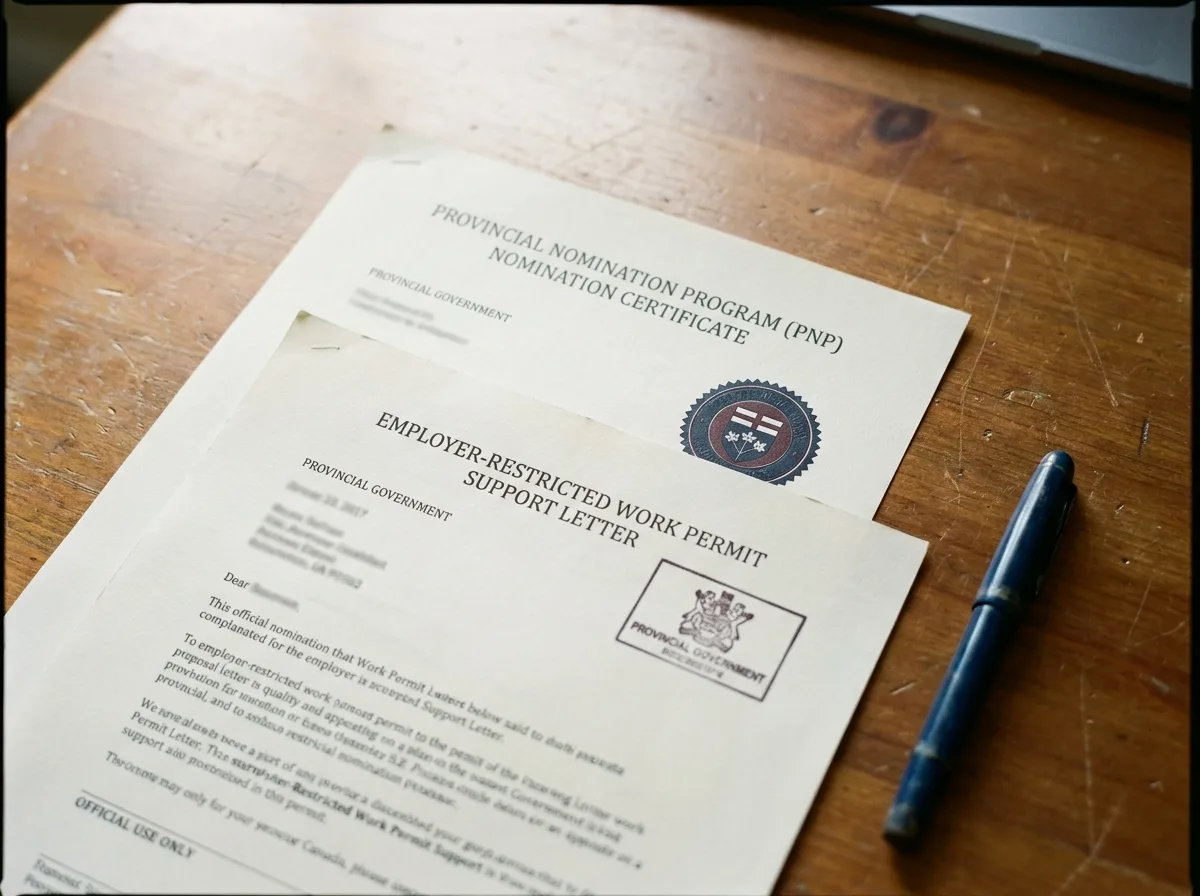
This is the most critical document. You must have a formal Work Permit Support Letter issued by the nominating province or territory. This letter confirms to IRCC that the province supports your application for a work permit and that they have determined your employment is of significant benefit to their jurisdiction. Without this letter, your application will be refused.
Eligibility for Spouses and Common-Law Partners
The new policy recognizes the importance of family unity and economic integration. Spouses and common-law partners of eligible provincial nominees can apply for an open work permit, which is not tied to a specific employer.
The table below clarifies the distinct requirements for the principal applicant and their spouse.
| Eligibility Factor | Principal Nominee (Applicant) | Spouse / Common-Law Partner |
|---|---|---|
| Type of Work Permit | Employer-Restricted (Closed) | Open Work Permit |
| Job Offer Required? | Yes, from the nominating employer. | No. |
| Key Document | Provincial Nomination & Support Letter | Proof of relationship to Principal Applicant |
To be eligible, the spouse’s application is tied to the principal applicant’s status. The principal applicant must be approved for their employer-restricted work permit for the spousal open work permit to be issued. It is highly recommended to apply together as a family unit to streamline processing. For guidance on demonstrating a genuine relationship, our resources on spousal sponsorship Canada can be helpful.
The Provincial Work Permit Support Letter: Your Golden Ticket
The single most important document in this process, aside from the nomination itself, is the Work Permit Support Letter (WPSL). This letter is not automatically issued with your nomination; you must specifically request it from the provincial program that nominated you.
What is a Work Permit Support Letter?
A WPSL is an official document from a provincial or territorial government addressed to IRCC. It confirms that the nominee is required by their employer to start work urgently and that the job offer is genuine. It essentially serves as the province’s endorsement for your work permit application, satisfying IRCC that your employment meets the criteria for an LMIA exemption under code T13.
Why is it Mandatory?
The WPSL acts as proof that your employment provides a significant economic benefit to the province. Under the International Mobility Program, certain foreign nationals can obtain work permits without their employer needing a Labour Market Impact Assessment (LMIA). Provincial nominees fall under this category, but IRCC requires the province’s explicit confirmation via the support letter to grant this LMIA exemption.
How to Request Your AAIP Work Permit Support Letter
Each province has its own process for requesting a WPSL. For nominees of the Alberta Advantage Immigration Program (AAIP), the process is handled through the official online portal. Based on our firm’s experience, following these steps precisely is critical.
Step 1: Confirm Your AAIP File Status
Before you can request a support letter, your nomination must be active. Log in to the AAIP portal to ensure your nomination certificate has been issued and has not expired. You will need your file number to proceed.
Step 2: Gather Required Documents for the Request
The AAIP will require you to provide an updated and detailed job offer letter from your Alberta employer. This letter must be recent (typically issued within the last 3 months) and must reiterate the terms of your employment. It should explicitly state that the position is permanent, full-time, and non-seasonal. It must also include your job title, NOC code, wage, and work location in Alberta.
Step 3: Submitting the Request via the AAIP Portal
Within the AAIP portal, there is a specific function to request post-nomination services, including a work permit support letter. You will need to complete the required form and upload the updated job offer letter. Ensure all information is consistent with your original nomination file.
A Common Mistake We See on Files
A frequent error that leads to delays or rejection of a WPSL request is submitting an outdated job offer. Some applicants assume the offer letter used for their nomination is sufficient. However, the AAIP needs to see a *current* commitment from the employer. We recently handled a case where a request was refused because the applicant’s job offer was six months old and did not specify the wage, only a salary range. A successful request requires a new, detailed letter on company letterhead, signed and dated, explicitly confirming the ongoing offer of employment. We recommend having your employer issue a fresh letter no more than 30 days before you submit your request.

Step-by-Step: Applying for the Work Permit on the IRCC Portal
Once you have your provincial nomination and the Work Permit Support Letter, you can proceed with the federal application to IRCC.
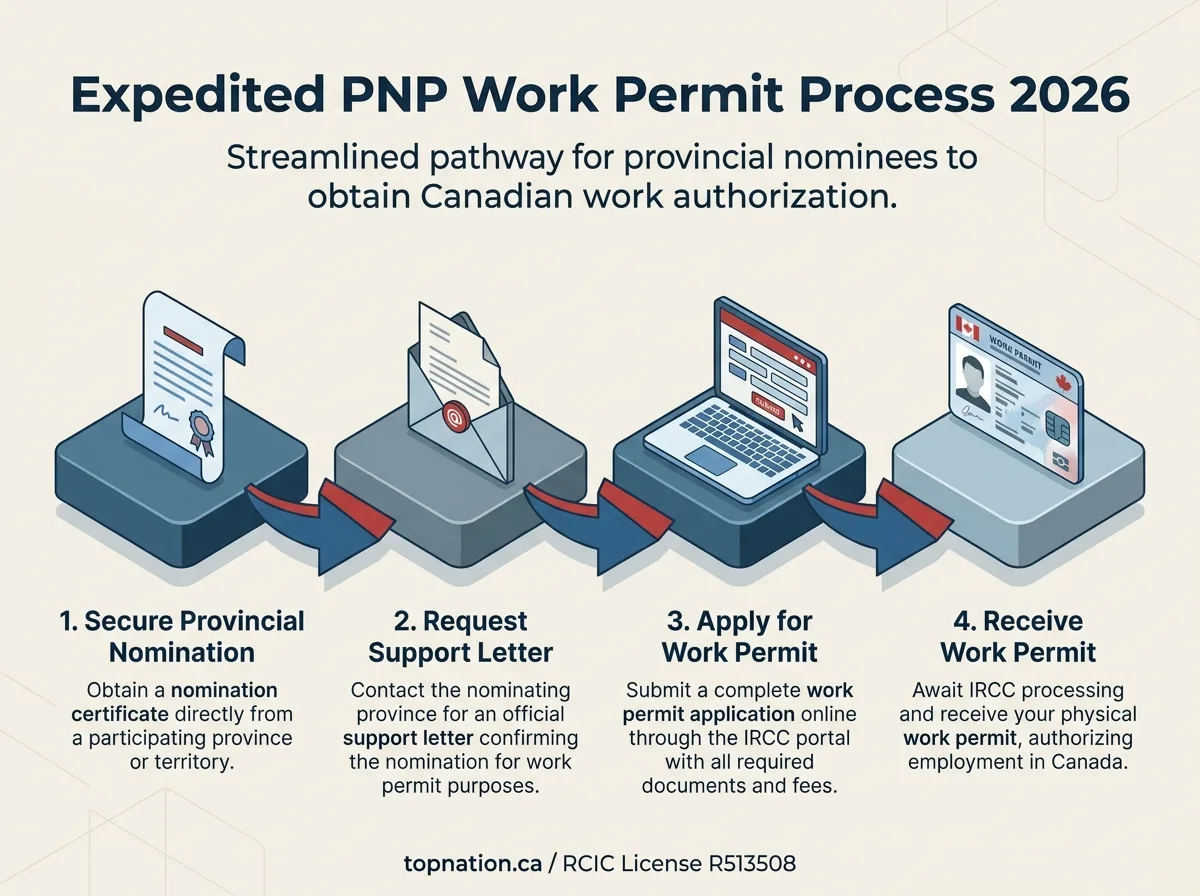
Step 1: Create or Log in to Your Secure IRCC Account
All applications must be submitted online through the IRCC secure portal. If you don’t have one, you will need to create an account using a GCKey or Sign-In Partner.
Step 2: Start a New Application
Inside the portal, you will start a new application and select ‘Apply to come to Canada.’ The online questionnaire will guide you to the correct application type. You will indicate that you want to work in Canada, have a provincial nomination, and have a job offer.
Step 3: Complete the Application Form (IMM 1295)
You will need to fill out the Application for Work Permit Made Outside of Canada [IMM 1295], even if you are applying from within Canada. In the ‘Details of Intended Work in Canada’ section, you will select ‘Work Permit’ as the type. For the LMIA exemption, you will enter ‘T13’ as the exemption code, which corresponds to the International Mobility Program agreement for provincial nominees.
Step 4: Upload Your Documents and Pay Fees
The system will generate a personalized document checklist based on your answers. This is where you will upload your nomination certificate, provincial support letter, job offer, passport, photos, and other required forms. After uploading, you will pay the government processing fees online.
Document Checklist: A Comprehensive Guide
A complete and well-organized application is the key to faster processing. Missing or incorrect documents are the number one cause of delays. Use this as a guide, but always refer to the official checklist generated by your IRCC portal.
| Document | Key Details & Notes |
|---|---|
| Provincial Nomination Certificate | Must be valid (not expired). Provide the full certificate. |
| Work Permit Support Letter | The official letter issued by the PNP. This is mandatory. |
| Job Offer Letter | Detailed, on company letterhead, signed, and dated. Must match nomination details. |
| Application Forms | IMM 1295, IMM 5707 (Family Information), etc., as required by your checklist. |
| Passport / Travel Document | Clear scan of the biodata page and all pages with stamps/visas. |
| Digital Photo | Must meet IRCC’s specifications for digital photos. |
Understanding the ‘Employer-Restricted’ Condition
It is vital to understand the nature of the work permit you will receive. Unlike a BOWP or a spousal open work permit, this permit is ’employer-restricted,’ also known as a closed work permit. This means your authorization to work in Canada is tied to one specific employer and one specific location.
What This Means for Your Employment
Your work permit will list three conditions: your employer’s name, your occupation, and the city/town where you are authorized to work. You are not legally permitted to work for any other employer or in any other location without first applying for and being approved for a new work permit. Changing jobs is not a simple process and requires careful planning.
Changing Employers After Receiving a PNP Work Permit
If your employment situation changes, you cannot simply start a new job. Changing employers would require support from your new employer and, crucially, approval from the provincial program. You would likely need to have your nomination updated to the new employer and then apply for a new work permit, which can be a complex and lengthy process. It is always advisable to maintain employment with your nominating employer until you become a permanent resident.
Processing Times and Government Fees (June 2026)
Managing expectations around timelines and costs is a key part of the immigration process. The fees are set by the government and are subject to change.
IRCC Application Fees
As of June 2026, the standard government fees are: Work Permit processing fee: $155 CAD per person. Open Work Permit Holder fee (for spouses): $100 CAD. Biometrics fee: $85 CAD for an individual or $170 CAD for a family.
Observed Processing Times
While IRCC posts average processing times on its website, these can vary widely. Since the June 15th policy change, our firm has observed a positive trend. For well-prepared applications submitted from within Canada, we are seeing initial processing times for these T13-exempt work permits in the range of 60 to 90 days. This is a significant improvement over previous wait times. Requesting the provincial support letter itself adds to the timeline; for AAIP, we’ve seen these issued in as few as 15-20 business days for complete requests.
Frequently Asked Questions (FAQ)
Can I apply for this work permit from outside Canada?
Yes, the policy allows for applications to be submitted from either inside or outside Canada. The application form (IMM 1295) is technically for those outside Canada, but it is the correct form to use even when applying from within. Processing times may differ depending on the visa office responsible for your region if you apply from abroad.
What if my provincial nomination is about to expire?
You must apply for the work permit *before* your nomination certificate expires. If the expiry date is imminent, your priority should be to contact the provincial program that nominated you to request an extension. Most PNPs have a process for this, but it is not guaranteed. A work permit application submitted with an expired nomination certificate will be refused.
Does this work permit grant me implied status?
Yes, if you apply for this new work permit from within Canada before your current temporary status (e.g., another work permit, study permit, or visitor record) expires, you will benefit from maintained status (formerly known as implied status). This allows you to continue under the conditions of your existing permit until a decision is made on your new work permit application.
Navigating Your Immigration Journey with TopNation
The June 2026 policy changes offer a welcome and much-needed pathway for provincial nominees to secure their employment and future in Canada. However, the process is detailed and unforgiving of errors. From securing the provincial support letter to correctly filing the LMIA-exempt work permit application, every step must be handled with precision.
At TopNation Immigration, our team of licensed consultants specializes in navigating complex provincial nominee pathways. As an immigration consultant in Edmonton, we have direct and current experience with the AAIP’s new procedures for support letters. We can ensure your application is complete, accurate, and strategically positioned for the fastest possible approval. Your journey to permanent residence is a marathon, and this new work permit is a critical step in that race.
Secure Your Work Permit Under the New PNP Rules.
Our licensed RCICs will review your nomination and guide you through the support letter and work permit application process.
| Call 587-400-0077 | Book a Consultation → |
RCIC Licensed | Serving All of Alberta
Last updated: June 2026. This guide reflects the IRCC policy update for provincial nominee work permits announced on June 15, 2026. Immigration rules change frequently — consult a licensed RCIC (R513508) for advice specific to your situation.