Your 2026 Guide to Trades Immigration
Canada’s demand for skilled trades is at an all-time high. The Express Entry system, through the Federal Skilled Trades Program (FSTP) and targeted category-based draws, offers a direct pathway to permanent residence for qualified tradespeople. This comprehensive guide details the specific eligibility, NOC codes, and provincial strategies for 2026.
EXPRESS ENTRY: SKILLED TRADES — 2026 GUIDE

For skilled trades professionals around the world—from electricians in Dublin to welders in Dubai and carpenters in Cape Town—Canada represents more than just a new job; it’s a pathway to a stable, prosperous future. In 2026, the demand for your skills has never been greater. The Canadian government, through its Express Entry system, has created dedicated streams designed specifically for tradespeople. This guide is your blueprint to navigating the Federal Skilled Trades Program (FSTP), understanding the crucial role of category-based draws, and leveraging powerful provincial nominee programs like the Alberta Advantage Immigration Program (AAIP) to secure your permanent residency in Canada.
Canada’s Growing Demand for Skilled Trades in 2026
Canada is facing a significant and prolonged shortage of skilled trades workers. An aging workforce, coupled with major infrastructure, construction, and energy projects nationwide, has created a critical gap that domestic labour cannot fill alone. Projections from BuildForce Canada indicate a need for hundreds of thousands of new construction and maintenance workers by the end of the decade. This isn’t just a statistic; it’s a government mandate. Immigration, Refugees and Citizenship Canada (IRCC) has been explicitly tasked with using the immigration system to target and invite the tradespeople Canada needs to build its future.
This reality is reflected directly in immigration policy. The introduction of category-based Express Entry draws in 2023 was a game-changer. For the first time, IRCC can specifically invite candidates from the pool based on their occupation, with trades being one of the top priority categories. This means that even if your Comprehensive Ranking System (CRS) score isn’t high enough for a general draw, your in-demand trade skill could earn you a coveted Invitation to Apply (ITA) for permanent residence.
Understanding the Federal Skilled Trades Program (FSTP)
The Federal Skilled Trades Program (FSTP) is one of the three economic immigration programs managed under the Express Entry system, alongside the Federal Skilled Worker Program (FSWP) and the Canadian Experience Class (CEC). It was specifically designed to address labour shortages by providing a streamlined path to permanent residence for qualified tradespeople with experience in specific occupations.
Unlike the FSWP, which uses a points grid and has mandatory education requirements, the FSTP is tailored to the realities of the trades sector. It recognizes that hands-on experience and certifications are often more critical than formal academic credentials. This is reflected in its unique and more accessible eligibility criteria, particularly concerning language proficiency and education.
How FSTP Integrates with Express Entry
To apply through the FSTP, you must first create an Express Entry profile. This involves providing information about your skills, work experience, language ability, and other personal details. Based on this information, you are assigned a CRS score. However, meeting the minimum FSTP eligibility criteria is the first and most crucial step. Once you are in the Express Entry pool as an FSTP candidate, you become eligible for two types of draws: general draws (if your CRS score is high enough) and category-based draws specifically for trades occupations.
FSTP vs. FSWP: Key Differences for Tradespeople
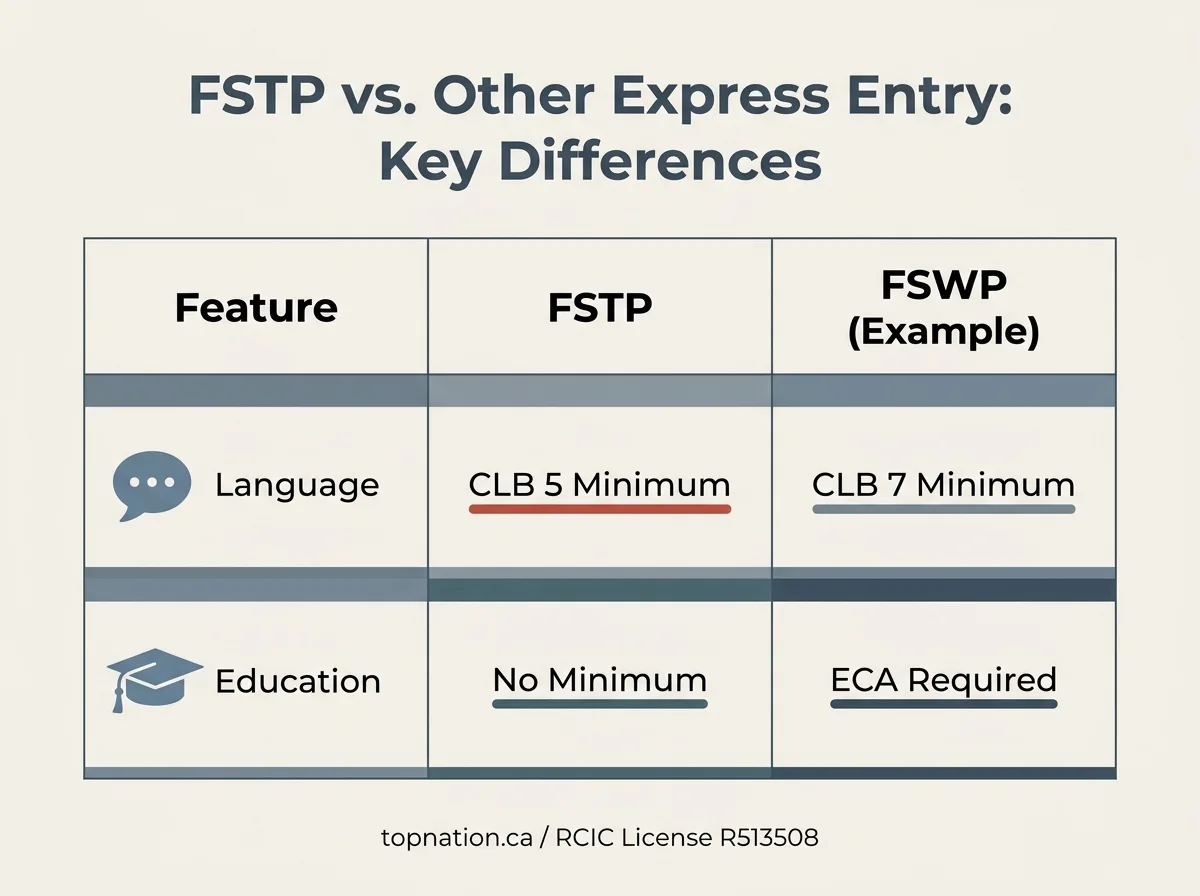
Many tradespeople wonder if they should apply through the FSTP or the more widely known FSWP. The choice often comes down to your specific profile. The FSTP has a lower language requirement (CLB 5 for speaking/listening, CLB 4 for reading/writing) and no minimum education requirement. In contrast, the FSWP requires a minimum of CLB 7 across all abilities and mandates an Educational Credential Assessment (ECA) to prove your foreign education is equivalent to a Canadian high school diploma or higher. For many hands-on professionals whose expertise isn’t reflected in a university degree, the FSTP is a far more practical and accessible pathway.

FSTP Eligibility Criteria: Your Detailed 2026 Checklist
Meeting the minimum requirements for the Federal Skilled Trades Program is non-negotiable. Before you can even think about your CRS score, you must satisfy every one of these criteria. Let’s break them down in detail.
1. Skilled Work Experience Requirement
This is the cornerstone of your FSTP application. You must have at least two years of full-time paid work experience (or an equal amount of part-time experience) in an eligible skilled trade within the five years before you apply. Full-time is defined as at least 30 hours per week. The experience must be in one of the specified National Occupational Classification (NOC) codes. It’s crucial that the main duties you performed align with the lead statement and main duties listed in the official NOC description.
2. Eligible NOC TEER 2 & 3 Occupations
Your work experience must fall under specific NOC Major Groups, which are primarily TEER 2 or TEER 3 occupations. These groups cover industrial, electrical, construction, maintenance, equipment operation, and supervisory roles in trades. The eligible major groups are:
- Major Group 72: Technical trades and transportation officers and controllers
- Major Group 73: General trades
- Major Group 82: Supervisors in natural resources, agriculture and related production
- Major Group 83: Occupations in natural resources and related production
- Major Group 92: Processing, manufacturing and utilities supervisors and central control operators
- Major Group 93: Central control and process operators and aircraft assembly assemblers and inspectors
- Unit Group 6320: Cooks, butchers and bakers
It is absolutely critical to correctly identify your NOC code. A mistake here can lead to your application being refused.
3. Job Offer or Certificate of Qualification
This is a unique requirement of the FSTP. You must meet one of the following two conditions:
- A valid job offer of full-time employment for a total period of at least one year from up to two Canadian employers. This often requires a Labour Market Impact Assessment (LMIA), although some LMIA exemptions may apply.
- A certificate of qualification in your skilled trade issued by a Canadian provincial, territorial, or federal authority. This certificate proves you are qualified to work in that trade in a specific province or territory.
4. Language Proficiency (Lower CLB Threshold)
The FSTP has a more accessible language requirement compared to other Express Entry programs. You must meet the Canadian Language Benchmark (CLB) level 5 for speaking and listening, and CLB level 4 for reading and writing. You must prove this by taking an approved language test (IELTS or CELPIP for English; TEF or TCF for French). While these are the minimums, achieving higher scores will significantly boost your CRS score.
5. No Minimum Education Requirement
A major advantage of the FSTP is that there is no mandatory education requirement. However, if you want to improve your rank in the Express Entry pool, you can earn points for your education. To do so, you must have your foreign educational credentials assessed by a designated organization (like WES) to get an Educational Credential Assessment (ECA) report.
6. Proof of Funds
Unless you are currently able to legally work in Canada and have a valid job offer, you must show that you have enough money to support yourself and your family after you arrive. The amount required depends on the size of your family and is updated annually by the Canadian government.
7. Admissibility to Canada
Like all immigration applicants, you must be admissible to Canada. This means you must not have any serious medical, criminal, or security issues that would make you ineligible to enter the country.
Deep Dive: Eligible NOC TEER 2 & 3 Occupations for FSTP
Understanding the specific occupations that qualify for the Federal Skilled Trades Program is the first step in assessing your eligibility. Canada’s National Occupational Classification (NOC) system categorizes jobs based on duties and work. For FSTP, the focus is on specific TEER 2 and TEER 3 roles within key industrial and service sectors.
Your work experience must align with the lead statement and a substantial number of the main duties described in the official NOC profile. Simply having the right job title is not enough; your day-to-day responsibilities must match. Below is a breakdown of the key Major Groups and examples of qualifying occupations.
| NOC Major Group | Description & Examples |
|---|---|
| Major Group 72 | Technical Trades: Includes construction, electrical, and industrial trades. Examples: Electricians (72200), Plumbers (72300), Carpenters (72310), Welders (72106), Heavy-duty equipment mechanics (72401). |
| Major Group 73 | General Trades: Covers maintenance and equipment operation roles. Examples: Automotive service technicians (72410), Heating, refrigeration and air conditioning mechanics (72402), Crane operators (72500). |
| Major Group 82 & 83 | Natural Resources & Agriculture: Supervisory and operational roles. Examples: Supervisors, logging and forestry (82010), Contractors and supervisors, agriculture (82030), Fishing masters and officers (83120). |
| Major Group 92 & 93 | Manufacturing & Utilities: Supervisory and control operator roles. Examples: Supervisors, petroleum, gas and chemical processing (92010), Power engineers and power systems operators (92100). |
| Unit Group 6320 | Cooks, Butchers, Bakers: Specific culinary trades. Examples: Cooks (63200), Butchers – retail and wholesale (63201), Bakers (63202). |
Verifying Your Work Experience
When you submit your application after receiving an ITA, you will need to provide detailed letters of reference from your employers. These letters must be printed on company letterhead and include your job title, salary, period of employment, hours worked per week, and a detailed list of your duties. IRCC officers will meticulously compare these duties against the official NOC description. Any discrepancies can jeopardize your entire application. This is an area where the expertise of a licensed immigration consultant is invaluable, ensuring your experience is framed correctly and accurately.
The Certificate of Qualification and Red Seal Program
For FSTP candidates without a Canadian job offer, the Certificate of Qualification is the key that unlocks eligibility. This certificate is issued by a provincial or territorial body that governs skilled trades and essentially confirms that you have the skills and experience to meet the standards of that province. In Canada, many skilled trades are regulated, meaning you need to be licensed or certified to work in them legally.
What is a Certificate of Qualification?
A Certificate of Qualification (often called a C of Q) is proof of your competency. To obtain one, you typically need to have your foreign experience and training assessed by the relevant provincial regulatory body. This process often involves submitting detailed documentation of your work experience, training, and education, and may require you to pass a written examination. The process varies significantly by province and by trade.
The Red Seal Endorsement: The Gold Standard
The highest standard of trade certification in Canada is the Red Seal Endorsement (RSE). A Red Seal, when affixed to a provincial or territorial trade certificate, indicates that a tradesperson has demonstrated the knowledge and skills required by the national standard for that trade. This endorsement is highly respected by employers and allows you to practice your trade in any province or territory in Canada where the trade is designated, without needing further examination. For immigration purposes, obtaining a Red Seal is a powerful asset, as it is a nationally recognized Certificate of Qualification.
How to Get Your Skills Assessed from Outside Canada
Each province has its own apprenticeship and trades certification authority. For example, in Alberta, it’s the Alberta Apprenticeship and Industry Training (AIT). You would need to apply to the relevant authority for your target province to have your credentials assessed. This is a complex process that requires careful preparation of your documents and a thorough understanding of the specific requirements for your trade. It is highly advisable to start this process well in advance of creating your Express Entry profile.
Language Proficiency: Understanding the CLB 4/5 Requirement
The language requirement for the FSTP is one of its most attractive features. It acknowledges that for many hands-on trades, advanced linguistic skill is less critical than technical ability. However, you must still demonstrate a foundational level of English or French proficiency to qualify.
Breaking Down CLB 5 and CLB 4
The Canadian Language Benchmarks (CLB) are the national standard used to describe, measure, and recognize the language ability of adult immigrants. For FSTP, the minimums are:
- CLB 5 in Speaking and Listening
- CLB 4 in Reading and Writing
This means you need to be able to participate in basic conversations, understand simple instructions, read straightforward texts, and write short, simple messages related to your field. These scores are converted from your results on an approved language test like IELTS General Training or CELPIP-General.
| Language Skill | Minimum CLB Level | Equivalent IELTS Score | Equivalent CELPIP Score |
|---|---|---|---|
| Speaking | 5 | 5.0 | 5 |
| Listening | 5 | 5.0 | 5 |
| Reading | 4 | 3.5 | 4 |
| Writing | 4 | 4.0 | 4 |
Strategy: Aiming Higher Than the Minimum
While meeting these minimums makes you eligible for the program, it does not guarantee an invitation. Language proficiency is a significant factor in your CRS score. Every point increase in your IELTS or CELPIP scores can translate into more CRS points. A tradesperson who achieves CLB 7 or higher will have a much more competitive profile than someone who only meets the minimum CLB 4/5 threshold. Investing time in preparing for your language test is one of the most effective ways to improve your chances of success in Express Entry.
Express Entry Category-Based Draws for Trades in 2026
The introduction of category-based selection rounds has fundamentally changed the Express Entry landscape for skilled trades professionals. This system allows IRCC to target candidates with specific, in-demand skills, addressing critical labour market needs directly. Trades occupations have been a consistent priority since these draws began.
How Category-Based Draws Work
In addition to the regular, all-program Express Entry draws that invite candidates based solely on their CRS score, IRCC now conducts targeted draws for specific categories. For 2026, the categories include healthcare, STEM professions, transport, agriculture, and, most importantly for this guide, trades.
When a trades-specific draw occurs, IRCC invites eligible candidates from the Express Entry pool who have work experience in one of the designated NOCs for that category. The key advantage is that the CRS cut-off score for these draws is often significantly lower than in general draws. For example, a general draw might require a score of 520, while a trades-specific draw could be as low as 380. This gives qualified tradespeople a realistic chance of receiving an ITA, even with a modest CRS score.
Eligible Occupations for Trades Category Draws
IRCC has published a specific list of NOC codes that are eligible for the trades category. This list is extensive and covers a wide range of professions, including:
- Residential and commercial installers and servicers (NOC 73200)
- Welders and related machine operators (NOC 72106)
- Electricians (except industrial and power system) (NOC 72200)
- Plumbers (NOC 72300)
- Carpenters (NOC 72310)
- Construction millwrights and industrial mechanics (NOC 72400)
- Heating, refrigeration and air conditioning mechanics (NOC 72402)
- Heavy-duty equipment mechanics (NOC 72401)
- Contractors and supervisors in various trades
To be eligible for these draws, you must have accumulated, within the past 3 years, at least 6 months of full-time, continuous work experience in one of these single occupations.
Provincial Nominee Programs (PNPs): The Alberta Advantage for Trades
While the federal Express Entry system is a powerful tool, it’s not the only path. Provincial Nominee Programs (PNPs) allow provinces and territories to nominate individuals who have the skills and experience needed in their local economies. For skilled trades workers, the Alberta Advantage Immigration Program (AAIP) is one of the most valuable PNPs in the country.
How Enhanced PNPs Supercharge Your Profile
Many PNPs have “enhanced” streams that are linked to the federal Express Entry system. If you are in the Express Entry pool and receive a nomination from a province like Alberta, you are awarded an additional 600 CRS points. This massive bonus effectively guarantees that you will receive an Invitation to Apply in the next Express Entry draw. This makes pursuing a provincial nomination a primary strategy for many trades candidates.
The Alberta Advantage Immigration Program (AAIP) for Skilled Trades
Alberta’s economy is booming, with massive projects in construction, energy, and manufacturing driving an insatiable demand for skilled trades. The AAIP has several streams that are highly favourable for tradespeople, especially the Alberta Express Entry Stream.
This stream allows the AAIP to search the federal Express Entry pool and issue Notifications of Interest (NOIs) to candidates who have strong ties to Alberta and work in an occupation that supports the province’s economic development and diversification. A valid job offer from an Alberta employer in your trade significantly increases your chances of receiving an NOI. Alberta frequently holds draws targeting candidates with job offers in specific in-demand sectors, with trades being a consistent priority.
Furthermore, Alberta’s list of eligible occupations is extensive, and the province is known for its high wages and quality of life, making it a top destination for tradespeople and their families. If you are a skilled trades worker, creating an Express Entry profile and indicating your interest in moving to Alberta is a critical strategic move. An immigration consultant in Edmonton can provide invaluable local knowledge on employer needs and AAIP priorities.

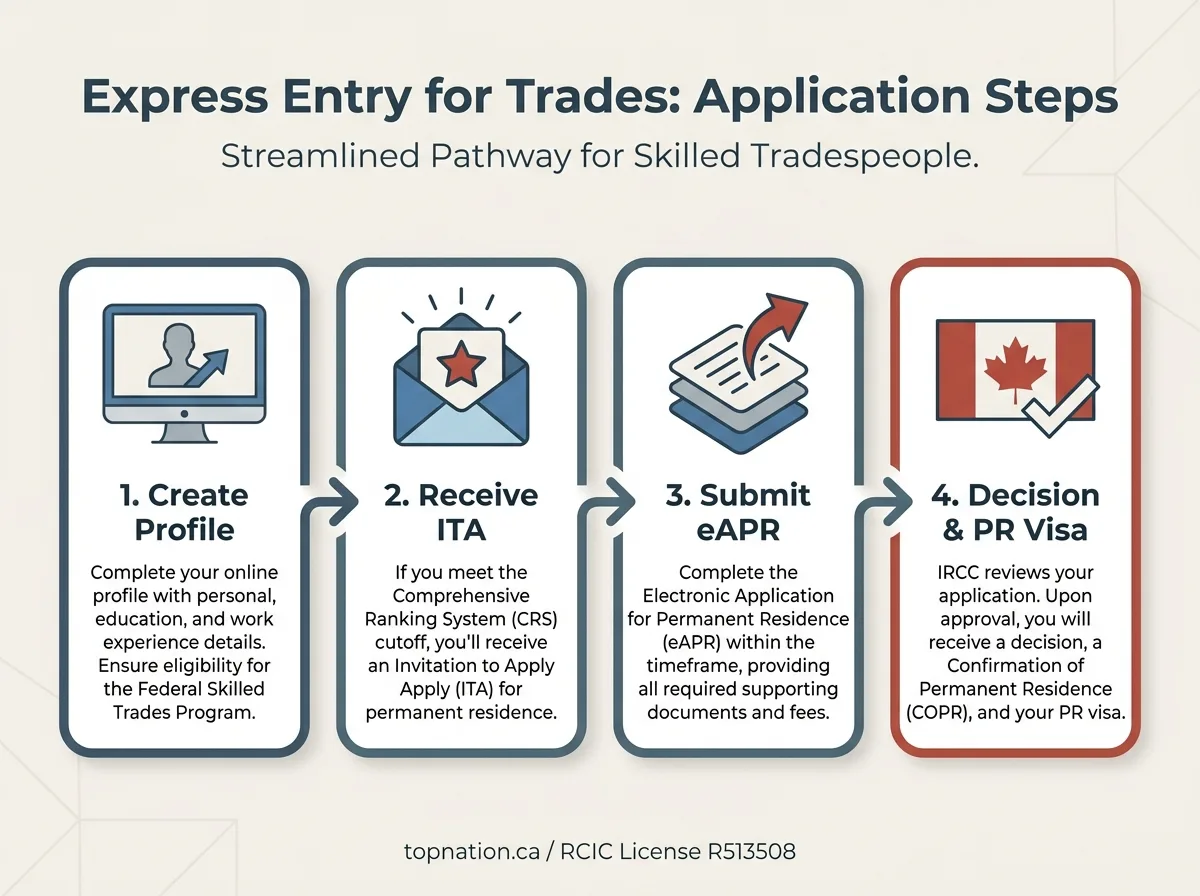
The Express Entry Application Process: A Step-by-Step Guide for Trades
Navigating the Express Entry system can seem daunting, but it can be broken down into a logical sequence of steps. Here is the typical journey for a skilled trades applicant.
Step 1: Determine Your Eligibility
Before anything else, confirm you meet the minimum requirements of the Federal Skilled Trades Program. This means verifying your two years of experience in an eligible NOC, meeting the CLB 4/5 language levels, and having either a valid job offer or a certificate of qualification.
Step 2: Gather Key Documents
You will need to complete your language tests (IELTS or CELPIP) and, if you want points for education, obtain an Educational Credential Assessment (ECA). This step should be done before creating your profile, as you need the results to enter the pool.
Step 3: Create Your Express Entry Profile
Using the IRCC secure online portal, you will create your Express Entry profile. You will input all your information: work history, education, language scores, age, etc. The system will automatically determine which program(s) you are eligible for (FSTP, FSWP, CEC) and calculate your initial CRS score.
Step 4: Enter the Pool and Wait for an Invitation
Once your profile is successfully submitted, you are placed in the Express Entry pool of candidates. You will be ranked against others based on your CRS score. Now, you are eligible to be invited in either a general draw, a trades-specific category-based draw, or to receive a Notification of Interest from a province like Alberta.
Step 5: Receive an Invitation to Apply (ITA)
If your score is high enough or you are selected in a targeted draw, you will receive an ITA. This is your official invitation from the Canadian government to apply for permanent residence. From the date you receive the ITA, you have 60 days to submit your complete application.
Step 6: Submit Your Electronic Application for Permanent Residence (e-APR)
This is the most critical stage. You must upload all your supporting documents to prove the claims you made in your Express Entry profile. This includes reference letters, proof of funds, police certificates, medical exam results, and language test reports. Accuracy and completeness are paramount.
Step 7: Final Processing and Decision
An IRCC officer will review your e-APR. They may request additional information or an interview. If everything is in order, you will receive a Confirmation of Permanent Residence (COPR). The standard processing time for Express Entry applications is six months from the submission of the e-APR.
Maximizing Your Chances: Strategic Tips for Trades Professionals
Simply meeting the minimum FSTP eligibility is often not enough to secure an ITA in a competitive system. A strategic approach is necessary to maximize your CRS score and improve your overall chances of success.
Improve Your Language Scores
This is the single most effective way for most candidates to increase their CRS score. Moving from a CLB 7 to a CLB 9, for example, can add a significant number of points. Invest in test preparation courses and practice tests. Even a small improvement in one language skill can make a difference.
Secure a Canadian Job Offer
A valid job offer supported by an LMIA can add 50 or 200 points to your CRS score, depending on the NOC code. While securing a job from abroad can be challenging, it is a powerful tool. Focus on networking, tailoring your resume to Canadian standards, and targeting employers in high-demand regions like Alberta.
Pursue Provincial Nomination
As discussed, a PNP nomination is the ultimate game-changer, adding 600 points to your score. Research the specific requirements for the Express Entry-linked streams in provinces where your trade is in high demand. Tailor your Express Entry profile to show interest in these provinces.
Gain Canadian Experience
If possible, obtaining a temporary Canadian work permit to gain at least one year of skilled work experience in Canada can significantly boost your profile. This not only adds CRS points but also makes you eligible for the Canadian Experience Class (CEC), opening up more invitation opportunities.
Consider Your Spouse or Partner’s Credentials
If you are applying with a spouse or common-law partner, their language skills, education, and Canadian work experience can also contribute points to your total CRS score. Ensuring they also take a language test and get an ECA can provide a valuable boost.
Frequently Asked Questions (FAQs) for FSTP Applicants
Navigating the details of the Federal Skilled Trades Program can bring up many questions. Here are answers to some of the most common queries we receive at TopNation Immigration.
Do I absolutely need a job offer for the FSTP?
No, a job offer is not mandatory if you have a Certificate of Qualification from a Canadian provincial or territorial body. You must meet one of these two conditions to be eligible. The Certificate of Qualification demonstrates that your skills are recognized in Canada, serving a similar purpose to a job offer in proving your ability to establish yourself economically.
What is the difference between a Certificate of Qualification and a Red Seal?
A Certificate of Qualification is issued by a specific province and allows you to work in that trade within that province. A Red Seal is an endorsement on your provincial Certificate of Qualification that signifies you meet a national standard. It provides greater mobility, allowing you to work in any province or territory where the trade is designated without further testing.
Is there an age limit for the Federal Skilled Trades Program?
There is no strict age limit to be eligible for the FSTP. However, the Express Entry CRS awards points for age, with the maximum points given to candidates between 20 and 29 years old. Points for age begin to decrease after 30 and drop to zero at age 45. While you can still apply after this age, you will not receive any points for this factor, making it more challenging to achieve a competitive CRS score.
How does the CRS score really work for FSTP candidates?
Even though FSTP has lower entry criteria, once you are in the Express Entry pool, you are ranked using the same Comprehensive Ranking System as all other candidates. Your score is based on factors like age, education, language skills, and work experience. This is why it’s crucial to maximize points wherever possible. However, the key advantage for FSTP candidates is the existence of trades-specific category-based draws, where the CRS cut-off is often much lower than in general draws, giving you a targeted pathway to an invitation.
How a Licensed RCIC Can Secure Your Future in Canada
The path to Canadian permanent residence through the skilled trades streams is filled with specific, technical requirements. A small error in identifying your NOC code, an improperly formatted reference letter, or a misunderstanding of the Certificate of Qualification process can lead to costly delays or even a refusal. This is where professional guidance becomes your most valuable tool.
At TopNation Immigration (CICC RCIC #R513508), we specialize in navigating complex economic immigration pathways for skilled professionals. Our team of licensed Regulated Canadian Immigration Consultants understands the unique challenges and opportunities for tradespeople. We provide a comprehensive assessment of your eligibility, develop a personalized strategy to maximize your CRS score, guide you through the provincial certification process, and meticulously prepare and submit your application to ensure it is perfect the first time. Your future is too important to leave to chance.
Your Trade is In Demand. Your Path to Canada Starts Here.
Get a personalized assessment of your eligibility for the Express Entry Trades Category.
RCIC Licensed | Serving All of Alberta
Last updated: May 2024. This guide reflects current Express Entry rules and FSTP requirements for 2026 planning. Immigration rules change frequently — consult a licensed RCIC for advice specific to your situation.