New Wage Mandates for Canadian Employers
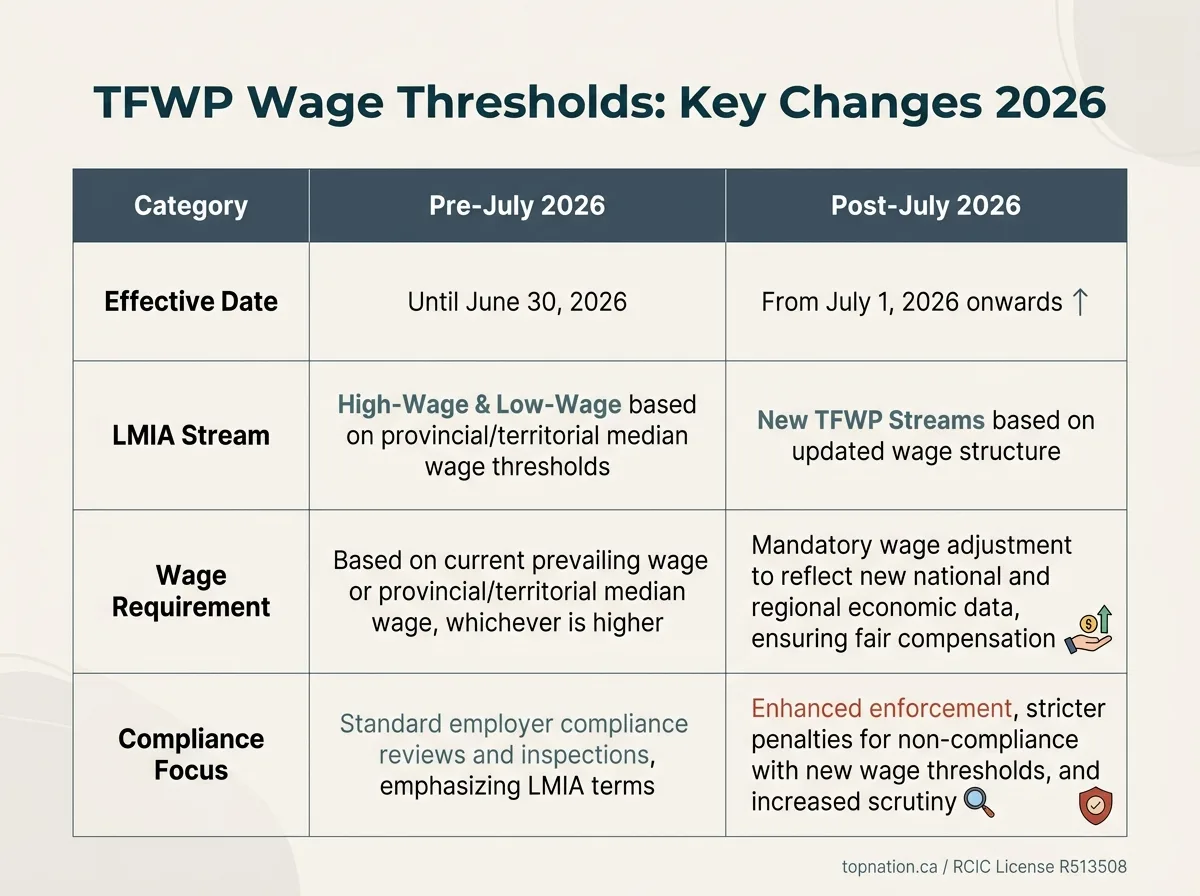
Effective July 17, 2026, new median hourly wage thresholds will be enforced for all Labour Market Impact Assessment (LMIA) applications under the Temporary Foreign Worker Program (TFWP). Employers must adjust their offered wages to meet or exceed these updated provincial rates to successfully hire foreign talent.
TFWP UPDATE — JULY 17, 2026
For Canadian employers relying on global talent, the landscape of the Temporary Foreign Worker Program (TFWP) is undergoing a significant financial adjustment. As of July 17, 2026, Employment and Social Development Canada (ESDC) will implement new, higher median hourly wage thresholds across all provinces and territories. This change directly impacts how Labour Market Impact Assessment (LMIA) applications are categorized and assessed, fundamentally altering the requirements for both the high-wage and low-wage streams. This guide provides a detailed breakdown for HR managers, business owners, and recruitment professionals on how to navigate these new rules, maintain compliance, and continue to successfully integrate foreign workers into their operations.

Navigating Canada’s New TFWP Wage Thresholds for 2026
The federal government’s decision to update the TFWP wage thresholds is rooted in its mandate to align the program with current economic realities and protect the domestic labour market. These adjustments are not arbitrary; they are based on the latest wage data from Statistics Canada’s Labour Force Survey. For employers, this means the goalposts for hiring temporary foreign workers have moved. An offered wage that was considered competitive yesterday might fall into the low-wage stream tomorrow, triggering a different, more stringent set of application requirements.
Understanding this shift is the first step toward strategic adaptation. It requires a proactive review of current and future hiring plans, payroll budgets, and overall talent acquisition strategies. Ignoring these changes can lead to refused LMIA applications, project delays, and significant operational disruptions. This guide is designed to equip you with the specific data and strategic insights needed to turn this regulatory challenge into a competitive advantage.
Understanding the Core Change: New Median Hourly Wages Explained
The central mechanism of the TFWP is the provincial or territorial median hourly wage. This figure acts as a dividing line, determining whether a position is classified as high-wage or low-wage. It is crucial to understand that this is not the same as the minimum wage. The median wage represents the midpoint of all wages in a given region—half of the workers earn more than the median, and half earn less. ESDC uses this metric to gauge whether an employer’s wage offer is fair and consistent with local market rates.
What is the Median Hourly Wage?
The median hourly wage is a statistical measure that provides a more accurate representation of the typical wage in an economy than the average wage, as it is not skewed by a small number of very high or very low earners. For TFWP purposes, if the wage you offer for a position is at or above the current median for that province, the LMIA application is processed through the high-wage stream. If the offered wage is below the median, it falls into the low-wage stream.
Why Does This Distinction Matter for Employers?
The classification of a position as high-wage or low-wage dictates the entire LMIA application process. Each stream has distinct requirements concerning recruitment efforts, transition plans, caps on the number of workers, and employer obligations regarding housing and transportation. The July 17, 2026, update will re-calibrate this dividing line, potentially shifting many positions from the high-wage to the low-wage category if employers do not adjust their compensation accordingly.

Provincial Breakdown: Key Wage Thresholds Across Canada
The new wage thresholds vary significantly by province and territory, reflecting the diverse economic landscapes across Canada. Employers with operations in multiple provinces must be acutely aware of these regional differences. A wage offer that qualifies for the high-wage stream in one province might not in another.
Below is a comparative table outlining the new median hourly wages effective July 17, 2026. Alberta, with its dynamic economy, sees a notable increase that local employers must factor into their 2026-2027 hiring budgets.
| Province/Territory | Previous Median Wage | New Median Wage (July 17, 2026) | Change |
|---|---|---|---|
| Alberta | $28.85 | $29.50 | + $0.65 |
| British Columbia | $28.75 | $29.00 | + $0.25 |
| Manitoba | $24.04 | $25.00 | + $0.96 |
| Ontario | $28.21 | $28.85 | + $0.64 |
| Quebec | $26.00 | $27.00 | + $1.00 |
| Saskatchewan | $26.75 | $27.00 | + $0.25 |
Focus on Alberta: Implications for Local Businesses
For businesses in Alberta, the new median wage of $29.50 per hour is a critical number. Industries such as hospitality, food services, and certain construction trades, which often rely on TFWs for positions paying between $28 and $29 per hour, will now find these roles classified under the low-wage stream. This triggers additional requirements, including a cap on the proportion of their workforce that can be TFWs and mandatory assistance with housing. Local employers, particularly those in cities like Edmonton and Calgary, must immediately review their compensation structures to avoid unintended non-compliance. For guidance specific to your business, it is wise to consult with an immigration consultant in Edmonton.
Impact on LMIA Applications: The Low-Wage Stream Post-July 2026
When an employer offers a wage below the new provincial median, the LMIA application falls into the Low-Wage Stream. This stream is designed with more stringent protections for both the foreign worker and the Canadian labour market, placing a heavier burden of proof and responsibility on the employer.
Key Requirements for the Low-Wage Stream
Employers applying under this stream must adhere to several key mandates:
- Cap on TFWs: Employers are subject to a cap on the number of low-wage temporary foreign workers they can hire at a specific work location.
- Housing and Transportation: You must demonstrate that suitable and affordable housing is available for the worker. In many cases, employers are required to provide or arrange for housing and cover transportation costs to and from the place of work.
- Employment Contract: A comprehensive employment contract must be provided and signed by both the employer and the worker, outlining wages, duties, and conditions.
- Recruitment Efforts: Employers must prove they have conducted extensive recruitment efforts to hire Canadians and permanent residents first, often targeting underrepresented groups.
Common Pitfall We See: The Generic Housing Plan
One of the most frequent reasons for a refusal in the low-wage stream is an inadequate housing plan. Many employers submit generic Kijiji or Zumper listings as proof of available housing. ESDC officers will reject this. A successful plan must be specific and actionable. Based on our firm’s experience with hundreds of LMIA applications, a successful housing plan includes signed rental agreements or letters from landlords confirming availability, photos of the accommodation, and a detailed budget showing the rent is affordable (typically less than 30% of the worker’s pre-tax income). Failure to provide this level of detail is a common and costly mistake.
Impact on LMIA Applications: The High-Wage Stream Post-July 2026
Offering a wage at or above the new median wage places the application in the High-Wage Stream. While this stream is exempt from the cap and housing requirements, it introduces its own critical obligation: the Transition Plan.
The Transition Plan: A Mandatory Commitment
For most high-wage LMIA applications, employers must submit a detailed Transition Plan. This plan is a formal commitment to undertake activities that will reduce your reliance on temporary foreign workers over time. It is not a mere formality; it is a key assessment criterion for the ESDC officer reviewing your file. Your plan must outline specific, measurable, and achievable activities.
Acceptable Transition Plan Activities
Your Transition Plan must include a minimum of three distinct activities. Examples include:
- Recruitment and Training: Investing in skills training for Canadian employees or participating in job fairs aimed at hiring local talent.
- Supporting PR Pathways: Actively assisting a temporary foreign worker in their application for permanent residence. This is often the most practical and effective activity.
- Knowledge Transfer: Facilitating the transfer of specialized skills from the foreign worker to Canadian colleagues.
The credibility of your Transition Plan is paramount. Our data from successful 2025-2026 applications shows that LMIAs with well-defined Transition Plans, particularly those committing to support a worker’s PR application, have a 20% higher approval rate than those with vague or generic commitments.
| Feature | Low-Wage Stream (Below Median) | High-Wage Stream (At or Above Median) |
|---|---|---|
| Primary Requirement | Meet cap, provide housing/transport plans | Submit a detailed Transition Plan |
| Workforce Cap | Yes, cap applies | No, cap does not apply |
| Work Permit Duration | Up to 2 years | Up to 3 years |
| PR Pathway Support | Supported, but less direct | Can be a key part of the Transition Plan |
Employer Compliance Strategies: Adapting to the New TFWP Landscape
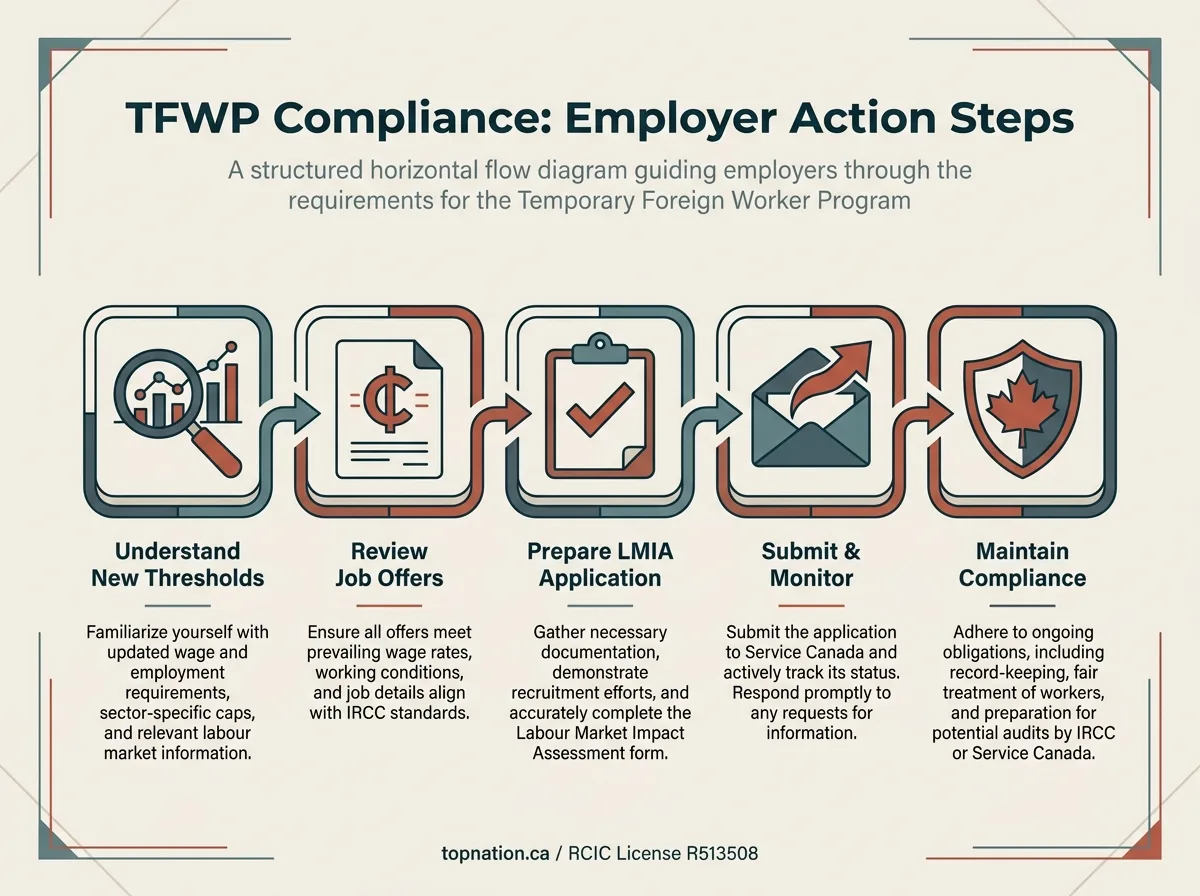
Proactive adaptation is essential to successfully navigate these changes. Reactive measures taken after the deadline will likely result in failed applications and hiring delays. We recommend a four-part strategy for all our corporate clients.
Step 1: Conduct a Wage and Position Audit
Immediately review all current and planned positions that are or will be filled by temporary foreign workers. Compare their current wages against the new median threshold for your province. Identify which positions will be re-classified from high-wage to low-wage if compensation is not adjusted.
Step 2: Budget for Increased Labour Costs
For positions that are critical to your operations and currently sit just below the new median wage, you face a strategic choice: increase the wage to qualify for the High-Wage Stream (avoiding the cap and housing rules) or prepare a robust application for the Low-Wage Stream. Both options have cost implications that must be factored into your 2026-2027 budget.
Step 3: Revise Recruitment and Transition Plans
Update your standard recruitment templates and Transition Plans to reflect the new reality. Ensure your advertising meets the specific requirements for the correct stream. If you plan to use the High-Wage Stream, start developing concrete, verifiable activities for your Transition Plan now. As a best practice, we advise clients to offer wages at least 2-3% above the median to create a buffer against future adjustments.
Step 4: Explore All Avenues, Including Exemptions
The TFWP and its LMIA process are just one part of Canada’s immigration system. Now is the perfect time to evaluate whether other programs might be a better fit. An expert can help you explore the full LMIA process and potential exemptions available under the International Mobility Program (IMP) or specific provincial nominee streams that might align with your needs. A comprehensive strategy considers all options.

The Role of a CICC-Regulated Immigration Consultant in TFWP Compliance
Navigating the complexities of the TFWP, especially during a period of regulatory change, can be daunting. The rules are intricate, and a small mistake on an application can lead to a refusal. A CICC-regulated immigration consultant (RCIC) provides more than just paperwork assistance; they offer strategic counsel to ensure your business goals are met within the bounds of Canadian immigration law.
Strategic Planning and Risk Mitigation
An experienced consultant can analyze your workforce needs and help you decide the most effective path forward. This may involve increasing wages to access the High-Wage Stream, developing a bulletproof Low-Wage Stream application, or identifying an LMIA-exempt work permit category you hadn’t considered. They can help you understand the nuances of the LMIA process and mitigate the risk of refusal.
Ensuring Application Perfection
From ensuring your job advertisements meet ESDC’s stringent criteria to crafting a compelling Transition Plan, an RCIC ensures every detail of your application is correct and strategically positioned for approval. This attention to detail is critical, as ESDC officers have very little discretion to overlook errors or omissions. By engaging professional help, you save time, reduce stress, and significantly increase your chances of a positive outcome.
Frequently Asked Questions for Employers
As these changes approach, many employers have similar questions. Here are answers to some of the most common inquiries we’ve received.
What happens if I submit my LMIA before July 17, 2026, but it’s assessed after?
ESDC generally assesses applications based on the rules in place at the time of submission. Therefore, an LMIA application submitted on or before July 16, 2026, should be assessed against the previous median wage thresholds. However, processing times can be unpredictable. To avoid any ambiguity, it is best to file well in advance or prepare your application to meet the new, higher wage requirements.
Do these new wage thresholds apply to LMIA-exempt work permits?
No. These median wage thresholds are specific to the Temporary Foreign Worker Program (TFWP), which requires an LMIA. LMIA-exempt work permits under the International Mobility Program (IMP), such as those under free trade agreements (CUSMA, CETA) or for intra-company transferees, are not directly governed by these provincial median wage figures. However, the wage offered must still be fair and competitive for the occupation and region.
How does this change affect positions under the Global Talent Stream (GTS)?
The Global Talent Stream has its own specific wage requirements, which are generally much higher than the provincial median. For Category B of the GTS, the wage must meet or exceed the prevailing wage for the occupation and be at least the provincial median. Therefore, an increase in the provincial median wage will also raise the minimum floor for some GTS applications, making it even more of a high-wage, high-skill stream.
My business is in a rural area with a lower cost of living. Are there any exceptions?
Unfortunately, the TFWP median wage thresholds are set at the provincial/territorial level and do not have specific exceptions for rural or remote regions. The same median wage applies in downtown Toronto as it does in a small northern Ontario town. Employers in rural areas must meet the same threshold as their urban counterparts, which can present unique challenges. This is where strategic planning with a consultant can be particularly valuable. You can contact a licensed RCIC to discuss your specific situation.
New TFWP Wage Rules Are Here. Is Your Business Ready?
Get a free, no-obligation review of your current TFWP strategy against the July 17, 2026 requirements.
| Call 587-400-0077 | Request Free Employer Assessment |
RCIC Licensed | Serving All of Alberta
Last updated: June 2024. This guide reflects the announced TFWP wage changes effective July 17, 2026. Immigration rules change frequently — consult a licensed RCIC for advice specific to your situation.