Quick Answer
LMIA vs LMIA exempt is the first decision an Alberta employer should make before hiring a foreign worker. An LMIA work permit usually requires labour-market proof through the Temporary Foreign Worker Program, while an LMIA-exempt work permit uses an International Mobility Program category where Canada has already recognized a broader economic, cultural, reciprocal, or family-based benefit.
For many employers, the right answer is not simply “which is faster?” It is which pathway matches the worker, the job offer, the business structure, and the compliance file you can defend later. This guide compares LMIA vs LMIA exempt options for Alberta employers in 2026, with practical examples and links to the official IRCC resources where exact program rules should be checked before filing.

What Is an LMIA Work Permit?
An LMIA work permit is normally connected to the Temporary Foreign Worker Program. In this route, the Canadian employer first applies for a Labour Market Impact Assessment and tries to show that hiring the foreign worker will not negatively affect Canadian workers or permanent residents. The employer usually needs to document recruitment efforts, wage compliance, business legitimacy, and the reason the role cannot be filled locally.
If the LMIA is approved, the worker can use that confirmation to apply for an employer-specific work permit. The worker is usually tied to the named employer, occupation, and location. For Alberta businesses facing chronic shortages, this can be a strong route, but it requires careful evidence. Therefore, employers should treat the LMIA as both an immigration application and a compliance file.
What Is an LMIA-Exempt Work Permit?
An LMIA-exempt work permit is usually processed through the International Mobility Program. Instead of proving a local labour shortage each time, the employer or worker relies on a specific exemption category recognized by IRCC. Common examples include CUSMA professionals, intra-company transferees, Francophone Mobility, reciprocal employment, and spousal open work permits.
Because the exemption must fit the facts exactly, code selection matters. For example, intra-company transferees use different logic than Francophone Mobility, and open work permit holders may not need an employer compliance filing at all. For a deeper list of codes and examples, use our LMIA exemption codes guide alongside IRCC’s official LMIA exemption codes page.
LMIA vs LMIA-Exempt: Key Differences at a Glance
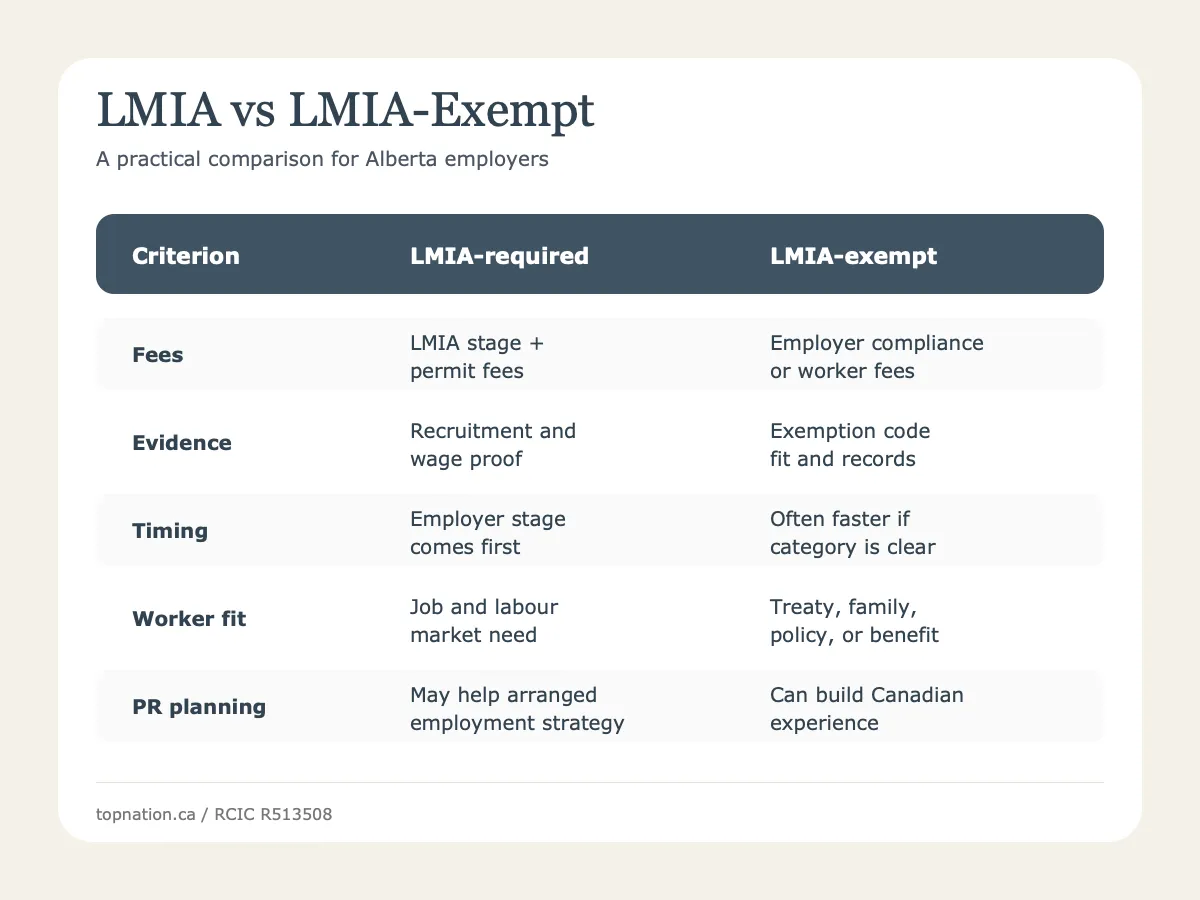
The table below gives a practical comparison. It is not a substitute for a file review, but it shows why LMIA vs LMIA exempt decisions should be made before you draft the job offer or promise a timeline to a candidate.
| Criterion | LMIA-required Work Permit | LMIA-Exempt Work Permit |
|---|---|---|
| Government fee | Usually includes the LMIA processing fee plus worker permit fees. | Often includes the employer compliance fee or only worker permit fees, depending on the category. |
| Employer compliance burden | Higher recruitment, wage, transition, and business legitimacy evidence. | Different burden: prove the exemption code fits and preserve employer compliance records where required. |
| Processing time range | Often longer because the employer stage comes before the worker permit. | Often faster when the category is clear, but visa office and biometrics still matter. |
| Worker eligibility | Driven by the job offer, employer need, wage, and worker qualifications. | Driven by a treaty, public policy, family status, reciprocal benefit, or Canadian-interest rule. |
| Renewal flexibility | Often requires a new or extended LMIA before a new work permit. | Depends on the exemption. Some categories renew cleanly; others are time-limited. |
| Path to PR | Can support permanent residence planning, including arranged employment in some cases. | Can still build Canadian experience, but CRS impact depends on the permit type and job offer rules. |
When an LMIA Is the Right Path for Your Alberta Business
An LMIA may be the right path when there is no clean exemption category and the business has a genuine labour need. Alberta employers in food service, construction, agriculture, trucking, trades support, and healthcare support often start here because the role is local, employer-specific, and tied to a practical shortage.
Before choosing this route, prepare the evidence early. You may need recruitment proof, wage justification, job duties aligned with the correct NOC, business documents, and a transition plan where required. In addition, the job offer should match the real workplace. If the worker arrives and the wages, hours, or duties differ from the file, the employer may face compliance risk.
The LMIA path can also support long-term planning. A worker who gains Canadian experience may later qualify for Express Entry or a provincial nominee pathway such as the AAIP Opportunity Stream. However, the temporary work permit and the permanent residence strategy should be planned together instead of treated as separate files.
When LMIA-Exempt Is the Right Path
An LMIA-exempt route may be better when the worker already fits a recognized exemption. A U.S. or Mexican professional under CUSMA, a specialized employee transferring from a related foreign company, a French-speaking worker outside Quebec, a spouse with open work authorization, or a recent graduate on a PGWP may not need the traditional LMIA route.
For Alberta employers, Francophone Mobility can be especially important when the role is outside Quebec and the worker can perform duties in French. Intra-company transfer can also be useful for growing companies that need executive, senior managerial, or specialized knowledge from a parent, branch, subsidiary, or affiliate abroad.
However, “LMIA-exempt” does not mean “evidence-exempt.” The file still needs a clear legal basis. The employer may still need to submit an offer through the IRCC Employer Portal, pay the compliance fee, and keep records. Open work permit holders are different because they can usually work for most employers without a new employer-specific filing.
LMIA vs LMIA Exempt Decision Process for Employers
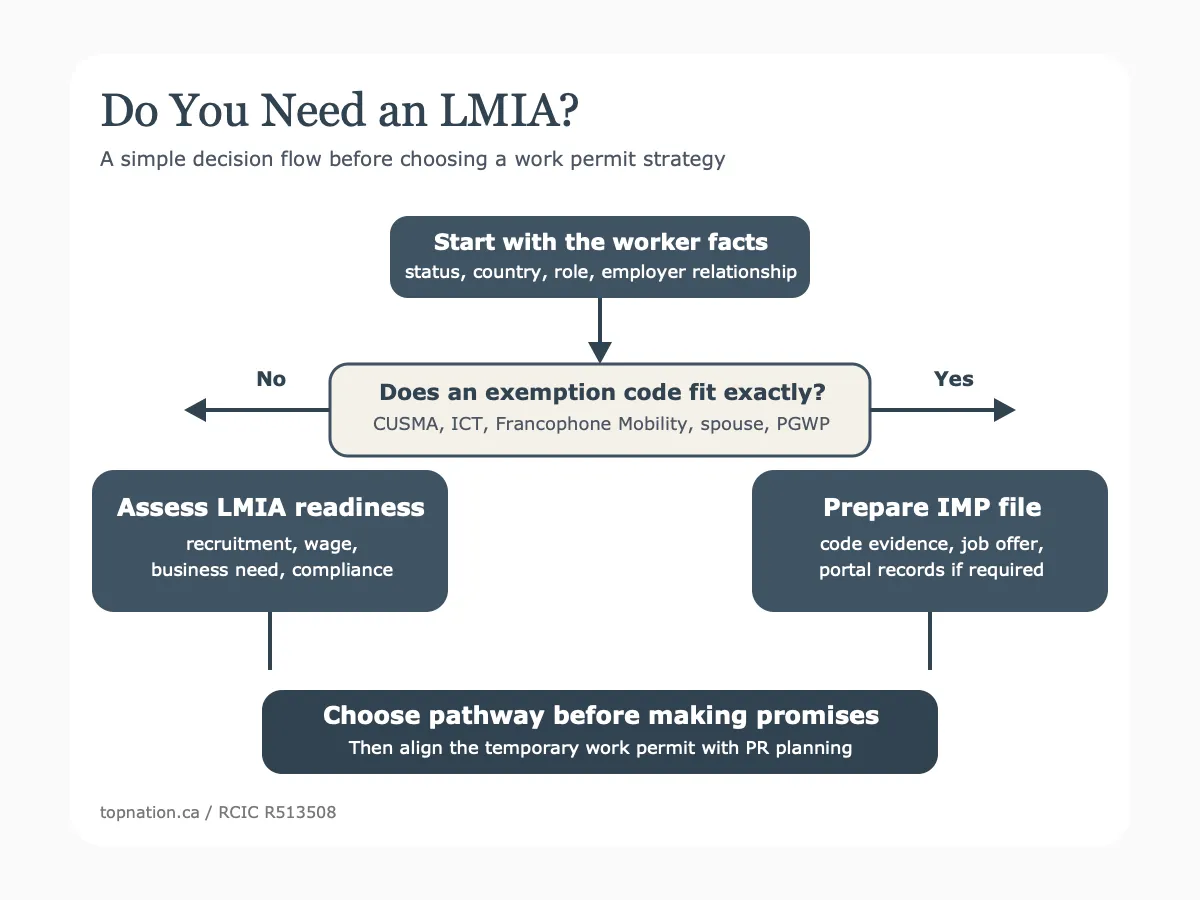
Use a simple decision process before you spend time on forms. First, identify the worker’s current status, nationality, education, employer relationship, language profile, and family situation. Next, compare those facts against official exemption categories. Then, if no exemption fits, assess whether the employer can support an LMIA with recruitment and wage evidence.
This is where many mistakes happen. Employers sometimes start an LMIA when the worker already has an open work permit. Others assume an exemption applies because the worker is skilled, even though there is no matching code. A short eligibility screen can save weeks of work and can prevent a refusal that damages the next application.
How TopNation Helps Alberta Employers Decide
TopNation reviews the role, worker profile, business structure, and permanent residence goal before recommending a pathway. For employers who need to hire foreign workers in Canada, the first step is confirming whether the file belongs under the LMIA route, an LMIA-exempt code, or an open-work-permit strategy.
We also help prepare document strategy, refusal-risk review, employer compliance records, and permanent residence planning. If the business needs broader support, our Alberta employer immigration services page explains how we work with Alberta employers across work permit and PR pathways. You can also contact TopNation for a direct review.
Frequently Asked Questions
Alberta Employer Work Permit Review
Need to Choose the Right Work Permit Path?
TopNation can review the role, worker profile, exemption codes, and LMIA risk before you commit to a filing strategy.
| Talk to an Alberta Immigration Expert → | Call (587) 400-0077 |
Last updated 2026. This article is general information for Alberta employers and workers, not legal advice for a specific immigration file.