Last updated: July 15, 2026 · Reviewed by TopNation Immigration Services’ licensed RCIC team, regulated by the CICC. Processing-time figures on this page are drawn from the ESDC LMIA processing times report and reviewed regularly.
Quick Answer — LMIA Processing Times 2026
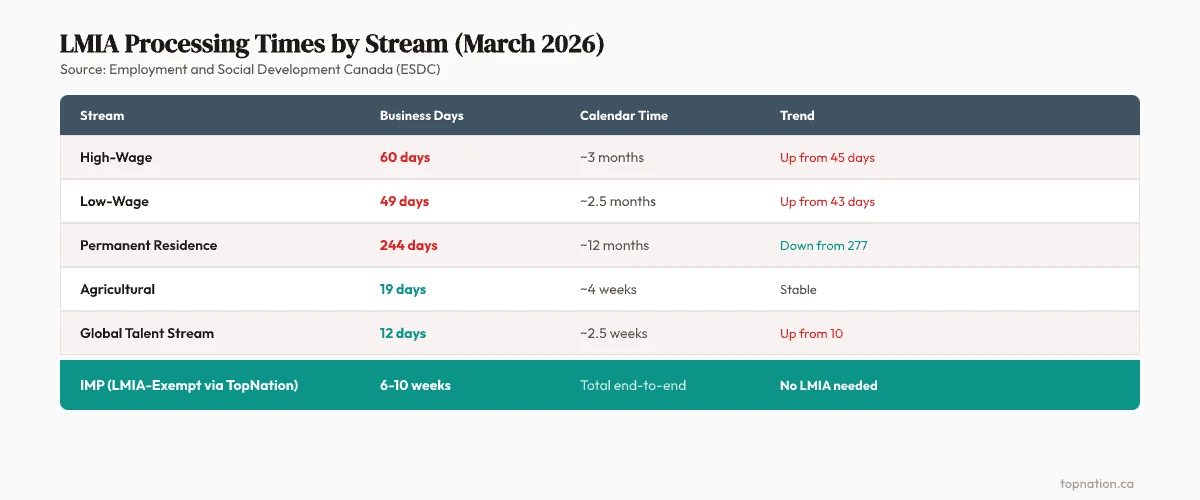
LMIA processing times in 2026 vary by stream: high-wage applications take 60 business days (about 12 weeks), low-wage 49 business days, the Global Talent Stream 12 business days, the Agricultural Stream 19 business days, the Seasonal Agricultural Worker Program 16 business days, and the LMIA-for-permanent-residence stream 244 business days — nearly a full year. These are ESDC processing times for complete applications and exclude the mandatory four-week advertising period. Source: ESDC/Service Canada, March 9, 2026.
March 2026 Update — LMIA Processing Times Have Increased Again
ESDC published new processing time data on March 9, 2026, and the numbers are not going in the right direction. High-wage LMIA applications now take 60 business days — a full two weeks longer than three months ago. The permanent residence stream still sits at 244 business days, which is nearly a full calendar year. Meanwhile, the International Mobility Program has expanded to 170,000 LMIA-exempt work permit spots for 2026, up 32% from original projections. If you are still waiting in the LMIA queue, this post breaks down exactly where things stand, what it is costing you, and what alternatives exist right now.
Current LMIA Processing Times by Stream (2026)
Processing times vary dramatically depending on which LMIA stream your application falls under. The table below reflects the most recent data published by Employment and Social Development Canada (ESDC) as of March 2026.
| LMIA Stream | Processing Time (Business Days) | Trend (vs. Q4 2025) |
|---|---|---|
| High-Wage | 60 business days (~12 weeks) | Up from 45 business days |
| Low-Wage | 49 business days (~10 weeks) | Up from 43 business days |
| Permanent Residence | 244 business days (~11.5 months) | Down from 277 business days |
| Agricultural | 19 business days (~4 weeks) | Slight decrease |
| Seasonal Agricultural Worker Program | 16 business days (~3 weeks) | Stable |
| Global Talent Stream | 12 business days (~2.5 weeks) | Up from 10-day target |
Source: ESDC / Service Canada, last updated March 9, 2026.
These are processing times only — not total timelines
The numbers above represent how long ESDC takes to review your LMIA application once it is complete. They do not include the mandatory four-week advertising period, the time you spend preparing documents, or the work permit application that comes after a positive LMIA. In reality, the total timeline from your first step to a worker arriving on the job is eight to twelve months for most streams — and potentially longer if your application is returned for additional information.
Why LMIA Wait Times Keep Getting Worse
You might assume that fewer temporary foreign worker admissions would mean faster processing. In 2026, the opposite is happening. LMIA processing times have risen for nearly every stream, even as the Temporary Foreign Worker Program (TFWP) cap has dropped to 60,000 annual admissions — a 27% reduction from the previous target of 82,000.
Several factors are driving this paradox.
Surge Filing Before Quota Cuts
When the federal government announced TFWP reductions in late 2025, employers rushed to submit applications before the new rules took effect. This created a backlog that ESDC is still working through. As a result, even routine high-wage applications are sitting in queue longer than expected.
Fraud Prevention Redeployment
ESDC has redirected staff resources toward fraud detection and compliance enforcement. Penalties for non-compliant employers doubled to $4.88 million in total during the 2024-2025 period, and 36 employers were banned from the program entirely. This enforcement push is politically popular, but it means fewer officers are processing new applications.
Regional Unemployment Caps Blocking Low-Wage Applications
Since mid-2024, ESDC will not process low-wage LMIA applications in Census Metropolitan Areas (CMAs) where unemployment is at or above 6%. As of early 2026, major centres including Toronto, Calgary, Edmonton, and Ottawa-Gatineau remain blocked. Although eight cities had their restrictions lifted in January 2026 after unemployment fell below the threshold, the quarterly review system means employers face a rolling uncertainty about whether their applications will even be accepted.
Stricter Documentation and Compliance Reviews
Officers are taking longer to evaluate each individual file. The introduction of enhanced fraud scrutiny, combined with new requirements for transition plans and wage verification, adds days or weeks to each assessment. Applications that would have been routine two years ago now face a higher bar for approval.
The Real Cost of Waiting (Not Just the $1,000 Fee)
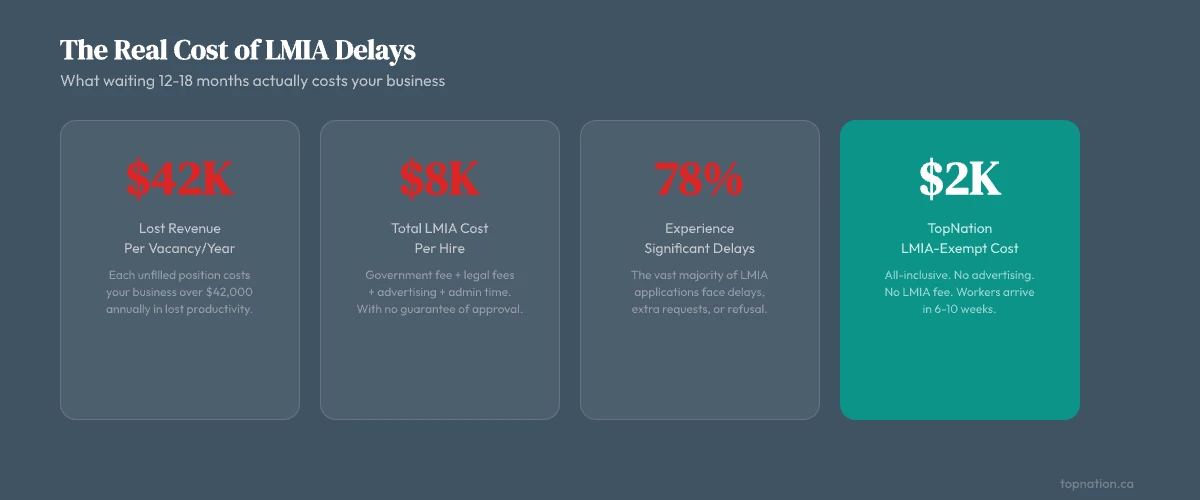
Most employers focus on the $1,000 LMIA government fee when they think about cost. That number is misleading. The real cost of the LMIA process is the sum of every dollar you spend — and every dollar you lose — between the day you decide to hire and the day your worker starts.
Direct Costs Add Up Fast
| Cost Component | Amount |
|---|---|
| LMIA Government Fee | $1,000 per position |
| Immigration Consultant / Lawyer | $3,000 – $7,000 |
| Mandatory Job Advertising (4 weeks, 3+ platforms) | $500 – $1,500 |
| Document Preparation and Translation | $500 – $1,000 |
| Employer Administrative Time (20-40 hours) | $1,000 – $2,000 in staff time |
| Total Direct Cost per Hire | $5,500 – $8,000+ |
For an employer filling three positions, the direct cost alone ranges from $16,500 to $24,000 before any worker has set foot in Canada.
Indirect Costs Are Even Higher
While you wait, each unfilled position is draining your bottom line. Industry research consistently puts the cost of an unfilled skilled position at $42,000 or more per year when you account for lost revenue, reduced output, overtime payments to existing staff, and missed contracts or opportunities.
If your LMIA takes six months from start to finish — which is common for the high-wage stream — that single unfilled position has already cost you roughly $21,000 in lost productivity. Furthermore, your remaining staff absorb the extra workload, leading to burnout, higher turnover, and a cycle that gets harder to break.
The Opportunity Cost Nobody Calculates
There is also the business you never bid on because you did not have the staff. The contract you turned down. The expansion you delayed. These costs never appear on a spreadsheet, but they compound over time. Every month spent in the LMIA queue is a month where your business operates below capacity.
What Happens When Your LMIA Is Delayed or Refused
Filing an LMIA is not a guarantee of approval. And even a positive decision can be derailed by procedural issues that add weeks or months to your timeline.
Common Reasons for LMIA Refusal
ESDC publishes the grounds for refusal, and the same issues come up repeatedly:
Insufficient recruitment efforts. This is the number one reason for LMIA denials. You must prove that you advertised the position on the Job Bank and at least two other recruitment platforms for a minimum of four consecutive weeks. If ESDC believes your efforts to hire a Canadian were not genuine or not sufficiently documented, the application will be refused.
Wage below the prevailing rate. Your offered wage must meet or exceed the median wage for the occupation and region as listed on the Job Bank. Offering even slightly below this threshold triggers an automatic refusal. Officers compare your offer directly against the wage report for your specific NOC code and geographic area.
NOC code mismatch. The National Occupation Classification code you select must accurately reflect the duties of the position. If your job description does not align with the NOC definition, it creates an inconsistency that officers flag immediately.
Incomplete documentation. Missing business records, tax filings, or proof of recruitment efforts will cause your application to be returned — and the processing clock resets when you resubmit.
The Clock-Reset Problem
This is the detail that frustrates employers most. If ESDC requests additional information or returns your application for corrections, the processing timer does not pause. It resets. A high-wage application that was 45 days into its 60-day processing cycle gets sent back to day one after resubmission.
According to industry data, 78% of employers who have gone through the LMIA process report significant delays beyond the estimated processing times. Many of those delays are caused by exactly this clock-reset scenario.
Appeal Options Are Limited
There is no formal appeal process for a negative LMIA decision. Your options are to request a reconsideration (which is rarely successful) or to submit a new application from scratch — paying the $1,000 fee again and restarting the entire process. For most employers, a refusal effectively means starting over with months of additional delay.
The Alternative: LMIA-Exempt Pathways
The federal government’s own numbers tell a clear story about where immigration policy is heading. The TFWP cap has been cut to 60,000 admissions for 2026. At the same time, the International Mobility Program (IMP) — which does not require an LMIA — has been expanded to 170,000 work permit spots. That is nearly three times the LMIA-based allocation.
In other words, the government is actively shifting employer hiring toward LMIA-exempt channels.
International Mobility Program (IMP): The Primary Alternative
Under the IMP, employers can hire foreign workers using an employer-specific work permit without a labour market test. There is no mandatory advertising period. The government fee is $230 per position (the employer compliance fee), compared to $1,000 for an LMIA. Total employer cost per hire typically comes in under $2,000.
Most importantly, the timeline is measured in weeks instead of months. From the time you submit the offer of employment through the IRCC Employer Portal to the day your worker starts, the typical end-to-end process takes six to ten weeks.
Compare that to the eight to twelve months most employers experience through the LMIA route, and the math becomes straightforward.
| Criteria | LMIA Route (TFWP) | LMIA-Exempt Route (IMP) |
|---|---|---|
| Processing Time | 60-244 business days | 2-8 weeks (work permit) |
| Government Fee | $1,000 per position | $230 per position |
| Job Advertising Required | Yes — 4 weeks minimum on 3+ platforms | No advertising required |
| Total Cost per Hire | $5,500-$8,000 | Under $2,000 |
| 2026 Target Admissions | 60,000 | 170,000 |
| Labour Market Test | Required | Not required |
For a full breakdown of how the IMP works step by step, see our complete guide to hiring foreign workers without LMIA in Canada →
Francophone Mobility: The Most Underused Exemption
Under the C16 Francophone Mobility exemption, any employer outside Quebec can hire a French-speaking foreign worker without an LMIA. The worker must demonstrate French language proficiency, and the position must be outside Quebec. That is it — no labour market test, no advertising, no proof that you tried to hire a Canadian first.
This pathway opens access to skilled workers from 29 Francophone countries, including Morocco, Tunisia, Senegal, Cameroon, and Ivory Coast. Many of these candidates hold professional certifications in hospitality, skilled trades, healthcare, and manufacturing.
If you operate in Alberta and have not explored Francophone Mobility, you are likely leaving the fastest available hiring pathway on the table. Request a free workforce assessment from TopNation → to find out if your positions qualify.

Which Industries Are Most Affected by LMIA Delays?
LMIA processing delays do not hit every industry equally. The sectors that depend most heavily on foreign workers — and that have the longest-standing domestic shortages — feel the impact hardest. Here is where the pain is concentrated in 2026.
Hospitality and Food Service
Eighty percent of Canadian food service operators report difficulty hiring kitchen staff. In Alberta, the gap between demand and domestic supply is widening. Cooks, line cooks, sous chefs, bakers, and food service supervisors are among the most chronically unfilled positions in the country.
For a restaurant owner waiting eight months for an LMIA while empty stations on the line cost revenue every night, the math does not work. LMIA-exempt pathways have become the primary hiring channel for hospitality employers who cannot afford to wait.
See how TopNation fills hospitality positions in 6-10 weeks →
Construction and Skilled Trades
Alberta could face a shortfall of 22,000 construction workers by 2033, according to industry projections. Carpenters, electricians, welders, heavy equipment operators, and concrete finishers are all in critical shortage. Major infrastructure projects across the province are competing for the same limited pool of domestic tradespeople.
An LMIA delay of three to six months on a construction project can cascade into missed deadlines, penalty clauses, and lost bids on future work. Consequently, more construction employers are turning to LMIA-exempt pathways to fill positions before project timelines slip.
Get construction workers on your site in weeks, not months →
Automotive and Mechanics
Automotive service technicians, mechanics, and body repair specialists are classified as skilled workers in high demand across every province. The retirement rate in automotive trades is outpacing new entrants by a significant margin. Many dealerships and independent shops have empty service bays that generate zero revenue while they wait for an LMIA decision.
International workers with recognized trade qualifications can enter through the IMP when the employer demonstrates significant benefit to the Canadian economy, particularly in regions with well-documented shortages.
TopNation specializes in placing certified automotive professionals →
Manufacturing
Machine operators, industrial mechanics, quality control technicians, and production supervisors are consistently difficult to recruit domestically. Alberta’s manufacturing sector has grown steadily, and the available workforce has not kept pace. LMIA delays compound the problem — by the time a positive decision arrives, the original production demand may have shifted entirely.
Healthcare
Registered nurses, personal support workers, lab technicians, and healthcare aides have some of the highest vacancy rates in Canada. While healthcare hiring involves additional credential recognition steps, the LMIA-exempt pathway through the IMP can significantly reduce the overall timeline compared to the traditional TFWP route. Provincial nominee programs in Alberta also prioritize healthcare workers for permanent residence.
How to Check Your LMIA Application Status
If you already have an LMIA application in the system, here is exactly how to check where it stands.
Step 1: Log Into the LMIA Online Portal
Access the portal through the Job Bank website at tfwp-jb.lmia.esdc.gc.ca. You will need the same credentials you used when you submitted the application. If a third-party representative submitted on your behalf, they should have portal access as well.
Step 2: Check the Employer Dashboard
After logging in, select the employer file you want to review. Under “LMIA applications,” you will see a list of all submitted applications with their current status. The status column updates as your application moves through the assessment process.
Step 3: Understand What the Statuses Mean
Submitted: Your application is in the queue but has not been assigned to an officer yet. This is where most of the waiting happens.
In Progress: An officer has been assigned and is actively reviewing your application. This does not mean a decision is imminent — the review itself can take weeks.
Additional Information Requested: ESDC needs more documentation or clarification. Respond promptly, because your processing timeline may reset after resubmission.
Decision Made: A decision has been rendered. You will receive an email notification, but you need to log into the portal to view the actual decision letter. Check your spam folder if you do not see the email.
Step 4: Contact Service Canada If Needed
If your application has been in “Submitted” status well beyond the posted processing times, you can contact the Employer Contact Centre at 1-800-367-5693 (Monday to Friday, 7 AM to 8 PM Eastern). However, calling will not speed up the process — it will only confirm your application’s current position in the queue.
A status check will not speed up your application
This is an important reality check. There is no mechanism to expedite a standard LMIA application once it is submitted. Contacting Service Canada, writing to your Member of Parliament, or having your lawyer follow up will not move your file ahead of the queue. The processing times are systemic, not case-specific. If you are already 50 days into a 60-day estimate and your positions are still unfilled, it may be worth exploring LMIA-exempt alternatives → for your next hire rather than waiting for the current cycle to finish.
Should You Still Apply for an LMIA?
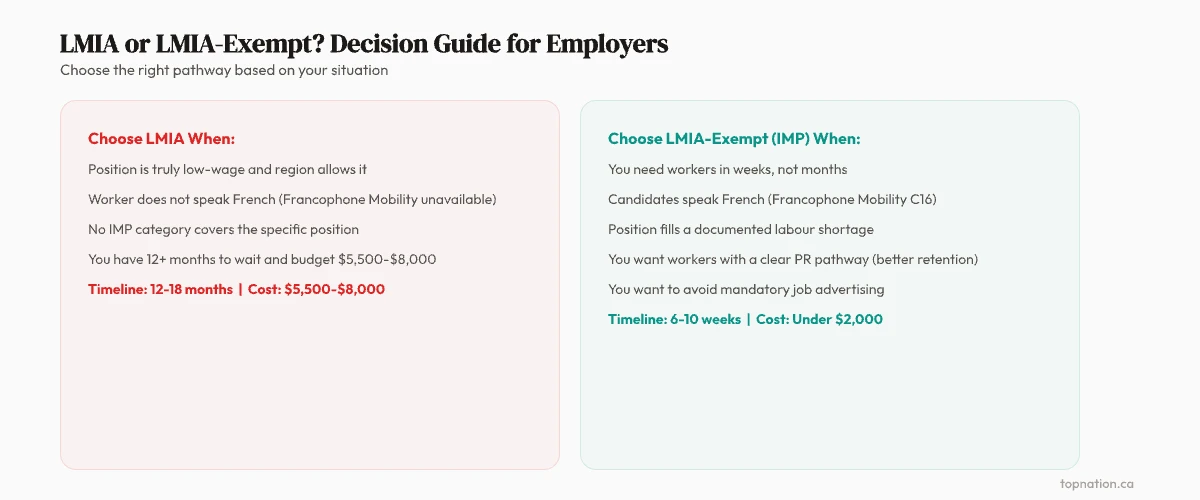
Despite the delays and costs, there are still situations where an LMIA makes strategic sense. However, for the majority of employers in 2026, the LMIA-exempt route is faster, cheaper, and less risky. Here is how to decide.
When an LMIA Still Makes Sense
Your worker needs LMIA-based CRS points for Express Entry. A valid job offer supported by an LMIA adds 50 or 200 Comprehensive Ranking System (CRS) points to a worker’s Express Entry profile, depending on the NOC skill level. If your worker is close to the CRS cutoff, this boost can make the difference for their permanent residence application.
You are hiring in the Agricultural or Global Talent streams. These streams have the shortest LMIA processing times — 19 and 12 business days respectively. For agricultural employers and tech companies hiring under the Global Talent Stream, the LMIA route is still efficient.
Your position does not qualify for any IMP exemption category. Not every role qualifies for an LMIA exemption. If your specific occupation and situation fall outside IMP eligibility, the LMIA route may be your only option.
When LMIA-Exempt Is the Better Choice
You need workers within the next three months. If your timeline is urgent, the LMIA route cannot deliver. Even the fastest non-agricultural LMIA stream takes 60 business days for the LMIA alone, with the work permit application coming after. The IMP route can deliver a worker to your door in six to ten weeks total.
You are hiring multiple workers. The cost savings compound with every additional hire. Filling five positions through the IMP saves between $17,500 and $30,000 compared to the LMIA route — and your workers arrive months earlier.
You operate in a CMA where low-wage LMIAs are blocked. If your business is in Toronto, Calgary, Edmonton, Ottawa-Gatineau, or another metro area where unemployment exceeds 6%, low-wage LMIA applications will not even be processed. The IMP is not subject to these regional restrictions.
You want to minimize administrative burden. The LMIA requires four weeks of advertising, detailed recruitment records, a transition plan, and extensive business documentation. The IMP requires an offer of employment through the Employer Portal and a $230 compliance fee. The paperwork difference is significant.
Decision Matrix: LMIA vs. LMIA-Exempt
| Your Situation | Recommended Path | Why |
|---|---|---|
| Need worker within 3 months | LMIA-Exempt (IMP) | 6-10 weeks vs. 8-12 months |
| Hiring 3+ workers at once | LMIA-Exempt (IMP) | $17,500-$30,000 savings on 5 hires |
| In a CMA with 6%+ unemployment | LMIA-Exempt (IMP) | Low-wage LMIAs are blocked |
| Worker needs CRS points for PR | LMIA | 50-200 bonus CRS points |
| Hiring agricultural workers | LMIA | 19-day processing is still fast |
| Hiring tech talent (Global Talent) | LMIA | 12-day processing is efficient |
| Position does not qualify for IMP | LMIA | Only available option |
| Not sure which path applies | Get assessed | Free assessment → |
Frequently Asked Questions
How long does an LMIA take in 2026?
As of March 2026, LMIA processing times range from 12 business days (Global Talent Stream) to 244 business days (Permanent Residence stream). The most common stream for employers — the high-wage stream — currently takes 60 business days, which translates to approximately 12 calendar weeks. However, this is only the ESDC processing time. When you add the mandatory four-week advertising period, document preparation, and the subsequent work permit application, the total timeline from start to worker arrival is typically eight to twelve months.
Can I speed up my LMIA application?
There is no paid expedite option and no formal mechanism to accelerate a standard LMIA application. The only practical ways to avoid delays are to submit a complete and accurate application the first time (preventing a clock-reset from additional information requests), to use the correct NOC code, and to ensure your wage offer meets or exceeds the median wage for the occupation and region. Beyond that, the processing timeline is determined by ESDC’s capacity and workload. If speed is critical, the LMIA-exempt route through the IMP → is your fastest option at six to ten weeks.
What is the LMIA-exempt alternative?
The International Mobility Program (IMP) allows employers to hire foreign workers without a Labour Market Impact Assessment. Instead of proving that no Canadian is available for the role, the hire must provide a significant economic, social, or cultural benefit to Canada. The government fee is $230 per position (compared to $1,000 for LMIA), no advertising is required, and the total timeline is six to ten weeks. In 2026, the IMP has 170,000 work permit spots allocated — nearly three times the 60,000 spots under the LMIA-based TFWP.
Is hiring through LMIA-exempt pathways legal?
Yes, entirely legal. The International Mobility Program is a federal government program administered by Immigration, Refugees and Citizenship Canada (IRCC). LMIA-exempt work permits are issued under the Immigration and Refugee Protection Regulations (IRPR). The government is not merely tolerating these pathways — it is actively expanding them. The 32% increase in IMP spots for 2026 reflects a deliberate policy shift toward employer-driven, LMIA-free hiring channels.
What happens if my LMIA expires before the worker arrives?
A positive LMIA is valid for six months from the date of issuance. The worker must submit their work permit application within that six-month window. If the LMIA expires before the worker applies, it becomes void and you must start the entire process over — including paying the $1,000 fee again. Given that high-wage LMIA processing alone takes 60 business days, and the subsequent work permit application adds another two to eight weeks, the six-month validity window can be tighter than it appears. Any delay on either side risks the LMIA expiring before the process is complete.
Can I start the LMIA-exempt process while my LMIA application is still pending?
Yes. There is no rule preventing you from exploring LMIA-exempt pathways while a pending LMIA application is being processed. In fact, many employers do exactly this — they have an LMIA in progress for one position while simultaneously filling another through the IMP. If the IMP hire is successful and your LMIA-based position is no longer needed, you can withdraw the LMIA application (though the $1,000 fee is non-refundable). Alternatively, you can use the positive LMIA for a different eligible worker.
Stop Waiting. Start Hiring.
Every week you spend in the LMIA queue is a week of lost revenue, strained staff, and missed growth. The data is clear: processing times are rising, costs are compounding, and the government is actively expanding LMIA-exempt alternatives. The employers who are filling positions right now are the ones who stopped waiting and explored a different path.
TopNation helps Canadian employers hire skilled foreign workers through LMIA-exempt pathways in six to ten weeks. Our team handles everything from candidate sourcing to immigration processing to permanent residence planning, so your workers stay long-term.
WHY EMPLOYERS CHOOSE TOPNATION
500+
Workers Placed
94%
Retention Rate
6 Weeks
Average Placement
Stop waiting months for LMIA approval. TopNation’s LMIA-exempt pathway gets workers to your door in weeks.
Hiring Francophone Workers in Alberta?
Canada's Francophone Mobility program (C16) lets Alberta employers hire French-speaking workers without an LMIA — government fee just $230, workers arrive in 6 weeks. See our specialized program for Francophone cooks and chefs, or explore all Francophone immigration pathways to Alberta.