An LMIA exemption code is the short alphanumeric code (e.g. C10, C16, T34, A75) printed on a Canadian work permit issued under the International Mobility Program (IMP). It tells IRCC officers, employers, and CBSA why no Labour Market Impact Assessment was required. This 2026 reference lists every LMIA exemption code currently used by IRCC, what it means, who qualifies, and the 2026 policy changes that have tightened the most popular ones.
Quick Answer
An LMIA exemption code is the IRCC reference code that identifies the legal basis for issuing a work permit without a Labour Market Impact Assessment. You will find the code printed on the work permit under “Remarks” or “Conditions”, typically in the format R205(a) - C10.
Work permits issued under an LMIA exemption are still part of the IMP, so the employer must submit an Offer of Employment through the IRCC Employer Portal and pay the $230 employer compliance fee. There is no $1,000 LMIA fee.
LMIA, LMIA-Exempt, and Work-Permit-Exempt: Know the Difference
Before reading the code table, disambiguate four concepts that get confused constantly. A worker can fall into only one of these lanes at a time.
| Concept | Work permit needed? | LMIA needed? | Employer pays $230 compliance fee? | Has an exemption code? |
|---|---|---|---|---|
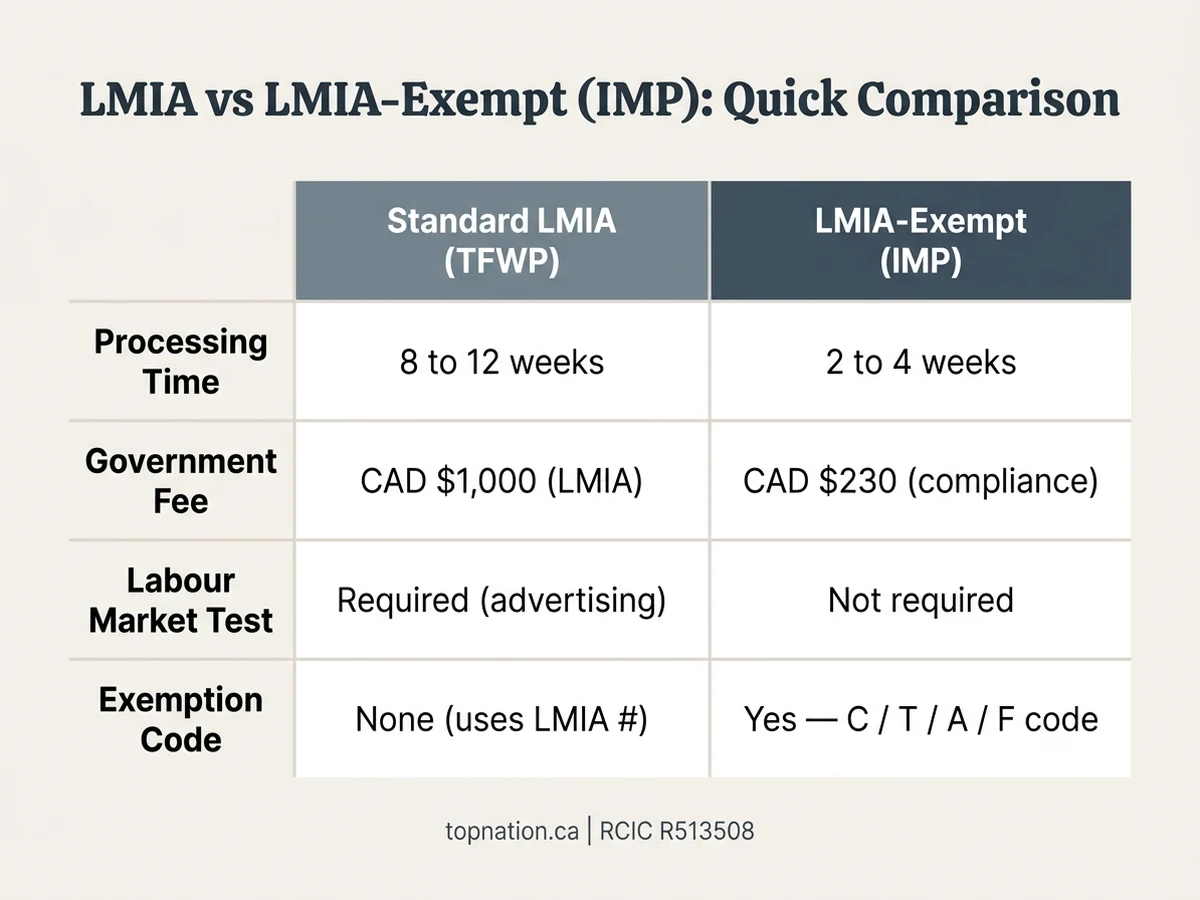
| TFWP (Temporary Foreign Worker Program) | Yes | Yes | No (employer pays $1,000 LMIA fee instead) | No (uses an LMIA number, not a C/T/A code) |
| IMP (International Mobility Program) | Yes | No (LMIA-exempt) | Yes — $230 | Yes — C, T, A, F, H or S code |
| R186 work-permit-exempt | No | No | No | Uses R186 paragraph reference |
| Business visitor (R186(a)) | No | No | No | R186(a) |
If the worker needs a work permit, they are in row 1 or row 2. If they do not need a work permit at all, they are in row 3 or row 4. The C, T, A, F, H and S codes below only apply to row 2 (IMP).
The Complete LMIA Exemption Code Directory
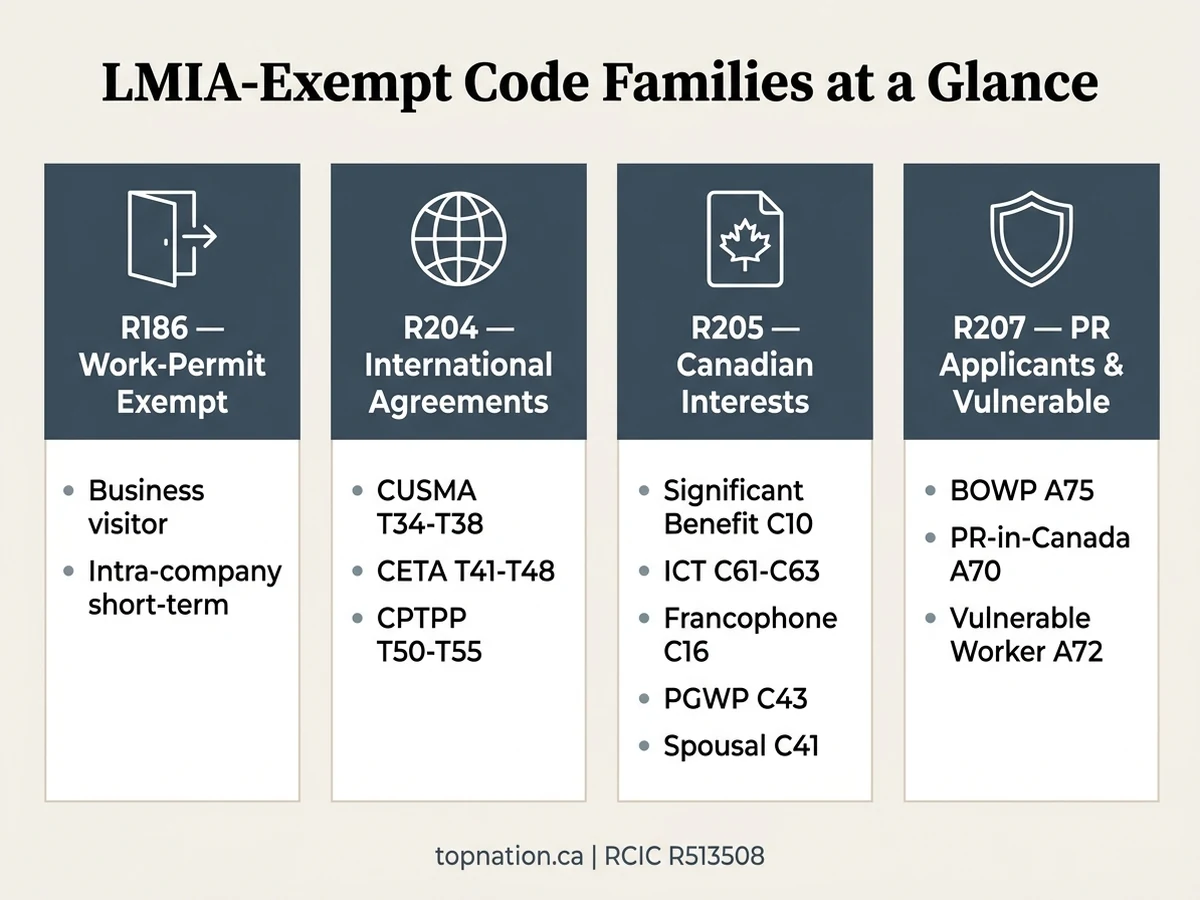
Every LMIA exemption code currently used by IRCC is grouped below by family: R186 (work-permit-exempt), R204 (international agreements), R205(a) (significant benefit), R205(b) (reciprocal), R205(c) (research, competitiveness, public policy), R205(d) (religious / charitable), R207 (PR applicants), and humanitarian codes. Each row links directly — for example /lmia-exemption-guide-2026/#c10.
R186 — Work permit not required
These categories let a foreign national work in Canada without any work permit at all. There is no exemption code in the C/T format — IRCC simply cites the paragraph of R186.
| Code | Category | Who it applies to | Basis |
|---|---|---|---|
| R186(a) | Business visitor | After-sales service, meetings, training, market research — no entry into the Canadian labour market | IRPR 186(a) |
| R186(g) | Performing artist | Foreign performers — concerts, festivals, time-limited engagements (not employed by a Canadian venue) | IRPR 186(g) |
| R186(h) | Athletes and team members | Foreign athletes on Canadian or foreign teams competing in Canada, and their essential support staff | IRPR 186(h) |
| R186(s) | International transport crew | Crew of aircraft, ships, trains, buses entering Canada in the course of duty | IRPR 186(s) |
| R186(v) | Off-campus student work | Full-time post-secondary students at a DLI — up to the weekly cap permitted by IRCC policy | IRPR 186(v) |
R204 — International agreements (free-trade and bilateral treaties)
In late 2023 / early 2024 IRCC renumbered many of the treaty codes. The legacy “T2x” CUSMA codes are gone. Where you may still see T21/T22/T23/T24 in older documents, the equivalent current codes are T34/T35/T36/T37/T38.
| Code | Category | Who it applies to | Basis |
|---|---|---|---|
| T34 | CUSMA Trader | US / Mexican citizens carrying on substantial trade between their home country and Canada (replaced T21) | R204(a) — CUSMA |
| T35 | CUSMA Investor | US / Mexican citizens directing a substantial investment they (or their enterprise) committed in Canada (replaced T22) | R204(a) — CUSMA |
| T36 | CUSMA Professional | US / Mexican citizens in one of ~60 listed professions (engineer, accountant, scientist, etc.) with a pre-arranged Canadian engagement (replaced T23) | R204(a) — CUSMA Ch.16 Appendix |
| T37 | CUSMA ICT — Executive / Senior Manager | Executives or senior managers being transferred from a US / Mexican parent to a Canadian branch, subsidiary or affiliate | R204(a) — CUSMA ICT |
| T38 | CUSMA ICT — Specialized Knowledge | Specialized-knowledge workers transferred from a US / Mexican parent to a Canadian branch, subsidiary or affiliate | R204(a) — CUSMA ICT |
| T33 | GATS Professional | Professionals from WTO member states under the General Agreement on Trade in Services | R204(a) — GATS |
| T41 | CETA ICT — Specialized Knowledge | EU specialized-knowledge workers transferred to a Canadian enterprise of the same corporate group | R204(a) — CETA |
| T42 | CETA ICT — Graduate Trainee | EU university graduates in a structured trainee programme inside a Canadian affiliate | R204(a) — CETA |
| T43 | CETA Independent Professional | EU self-employed professionals in a listed field providing a service to a Canadian client | R204(a) — CETA |
| T44 | CETA ICT — Senior Personnel / Executive | EU executives and senior managers transferred to a Canadian enterprise of the same corporate group | R204(a) — CETA |
| T45 | CETA Spouse | Spouse of a T41 / T42 / T44 principal worker | R204(a) — CETA |
| T46 | CETA Trader / Investor | EU traders and investors under the CETA investment chapter | R204(a) — CETA |
| T47 | CETA Technical Specialist | Specialised technicians installing, testing or repairing equipment sold to a Canadian buyer | R204(a) — CETA |
| T48 | CETA Contractual Service Supplier | EU contractors fulfilling a services contract for a Canadian client | R204(a) — CETA |
| T50–T55 | CPTPP — Investor / ICT / Professional / Spouses / Trainee / Specialized | Citizens of Japan, Australia, Singapore, Vietnam, New Zealand, Brunei, Malaysia, Mexico, Chile, Peru and the UK (post-accession) | R204(a) — CPTPP |
| F10–F15 | Canada–Colombia FTA | Colombian professionals, traders, investors, ICTs and spouses | R204(a) |
| F20–F24 | Canada–Chile FTA | Chilean professionals, ICTs and traders | R204(a) |
| F30–F36 | Canada–Korea FTA | South Korean professionals, ICTs, traders, investors | R204(a) |
| F42 | Canada–Panama Professionals | Panamanian professionals under the FTA professionals chapter | R204(a) |
| F50–F55 | Canada–Peru FTA | Peruvian professionals, ICTs, traders, investors | R204(a) |
| F60–F67 | Canada–UK Trade Continuity Agreement | UK professionals, ICTs, traders, investors, spouses (post-Brexit continuation of CETA-style mobility) | R204(a) |
| T11 | Airline personnel | Foreign airline ground crew under bilateral air agreements | R204(a) |
| T13 | Provincial Nominee Program work permit | PNP-nominated workers whose nomination includes a job offer (provincial agreement under R204(c)) | R204(c) |
| T10 | Quebec Investor | Workers under the Canada–Quebec accord investor stream | R204(c) |
R205(a) — Significant benefit
The largest family of LMIA exemptions. The unifying test is that the work brings significant cultural, social or economic benefit to Canada.
| Code | Category | Who it applies to | Basis |
|---|---|---|---|
| C10 | Significant Benefit — General (officer discretion) | Catch-all when no other code fits but the work brings quantifiable benefit. Not for intra-company transfers (use C61–C63). Tightened 24 Feb 2026 — benefit must now be “unique or exceptional” with quantifiable evidence. | R205(a) |
| C11 | Entrepreneur / self-employed | Owner-operators of a Canadian business they control or are starting (not the same as Start-up Visa — see A77) | R205(a) |
| C12 | Retired (was ICT) | Retired in 2024. Previously used for intra-company transfers; workers were migrated to C61, C62, C63. Older work permits in circulation may still show C12. | Historical |
| C13 | Emergency repair personnel | Specialists urgently required to repair industrial / commercial equipment to prevent disruption | R205(a) |
| C14 | Essential film and TV workers | Key film/TV production crew whose role is essential and cannot be filled domestically | R205(a) |
| C15 | Rural and Northern Immigration Pilot (RNIP) | Candidates with a community recommendation in one of the participating RNIP communities | R205(a) |
| C16 | Francophone Mobility | French-speaking workers (NCLC / CLB 5+ in oral skills) with a job in TEER 0–5 outside Quebec. One of the strongest pathways in 2026. | R205(a) |
| C17 | RNIP spouse | Spouse / common-law partner of a C15 principal applicant | R205(a) |
| C18 | Atlantic Immigration Program | Workers with a Confirmation of Designation from a designated Atlantic employer | R205(a) |
| C60 | Provincial business / Quebec self-employed | Workers under provincial entrepreneur streams or Quebec self-employed stream | R205(a) |
| C61 | Intra-Company Transferee — Start-up of a branch / affiliate | Senior workers transferred to establish a new Canadian branch, subsidiary or affiliate | R205(a) — ICT |
| C62 | ICT — Executive / Senior / Functional Manager (existing entity) | Workers transferred to an existing Canadian entity in an executive, senior or functional management role — maximum 7-year total stay | R205(a) — ICT |
| C63 | ICT — Specialized Knowledge (existing entity) | Workers with proprietary knowledge of the company’s product, service, or processes — maximum 5-year total stay | R205(a) — ICT |
R205(b) — Reciprocal employment
| Code | Category | Who it applies to | Basis |
|---|---|---|---|
| C20 | Reciprocal Employment — General | Workers whose employment creates a similar reciprocal opportunity for Canadians abroad. Updated 20 Feb 2026 — the worker’s country of origin must demonstrate reciprocity; coverage extended to Canadian permanent residents working abroad. GCMS submissions now require province, city and NOC. | R205(b) |
| C21 | International Experience Canada (IEC) | Working Holiday, Young Professionals, International Co-op streams under youth mobility agreements | R205(b) |
| C22 | Academic exchange | Visiting professors, lecturers, exchange instructors under inter-institutional agreements | R205(b) |
| C23 | Performing arts | Foreign artists working with Canadian artists where reciprocity exists | R205(b) |
| C24 | Summer camp counsellors | Foreign counsellors at Canadian camps in reciprocal programmes | R205(b) |
| C26 | Coaches and athletes | Foreign coaches and athletes hired by Canadian teams under reciprocal arrangements | R205(b) |
R205(c) — Research, competitiveness, and public policy
| Code | Category | Who it applies to | Basis |
|---|---|---|---|
| C31 | Research | Foreign researchers at recognised institutions | R205(c)(i) |
| C32 | Educational co-op (post-secondary) | Foreign students whose curriculum requires a co-op placement | R205(c)(i.1) |
| C33 | Educational co-op (secondary) | Secondary-school students on a mandatory co-op placement | R205(c)(i.1) |
| C41 | Spouse / common-law partner of a high-skilled worker | Open work permit for spouses of workers in TEER 0–3 jobs. Tightened 21 January 2025 — principal must be in TEER 0/1 (or eligible TEER 2/3) AND have at least 16 months remaining on their permit. | R205(c)(ii) |
| C42 | Spouse of a full-time international student | Open work permit for spouses of students in master’s / doctoral / select programs. Tightened 2025 — refusal expected if principal is in the final term of study. | R205(c)(ii) |
| C43 | Post-Graduation Work Permit (PGWP) | Graduates of an eligible Canadian DLI programme. Field-of-study eligibility list frozen for 2026 at 1,107 programs. | R205(c)(ii) |
| C44 | Post-doctoral PhD fellow | Post-doctoral fellows holding a PhD | R205(c)(ii) |
| C45 | Medical / dental resident | Foreign medical and dental residents in Canadian training programs | R205(c)(ii) |
| C46 | Dependent child of a high-skilled worker | Open work permit for dependent children of TEER 0–3 workers (paired with C41) | R205(c)(ii) |
| C47 | Spouse of a low-skilled worker | Mostly closed January 2025. Open permit for spouses of TEER 4/5 workers — limited transitional cases only. | R205(c)(ii) |
| C48 | Dependent child of a low-skilled worker | Paired with C47 — similarly restricted in 2025/2026 | R205(c)(ii) |
| C49 | Family of an economic PR applicant | Spouses and dependants of certain economic PR applicants in process | R205(c)(ii) |
| C52 | Academic award recipient | Recipients of specific academic awards or fellowships | R205(c)(ii) |
| C88 | Innovation Stream Pilot | Workers hired by designated high-growth Canadian employers under the Innovation Stream pilot | R205(c) |
R205(d) — Religious or charitable work
| Code | Category | Who it applies to | Basis |
|---|---|---|---|
| C50 | Religious work | Pastors, imams, rabbis, ministers and similar religious workers | R205(d) |
| C51 | Charitable work | Workers performing duties for a registered charity | R205(d) |
R207 / R207.1 / R205(a) — PR applicants in Canada and vulnerable workers
| Code | Category | Who it applies to | Basis |
|---|---|---|---|
| A70 | PR applicants in Canada | In-Canada spouse / common-law class, protected persons, H&C applicants, family-class | R207 |
| A71 | Live-in caregiver applied for PR | Legacy live-in caregivers who have applied for PR | R207 |
| A72 | Vulnerable worker at risk of abuse | Open work permit for workers experiencing or at risk of abuse from a current employer | R207.1 |
| A73 | Quebec CSQ holder — inside Quebec | Workers with a Quebec Selection Certificate who are physically in Quebec | R207 |
| A75 | Bridging Open Work Permit (BOWP) | Holders of a valid work permit with a pending PR application in an eligible economic class — bridges them until PR decision | R207 |
| A76 | Quebec CSQ holder — outside Quebec | CSQ holders located outside Quebec who need to work elsewhere in Canada temporarily | R207 |
| A77 | Start-up Visa applicant | Approved Start-up Visa entrepreneurs needing to establish their business while PR is processed | R205(a) |
| C90 | Home Child-Care / Home Support Worker Pilot applicant | Caregivers who applied for PR under the HCCP / HSW pilot | R205(a) |
| C91 | Spouses / dependants of C90 | Family members of HCCP / HSW pilot applicants | R205(a) |
Humanitarian and protection-related codes
| Code | Category | Who it applies to | Basis |
|---|---|---|---|
| S61 | Refugee claimant | Refugee claimants whose claim has been referred to the IRB | R206 |
| S62 | Unenforceable removal order | Persons under a removal order that cannot currently be enforced | R206 |
| H81 | Destitute student | Students experiencing financial hardship outside their control | R208 |
| H82 | TRP holder 6 months or longer | Holders of a Temporary Resident Permit valid for 6 months or more | R208 |
What Changed in 2025–2026
Policy update timeline
- 21 January 2025 — C41 (spouse of high-skilled) restricted: principal worker must be in TEER 0/1 (or eligible TEER 2/3) with 16+ months remaining on their permit.
- 2025 — C42 (spouse of international student) refusal expected when principal student is in the final term of study.
- 20 February 2026 — C20 (reciprocal) update: reciprocity must be shown in the worker’s country of origin; coverage extended to Canadian PRs; GCMS submissions now require province / city / NOC.
- 24 February 2026 — C10 (significant benefit, general) tightened: benefit must now be “unique or exceptional” with quantifiable evidence. Officer discretion is narrower.
- 2026 — PGWP (C43) field-of-study eligibility list frozen at 1,107 programs.
- 2026 levels — IMP target of 170,000 (+32%) LMIA-exempt permits while the TFWP target is reduced to 60,000. The structural direction is away from LMIA and toward exemptions.
How to Find Your LMIA Exemption Code
Use this decision tree to narrow down the family before going to the table above. Work through the questions in order — the first “yes” usually wins.
- Are you a US or Mexican citizen with a Canadian job in a CUSMA-listed profession, or being transferred by a US / Mexican parent company? → Look at T34 / T35 / T36 / T37 / T38.
- Are you an EU citizen being transferred or contracted by a CETA enterprise? → T41–T48.
- Are you a UK citizen? → F60–F67 (Canada–UK TCA).
- Are you French-speaking and being hired in TEER 0–5 outside Quebec? → C16 Francophone Mobility.
- Are you the spouse of a worker in TEER 0/1 (or eligible TEER 2/3)? → C41. Children → C46.
- Did you just graduate from a Canadian DLI? → C43 PGWP.
- Have you already applied for PR from inside Canada with a valid work permit? → A75 Bridging Open Work Permit.
- Are you on the in-Canada spouse / common-law class, H&C, or protected-person stream? → A70.
- Are you being moved by your employer to a Canadian branch, subsidiary or affiliate? → C61 (new branch), C62 (executive / senior manager) or C63 (specialized knowledge).
- Are you a PNP nominee with a job offer? → T13.
- None of the above and your work brings clear, quantifiable benefit to Canada? → C10 (now narrow — expect close scrutiny in 2026).

Costs and Process Compared
| Item | LMIA / TFWP | LMIA-exempt / IMP |
|---|---|---|
| Government fee paid by employer | $1,000 LMIA fee | $230 employer compliance fee |
| Government fee paid by worker | $155 work-permit fee + biometrics | $155 work-permit fee + biometrics |
| Advertising / recruitment requirement | Yes — minimum 4 weeks, 3 channels | No |
| Submission portal | ESDC LMIA portal | IRCC Employer Portal (Offer of Employment) |
| Typical pre-application turnaround | Several weeks (often months for low-wage) | Same day (Offer of Employment generates an A# instantly) |
The $230 employer compliance fee applies to every LMIA-exempt code in the table above, including ICT (C61/C62/C63), CUSMA / CETA / CPTPP treaty codes, Francophone Mobility (C16), and spousal open work permits (C41/C42). The only fee-exempt categories are R186 (no work permit at all).
Frequently Asked Questions
Related TopNation Resources
- Labour Market Impact Assessment (LMIA) — full process and costs
- Canadian work permit overview
- Post-Graduation Work Permit (PGWP / C43) 2026 guide
- Express Entry Canada 2026 guide
- Alberta Advantage Immigration Program (AAIP) 2026 guide
- For employers: hiring foreign workers in Canada
Not sure which exemption code applies?
Talk to a licensed RCIC
TopNation Immigration is a regulated Canadian immigration consultancy. A licensed RCIC will match your file to the right LMIA exemption code (or confirm you need an LMIA) before you submit anything.
| Book a Consultation → | Call 587-400-0077 |
Immigration Services Across Alberta
TopNation's RCIC-licensed consultants assist clients throughout Alberta — not just Edmonton. Whether you are in Fort McMurray, Red Deer, Calgary, or a rural community, we handle work permits, permanent residence, and employer compliance from start to finish. Book a consultation →
Hiring Francophone Workers in Alberta?
Canada's Francophone Mobility program (C16) lets Alberta employers hire French-speaking workers without an LMIA — government fee just $230, workers arrive in 6 weeks. See our specialized program for Francophone cooks and chefs, or explore all Francophone immigration pathways to Alberta.