Last reviewed: June 2026 · Reviewed by TopNation’s CICC-licensed RCIC team.
On this page
Processing Time Alert — Apply at Least 6 Months Early
IRCC's current PR card renewal processing time is approximately 104 days. Apply at least 6 months before your card expires to avoid travel disruptions. If your card has already expired and you need to travel internationally, you will need a Permanent Resident Travel Document (PRTD) to board a flight back to Canada. Speak with an RCIC consultant to review your situation →
What Is a Permanent Resident Card and Why Does It Need Renewal?
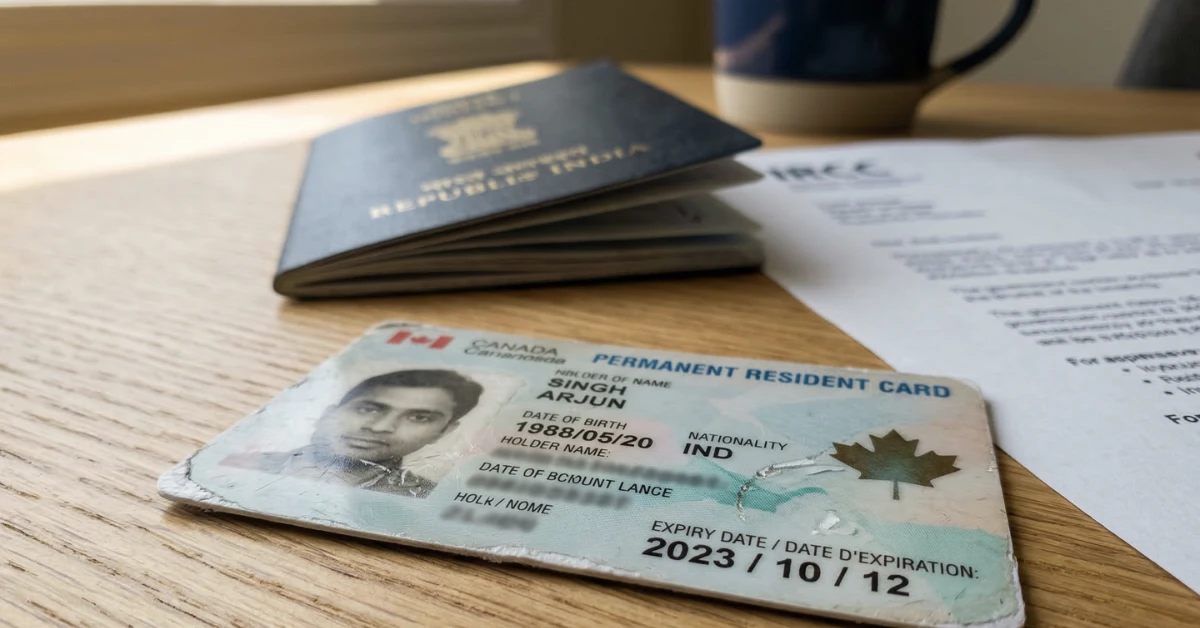
Your permanent resident card (PR card) is your official proof of status as a permanent resident of Canada. Issued by Immigration, Refugees and Citizenship Canada (IRCC), it is a wallet-sized plastic card valid for five years from the date of issue.
The PR card serves two critical functions. First, it allows you to board commercial flights and other carriers to return to Canada after international travel. Second, it proves your permanent resident status to Canadian employers, banks, provincial services, and government agencies. Without a valid card, you may be denied boarding on flights to Canada — even if your permanent resident status itself is perfectly valid.
It is important to understand that your PR card and your PR status are two separate things. The card is simply a document. Your status as a permanent resident continues as long as you meet your residency obligations, regardless of whether your card is currently valid or expired. However, an expired card creates significant practical problems, particularly around international travel.
Key Distinction: Expired Card vs. Lost PR Status
An expired PR card does not mean you have lost permanent residency. Your status continues as long as you meet the 730-day physical presence requirement. You can renew an expired card at any time. The problem arises only when you need to travel — airlines cannot let you board a flight to Canada without a valid card or PRTD.
PR Card Renewal Eligibility: The Residency Obligation
Before submitting your renewal application, you must confirm you meet the residency obligation. This is the single most important eligibility requirement and the most frequent reason applications result in complications.
The 730-Day Physical Presence Requirement
To be eligible to renew your permanent resident card, you must have been physically present in Canada for a minimum of 730 days (two years) out of the last five years. These days do not need to be consecutive — any combination of days across the five-year window counts.
IRCC also recognizes the following days as counting toward your 730-day requirement, even if spent outside Canada:
- Days outside Canada while employed full-time by a Canadian business or the federal or provincial government
- Days outside Canada while accompanying a Canadian citizen spouse or common-law partner
- Days outside Canada while accompanying a permanent resident spouse who is employed full-time by a Canadian business
What If You Do Not Meet the 730 Days?
If your physical presence calculation falls short of 730 days, do not apply for renewal without first speaking to a licensed immigration consultant. Submitting an application when you have not met the residency obligation can trigger a formal finding that your permanent resident status has been lost — an outcome that is far harder to recover from than addressing the issue before you file.
In many cases, humanitarian and compassionate (H&C) grounds allow a renewal to proceed even where residency obligations were not fully met. A qualified RCIC can also review your travel history in detail — identifying days that legitimately count toward your total that you may have overlooked — before advising on your realistic options.
Not Sure If You Meet the Residency Requirement?
A full residency calculation with a consultant takes 15 minutes and can prevent a far more serious problem down the road. TopNation's RCIC-licensed team will review your travel history before you file anything.
Review My Residency EligibilityDocuments Required for PR Card Renewal in 2026
A complete document package is the single most important factor in how quickly your application moves through IRCC. Incomplete submissions are returned — adding weeks to your wait before you can resubmit. Gather everything below before you begin your online application.
Documents Required for All Applicants
| Document | Details & Notes |
|---|---|
| Current or most recent PR card | Scan front and back. Include even if expired or damaged. |
| Two passport-style photos | White background, taken within last 6 months. Must meet IRCC photo specifications exactly. |
| Complete 5-year travel history | All international trips with entry/exit dates, countries visited, and purpose of each trip. |
| Proof of physical presence in Canada | CRA Notices of Assessment, T1 tax returns, employment records, lease agreements, or school records. |
| Valid passport | Must be valid at time of application. Provide scanned copy of biographical data page. |
| IMM 5444 — Application to Renew a PR Card | Completed online through your IRCC secure account. Not a paper form. |
Additional Documents for Specific Situations
| Situation | Additional Document Required |
|---|---|
| Name change since last PR card issued | Legal name change certificate, marriage certificate, or divorce decree |
| Extended absence from Canada (6+ months) | Written explanation letter plus supporting evidence (employer letter, medical records, or family documentation) |
| Accompanied Canadian citizen spouse abroad | Proof of spouse's Canadian citizenship plus proof of marriage or cohabitation |
| Worked outside Canada for Canadian employer | Employer letter confirming your employment status, work location, and exact dates outside Canada |
| Lost or stolen PR card | Police report or signed statutory declaration explaining how and when the card was lost |
Calculate Your Days Before Gathering Documents
Before assembling your document package, calculate your physical presence total using passport stamps, flight booking records, and bank transaction dates. Knowing your day count upfront determines which additional documents you will need to include and prevents surprises mid-application.
How to Renew Your PR Card: Step-by-Step Process
PR card renewals are submitted entirely online through your IRCC secure account. Paper applications are no longer accepted for most applicants. Here is the complete process from start to finish.
Log In to Your IRCC Secure Account
Go to canada.ca and access your IRCC secure account using your GCKey or a provincial sign-in partner. If you do not have an account, create one. You will need your existing PR card number and personal information to link your profile.
Complete Form IMM 5444 Online
Select "Apply to Renew a Permanent Resident Card" from your dashboard. Complete the IMM 5444 form with your personal details, current Canadian mailing address (IRCC ships your new card here), full travel history for the past five years, and residency information.
Upload All Supporting Documents
Scan and upload every required document in PDF or JPEG format. Each file must be under 4MB and clearly legible. Do not submit your application until every document on your checklist is uploaded — incomplete applications are returned, delaying the process by weeks.
Pay the $50 Government Fee
Pay the $50 CAD processing fee by credit card through your IRCC account. Keep your payment confirmation number — it is your reference if you ever contact IRCC about your application. The fee is non-refundable regardless of outcome.
Submit and Monitor Your Application
Submit your completed application and save your confirmation with the application number. Use this number to track your status online through your IRCC account. IRCC will contact you directly if additional information is needed.
Receive Your New PR Card by Mail
Once approved, IRCC mails your new PR card via registered mail to the Canadian address on your application. Ensure your address is correct and that someone is available to receive registered mail. Your new card will be valid for five years from the date of issue.
PR Card Renewal Processing Times and Fees in 2026
The most critical factor in managing your renewal is timing. Applying too late creates travel problems; understanding the current processing window lets you plan with confidence.
Current Processing Times (2026)
| Application Type | Current Processing Time | Recommended Lead Time |
|---|---|---|
| Standard PR card renewal | ~104 days (approx. 3.5 months) | Apply 6 months before expiry |
| Lost or stolen card replacement | ~104 days | Apply immediately with police report |
| Permanent Resident Travel Document (PRTD) | Varies by visa office (2–8 weeks) | Apply before booking return flight |
Government Application Fees
| Service | Fee | Notes |
|---|---|---|
| PR card renewal | $50 CAD | Non-refundable. Paid online through IRCC account. |
| Permanent Resident Travel Document | $50 CAD | Single-entry only. Applied for outside Canada at a Canadian visa office. |
| Biometrics | Not required | PR card renewals do not require new biometrics collection. |
The 9-Month Application Window
IRCC allows you to apply up to 9 months before your card expires. With a current processing estimate of 104 days, applying 6 months ahead gives you approximately 75 extra days of buffer if your application takes longer than the estimate. Do not cut it close.
Need Help With Your PR Card Renewal Application?
A missed document or an inaccurate travel history can delay your file by months. TopNation's RCIC-licensed consultants review every renewal application personally before it goes to IRCC — so your file goes in right the first time.
Book a PR Card Renewal ConsultationCommon Reasons PR Card Renewals Are Delayed or Refused
The majority of PR card renewal delays are entirely avoidable. The most common issues are document-related, not residency-related — meaning a careful review before submission prevents most problems.
Top Causes of Application Delays
- Incomplete travel history — Missing even one international trip from your five-year record is grounds for IRCC to return your application as incomplete
- Photos not meeting specifications — Wrong dimensions, a coloured background, or photos older than six months trigger rejection at intake before your application is even reviewed
- Incorrect mailing address — Your new card ships to the address listed. An outdated address means a lost card and a full reapplication process
- Insufficient proof of presence — Tax returns alone may not be enough for borderline residency cases; additional corroborating documents such as employment records or lease agreements strengthen your file
- No explanation for extended absences — Trips longer than six months without documentation raise residency obligation questions regardless of your overall day count
- Form errors on IMM 5444 — Mismatches between your form answers and your supporting documents cause delays while IRCC requests clarification
What Happens If Your Application Is Refused
If IRCC determines you have not met your residency obligation, an officer will issue a formal report under section A44(1) of IRPA. You will be notified and may be referred to an admissibility hearing before the Immigration Division of the Immigration and Refugee Board.
The hearing is your formal opportunity to present evidence and arguments — including H&C grounds — for why your permanent resident status should be maintained. Many permanent residents successfully retain their status at these hearings when properly represented. The critical point is never triggering this process without preparation. If you are unsure about your residency count, speak with an RCIC before filing anything.

Travelling Outside Canada During Your PR Card Renewal
Needing to travel internationally while your renewal is pending is one of the most common stressful situations permanent residents face. Understanding your options before you book any flights protects you from being stranded abroad.
Leaving Canada While Your Renewal Is Pending
You are legally permitted to leave Canada while your PR card renewal application is being processed. Your application continues moving through the queue while you are abroad. The critical issue is your ability to return.
Canadian law requires all commercial carriers — airlines, cruise ships, and bus companies — to verify that travelers have the right to enter Canada before boarding. Without a valid PR card or a Permanent Resident Travel Document (PRTD), carriers will deny boarding on flights to Canada regardless of how valid your underlying PR status is.
The Permanent Resident Travel Document (PRTD)
A PRTD is an emergency travel document for permanent residents who are outside Canada and cannot use a PR card to return. It allows one return trip to Canada. To obtain a PRTD you must be physically outside Canada and apply at the nearest Canadian embassy, high commission, or visa application centre. Requirements include:
- Completed form IMM 5524
- $50 CAD application fee
- Proof of permanent resident status (your COPR, landing record, or previous PR card)
- Valid identity document (passport)
- Evidence that you meet your residency obligation, or H&C grounds if you do not
Valid PR Card
- Unlimited returns to Canada by air
- Valid for five years from issue
- Accepted by all airlines automatically
- Proof of PR status within Canada
- Renewed online while in Canada
PRTD (Travel Document)
- Single-entry — one return trip only
- Must be outside Canada to apply
- Processing time varies by visa office
- Requires meeting residency obligation
- Emergency option when card expired abroad
Renewing Your PR Card After Extended Time Outside Canada
If you have lived primarily outside Canada for a significant period, your renewal requires additional care before you file. This section addresses the most sensitive renewal scenarios.
You Have Been Away for More Than Three Years
If the majority of your last five years was spent outside Canada, do not apply for renewal without a residency calculation review first. The consequences of triggering a formal inadmissibility proceeding without preparation are significantly worse than proactively addressing the residency question with an RCIC before filing.
Options that may be available to you depending on your circumstances include H&C grounds submissions based on ties to Canada, dependents in Canada, or degree of establishment; arguments based on exceptional hardship if required to leave Canada; and in cases where PR status is genuinely lost, a strategic exit and reapplication through a new immigration pathway. None of these decisions should be made without qualified professional advice.
You Worked Abroad for a Canadian Company
Days spent outside Canada while employed full-time with a Canadian business count toward your 730-day residency requirement. This is one of the most under-utilized exceptions in the residency obligation rules. Many permanent residents who believe they are short of 730 days are actually eligible once employment days abroad are properly counted. You will need a formal letter from your employer confirming your employment status, your position, and the exact dates you were working outside Canada on company business.
You Accompanied a Canadian Citizen Spouse Abroad
Days spent outside Canada accompanying a Canadian citizen or permanent resident spouse also count toward your residency obligation. You must provide proof of the relationship and proof of your spouse's citizenship or PR status. These days require careful documentation and must be clearly declared in your application.
What IRCC’s 104-Day Processing Time Actually Means
The 104-day figure IRCC publishes on its official processing-time page is a service standard for files that move through the queue without a residency-obligation review or additional verification. It is not a promise.
What pushes a file into secondary review
Based on IRCC’s published guidance on the PR card renewal program, files that take longer than the service standard tend to share one or more of these features:
- Extended absences (six months or more in a single trip) that require a written explanation and supporting evidence
- A residency-obligation calculation that is borderline — close to but above 730 days
- A legal name change since the last card was issued (requires marriage certificate, divorce decree, or court-ordered name change)
- An incomplete five-year travel history, or gaps between passport stamps and declared trips
- Reliance on the “accompanying a Canadian-citizen spouse” or “working for a Canadian business abroad” provisions, which IRCC always documents carefully
If your file has any of these features, plan for a longer-than-104-day window and apply earlier than the six-month default. In our day-to-day work, files without any of these markers tend to clear close to the published estimate; files with two or more regularly take longer.
Which Days Count Toward Your 730-Day Residency Obligation
This is the single most misunderstood part of PR card renewal. Permanent residents often assume only days physically inside Canada count. IRCC’s rules under section 28 of the Immigration and Refugee Protection Act are broader than that — and several types of days outside Canada count when documented correctly.
The table below walks through five common scenarios using IRCC’s published rules on the residency obligation page.
| Scenario | Counts toward 730 days? | What IRCC requires as proof |
|---|---|---|
| Physically present in Canada | Yes | Passport stamps, CBSA entry/exit records, tax returns, employment records |
| Accompanying a Canadian-citizen spouse or common-law partner abroad | Yes | Proof of spouse’s Canadian citizenship plus proof of marriage or cohabitation and shared address abroad |
| Employed full-time abroad by a Canadian business or the federal/provincial public service | Yes | Employer letter on letterhead confirming Canadian-business status, the assignment, position, and exact dates abroad |
| Working remotely abroad for a non-Canadian employer | No | Does not qualify, even if the work is for a Canadian client — the employer itself must be Canadian |
| Visiting family or tourism outside Canada | No | Does not count regardless of length or purpose |
The “working remotely for a foreign employer” case has become much more common since 2020 and is the residency-obligation trap we see most often. Time spent in Bali or Lisbon working for a U.S. tech company looks like “Canadian work” in the abstract but does not count under section 28. If this applies to you, do the day-count carefully before filing.
Renewing Your PR Card from Edmonton
If you live in Edmonton or anywhere in Alberta, your PR card renewal is filed online through your IRCC secure account — the province you live in does not change the federal process. There is no Edmonton-specific paper form and no in-person filing counter at IRCC Edmonton for routine renewals.
Practical notes for Edmonton-based applicants:
- Alberta proof of presence is straightforward. Alberta Health Care Insurance Plan (AHCIP) registration history, an Alberta driver’s licence, an Alberta lease, and CRA Notices of Assessment filed at an Alberta address are all strong residency-obligation evidence.
- Biometrics are not required — the renewal uses your existing biometrics on file with IRCC.
- If your card has already expired and you need to travel, a Permanent Resident Travel Document (PRTD) is applied for at a Canadian visa office abroad. We can help you assemble the PRTD package before you leave so your file arrives complete.
TopNation’s Edmonton office handles PR card renewals by phone, video, or in person at our south-west Edmonton office.
TopNation Immigration: PR Card Renewal Services in Edmonton
TopNation's RCIC-licensed consultants have guided hundreds of permanent residents through the renewal process, including complex cases involving borderline residency calculations, extended absences, and urgent PRTD applications for clients stranded abroad.
What Our PR Card Renewal Service Covers
- Full residency obligation calculation — We count every eligible day including overseas employment days and spousal accompaniment days that many applicants miss on their own
- Personalized document checklist — Based on your specific travel history and situation, not a generic template
- Application review before submission — Every form and supporting document reviewed by an RCIC before anything goes to IRCC
- Complex case representation — If your residency count is borderline, we advise on the strongest H&C approach before you file
- Urgent PRTD support — Assistance for permanent residents who need to return to Canada without a valid card
We serve clients from our Edmonton office at 1253 91 St SW #102, as well as by phone and video consultation for permanent residents across Alberta and across Canada who need professional guidance on their renewal.
Get Your PR Card Renewal Right the First Time
Speak directly with an RCIC-licensed consultant who will review your residency history, confirm your eligibility, and prepare a complete, accurate application. In-person, phone, and video consultations available.
Schedule Your ConsultationFrequently Asked Questions: PR Card Renewal Canada 2026
How long does PR card renewal take in Canada in 2026?
PR card renewal processing time in 2026 is approximately 104 days (about 3.5 months) based on IRCC's current estimates. This can vary depending on whether your application is complete and whether IRCC requires additional documents. A complete, accurate application submitted with all supporting documents is the single best way to avoid unnecessary delays.
What documents do I need to renew my PR card?
All applicants need: their current or expired PR card, two IRCC-compliant passport photos taken within the last six months, a complete five-year travel history, proof of physical presence in Canada (CRA Notices of Assessment, tax returns, or employment records), and a valid passport. Additional documents apply if you changed your name, had extended absences, or worked outside Canada for a Canadian employer.
How much does it cost to renew a PR card in Canada?
The government application fee is $50 CAD, paid online to IRCC through your secure account when you submit your application. This fee is non-refundable even if your application is returned or refused. There are no biometric fees for PR card renewals.
Can I travel outside Canada while my PR card renewal is in progress?
You may leave Canada while your renewal is pending, but you cannot board a commercial flight back to Canada without a valid PR card or a Permanent Resident Travel Document (PRTD). If international travel is unavoidable before your new card arrives, apply for a PRTD at the Canadian embassy or visa application centre in your destination country before attempting to return by air.
What happens if my PR card expires?
An expired PR card does not end your permanent resident status. You remain a permanent resident as long as you continue meeting your residency obligation. However, you cannot board a flight to Canada without a valid card or PRTD. You can cross land and sea borders with an expired card and other proof of PR status. Apply for renewal promptly — current processing is approximately 104 days.
What is the physical presence requirement for PR card renewal?
You must have been physically present in Canada for at least 730 days (2 years) out of the last 5 years to meet your residency obligation. These days do not need to be consecutive. Days outside Canada while employed full-time by a Canadian employer, or while accompanying a Canadian citizen spouse or common-law partner, may also count toward this requirement.
Can I apply for PR card renewal online?
Yes. All PR card renewals are submitted through your IRCC secure account at canada.ca. You complete form IMM 5444 online, upload your supporting documents, pay the $50 fee electronically, and submit. Paper applications are no longer accepted for most applicants. Your new card will be mailed to your Canadian address once the application is approved.
What if I do not meet the 730-day residency requirement?
Do not submit a renewal application without professional guidance first. Filing when you have not met your residency obligation can trigger a formal inadmissibility finding — a more serious outcome than addressing the issue proactively. In some situations, humanitarian and compassionate (H&C) grounds allow renewal to proceed. A licensed RCIC can also review your travel history to confirm whether all eligible days have been counted before you decide how to proceed.
How do I get a Permanent Resident Travel Document (PRTD)?
Apply at the Canadian embassy, high commission, or visa application centre in the country where you are currently located. Submit form IMM 5524 with proof of PR status, a valid identity document, and the $50 application fee. The PRTD is a single-entry document — it authorizes one return trip to Canada only. Contact the specific visa office for current processing time estimates, as they vary significantly by location.
How early can I apply to renew my PR card before it expires?
IRCC allows applications up to 9 months before your card expires. With processing currently estimated at 104 days, applying six months ahead of your expiry date provides approximately 75 extra days of buffer if your application takes longer than the estimate. Never wait until your card has expired to apply — an expired card immediately creates travel restrictions that can affect your personal and professional life.
Related Immigration Resources
Continue exploring TopNation's permanent resident and immigration guides:

TopNation Immigration Consultant
RCIC-licensed immigration consultants serving Edmonton, Sherwood Park, St. Albert, and all of Alberta. We specialize in permanent resident renewals, Express Entry, Provincial Nominee Programs, and family sponsorship