Last updated: July 15, 2026 · Reviewed by TopNation Immigration Services’ licensed Regulated Canadian Immigration Consultant (RCIC) team, regulated by the College of Immigration and Citizenship Consultants (CICC). This guide reflects AAIP policy as published by the Government of Alberta on the date shown above.
Quick Answer — AAIP 2026 at a glance
The Alberta Advantage Immigration Program (AAIP) in 2026 has 6,403 nomination spots across 8 streams and currently takes roughly 3 to 4 months at the provincial stage (per Alberta’s June 30, 2026 queue dates), plus about 7 months of federal IRCC processing for Express Entry–linked files or 14 months for base PNP. As of June 30, 2026, 3,261 nominations have been issued and 3,204 remain, with 37,497 eligible candidates in the Worker EOI pool. A $135 CAD Worker Expression of Interest (WEOI) fee applies to all worker-stream submissions since April 7, 2026. Realistic end-to-end timeline from EOI to permanent residence: 10–21 months depending on stream and federal route.
If you are reading the old version of this AAIP 2026 guide, throw it away. The Alberta Advantage Immigration Program (AAIP) looks almost nothing like it did at the start of 2026: it went from three streams to eight, introduced a brand-new $135 WEOI submission fee, raised the federal PR fee to $990, and added Tourism & Hospitality, Aviation, and Law Enforcement as priority sectors. This 2026 rebuild is the version you should follow.
Below: every stream, every 2026 fee, the corrected CLB-by-TEER table, processing times by stream, and worked total-cost examples for a single applicant, a couple, and a couple with one child.

What is the AAIP in 2026?
The Alberta Advantage Immigration Program is Alberta’s Provincial Nominee Program. Alberta does not grant permanent residence directly: it issues a provincial nomination, which then gives the applicant up to 600 additional CRS points (Enhanced PNP) or a base-stream PR application path. The applicant must still pass the federal medical, security, and admissibility checks at IRCC.
In 2026, Alberta restructured the program around two big shifts:
- Eight streams instead of the previous three, with four sub-pathways nested under the Alberta Express Entry Stream.
- A two-stage application flow: a paid Worker Expression of Interest ($135 CAD, non-refundable) is submitted first; if invited, the applicant then files the full nomination application.
2025 ended with approximately 6,603 nominations issued against an EOI pool of about 45,622 candidates — meaning competition is roughly 7 candidates per nomination. The 2026 allocation of 6,403 keeps that ratio tight.
The 8 AAIP streams in 2026
Alberta groups its eight streams into worker streams (four) and entrepreneur streams (four). Most readers of this guide will apply through a worker stream.
Alberta’s 8 AAIP Streams in 2026
6,403 nominations · 4 worker streams · 4 entrepreneur streams
Worker Streams (4)
|
Alberta Opportunity Stream (AOS) Workhorse worker stream — foreign workers with a qualifying Alberta job offer. 3,425 spots. |
Alberta Express Entry Stream (AEES) Express-Entry-aligned, +600 CRS on nomination. Four sub-pathways:
|
|
Rural Renewal Stream (RRS) Rural Alberta communities (under 100,000). Requires community endorsement letter. 1,000 spots. |
Tourism & Hospitality Stream NEW 2026 Hotels, ski resorts, restaurants, tour operators, Indigenous tourism. Brand-new for 2026. 150 spots. |
Entrepreneur Streams (4)
|
Rural Entrepreneur Stream Start or buy a business in a designated rural Alberta community. |
Graduate Entrepreneur Stream Alberta post-secondary graduates launching a business in Alberta. |
|
Foreign Graduate Entrepreneur Stream Graduates from approved international institutions launching in Alberta. |
Farm Stream Buyers or expansion-investors in Alberta primary agriculture operations. |
Combined entrepreneur allocation: 90 nominations in 2026. Source: Alberta.ca AAIP streams.
1. AAIP Alberta Opportunity Stream (AOS)
The workhorse stream — the largest 2026 allocation (3,425 nominations). AOS is for temporary foreign workers already living and working in Alberta who have a qualifying job offer from an Alberta employer. Full criteria are published on the Government of Alberta’s Alberta Opportunity Stream page.
Work experience requirement:
- 12 months of full-time Alberta work experience in the last 18 months, or
- 24 months of full-time Canadian or foreign work experience in the last 30 months in the same NOC as the job offer, or
- Post-Graduation Work Permit (PGWP) holders: only 6 months of Alberta work experience required.
2. Alberta Express Entry Stream (AEES)
AEES is the Express-Entry-aligned stream, formally the Alberta Express Entry Stream. The candidate must have an active IRCC Express Entry profile, and a successful nomination adds 600 CRS points — effectively guaranteeing an ITA at the next federal draw. In 2026, AEES contains four sub-pathways:
- Dedicated Health Care Pathway — physicians, nurses, allied health. Requires Alberta job offer plus proof of registration (or eligibility) with the relevant Alberta regulatory college. 2026 allocation: 500.
- Accelerated Tech Pathway — 38 eligible tech occupations. Industry-leading processing of 4–8 weeks. 2026 allocation: 600.
- Law Enforcement Pathway — sworn officers and select civilian roles. 2026 sees specific Law Enforcement draws.
- Priority Sector draws — open to candidates working in any of Alberta’s eight 2026 priority sectors. 2026 allocation: 600.
3. Rural Renewal Stream (RRS)
RRS is for workers willing to settle in rural Alberta communities outside the Edmonton and Calgary CMAs. Effective January 1, 2026, the Rural Renewal Stream rules tightened significantly:
- Community endorsement letter required, issued by a designated rural community organization, valid for 12 months.
- Communities must have a population of under 100,000.
- Each community has an annual endorsement cap, awarded on a merit basis.
- A settlement plan describing housing, employment, and integration must accompany the application.
- 2026 allocation: 1,000 nominations.
4. Tourism & Hospitality Stream (NEW in 2026)
A brand-new stream for 2026 targeting hotels, ski resorts, restaurants, tour operators, and Indigenous tourism operators. 2026 allocation: 150 nominations. Backlog at launch is sitting near 12 months — this stream is in heavy demand and the cap is tight. See the Government of Alberta’s Tourism and Hospitality Stream page for eligibility.
5–8. Entrepreneur streams (briefly)
Alberta runs four entrepreneur streams, sharing a 2026 allocation of 90 nominations combined:
- Rural Entrepreneur Stream — start or buy a business in a designated rural community.
- Graduate Entrepreneur Stream — Alberta post-secondary graduates launching a business in Alberta.
- Foreign Graduate Entrepreneur Stream — graduates from approved international institutions launching in Alberta.
- Farm Stream — buyers or expansion-investors in Alberta primary agriculture operations.
2026 AAIP nomination allocation by stream
Alberta’s 2026 federal allocation is 6,403 nominations. Internal stream-by-stream allocations published or attributed by AAIP planners:
| Stream / pathway | 2026 spots |
|---|---|
| Alberta Opportunity Stream (AOS) | 3,425 |
| AEES — Accelerated Tech Pathway | 600 |
| AEES — Priority Sector draws | 600 |
| AEES — Dedicated Health Care Pathway | 500 |
| Rural Renewal Stream (RRS) | 1,000 |
| Tourism & Hospitality Stream | 150 |
| Entrepreneur streams (4 combined) | 90 |
| Total 2026 allocation | 6,403 |
As of June 30, 2026: 3,261 nominations issued, 3,204 remaining, 1,466 applications in the processing queue, and 37,497 eligible Worker EOIs in the selection pool. 2025 closed at approximately 6,603 nominations (EOI pool ~45,622) — and Alberta hit its 2025 cap in late November. Physician and Francophone nominations that meet federal criteria sit outside the 6,403 cap: Alberta has used 50 physician and 12 Francophone bonus nominations so far in 2026.
2026 AAIP draws so far: scores and invitations (January–June)
Alberta ran 57 draws in the first half of 2026, issuing more than 9,600 invitations to apply. Here is the complete picture by stream, compiled from Alberta’s official draw table (updated June 30, 2026):
| Stream / pathway | H1 draws | Invitations (approx.) | Min. score range |
|---|---|---|---|
| Alberta Opportunity Stream | 8 | ~6,030 | 50–65 |
| Accelerated Tech Pathway | 7 | ~1,026 | 55–63 |
| Rural Renewal Stream | 8 | ~874 | 50–55 |
| Health Care (EE, non-EE & priority) | 14 | ~770 | 45–64 |
| Manufacturing (priority sector) | 5 | ~263 | 50–56 |
| Construction / trades (priority sector) | 4 | ~259 | 59–61 |
| Tourism & Hospitality Stream | 3 | 227 | 71–73 |
| Agriculture (priority sector) | 3 | ~113 | 48–52 |
| Aviation / trades (priority sector) | 1 | 35 | 47 |
| Law Enforcement Pathway | 3 | <30 | 46–58 |
Source: Alberta.ca AAIP processing information, official draw table as of June 30, 2026. Several Law Enforcement and Agriculture draws issued fewer than 10 invitations, so stream totals are approximate.
What the H1-2026 draw record actually tells you:
- The largest draw of 2026 so far was May 27 — 993 Alberta Opportunity Stream invitations at a minimum score of just 51.
- Tourism & Hospitality has the highest cutoffs in the program (71–73) — its small 150-spot allocation makes it the most competitive stream despite targeting TEER 4–5 occupations.
- Health Care non-EE is the most volatile queue: the minimum score jumped from 45 (June 9) to 63 (June 29).
- June alone produced 1,829 invitations across 14 draws — Alberta draws as-needed, not on a fixed schedule.
- Wages now matter in selection. Since February 25, 2026, WEOIs from candidates with Alberta job offers must include wage and work-hours data, and Alberta runs draws that prioritize those factors. A missing wage field can silently exclude you from those draws.
- Your WEOI is editable since May 26, 2026 (editing does not extend its 12-month validity), and you can now decline an invitation within the 15-day window and return to the pool.
- Alberta launched an official Eligibility Explorer tool on June 17, 2026 — worth running before paying the $135 WEOI fee.
July 2026 status: half the allocation is gone
At the exact midpoint of the year, Alberta has used 51% of its 6,403 allocation (3,261 issued, 3,204 remaining) with 37,497 eligible EOIs competing — roughly 12 candidates per remaining nomination. In 2025 the allocation ran out in late November. If you plan to apply this year, submit your WEOI early: AAIP reserves the right to close intake for any stream at any time, without notice.
2026 AAIP priority occupations (8 sectors)
In 2026 Alberta expanded its priority-sector list from five to eight. Representative NOC examples per sector:
| Sector | Representative NOC examples |
|---|---|
| Health Care | 31301 (RN), 32101 (LPN), 33102 (nurse aide), 31100 (specialist physician) |
| Technology | 21231 (software engineer), 21232 (web dev), 21222 (cybersecurity) |
| Construction | 72010 (construction supervisors), 72200 (electrician), 72106 (welder) |
| Manufacturing | 94100 (machinery operators), 72400 (industrial mechanics) |
| Aviation | 72404 (aircraft mechanic), 22244 (aircraft instruments), 73300 (air pilots — NOC under MOC review) |
| Agriculture | 85100 (livestock workers), 84120 (specialised livestock workers) |
| Tourism & Hospitality | 63200 (chefs), 62020 (food-service supervisors), 64314 (hotel front-desk) |
| Law Enforcement | 42100 (police officers, excluding commissioned), 43201 (sheriffs and bailiffs) |
NOC examples are representative — Alberta publishes the official eligible-occupation list per pathway. Always verify the specific NOC code against the current Alberta.ca priority-sector or Accelerated-Tech occupation page before applying.
Language requirements by TEER (CLB)
Language requirements are tied to the TEER level of the applicant’s job offer (or the job they performed for the qualifying work experience). The earlier version of this guide had this table inverted — here is the correct 2026 mapping:
| TEER level | Minimum CLB / NCLC (per ability) | Notes |
|---|---|---|
| TEER 0, 1, 2, 3 (skilled) | CLB 5 / NCLC 5 | All four abilities: listening, speaking, reading, writing |
| TEER 4, 5 (intermediate/labour) | CLB 4 / NCLC 4 | All four abilities |
| NOC 33102 — Nurse aides & orderlies | CLB 7 / NCLC 7 | Regulatory carve-out: higher language floor |
Accepted tests: IELTS General Training, CELPIP General, PTE Core (English); TEF Canada, TCF Canada (French). Test results must be less than 2 years old at submission. NCLC values are the French-language equivalents (NCLC 5 = CLB 5).
AAIP AOS eligibility — the corrected 2026 version
To qualify for AOS in 2026 an applicant must satisfy all of the following (per the Government of Alberta’s AOS eligibility requirements):
- A valid Alberta job offer in an eligible occupation from an Alberta employer.
- Currently living and working in Alberta on a valid work permit at the time of application.
- Work-experience minimum: 12 months full-time Alberta experience in the last 18 months OR 24 months Canadian/foreign experience in the last 30 months in the offered NOC. PGWP holders need only 6 months Alberta experience.
- Language: CLB 5 (TEER 0–3) or CLB 4 (TEER 4–5) — see table above; NOC 33102 requires CLB 7.
- Education: completed studies equivalent to a Canadian high-school diploma; for regulated occupations, equivalent post-secondary plus registration with the Alberta regulator.
- Settlement funds appropriate to family size (typically 50% of LICO low-income cut-off).
AAIP fees 2026
Two big fee changes hit in 2026: a brand-new $135 WEOI submission fee (April 7), and a federal PR fee bump effective April 30. The full provincial + federal stack:
| Fee item | 2026 amount (CAD) | Notes |
|---|---|---|
| Worker Expression of Interest (WEOI) fee | $135 | NEW Apr 7, 2026. Per submission, non-refundable, 24-hour pay window via eServices |
| AAIP nomination application fee | $1,500 | Paid after invitation to apply. Old “$500” figure is obsolete |
| Federal PR — principal processing | $990 | Raised Apr 30, 2026 (was $850) |
| Federal PR — RPRF (Right of PR) | $600 | Raised Apr 30, 2026 (was $515) |
| Federal PR — spouse/partner processing | $990 | Plus $600 RPRF for the spouse/partner |
| Federal PR — dependent child | $270 per child | Raised Apr 30, 2026 (was $230) |
| Biometrics | $85 / $170 | $85 per person, $170 per family (unchanged) |
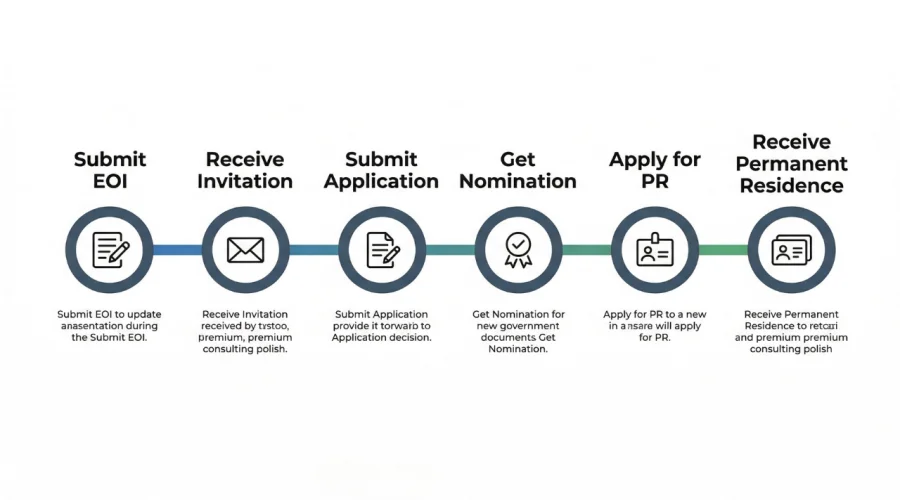
AAIP step-by-step: from EOI to PR card
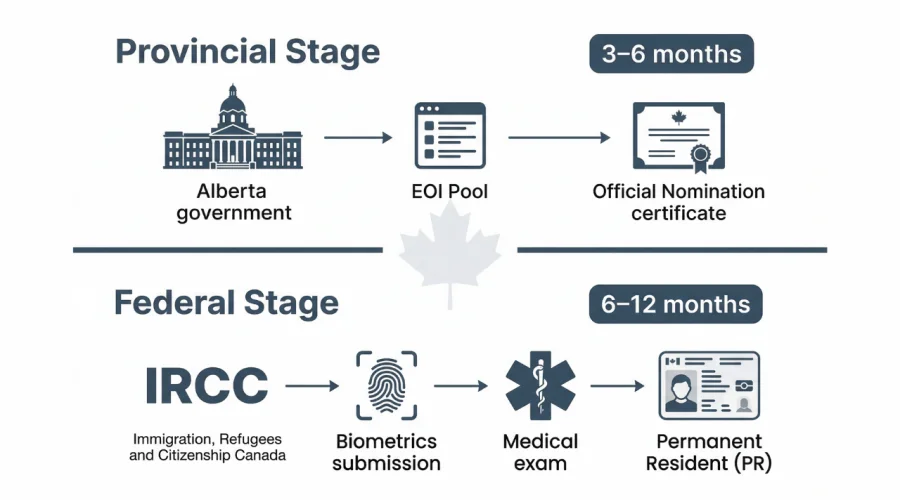
- Profile prep. Take your language test, get your ECA (Educational Credential Assessment), secure your Alberta job offer (or confirm your Alberta employment), and identify which stream you fit.
- WEOI submission. Submit a Worker Expression of Interest through Alberta’s eServices portal. Pay the $135 non-refundable fee within 24 hours. WEOIs are scored and ranked.
- Invitation to apply. If selected from the EOI pool, you receive an invitation. AOS, AEES sub-pathways, RRS, and Tourism & Hospitality each draw separately.
- Nomination application. File the full application within the deadline given in the invitation. Pay the $1,500 nomination fee. Upload all supporting documents.
- Alberta nomination. If approved, Alberta issues a Provincial Nomination Certificate. If you applied via AEES, your IRCC Express Entry profile receives the 600 CRS bonus.
- Federal PR application. File the federal PR application — Enhanced (via Express Entry) or Base — and pay $990 + $600 RPRF + biometrics. Complete medical, security, and admissibility.
- COPR + landing. Receive your Confirmation of Permanent Residence. Land in Canada. PR card issued within ~30–60 days of landing.
2026 AAIP processing times by stream
There is no single “AAIP processing time” any more. Each stream has its own queue:
| Stream | Provincial processing (2026) |
|---|---|
| Alberta Opportunity Stream (AOS) | ~3 months (assessing applications received on or before April 2, 2026) |
| Alberta Express Entry Stream — main | ~3 months (files from March 24, 2026) |
| AEES — Accelerated Tech Pathway | ~3 months (same queue as AEES; historically the fastest to clear) |
| AEES — Dedicated Health Care Pathway | Near-current (assessing files from June 19, 2026) |
| Rural Renewal Stream (RRS) | ~4 months (files from March 2, 2026) |
| Tourism & Hospitality Stream | ~3 months (files from April 7, 2026 — the 12-month backlog reported earlier in 2026 has cleared) |
Source: Alberta.ca AAIP processing information, “currently assessing applications received on or before” dates as of June 30, 2026. Queue dates move roughly weekly.
Add federal processing on top of the provincial step:
- Enhanced PNP (via Express Entry): ~7 months federal processing.
- Base PNP (non-EE streams): ~14 months federal processing.
Realistic end-to-end timeline (EOI to COPR): 10 to 21 months depending on stream + federal route — Express Entry–linked files land at the fast end (~3 months provincial + ~7 months federal), paper-based PNP at the slow end (~4 months provincial + ~14 months federal). For a deeper look at IRCC processing trends, see our AAIP Processing Times 2026 analysis.
Total cost examples (2026)
Worked examples using the corrected 2026 fee stack. Excludes representation fees and adds typical out-of-pocket items (language test, ECA, medical, photos, document translation):
| Item | Single | Couple | Couple + 1 child |
|---|---|---|---|
| WEOI fee | $135 | $135 | $135 |
| AAIP nomination fee | $1,500 | $1,500 | $1,500 |
| Federal processing (principal) | $990 | $990 | $990 |
| RPRF (principal) | $600 | $600 | $600 |
| Spouse processing + RPRF | — | $1,590 | $1,590 |
| Dependent child | — | — | $270 |
| Biometrics | $85 | $170 | $170 |
| Language test (IELTS/CELPIP) | $330 | $660 | $660 |
| ECA (WES typical) | $220 | $440 | $440 |
| IRCC medical exam | $300 | $600 | $900 |
| Estimated total (excl. representation) | ~$4,160 | ~$6,685 | ~$7,255 |
Need an Alberta strategy?
Talk to a licensed RCIC about your AAIP path
We help workers, employers, and graduates choose the right AAIP stream for 2026 — and avoid the WEOI/job-offer/CLB mistakes that get applications refused.
| Book a Consultation → | Call 587-400-0077 |
Common 2026 AAIP mistakes

- Submitting WEOI without scoring it first. The $135 fee is non-refundable. Score the EOI honestly before you submit so you understand your draw odds.
- Choosing the wrong stream. An AOS-eligible candidate who submits to AEES Priority Sector (or vice versa) usually gets rejected at the stream-fit stage, costing the $135 and time.
- Stale language test. CLB results expire 2 years from the test date — not from your WEOI date. Watch the calendar.
- Mistaking community endorsement for nomination. RRS requires the community letter, but the letter is not a nomination — Alberta still must approve the file.
- Forgetting the federal step. Provincial nomination is not permanent residence. You still need IRCC to issue COPR after federal processing.
- Job offer without Alberta employer registration. The employer must complete the Employer Engagement step in Alberta’s eServices before the worker can include the job offer in the WEOI.
Frequently asked questions
Related resources
- AAIP Processing Times 2026: stream-by-stream analysis
- AAIP 2026 Changes: what Alberta employers need to know
- Alberta PNP Changes 2026: 5 major AAIP updates (April)
- Express Entry Canada 2026: pillar guide
- How to improve your CRS score in 2026
- LMIA Exemption: complete 2026 guide for employers and workers
- Immigration Consultant vs Immigration Lawyer: which do you need?
- Best Immigration Consultant in Edmonton: how to verify your RCIC
Immigration Services Across Alberta
TopNation's RCIC-licensed consultants assist clients throughout Alberta — not just Edmonton. Whether you are in Fort McMurray, Red Deer, Calgary, or a rural community, we handle work permits, permanent residence, and employer compliance from start to finish. Book a consultation →
Alberta Immigration Resources
Not sure if you qualify? Check your AAIP points score. For the latest updates, see 2026 AAIP changes for employers.