PROPOSED EXPRESS ENTRY CHANGES
On June 12, 2026, Immigration, Refugees and Citizenship Canada (IRCC) announced a proposal to introduce a ‘high-wage occupation factor’ into Express Entry draws. This could add significant CRS points for candidates in top-earning roles, reshaping the path to permanent residence for skilled professionals.
EXPRESS ENTRY UPDATE — JUNE 2026
Canada’s Express Entry system is poised for a significant evolution. The proposed introduction of a ‘high-wage occupation factor,’ announced in mid-2026, signals a strategic pivot towards prioritizing candidates whose earning potential aligns with Canada’s high-growth sectors. This analytical guide is for high-skilled professionals who want to understand what this change means for their Comprehensive Ranking System (CRS) score and their overall immigration strategy. We will break down the proposal, identify the occupations most likely to benefit, and outline actionable steps you can take today to position your profile for success in this new landscape.

Understanding the Shift: From Broad Strokes to Targeted Selection
For years, Express Entry primarily ranked candidates based on a comprehensive set of human capital factors like age, education, work experience, and language proficiency. While effective, this model was broad. The introduction of category-based selection in 2023 marked a major change, allowing IRCC to target candidates in specific sectors facing critical labour shortages, such as healthcare, STEM, trades, transport, and agriculture.
The proposed high-wage factor is the next logical step in this targeted approach. It acknowledges a simple economic reality: high wages are often a direct indicator of high-demand, high-value skills. By creating a pathway that rewards earning potential, Canada aims to attract global talent that can contribute immediately to the tax base and fill senior, specialized, or leadership roles that drive innovation and economic growth.
Defining ‘High-Wage’ in the Canadian Immigration Context
The crucial question for every candidate is: what does IRCC consider a ‘high-wage’ occupation? While official criteria are yet to be finalized, the definition will almost certainly be tied to provincial or national median wage data published by Statistics Canada. A common benchmark used in other immigration programs, like some Provincial Nominee Programs (PNPs), is the median hourly wage of a specific province.
Candidates will likely need to demonstrate that their job offer, or their prevailing wage for their occupation and region, meets or significantly exceeds this median. It is unlikely to be a single national number; rather, it will be a nuanced calculation that considers regional differences in cost of living and labour markets.
What Is a Median Wage?
The median wage is the midpoint of the wage distribution; half of all workers in a group earn more than the median, and half earn less. It is a more accurate measure than the average wage, which can be skewed by a small number of very high earners. IRCC will likely use this as the baseline for determining eligibility for the new factor.
Provincial Median Wages as a Likely Benchmark
To prepare, candidates should familiarize themselves with the median hourly wages in their target province. Below is a table based on the latest available data from Statistics Canada, which can serve as a preliminary guide.
| Province/Territory | Median Hourly Wage (Approx.) |
|---|---|
| Alberta | $30.00 |
| British Columbia | $29.50 |
| Ontario | $28.75 |
| Quebec | $27.00 |
| Canada (Average) | $28.50 |
Note: These are illustrative figures. Official thresholds will be published by IRCC upon the program’s launch.

How the High-Wage Factor Could Impact Your CRS Score
IRCC has two primary mechanisms to implement this new factor: creating a new category-based draw or adding a new set of points to the CRS. Both have distinct implications for candidates.
Scenario 1: A New Category-Based Draw
This is the most likely scenario. Similar to draws for French speakers or healthcare workers, IRCC could hold specific invitation rounds for candidates in the Express Entry pool who have a job offer or work experience in a designated high-wage occupation. In this case, the CRS cut-off for these draws would likely be lower than for general draws, as the pool of eligible candidates is smaller.
Scenario 2: Additional CRS Points
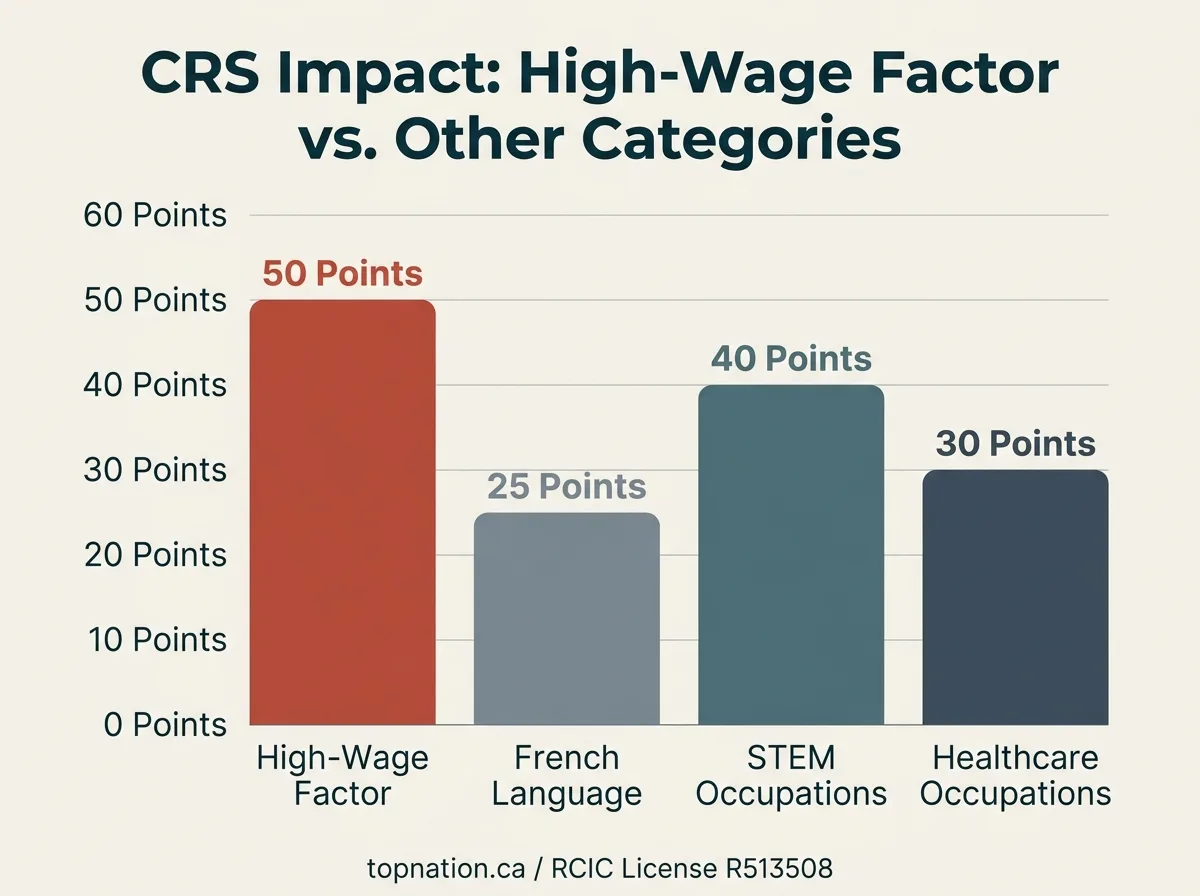
Alternatively, IRCC could award a block of additional points—perhaps 25, 50, or even 100—to any candidate in the pool whose primary NOC is considered high-wage. This would be similar to the points awarded for a Canadian degree or a Provincial Nomination. This would directly boost a candidate’s overall score, increasing their chances in general draws.
Illustrating the Potential CRS Boost
Let’s consider a hypothetical candidate to see the potential impact. A 32-year-old software developer with a Master’s degree, three years of foreign work experience, and advanced English scores has a solid CRS score. However, with the new factor, their chances could dramatically improve.
| CRS Factor | Score Before High-Wage Factor | Score After Hypothetical 50 Points |
|---|---|---|
| Core Human Capital | 469 | 469 |
| Spouse/Partner Factors | 0 (Single) | 0 (Single) |
| Skill Transferability | 50 | 50 |
| High-Wage Occupation Factor | 0 | 50 |
| Total CRS Score | 519 | 569 |
A jump from 519 to 569 would move this candidate from being competitive to being in a prime position to receive an Invitation to Apply (ITA) in nearly any recent general draw.
Key NOC Codes Poised to Benefit from the High-Wage Factor
While the official list of occupations has not been released, we can make educated projections based on current labour market data and existing high-demand sectors. The focus will likely be on TEER 0 (Management), TEER 1 (Professional), and some high-skilled TEER 2 (Technical) occupations. These roles typically require specialized education and experience, commanding higher salaries.
Projected Priority Occupations
Below are some of the National Occupational Classification (NOC) codes that are strong candidates for inclusion in the high-wage category, based on their national median wage and strategic importance to the Canadian economy.
| NOC Code | Occupation Title | TEER |
|---|---|---|
| 10010 | Financial managers | 0 |
| 20010 | Engineering managers | 0 |
| 21211 | Data scientists | 1 |
| 21231 | Software engineers and designers | 1 |
| 21222 | Cybersecurity specialists | 1 |
| 31102 | General practitioners and family physicians | 1 |
| 41200 | University professors and lecturers | 1 |
It’s important to note this list is speculative. The final list will be determined by IRCC based on comprehensive labour market analysis. Candidates in related fields with high earning potential should also monitor developments closely.
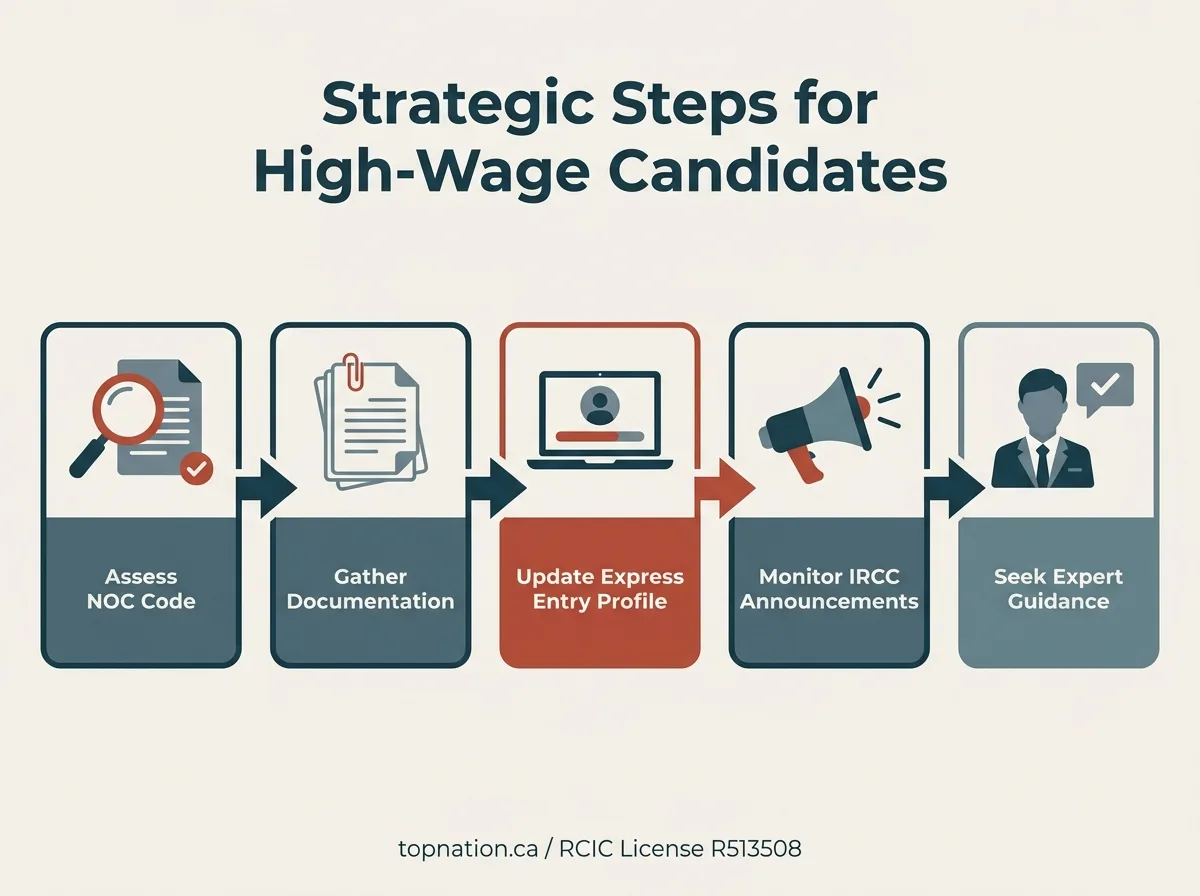
Strategic Preparation for High-Wage Candidates
With these changes on the horizon, proactive preparation is key. Simply having a high salary is not enough; your Express Entry profile must be meticulously prepared to prove it. At TopNation, we guide clients through this process daily.
Checklist: Is Your Profile Ready for the High-Wage Factor?
Use this checklist to assess your readiness:
- Verify Your NOC Code: Is your primary NOC code accurate and does it truly reflect your job duties? The duties listed in your reference letters must align with the lead statement and main duties of the NOC you claim.
- Gather Detailed Reference Letters: Your employment reference letters are the most critical evidence. They must go beyond confirming your title and dates of employment. They should detail your salary, bonuses, hours per week, and a comprehensive list of duties that clearly demonstrate the complexity and seniority of your role.
- Secure an Educational Credential Assessment (ECA): An ECA is mandatory for most Express Entry candidates, but for high-wage roles, it’s crucial to have it done for ALL post-secondary credentials to maximize education points.
- Maximize Language Scores: Do not settle for minimum language scores. A high wage often corresponds with high-level communication skills. Aim for a Canadian Language Benchmark (CLB) of 9 or higher in all abilities to maximize your CRS score.
- Document Your Salary Correctly: Ensure your proof of funds and salary documentation (pay stubs, T4s if in Canada, letters of employment) are clear, consistent, and easily verifiable.
Common Mistake We See: The ‘Title vs. Duties’ Mismatch
A frequent issue we encounter is a mismatch between a candidate’s job title and their actual duties. For example, a client might have the title ‘Senior IT Project Manager’ (a high-wage role), but their reference letter describes duties that are more aligned with an ‘Administrative Coordinator’. This discrepancy is a major red flag for immigration officers and can lead to a refusal. It is essential that your documented duties reflect the seniority and responsibility that justify a high wage.
Firm-Observed Insight: The Power of Supporting Evidence
Based on our analysis of hundreds of high-earner profiles managed by our firm, we’ve observed that applications with robust supporting evidence for salary claims tend to be processed more smoothly. This includes not just the job offer and reference letter, but also performance reviews that mention salary increases, bonus payout letters, and even redacted employment contracts that specify compensation structures. This level of detail builds a stronger, more credible case.
Comparing the High-Wage Factor with Other Express Entry Categories
How does this new proposed factor fit with existing category-based selections? It complements them by creating a new avenue for skilled workers who might not fall into the specific occupations listed under STEM, trades, or healthcare, but who possess equally valuable and in-demand skills.
Synergy with Existing Categories
Many roles in the STEM or healthcare categories are already high-wage occupations (e.g., software engineers, specialist physicians). For these candidates, the new factor could provide a dual benefit, making them eligible for multiple types of category-based draws and increasing their overall chances of receiving an ITA.
A New Pathway for Other Professionals
The real beneficiaries will be professionals in fields not currently targeted, such as senior management, finance, law, and marketing. A high-performing Financial Manager or a senior Marketing Director, for example, could now have a dedicated pathway through Express Entry that recognizes their economic contribution, even if their specific NOC is not on a targeted sector list. This broadens the scope of Express Entry to capture a wider range of top-tier talent. Candidates may also explore investment migration if their profile aligns with business-focused streams.

Anticipated Implementation Timeline and Next Steps
Following the June 12, 2026 announcement, IRCC typically enters a period of public and stakeholder consultation. While timelines can shift, we can project a possible path forward.
Projected Timeline
- Q3 2026: Stakeholder consultations and finalization of the ‘high-wage’ definition and list of eligible occupations.
- Q4 2026: Official publication of the new Ministerial Instructions outlining the new category or points system in the Canada Gazette.
- Q1 2027: First Express Entry draws incorporating the high-wage occupation factor are held.
It is crucial for potential candidates to use this interim period to prepare their profiles. Waiting for the official launch could mean missing the first, and often largest, invitation rounds.
Navigating Your Immigration Journey with Expert Guidance
The landscape of Canadian immigration is constantly evolving. A change like the proposed high-wage factor creates significant opportunities, but it also adds a new layer of complexity to the application process. Ensuring your profile is perfectly optimized, that your NOC is correctly identified, and that your documentation is flawless is more important than ever.
Working with a licensed Regulated Canadian Immigration Consultant (RCIC) removes the guesswork. An expert can assess your eligibility against the new and existing criteria, help you craft a strategy to maximize your CRS score, and ensure your application is submitted correctly and completely. Whether you are in Alberta and seeking an Immigration Consultant Edmonton, or applying from abroad, professional guidance is a critical investment in your future. This is also true for other streams, like the detailed process for spousal sponsorship, where expert advice is invaluable.
For those with job offers, understanding the intricacies of work permits and the LMIA Exemption Guide is equally important and can be a parallel part of your strategy.
The Express Entry Rules Are Changing. Is Your Profile Optimized?
Our RCICs can assess your profile against the proposed high-wage criteria to maximize your chances.
| Call 587-400-0077 | Get a Profile Assessment |
RCIC Licensed | Serving All of Alberta
Last updated: June 2026. This guide reflects our analysis of proposed Express Entry changes announced on June 12, 2026. Immigration rules change frequently — consult a licensed RCIC (CICC #R513508) for advice specific to your situation.