Quick Answer
A post-graduation work permit 2026 application lets many eligible Canadian graduates work in Canada on an open work permit after study. However, IRCC’s 2024-2025 changes tightened eligibility for some programs, especially non-university and college programs tied to field-of-study rules and language requirements. In 2026, students can still qualify if their school, program, study history, language proof, and application timing meet the current IRCC rules.
The post-graduation work permit 2026 pathway is one of the most important bridges between Canadian study and permanent residence. It can give graduates time to build skilled Canadian work experience, choose the right employer, and plan for Express Entry or a provincial nominee program. The challenge is that PGWP eligibility is no longer something students should assume automatically. Before you enrol, graduate, or apply, you should verify the program rules, document timing, and PR plan together.

What Is a Post-Graduation Work Permit (PGWP)?
A Post-Graduation Work Permit, or PGWP, is an open work permit for eligible graduates from Canadian designated learning institutions. Because it is open, the worker is not tied to one employer and does not usually need an LMIA. That makes it different from an employer-specific work permit, where the job offer, employer, occupation, and location can be fixed on the permit.
The length of a PGWP is usually connected to the length of the eligible program. A program of at least 8 months but less than 2 years may lead to a permit up to the same length as the program. A program of 2 years or more may lead to a permit of up to 3 years. In many cases, a master’s program of less than 2 years can also qualify for a 3-year permit if the program meets IRCC conditions.
A PGWP is normally a once-in-a-lifetime benefit. If you already received one, you should not plan on getting a second PGWP after another program. Many graduates use this one permit to build the 12 months of skilled Canadian work experience needed for the Canadian Experience Class.
What Changed in 2024-2025 for PGWP 2026 Applicants
The biggest shift for PGWP 2026 applicants is that program eligibility became more selective. For many non-university programs, students need to confirm that the program is connected to a field of study that IRCC recognizes for PGWP purposes. This is especially important for college, vocational, and career-focused programs. Students should check IRCC’s official PGWP eligibility page before enrolling and again before applying.
Language requirements also became more important. As of the current policy framework, university graduates generally face a higher language threshold than college graduates, with English CLB and French NCLC equivalents used to measure results. Because language test validity, test type, and application timing all matter, the safest approach is to book the language test before the final term becomes crowded with graduation documents.
Another practical change is spousal planning. Many PGWP holders no longer create automatic open work permit eligibility for a spouse just because they graduated. In addition, study permit caps in 2024 and 2025 changed the number and type of students entering Canada, which may affect future PGWP applicant pools. Therefore, students should plan the PGWP and family strategy early rather than waiting until final marks are issued.
PGWP Eligibility Requirements 2026 — Full Checklist
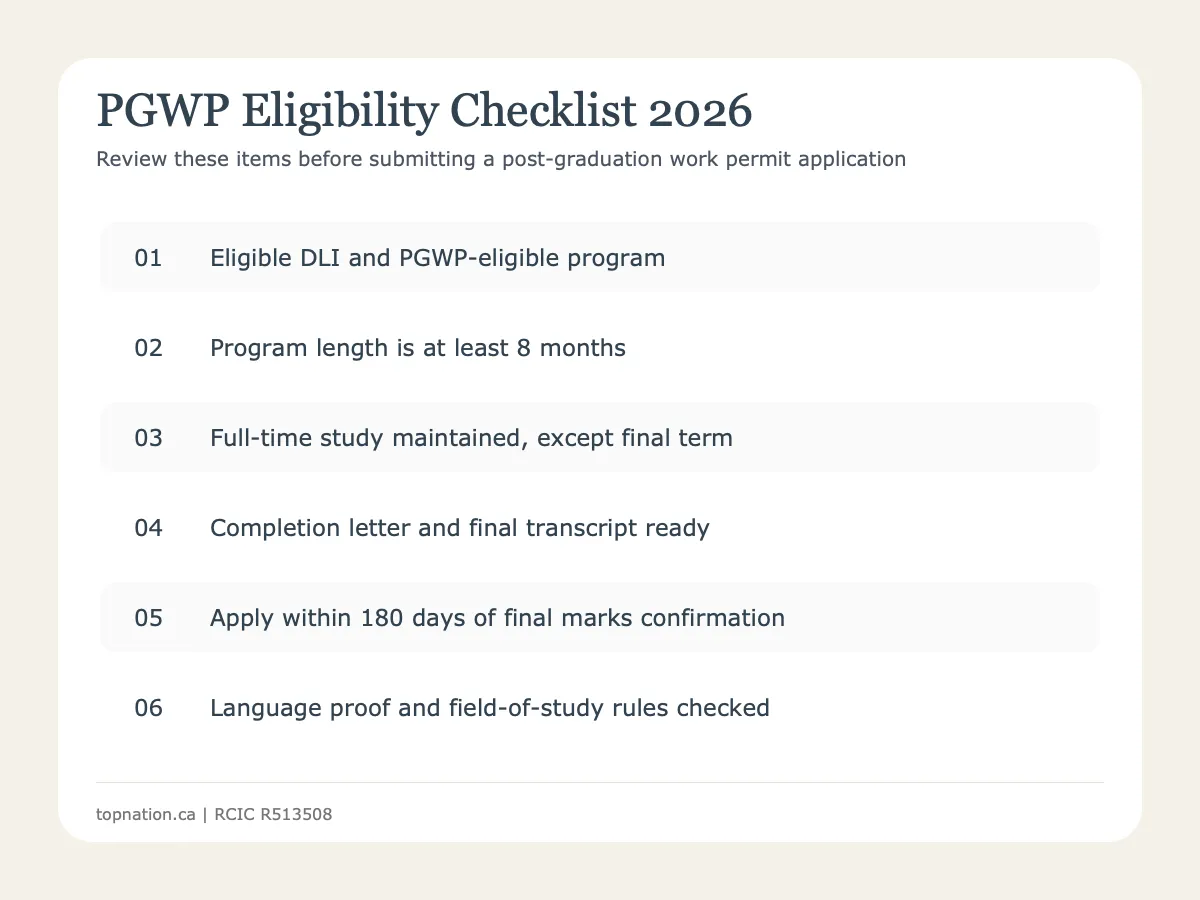
The post-graduation work permit 2026 checklist starts with study status. You should have maintained authorization to study throughout the program, completed an eligible program at a Designated Learning Institution, and respected full-time study requirements, except for limited situations such as the final academic term. You can confirm school status through IRCC’s Designated Learning Institutions list.
- Eligible DLI and program: the school must be a DLI, and the specific program must support PGWP eligibility.
- Program length: the program should be at least 8 months long.
- Full-time study: you should normally maintain full-time status in each academic session, except allowed final-term exceptions.
- Completion documents: you need proof of completion, usually a final transcript and official completion letter.
- 180-day timing: you must apply within 180 days of receiving written confirmation that you completed the program.
- Field-of-study rules: if your program type is subject to the 2024-2025 restrictions, confirm it appears on the eligible list.
- Language proof: prepare CLB or NCLC results at the level required for your program type.
Do not treat this as a last-week task. If your language test, final transcript, or completion letter arrives late, the 180-day window can still keep moving. Also, if your study permit expires before you apply, your options can become more complicated and time-sensitive.
How Long Is Your PGWP? — Program-Length Formula
PGWP duration is not chosen by the applicant. IRCC reviews the completed program, the credential, the length of study, and the documents submitted. The table below summarizes the general planning formula, but the final decision always depends on IRCC’s assessment.
| Program Length | Possible PGWP Duration | Notes |
|---|---|---|
| Less than 8 months | Usually not eligible | Short programs normally do not support PGWP eligibility. |
| 8 months to less than 2 years | Up to program length | A 12-month eligible program may lead to a permit up to 12 months. |
| 2 years or longer | Up to 3 years | This is often the strongest planning window for PR work experience. |
| Eligible master’s program | Often up to 3 years | Check current IRCC rules before assuming the exception applies. |
| Multiple eligible programs | May be combined | Combination rules are technical and should be reviewed before filing. |
A longer PGWP can matter because permanent residence often depends on work experience. If your permit is short, you need a tighter plan for job search, skilled NOC alignment, language testing, and provincial nomination timing.
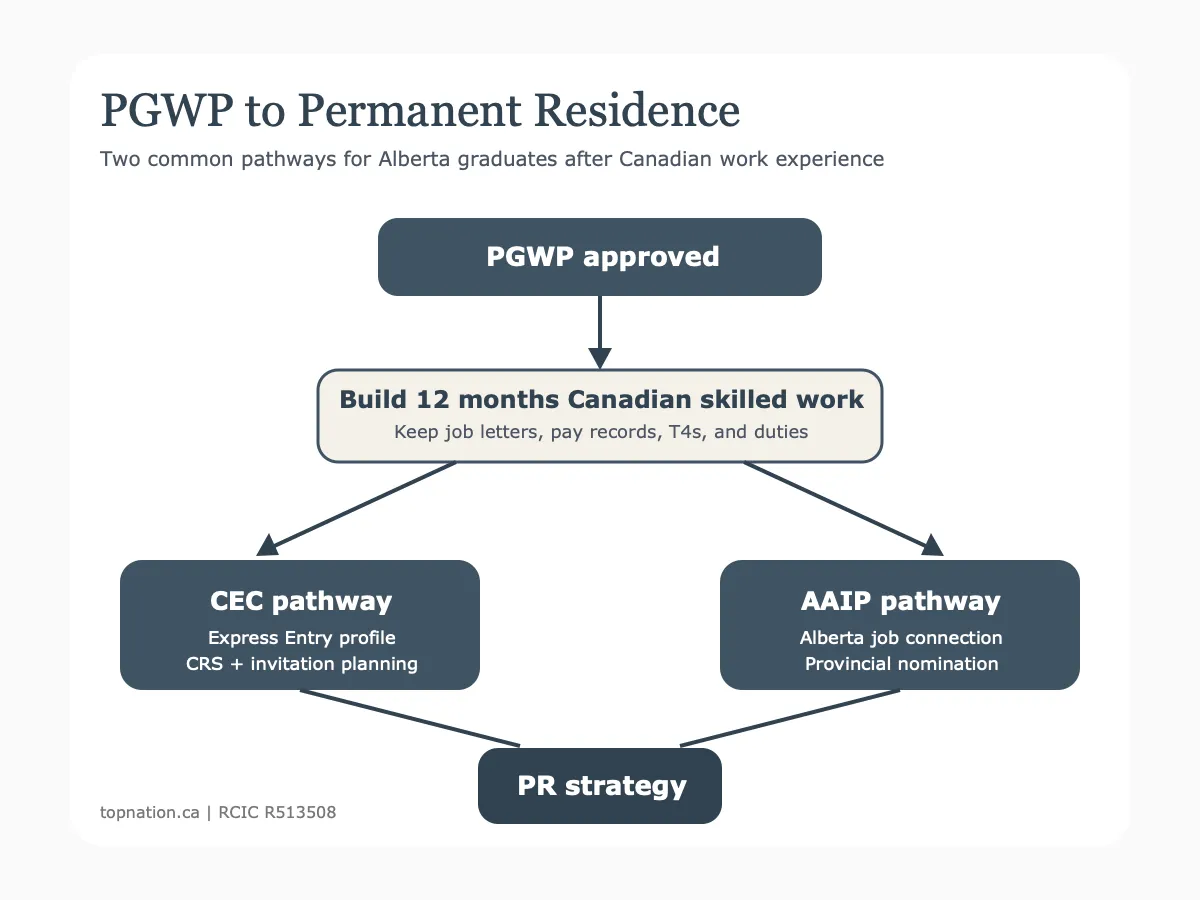
PGWP to Permanent Residence — The Two Most Common Pathways
The first common pathway is Canadian Experience Class. PGWP holders often use the permit to gain 12 months of full-time, paid, skilled Canadian work experience. IRCC’s official Canadian Experience Class requirements explain the core federal criteria. Your job duties, TEER level, hours, and timing matter, so keep pay stubs, job letters, T4s, and proof of role changes.
The second common pathway is a provincial nominee program. In Alberta, PGWP holders may explore the Alberta PNP and, where eligible, the AAIP Opportunity Stream. The provincial route can be useful when Express Entry CRS is not high enough or when the applicant has a strong Alberta job connection.
Express Entry is still the umbrella system for many federal PR files, so graduates should understand the broader Express Entry Canada 2026 guide. If your PR application is filed before your PGWP expires, a Bridging Open Work Permit may help you maintain work authorization while the PR file is in process.
Common PGWP Mistakes That Cost Applicants the Permit
The most painful PGWP mistakes are usually preventable. Applying after the 180-day window is one. Letting the study permit expire before applying is another. Students also run into trouble when they assume that every DLI program is PGWP-eligible, even though school eligibility and program eligibility are not always the same thing.
Part-time study can also create risk unless it fits an allowed exception, such as a final term. Missing the language test deadline can be just as damaging if the application is submitted without required proof. Finally, many refusals start with document category errors: the completion letter, final transcript, passport, status document, and language result should be organized before submission, not uploaded in a rush.
If your facts are messy, get advice before filing. A refusal can waste the single PGWP opportunity and can also disrupt your pathway to Canadian work experience.
How TopNation Helps PGWP Applicants in Alberta
TopNation helps students and recent graduates review PGWP eligibility before submission. That includes checking the DLI, program type, field-of-study concern, study history, language proof, completion documents, and timing. We also review whether the applicant should apply inside Canada, restore status first, or plan a different work permit strategy.
For Alberta-based graduates, the PGWP conversation should also include permanent residence. A PGWP is useful because of what it lets you do next: build skilled work experience, prepare an Express Entry profile, or time an AAIP strategy. If you want a file-specific review, you can contact TopNation before you apply.
We also help applicants sequence job search, language testing, and PR documentation so the PGWP period is not wasted. A strong plan starts before graduation and keeps the temporary work permit, work experience, and permanent residence timeline moving in the same direction.
Frequently Asked Questions
PGWP Eligibility Review
Need an Eligibility Review Before You Apply?
TopNation can review your program, documents, deadline, and PGWP-to-PR strategy before you submit.
| Talk to an RCIC → | Call (587) 400-0077 |
Last updated: May 2026. This article is general information, not legal advice. IRCC rules change frequently, so verify the current eligibility list before applying or consult a licensed representative.