
Major Policy Shift for Employers
Effective July 10, 2026, the Government of Canada has lifted the refusal to process low-wage Labour Market Impact Assessment (LMIA) applications in 8 designated economic regions. This change directly impacts employers in sectors like accommodation, food services, and retail trade.
LMIA POLICY UPDATE — JULY 10, 2026
For Canadian employers in specific high-need regions, the persistent challenge of filling low-wage positions has been a significant barrier to growth. A recent federal policy change, effective July 10, 2026, directly addresses this by lifting processing restrictions on low-wage LMIA applications in eight designated economic regions. This move opens a critical talent pipeline for businesses in sectors like Accommodation and Food Services (NAICS 72) and Retail Trade (NAICS 44-45). This comprehensive guide provides a tactical roadmap for employers in Halifax, Winnipeg, Regina, and other affected areas to understand the new landscape, navigate the application process, and strategically leverage this opportunity to build a stable workforce.
Understanding the July 10, 2026 LMIA Policy Shift
This policy adjustment isn’t just a minor tweak; it’s a targeted intervention designed to alleviate acute labour shortages in specific communities. For employers who were previously unable to access the Temporary Foreign Worker Program (TFWP) for certain roles, this change represents a fundamental shift in their recruitment strategy.
What Were the Previous Restrictions?
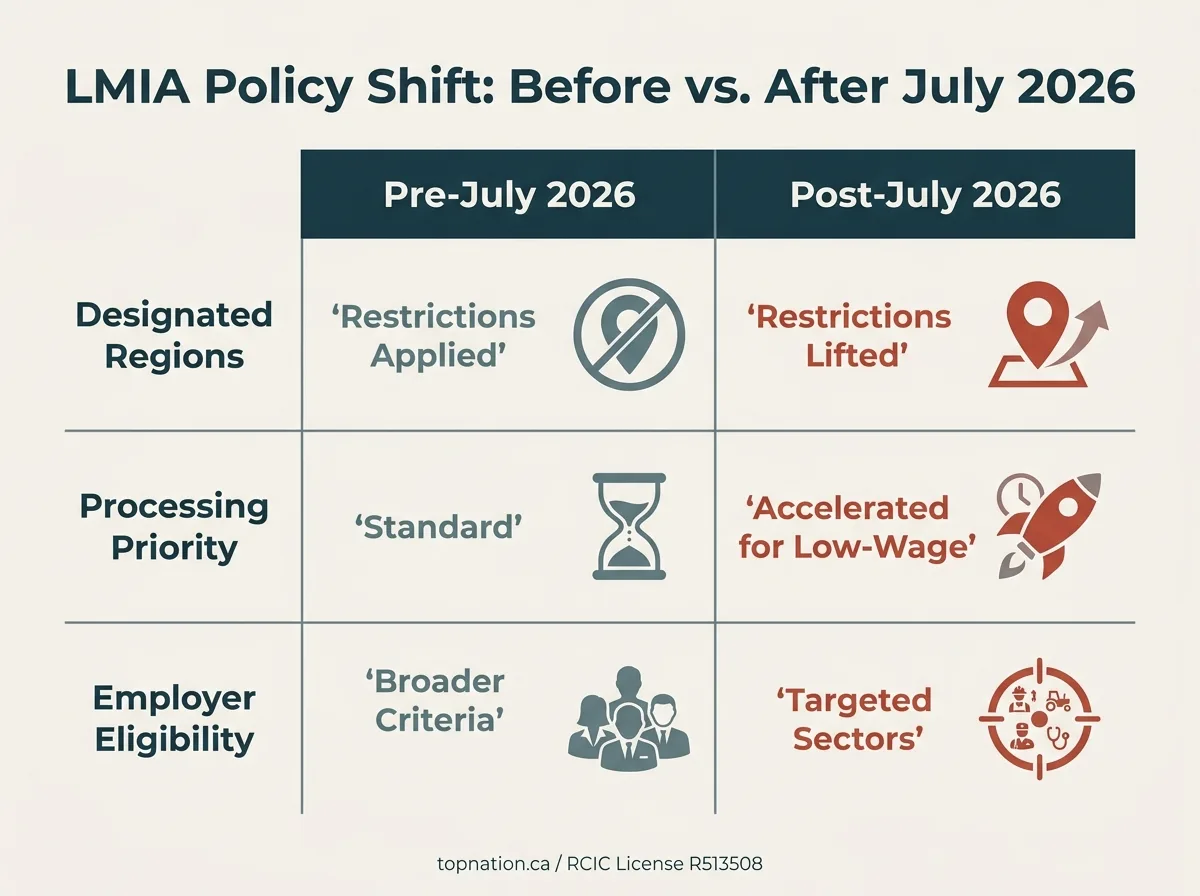
Prior to this announcement, Employment and Social Development Canada (ESDC) maintained a policy of refusing to process LMIA applications for low-wage positions in regions where the unemployment rate was 6% or higher. This cap was intended to prioritize the local labour force. However, in practice, it often created a disconnect where specific industries still faced critical staff shortages despite the overall unemployment statistic. For employers in sectors like hospitality and retail, this meant many essential roles, such as food counter attendants or retail sales associates, were ineligible for the TFWP.
What Exactly Has Changed as of July 10, 2026?
The new directive lifts this refusal-to-process policy, but only within eight specific economic regions identified as having unique and persistent labour market pressures. It does not eliminate the cap nationwide. For employers operating within the precise boundaries of these designated zones, LMIA applications for low-wage positions in eligible sectors (primarily NAICS 72 and 44-45) will now be accepted and processed by ESDC. All other standard LMIA requirements, such as recruitment efforts and prevailing wage adherence, remain fully in effect.
Why This Change Matters for Your Business
This is a strategic opportunity to stabilize your operations. By gaining access to the TFWP, you can fill vacancies that have remained open for months, reduce the strain on your existing staff, and maintain consistent service levels. It allows for more predictable workforce planning and can reduce the high costs associated with constant recruitment and turnover in a tight domestic labour market. For many small and medium-sized businesses, this could be the key to sustainable growth.
The Eight Designated Regions Where Restrictions Are Lifted
The government’s selection of these eight regions is based on detailed labour market analysis, identifying areas where low-wage sector shortages are most acute. If your business operates within one of these zones, you are now eligible to apply under the new rules.
Atlantic Canada Focus
The Atlantic provinces feature prominently in this update, reflecting ongoing demographic and labour challenges. The designated regions are Halifax, Nova Scotia; St. John’s, Newfoundland and Labrador; and Moncton, New Brunswick. These urban centres are hubs for tourism, retail, and services, sectors that have struggled significantly to find and retain local talent for low-wage roles.
Prairie Powerhouses
In the Prairies, the policy change targets key economic engines. The designated regions include Winnipeg, Manitoba; Regina, Saskatchewan; and Saskatoon, Saskatchewan. These cities have diverse economies but share a common challenge in staffing their rapidly growing service and retail sectors, making this policy lift a welcome relief for local businesses.
Central & Western Canada Selections
Rounding out the list are two regions with specific industrial and service-based needs. Thunder Bay, Ontario, and Kelowna, British Columbia, have been included. Kelowna’s tourism-driven economy and Thunder Bay’s role as a regional service hub have created labour demands that the local market has been unable to meet.
| Designated Region | Primary Affected Sectors (NAICS Codes) |
|---|---|
| Halifax, NS | Accommodation and Food Services (72), Retail Trade (44-45) |
| St. John’s, NL | Accommodation and Food Services (72), Retail Trade (44-45) |
| Moncton, NB | Accommodation and Food Services (72), Retail Trade (44-45) |
| Winnipeg, MB | Accommodation and Food Services (72), Retail Trade (44-45), Food Manufacturing (311) |
| Regina, SK | Accommodation and Food Services (72), Retail Trade (44-45) |
| Saskatoon, SK | Accommodation and Food Services (72), Retail Trade (44-45) |
| Thunder Bay, ON | Accommodation and Food Services (72), Retail Trade (44-45) |
| Kelowna, BC | Accommodation and Food Services (72), Retail Trade (44-45) |
Key Sectors Benefiting from the Policy Change
While the regional designation is the first criterion, the policy is further targeted at specific sectors. Understanding if your business falls under the eligible North American Industry Classification System (NAICS) codes is essential.
Accommodation and Food Services (NAICS 72)
This sector is the primary beneficiary. It includes hotels, motels, restaurants, fast-food outlets, caterers, and bars. Roles such as Food Counter Attendants (NOC 65201), Kitchen Helpers (NOC 65201), and Light Duty Cleaners (NOC 65310) are prime examples of positions that will now be eligible for low-wage LMIA applications in the designated regions.
Retail Trade (NAICS 44-45)
Businesses in retail, from grocery stores to clothing boutiques, also stand to gain. Common low-wage positions that have been difficult to fill include Retail Salespersons (NOC 64100), Cashiers (NOC 65100), and Shelf Stockers (NOC 65102). This policy allows retailers in the eight regions to address staffing gaps and ensure a better customer experience.
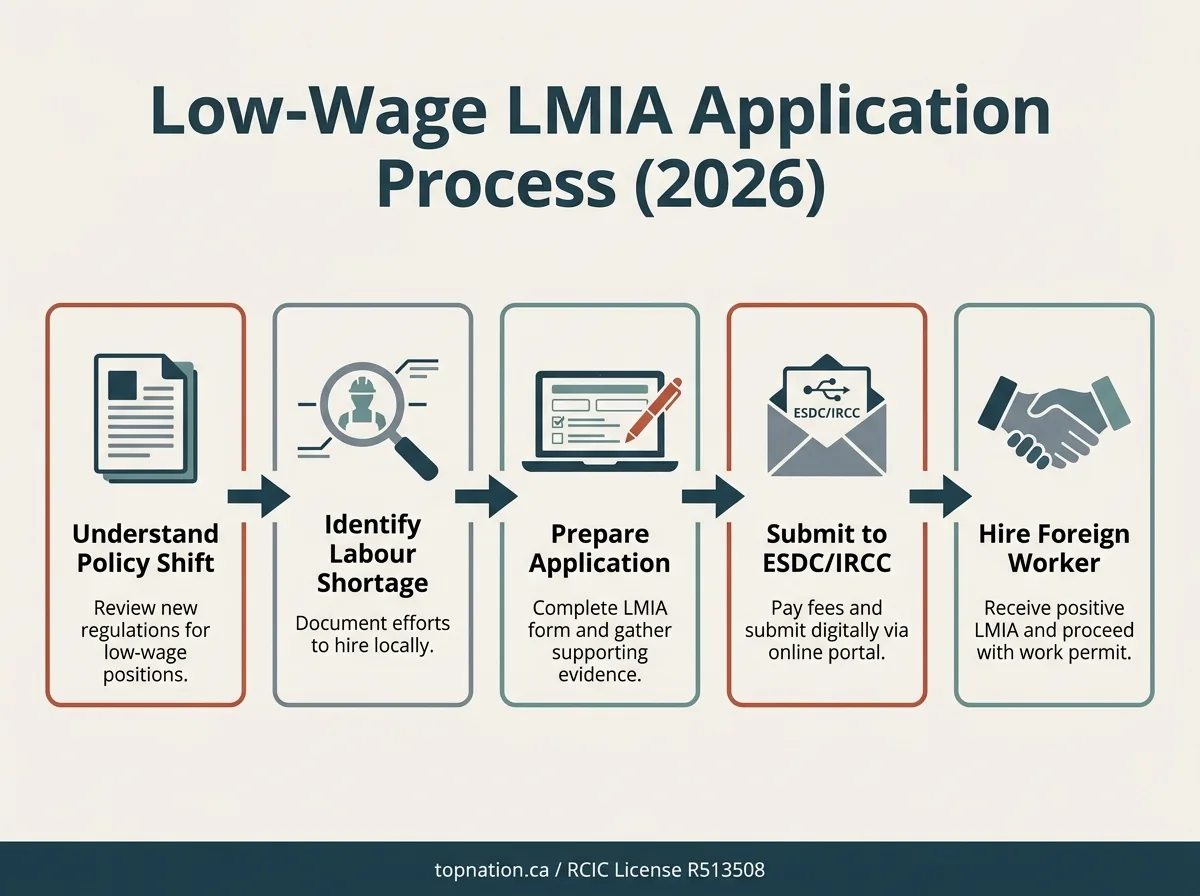
Navigating the Low-Wage LMIA Application Process (2026)
With the restrictions lifted, the door is open, but the process remains rigorous. A successful application requires meticulous preparation and a clear understanding of ESDC’s expectations. All standard general LMIA requirements continue to apply.
Step 1: Confirming Your Eligibility
First, verify that your business’s physical location falls within the official boundaries of one of the eight designated economic regions. Second, confirm that the position you wish to fill is classified under an eligible NAICS code, typically 72 or 44-45. Finally, ensure the position is genuinely low-wage, meaning the offered salary is below the provincial or territorial median hourly wage.
Step 2: Meeting Advertising and Recruitment Requirements
You must prove that you have made significant efforts to hire a Canadian or permanent resident first. This involves advertising the position on the national Job Bank and at least two other alternative recruitment platforms for a minimum of four consecutive weeks. One of these platforms must target an underrepresented group (e.g., Indigenous persons, persons with disabilities, newcomers). Meticulous record-keeping of all applications received and reasons for not hiring local candidates is mandatory.
A Common Mistake We See: Insufficient Proof of Recruitment
A frequent reason for LMIA refusal is a poorly documented recruitment process. Employers often fail to keep detailed notes on why each Canadian applicant was not suitable for the role. Vague reasons like “not a good fit” are insufficient. You must provide specific, job-related justifications (e.g., “Applicant lacked required food handling certification,” or “Candidate was not available for required shift schedule”). We advise clients to create a detailed spreadsheet tracking every applicant and the specific outcome.
Step 3: Determining the Prevailing Wage
You must offer a wage that is equal to or greater than the prevailing wage for that specific occupation in that specific region, as listed on the Job Bank. Offering a lower wage will result in an automatic refusal. This is a non-negotiable aspect of the program designed to protect temporary foreign workers from exploitation.
Step 4: The Transition Plan (A Critical Component)
For all low-wage LMIA applications, you must submit a Transition Plan. This is a formal document outlining the concrete steps you will take to recruit, train, and retain Canadians and permanent residents, thereby reducing your future reliance on temporary foreign workers. This plan is not a mere formality; ESDC officers scrutinize it to ensure it is credible and actionable. Failure to provide a convincing Transition Plan is a common point of failure.
Essential Employer Responsibilities and Compliance
Receiving a positive LMIA is not the end of the process; it is the beginning of your responsibilities as an employer under the TFWP. Compliance is taken extremely seriously, with significant penalties for employers who fail to meet their obligations.
Your Obligations Under the TFWP
You are legally bound to uphold all promises made in the LMIA application and job offer. This includes paying the stated wage, providing the agreed-upon hours of work, and ensuring the job duties match what was approved. You must also pay for the worker’s round-trip transportation from their country of residence to the work location in Canada and provide or arrange for affordable housing.

Preparing for a Compliance Review
ESDC can conduct an inspection at any time to verify your compliance. This can include a review of your payroll records, interviews with workers, and a physical inspection of the workplace and housing. Maintaining perfect records is your best defence. Keep all documents related to the LMIA, recruitment, employment contracts, and payroll for a minimum of six years.
| Compliance Area | Key Employer Obligation | Common Pitfall to Avoid |
|---|---|---|
| Wages | Pay at least the prevailing wage as stated in the LMIA. | Making unauthorized deductions from paycheques. |
| Working Conditions | Provide a safe workplace free of abuse and substantially the same as offered. | Assigning the worker duties from a different, lower-skilled NOC. |
| Housing | Ensure affordable and suitable housing is available. | Charging more than 30% of pre-tax earnings for employer-provided housing. |
| Record Keeping | Retain all LMIA-related documents for 6 years. | Failing to keep copies of recruitment ads and applicant details. |
Strategic Advantages for Employers in Affected Regions
Beyond simply filling a vacant spot, leveraging this policy change can provide long-term benefits for your business. It’s an investment in stability and can even create pathways to permanent residency for your most valued employees, fostering loyalty and reducing future turnover.
Addressing Critical Labour Gaps and Stabilizing Operations
The most immediate benefit is the ability to finally staff your business adequately. This leads to improved service quality, reduced burnout among existing employees, and the capacity to take on more business. Based on TopNation’s Q2 2026 file data, well-prepared low-wage LMIA applications in the food service sector are seeing decisions in approximately 45-60 business days, allowing for relatively quick relief.
A Pathway to Permanent Residence for Valued Employees
A positive LMIA and a Canadian job offer can be a significant asset for a foreign worker seeking permanent residence through programs like Express Entry or a Provincial Nominee Program (PNP). By supporting a reliable employee’s PR application, you can secure a long-term, loyal member of your team who is invested in your business and community. This transforms a temporary solution into a permanent asset.
Common Questions About the New Low-Wage LMIA Rules
Navigating policy changes can be confusing. Here are answers to some of the most common questions we receive from employers.
Does this mean LMIAs are automatically approved in these regions?
No. It simply means ESDC will now accept and process the applications instead of refusing them outright based on the regional unemployment rate. Your application must still meet all the rigorous requirements of the TFWP, including proving a genuine need for the worker and demonstrating adequate recruitment efforts.
Can I hire for any low-wage position?
No. The policy lift is primarily targeted at specific sectors, most notably Accommodation and Food Services (NAICS 72) and Retail Trade (NAICS 44-45). You must verify that the position’s NAICS code is eligible under this specific public policy.
What if my business is located just outside a designated region?
Unfortunately, the policy is strict about geographic boundaries. If your work location is not within the defined economic region, the previous refusal-to-process policy may still apply if your local unemployment rate is 6% or higher. For help with your specific situation, it is best to seek professional immigration assistance.
How TopNation Immigration Consulting Can Assist
This policy change is a significant opportunity, but the LMIA process is complex and unforgiving of errors. Our CICC-licensed RCIC team specializes in helping Canadian employers navigate the TFWP with confidence and precision. We ensure your application is not just complete, but compelling.
Your Pre-Application Go/No-Go Checklist
Before investing time and resources, consider this quick checklist. Can you confidently answer ‘yes’ to all these points? First, is your business address located squarely within one of the eight designated regions? Second, have you conducted at least four weeks of compliant advertising and can you prove why Canadian applicants were not hired? Third, are you prepared to pay the prevailing wage and manage all employer obligations, including housing and transportation costs? Finally, have you developed a realistic and detailed Transition Plan? If you hesitate on any of these, it’s a sign that professional guidance could be critical.
End-to-End Support from LMIA to Work Permit
We manage the entire process for you, from advising on recruitment strategy and preparing a robust LMIA application to assisting your future employee with their work permit application. We handle the paperwork and government correspondence, allowing you to focus on running your business. Our goal is to make the process as seamless as possible while maximizing your chances of a positive outcome. Partnering with a firm like ours can be the difference between a successful application and a costly refusal. We encourage you to contact a licensed RCIC to discuss your specific needs.
New LMIA Rules Create Opportunity. Are You Ready?
Our free employer assessment will determine your eligibility under the new policy and outline a clear strategy.
| Call 587-400-0077 | Request Free Employer Assessment |
RCIC Licensed | Serving All of Alberta
Last updated: July 2026. This guide reflects the policy changes for low-wage LMIA processing announced for July 10, 2026. Immigration rules change frequently — consult a licensed RCIC for advice specific to your situation.