NEW IRCC GUIDELINES ON LANGUAGE TEST VERIFICATION
As of June 23, 2026, Immigration, Refugees and Citizenship Canada (IRCC) has issued new operational directives to officers, significantly increasing scrutiny on all language test results. This change directly impacts applicants who may face a devastating 5-year ban for even unintentional discrepancies or incomplete declarations.
IRCC POLICY UPDATE — JUNE 23, 2026
A genuine language test result is the cornerstone of many Canadian immigration applications. Following a significant operational update on June 23, 2026, IRCC has intensified its efforts to verify the authenticity of every IELTS, CELPIP, and TEF result submitted. For honest applicants, this new landscape requires a higher standard of diligence and transparency. Failing to understand these new verification protocols can lead to devastating consequences, including application refusal and a five-year ban for misrepresentation. This guide provides a clear, actionable checklist to ensure your application is built on a foundation of integrity, helping you navigate IRCC’s enhanced scrutiny with confidence.

Understanding IRCC’s New Stance on Language Test Integrity
The integrity of the Canadian immigration system relies on the verifiable and authentic documents provided by applicants. Language proficiency is a critical selection factor, directly impacting an applicant’s ability to integrate economically and socially. IRCC’s heightened scrutiny is not designed to penalize genuine applicants but to protect the system’s fairness and value. The June 23, 2026, directive empowers immigration officers with more robust tools and clearer mandates to detect and act upon any irregularities found in language test submissions.
This policy shift addresses concerns over sophisticated fraud networks and ensures that all candidates are assessed on a level playing field. For applicants, this means that simple mistakes, such as failing to disclose a previous test attempt or entering an incorrect Test Report Form (TRF) number, are now more likely to be flagged for in-depth review, potentially leading to serious complications.
Why the Increased Scrutiny? Unpacking IRCC’s Concerns
IRCC’s decision to enhance verification protocols stems from several key concerns that threaten the integrity of Canada’s immigration programs. Understanding these drivers helps applicants appreciate the importance of meticulous accuracy in their submissions.
Protecting the Points-Based System
Programs like Express Entry are highly competitive, with a few points often making the difference between receiving an Invitation to Apply (ITA) and remaining in the pool. Language scores are a significant source of points. Fraudulent results unfairly inflate an applicant’s Comprehensive Ranking System (CRS) score, displacing deserving candidates who have earned their scores legitimately. The new measures aim to restore and maintain fairness in this competitive system.
Combating Organized Fraud
IRCC has identified instances of organized schemes involving fraudulent documents, including sophisticated, forged language test reports. These operations undermine the system on a large scale. The new verification methods, including direct data sharing with testing organizations like IDP (IELTS) and Paragon Testing Enterprises (CELPIP), create a more secure digital chain of custody for test results, making it harder for fraudulent documents to go undetected.
Ensuring Successful Integration
Beyond the points, language ability is a proven predictor of an immigrant’s long-term success in Canada. Applicants who enter with overstated language skills may struggle to find employment in their field, navigate daily life, and integrate into their communities. By ensuring language scores are authentic, IRCC is also upholding its mandate to select immigrants who are best positioned to succeed.
The Operational Update: What Changed on June 23, 2026?
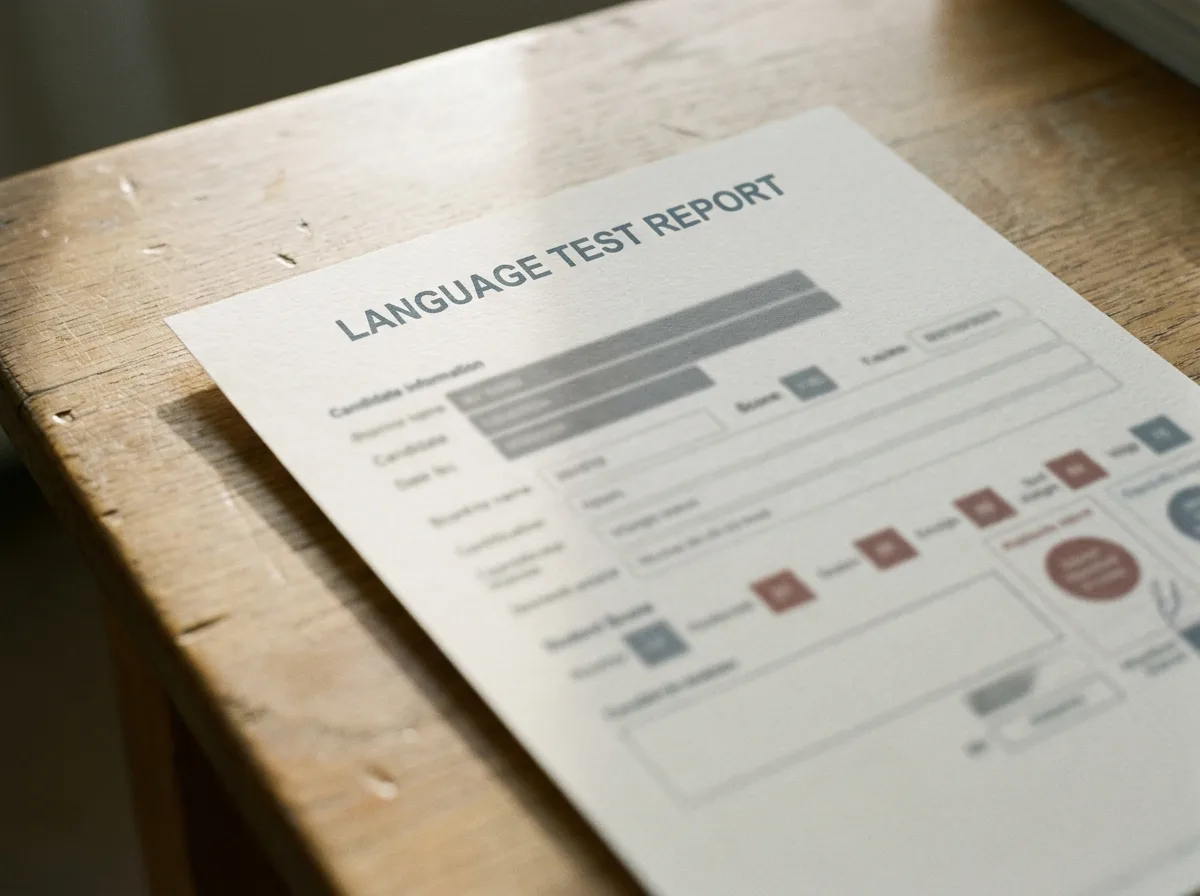
The operational bulletin released to IRCC officers introduces several key changes to the verification process. While the full details are internal, the directive focuses on moving from manual spot-checks to a more systematic and data-driven approach. Genuine applicants must be aware of how their information is now being cross-referenced.
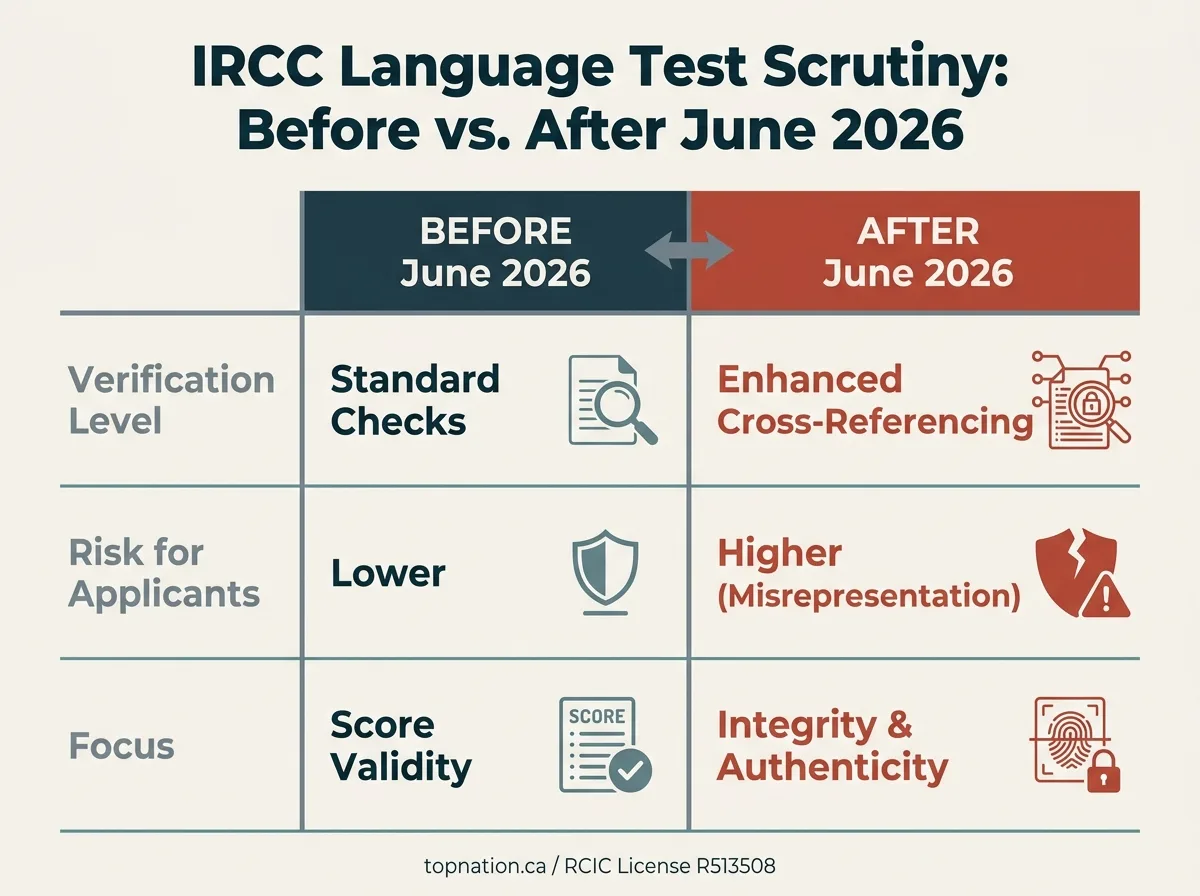
The table below outlines the practical differences in verification before and after the policy update, highlighting the increased depth of review now being applied to all applications.
| Verification Aspect | Pre-June 2026 Protocol | Post-June 2026 Protocol |
|---|---|---|
| Result Verification | Manual lookup on test provider’s online portal, often on a random or risk-based basis. | Systematic API-based verification for nearly all applications, cross-referencing multiple data points automatically. |
| Test History Check | Primarily relied on applicant’s self-declaration. Previous test attempts were rarely investigated unless a clear red flag was present. | Automated flagging of undisclosed test history. IRCC systems may now query test providers for an applicant’s full test history. |
| Score Progression Analysis | Not a standard procedure. Only investigated in clear cases of suspected fraud. | Analysis of score jumps. Unusually large increases in scores over a short period may trigger a request for more information or a Procedural Fairness Letter (PFL). |
What Constitutes ‘Fraudulent Language Test Results’ or Misrepresentation?
Misrepresentation under section A40(1)(a) of the Immigration and Refugee Protection Act (IRPA) is a serious finding. It is crucial to understand that it covers not only outright fraud but also the withholding of material facts that could influence an officer’s decision. This is where genuine applicants can inadvertently find themselves in trouble.
Overt Fraud vs. Unintentional Misrepresentation
Overt fraud is clear-cut: submitting a forged or altered test report, or having someone else take the test on your behalf. These actions carry the most severe penalties. However, unintentional misrepresentation is more nuanced. This can include providing an incorrect TRF number, failing to declare a previous, lower-scoring test, or even making a mistake on your date of birth that doesn’t match the test provider’s records. While the intent is different, if the error is deemed ‘material’ to the application, it can still lead to a finding of misrepresentation.
Common Mistake We See: Failing to Disclose All Test Attempts
A common error we see at TopNation involves clients who have taken a language test multiple times. For example, a client takes the IELTS test in January and scores CLB 7. They study hard and retake it in April, scoring CLB 9. When creating their Express Entry profile, they only declare the April test, believing the January result is irrelevant. Under the new scrutiny, IRCC’s system may flag that the applicant has a history with the test provider that wasn’t fully disclosed. This can lead to a Procedural Fairness Letter asking the applicant to explain the omission. The onus is then on the applicant to prove it was an innocent oversight, not an attempt to hide a material fact.
A Checklist for Genuine Applicants: Ensuring Your Application is Bulletproof
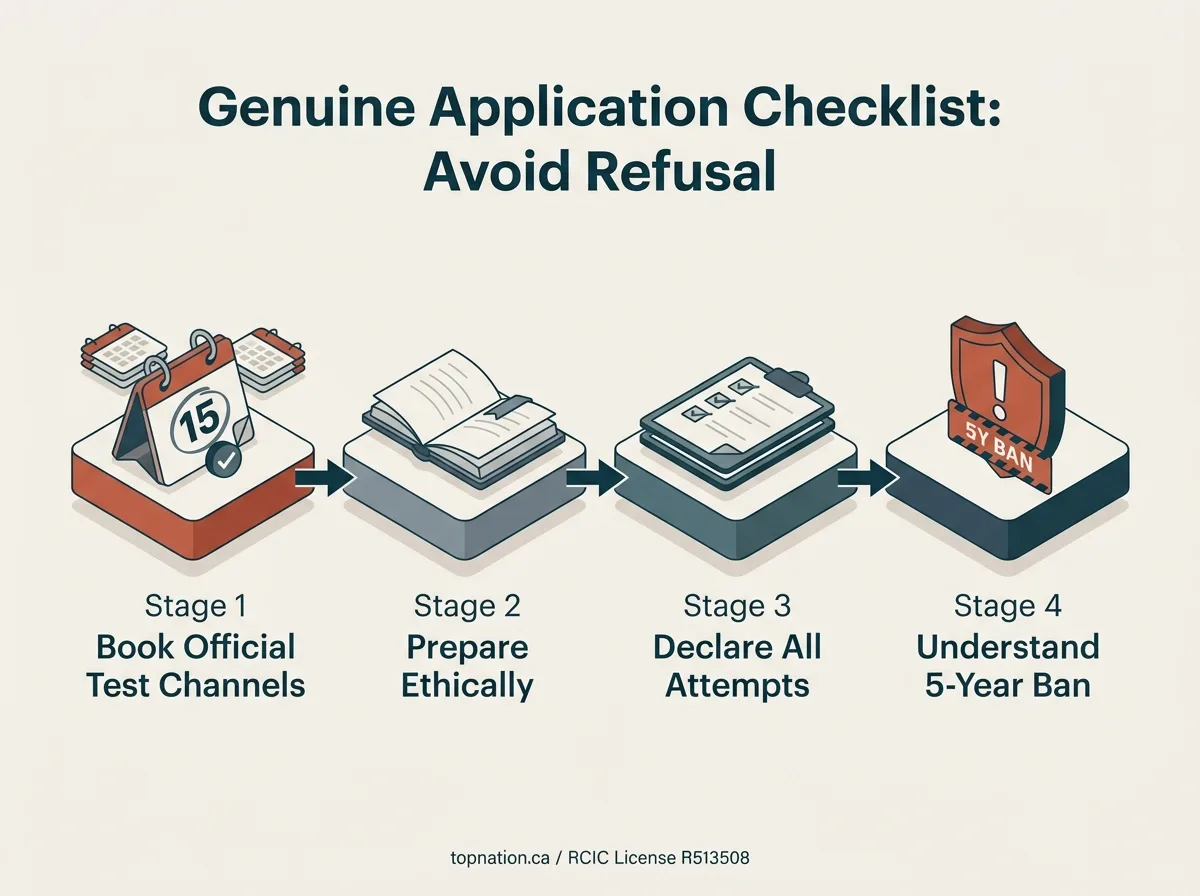
To avoid any issues, genuine applicants should adopt a policy of radical transparency and diligence. Follow these steps to ensure your language test submission is beyond reproach.
Step 1: Book Your Language Test Through Official Channels Only
Never use a third-party agent or consultant who offers to book the test for you, especially if they make promises about results. Always book your IELTS, CELPIP, or TEF directly through their official websites. This ensures you are registered at a legitimate test centre and that your personal information is secure and accurate from the very beginning.
Step 2: Prepare Ethically and Avoid Unauthorized Assistance
Use official preparation materials from the test providers and reputable education companies. Be wary of any tutor or service that claims to have access to test questions or offers guaranteed scores. These are red flags for fraudulent activity. Documenting your legitimate study efforts, such as keeping receipts for courses or practice tests, can be useful evidence if your score progression is ever questioned.
Step 3: Accurately Declare All Previous Test Attempts
This is the golden rule under the new guidelines. When filling out your application forms, if there is a question about previous language tests, disclose every single attempt, regardless of the score. It is far better for an officer to see a complete history of improvement than to discover an undisclosed test. Transparency demonstrates honesty and builds trust in your application.
Step 4: Double-Check Every Detail Before Submission
Before you submit your application, meticulously check that the Test Report Form (TRF) number, PIN (if applicable), test date, and your personal details on the application form exactly match the information on your official test result certificate. A single-digit error can cause the automated verification to fail, triggering a manual review and unnecessary delays or questions.
Understanding the Severe Consequences of Misrepresentation
The distinction between a simple application refusal and a refusal with a finding of misrepresentation is critical. The consequences of the latter are severe and long-lasting, impacting any future attempts to come to Canada for any reason.
| Outcome | Simple Refusal | Refusal with Misrepresentation Finding |
|---|---|---|
| Reason | Failure to meet program eligibility criteria (e.g., points too low, incomplete documents). | Providing false information or withholding material facts, directly or indirectly. |
| Immediate Impact | Application is refused. Applicant can typically re-apply immediately if they become eligible. | Application is refused and a 5-year ban from applying for any Canadian visa is imposed. |
| Long-Term Record | The refusal is part of the applicant’s immigration history but does not automatically prejudice future applications. | A permanent finding of inadmissibility (A40) is recorded in the GCMS. This must be addressed in all future applications, even after the 5-year ban expires. |

Proactive Measures: What to Do If You’re Concerned
If you have already submitted an application and are now concerned about a potential omission or error related to your language test history, it is better to be proactive than to wait for IRCC to find the issue.
If Your Application is Still in Process
You can submit a web form to IRCC to provide the additional information or correct the error. You should include a clear letter of explanation, detailing the information you are adding and explaining why it was not included initially. Framing this as a proactive correction is much more favourable than being asked to explain a discrepancy found by an officer. In some complex cases, it may be strategic to withdraw the current application and resubmit a new, completely accurate one. This is a significant decision that should be made after you consult with an experienced RCIC.
If You Have Received a Procedural Fairness Letter
A Procedural Fairness Letter (PFL) is your opportunity to respond to an officer’s concerns before a final decision is made. Do not ignore it. You must provide a detailed, honest, and evidence-based response within the given deadline. This is a critical moment in your application, and professional legal representation is highly recommended to formulate the strongest possible response.
TopNation’s Data: Observed Trends Since June 2026
At TopNation, we continuously monitor policy impacts on our clients’ files. Since the June 23 update, our CICC-licensed RCIC team has observed a tangible shift in how language test results are being processed, particularly for Express Entry applications and some Provincial Nominee Programs.
Specifically, we have seen approximately a 15% increase in Procedural Fairness Letters related to language test discrepancies across our Express Entry caseload. The most common trigger appears to be a mismatch between self-declared test history and information IRCC obtains from the testing bodies. Furthermore, the average response time required by IRCC in these PFLs has been a tight 14-day window, a significant reduction from the previous 30-day standard. This compressed timeline underscores the need for applicants to have their documentation and explanations ready, reinforcing the importance of working with a representative who can act quickly and effectively on your behalf.
TopNation’s Commitment: Ethical Guidance for a Secure Immigration Journey
Navigating Canada’s immigration system requires more than just filling out forms; it demands a commitment to integrity and a thorough understanding of the rules. The latest IRCC directives on language test verification are a clear signal that the department is prioritizing authenticity and fairness above all else. This aligns perfectly with our philosophy at TopNation.
Our role as licensed immigration consultants (RCIC #R513508) is to provide you with expert, ethical guidance. We help you present your case truthfully and completely, ensuring that your application is not only compliant but also resilient to the highest levels of scrutiny. From reviewing your entire immigration history for potential red flags to helping you craft a clear letter of explanation for any past inconsistencies, we are here to protect your interests and your future in Canada. This commitment extends to all application types, including complex spousal sponsorship applications where credibility is paramount.
Language Test Scrutiny is High. Ensure Your Application is Flawless.
Our licensed RCICs can review your entire application history to identify and address potential red flags before you submit.
| Call 587-400-0077 | Request a File Review → |
RCIC Licensed | Serving All of Alberta
Last updated: October 2023. This guide reflects IRCC’s operational update of June 23, 2026. Immigration rules change frequently — consult a licensed RCIC for advice specific to your situation.