Current PGWP Processing Times at a Glance (updated July 2026)
PGWP processing times in mid-2026 vary sharply by application method. Online applications submitted from within Canada are the fastest path — most files are decided within the range published on IRCC’s live processing-times tool (historically around 90 to 180 days, with recent months trending toward the shorter end for complete files). Paper applications from within Canada run longer, typically several months more than online. Applications filed from outside Canada follow the work-permit-outside-Canada service standard for the applicant’s country of residence, which changes weekly. Flagpoling at a Canadian port of entry to activate a PGWP is no longer permitted — IRCC ended this practice on December 23, 2024. Always confirm the current number on IRCC’s live tool before making job-start or travel decisions.
Important: this page is about PGWP processing timelines after you submit. If you need to confirm whether you are eligible to apply in the first place — DLI status, program length, field-of-study restrictions, the 180-day application window — read our companion guide: Post-Graduation Work Permit (PGWP) Canada 2026.
PGWP PROCESSING TIMES 2026
The Post-Graduation Work Permit is the single most-used bridge between Canadian study and permanent residence — but every applicant asks the same question the moment they hit “submit”: how long until I have my permit in hand? The answer depends on three variables IRCC treats as separate service standards: where you apply from (inside or outside Canada), how you apply (online or on paper), and the completeness of your file at submission. This guide breaks down each 2026 timeline with real IRCC service-standard context, explains the work authorization you have while you wait, and flags the operational changes that reshaped PGWP timing over the last 12 months — most importantly the end of flagpoling and the interim work-authorization public policies IRCC has run since 2022.
Understanding PGWP Processing Times in 2026
“Processing time” for a PGWP is the number of days between IRCC receiving your complete application and IRCC issuing a decision (approval, refusal, or a request for additional information). IRCC publishes and updates this figure weekly through its live Check Processing Times tool. The number shown is a rolling average of the last 6 months of decided files — it is not a service-standard guarantee, but it is the best forward-looking estimate available and the one your file will most likely track against.
Two things about that number matter for planning. First, it is calculated per application method — online-inside-Canada, paper-inside-Canada, and work-permit-outside-Canada each carry their own average. Second, it excludes the two things that most commonly extend real-world timing: incomplete submissions that trigger a document request (which pauses the clock while you respond) and files pulled for secondary review over completion-letter or program-eligibility questions. A file that is complete on submission and clearly PGWP-eligible on its face is the file that tracks the published average.
PGWP Processing Time by Application Method — Current 2026 Averages
The table below summarizes the current typical range for each PGWP application method as of mid-2026. These ranges reflect the last 6 to 12 months of IRCC-published data plus practitioner-observed variance in our Edmonton practice. Always verify the current number on the IRCC processing-times tool the day you plan to submit.
| Application Method | Typical 2026 Range | Work Authorization While Waiting |
|---|---|---|
| Online, from within Canada | ~90 to 180 days (fastest) | Full-time under maintained status if applied before study permit expiry |
| Paper, from within Canada | Several months longer than online | Full-time under maintained status if applied before study permit expiry |
| Online, from outside Canada | Varies by country of residence — check live tool | None — must wait for approval before entering Canada to work |
| Flagpoling at a port of entry | Not permitted for PGWP (ended Dec 23, 2024) | N/A |
Online PGWP Applications From Within Canada — The Fastest Path

An online PGWP application filed through your IRCC Secure Account while you are physically in Canada is the fastest route to a decision. This is IRCC’s default expected workflow for the vast majority of graduates — the online portal at canada.ca/study/work/after-graduation/apply is designed around it, and IRCC’s internal triage prioritizes complete online files for automated pre-screening.
The historical published service standard for this path has been around 90 days. Actual averages have fluctuated over the last 24 months as IRCC absorbed post-pandemic backlog and the 2024 field-of-study rule changes, drifting into the 120- to 180-day band during peak submission windows (October to January, when the largest tranche of fall graduates apply at once). Files submitted in slower months and complete on their face have consistently decided at or below the 90-day mark. The single largest predictor of hitting the fast end of the range is document completeness at submission — every request for additional information adds 4 to 8 weeks of queue time to your file.
The strategic play if you have flexibility on submission timing: file within days of receiving your written completion confirmation, from within Canada, online, with a complete document set. Avoid the November-to-January submission crunch if your program completion date allows.
Paper PGWP Applications From Within Canada — Slower and Rarely Necessary
IRCC still accepts paper PGWP applications from within Canada by mail, but the volume is small and the timing runs materially slower than online. Paper files require manual intake, physical routing, and manual data entry before they enter the processing queue — each of which adds weeks to the front of the file. In practice, paper PGWP files decide several months later than online equivalents, and the gap widens during peak submission periods.
There is almost no practical reason for an eligible applicant with an IRCC Secure Account to file on paper today. The two edge cases where paper still makes sense: applicants with a disability that prevents online filing (IRCC provides accommodation pathways), and applicants whose file involves an unusual document type the online portal does not accept. If either applies, the paper option remains open — but expect to add multiple months to the timeline.
PGWP Applications From Outside Canada — Country-Dependent
Applicants who have already left Canada and want to apply for a PGWP from abroad file through the standard work-permit-outside-Canada channel. The processing time is not a single number — it varies by the country of residence at the time of application, with each visa office publishing its own rolling average through the same IRCC processing-times tool. Timelines can range from a few weeks in low-volume visa offices to many months in high-volume ones.
There is no work authorization associated with a pending PGWP filed from abroad. You cannot enter Canada to begin work until IRCC approves the application, issues the port-of-entry Letter of Introduction, and a border services officer issues the physical permit on arrival. For most graduates, filing from inside Canada online before leaving is materially faster and gives you the immediate work-authorization benefit described below — leaving Canada before submitting the PGWP is almost always the wrong sequencing choice.
Flagpoling for PGWP — Ended December 23, 2024
Historically, some PGWP applicants would file online, wait for approval, then leave Canada briefly (typically at a US land border) and re-enter to have their PGWP physically issued at the port of entry — a practice called “flagpoling.” This shaved days off the wait between online approval and holding a physical permit and gave the applicant an immediate landed work document.
Effective December 23, 2024, IRCC and the Canada Border Services Agency ended flagpoling for PGWP applications at all Canadian ports of entry. The change was announced to reduce port-of-entry congestion and standardize processing. What this means practically: after your PGWP is approved online, IRCC mails the physical permit to your Canadian mailing address — you cannot shortcut this by driving to a border crossing. Mail delivery typically takes 1 to 4 weeks after approval, so factor this into any job-start plan.
Working in Canada While Your PGWP Is Pending — The Rules
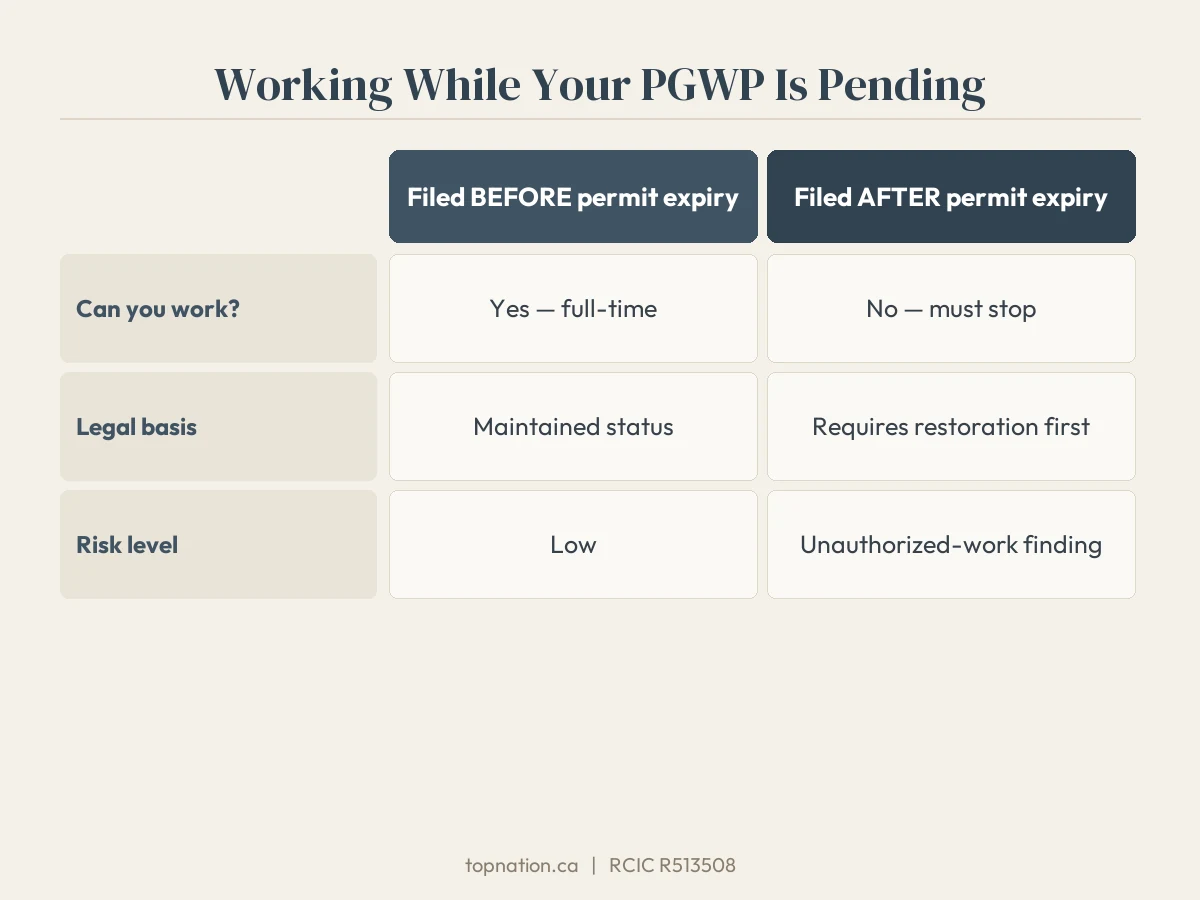
This is where PGWP timing gets strategic. Under section 186(w) of the Immigration and Refugee Protection Regulations and the related IRCC public policies extended repeatedly since 2022, most PGWP applicants who file from within Canada can work full-time while their file is in the queue — provided the sequencing is right. Getting the sequence right is worth more than any other single move an applicant makes.
Maintained Status (the “implied status” rule)
If you submit a complete PGWP application before your study permit expires, you enter maintained status the moment IRCC receives your application. Maintained status carries the same work rights you held under your study permit’s post-completion authorization — which, for a graduate who has met the criteria for the transition from study to PGWP, generally means full-time open work authorization until IRCC issues a decision on the pending PGWP. If your study permit expires while your file is pending, maintained status continues so long as you remain in Canada.
The failure mode: filing after your study permit expires. Maintained status does not apply, and you cannot legally work until either a restoration application is approved or the PGWP itself is issued. This is the single most common cause of unauthorized-work findings on subsequent PR files — do not miss the pre-expiry filing deadline.
The IRCC Interim Work-Authorization Public Policies
IRCC has repeatedly used public-policy instruments since 2022 to give PGWP applicants an additional bridge when standard maintained status did not fit the fact pattern — for example, a 180-day interim work-authorization letter for applicants whose first PGWP was pending unusually long, or transition measures for applicants caught between study-permit expiry and PGWP submission. The specific policies in effect have changed roughly every 6 to 12 months and each has its own eligibility criteria. Before relying on any interim work authorization, check the current IRCC PGWP page for the policy in force on your submission date and read the eligibility conditions carefully. When in doubt, talk to a licensed RCIC before starting work under any interim policy — the downside risk of getting this wrong is loss of future PR eligibility.
What Actually Delays Your PGWP File
The published average assumes your file is complete on submission and clearly PGWP-eligible on its face. In practice, files routinely sit weeks or months beyond the average because of avoidable issues. The four most common delays we see in our Edmonton practice:
1. Missing or Late Completion Letter
IRCC requires either a final transcript OR an official letter from your Designated Learning Institution confirming that all program requirements have been met. Many students submit before the school issues the final completion letter, then respond weeks later when IRCC asks for it — each round trip adds 4 to 8 weeks. File after the completion letter arrives, not before.
2. Program-Eligibility Questions Triggering Manual Review
Since IRCC’s 2024-2025 field-of-study rule changes, files from non-university institutions in flagged program categories are more likely to be pulled for manual eligibility review — particularly if the program name, transcript wording, or DLI listing does not clearly demonstrate PGWP eligibility. See our companion PGWP eligibility guide to confirm your program is on the current list before submitting.
3. Biometrics Not Given or Not Valid
Most PGWP applicants have valid biometrics on file from the original study permit application (biometrics are valid for 10 years). If yours have expired or were never given, IRCC issues a biometrics instruction letter after submission — you then have 30 days to attend an appointment. The file does not advance in the queue until biometrics are complete, and a busy Service Canada / VAC location can add 2 to 4 weeks of appointment lead time.
4. Medical Exam Requested
Most PGWP applicants do not need an upfront medical, but IRCC can request one if the graduate intends to work in a job that involves close contact with vulnerable populations (healthcare, childcare, elder care). A requested medical adds 4 to 12 weeks depending on the panel physician’s availability and the referral flow back to IRCC.
How PGWP Processing Time Affects Your Express Entry and AAIP Timing
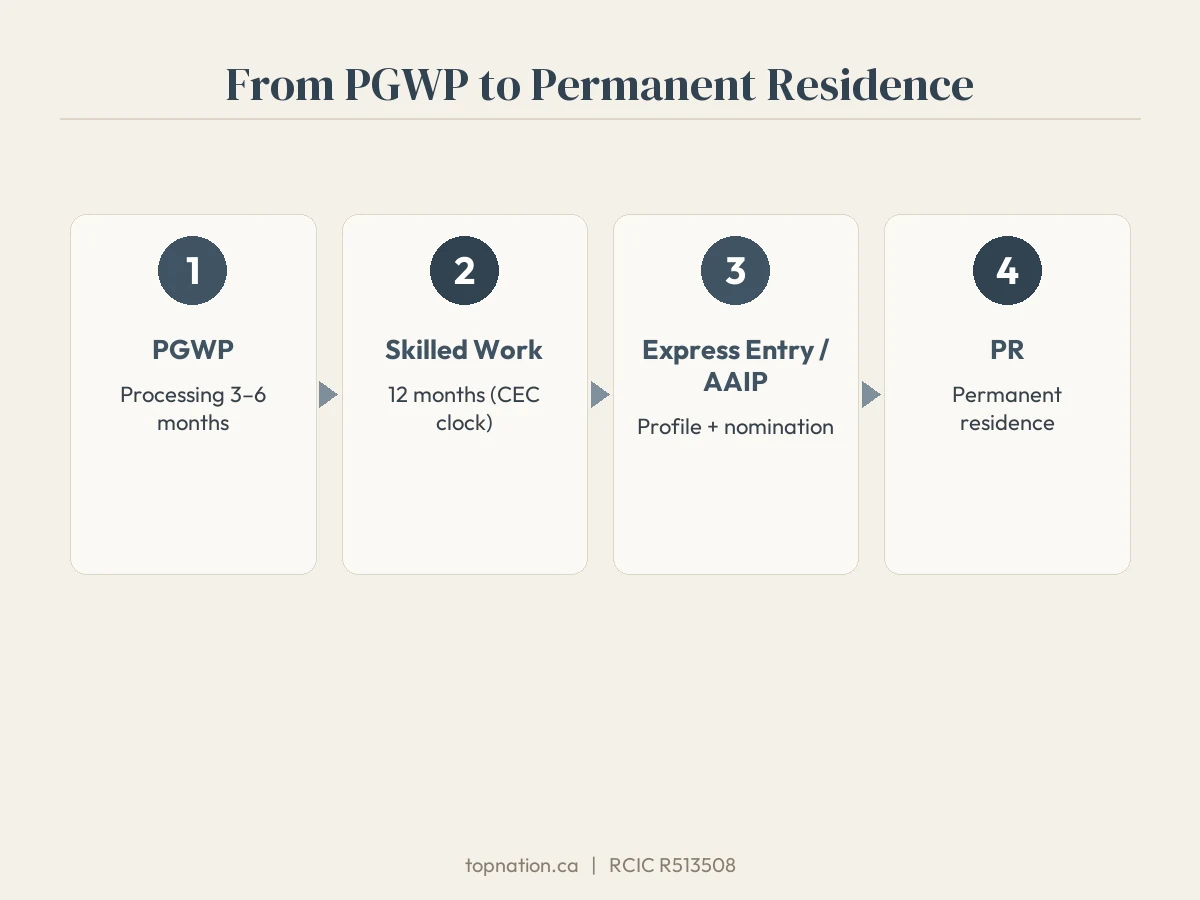
For most international graduates, the PGWP is not the destination — it is the platform for building the 12 months of skilled Canadian work experience needed for the Canadian Experience Class under Express Entry, or for qualifying under an Alberta Advantage Immigration Program stream. PGWP processing time matters because it delays the start of your qualifying work clock.
Work performed while your PGWP is pending (under maintained status or an interim work-authorization policy) generally counts toward Canadian Experience Class work experience — provided the work is paid, full-time, in a skilled NOC, and authorized under a valid status. This is one of the strongest reasons to file the PGWP from within Canada, online, before study permit expiry: your CEC clock keeps running while you wait for the physical permit.
If your medium-term plan is Alberta PNP or federal Express Entry, sequence your PGWP timing against your language testing, provincial nomination window, and Express Entry profile submission. See our Express Entry processing times 2026 guide and AAIP processing times 2026 guide for the downstream federal and provincial timelines you will be planning against once your PGWP is in hand.
What to Do While You Wait for Your PGWP

The 3-to-6-month gap between submission and permit-in-hand is a period most graduates underuse. The strategic moves:
- Keep working under maintained status. If you filed before study-permit expiry, continue full-time employment in a skilled NOC role — every month here counts toward your future Canadian Experience Class 12-month requirement.
- Book or refresh your language test. IELTS General and CELPIP results are valid for 2 years. Test now so results are current when you file your Express Entry profile.
- Build your Express Entry profile early. You do not need a PGWP in hand to create the profile — you need it to claim CEC work experience, which requires 12 months first. Get the profile shell built and IELTS uploaded so you can submit the moment you cross 12 months of qualifying work.
- Track any Alberta PNP nomination-of-interest triggers. The AAIP Alberta Express Entry Stream can issue Notifications of Interest to candidates already in the federal pool — putting you in the pool early keeps this door open.
- Monitor IRCC portal weekly. Status changes, biometrics requests, and additional-information requests all appear in the portal first. Miss the 30-day response window on any of these and your file sits.
- Avoid extended foreign travel. Brief trips are fine while your PGWP is pending, but plan re-entry carefully — if maintained status is the basis for your work authorization, you must re-enter as a visitor or under existing authorization and cannot resume work under maintained status once outside Canada.
Frequently Asked Questions
How can I check the current PGWP processing time for my situation?
Use IRCC’s live Check Processing Times tool and select “Work permit” then the option that matches how and where you are applying (online inside Canada, paper inside Canada, or from outside Canada by country). The number shown is the rolling average of the last 6 months of decided files and updates weekly. Once your file is submitted, log into your IRCC Secure Account weekly to monitor status changes.
Can I work full-time in Canada while my PGWP application is pending?
Yes, in most cases — if you submitted your complete PGWP application from within Canada before your study permit expired. You enter maintained status the moment IRCC receives the application, which generally carries full-time open work authorization until IRCC decides your file. If you filed after your study permit expired, maintained status does not apply and you cannot legally work until either restoration is approved or the PGWP itself is issued. Confirm your specific facts with a licensed RCIC before starting or continuing work.
Can I flagpole at a Canadian port of entry to get my PGWP faster?
No. IRCC and CBSA ended flagpoling for PGWP applications on December 23, 2024. After your online PGWP is approved, IRCC mails the physical permit to your Canadian mailing address — typically within 1 to 4 weeks of approval. You cannot shortcut this by driving to a border crossing.
What if my PGWP application exceeds the published processing time?
If your file has been in process for more than 30 days beyond the published average, you can submit a “webform request for case-specific information” through the IRCC website. Typical response time is 2 to 4 weeks. Do not submit multiple webforms — duplicate requests do not accelerate the file and can add administrative noise. If you are close to a job-start date or a status-expiry issue, retain a licensed RCIC to review the file before escalating further.
Does time worked while my PGWP is pending count toward Canadian Experience Class?
Generally yes — if the work is paid, full-time, in a skilled NOC, performed under valid work authorization (maintained status or an active IRCC interim work-authorization policy), and you can document it with pay stubs, T4s, and an employer reference letter. Work performed during study (part-time or full-time under a study permit) does not count toward CEC — only post-study work does.
How long after PGWP approval does the physical permit arrive?
Typically 1 to 4 weeks by Canada Post to your Canadian mailing address. If it does not arrive within 4 weeks of the approval message in your IRCC portal, submit a webform request for a replacement or status update. Keep the approval message screenshot — some employers will accept it as evidence of work authorization while you wait for the physical permit, though this is at the employer’s discretion.
What is the fastest way to get a PGWP decision in 2026?
Apply online, from within Canada, immediately after receiving written program-completion confirmation, with a complete document set (final transcript or completion letter, valid passport, valid biometrics, language test results if required for your program category). Avoid submitting during the October-to-January graduation crunch if your program completion date allows. Complete files submitted in slower months consistently decide at or below the published average.
PGWP Pre-Submission Review
File Right the First Time — Talk to a Licensed RCIC
TopNation reviews your program eligibility, document set, submission timing, and work-authorization sequencing before you file — the single biggest predictor of a fast, clean PGWP decision.
| Talk to an RCIC → | Call (587) 400-0077 |
RCIC Licensed CICC | Edmonton, Alberta | Licensed since 2013
Last updated: July 2026. Processing times reflect IRCC-published averages as of the update date and are subject to weekly change. This article is general information, not legal advice — individual PGWP timing and work-authorization eligibility vary by fact pattern; consult a licensed RCIC for case-specific guidance.