FASTER IN-CANADA WORK PERMITS
As of June 2026, Immigration, Refugees and Citizenship Canada (IRCC) has significantly reduced processing times for most in-Canada work permit applications and extensions. This policy shift creates a major strategic opportunity for Alberta employers to hire skilled foreign nationals already in the country with unprecedented speed and efficiency.
EMPLOYER GUIDE — JUNE 2026 UPDATE
For Alberta employers navigating a competitive labour market, the solution to critical skill shortages may already be in your backyard. Hiring foreign nationals who are already in Canada offers a powerful alternative to the lengthy and often complex process of overseas recruitment. These candidates possess valid status, Canadian experience, and are available to start much faster. This comprehensive guide details the strategic advantages, key pathways, and compliance requirements for Alberta businesses looking to leverage this valuable, onshore talent pool, especially in light of recent processing speed improvements.

The Strategic Advantage of Hiring In-Canada Foreign Talent
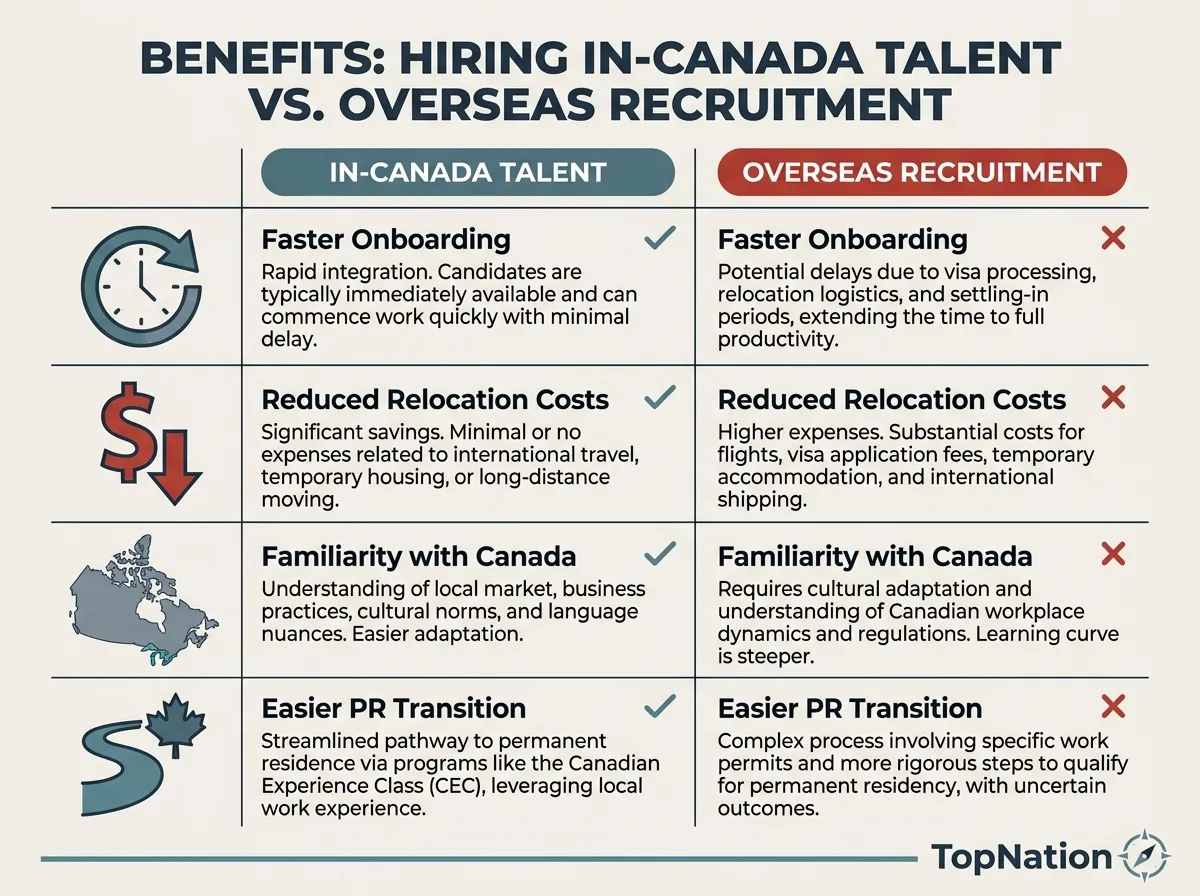
Opting to hire foreign workers already residing in Canada is not just a matter of convenience; it’s a strategic business decision that directly impacts your bottom line and operational stability. The benefits extend far beyond simply filling a vacant position, offering a more predictable and efficient recruitment cycle.
Reduced Recruitment Timelines and Costs
Traditional international recruitment involves significant time and financial investment in overseas advertising, interviews across time zones, and complex relocation logistics. By focusing on in-Canada candidates, you bypass many of these hurdles. The talent pool is immediately accessible, interviews can be conducted in person, and the need for relocation support is often eliminated, drastically reducing both the time-to-hire and associated costs.
Proven Canadian Work Experience
A candidate with in-Canada experience brings more than just their technical skills. They have a demonstrated understanding of the Canadian workplace culture, professional communication norms, and industry-specific standards. This familiarity, often validated by Canadian references, minimizes the onboarding curve and reduces the risk of a cultural mismatch, leading to faster integration and productivity.
Immediate Availability and Integration
Many foreign nationals in Canada hold open or employer-specific work permits that allow them to transition to a new role relatively quickly. Unlike overseas candidates who face long waits for visa processing and travel arrangements, in-Canada talent can often start a new position within weeks, not months. This agility is crucial for projects with tight deadlines or for filling business-critical roles without prolonged disruption.
Key Benefits for Alberta Businesses
The decision to hire onshore foreign talent provides Alberta businesses with a distinct competitive edge. This approach de-risks the hiring process and aligns with long-term workforce planning, creating a more resilient and integrated team.
Access to a Pre-Screened Talent Pool
Every foreign national working or studying in Canada has already been screened by Canadian immigration authorities. This includes assessments of their education, language proficiency, and admissibility. As an employer, you are engaging with a talent pool that has already met a baseline of federal requirements, adding a layer of assurance to your recruitment process.
Higher Retention Potential through PR Pathways
Foreign workers already in Canada are often actively seeking pathways to permanent residence (PR). By offering a qualifying job, you position your company as a crucial partner in their immigration journey. Programs like the Alberta Advantage Immigration Program (AAIP) are specifically designed for this purpose. Supporting an employee’s PR application fosters immense loyalty and significantly increases long-term retention rates.

Navigating LMIA-Exempt Pathways for In-Canada Workers
While the Labour Market Impact Assessment (LMIA) is a common requirement, many in-Canada candidates hold work permits under LMIA-exempt streams. Understanding these pathways is key to unlocking fast and efficient hiring. Your role as an employer is often to submit an offer of employment through the IRCC Employer Portal, a much simpler process than a full LMIA application.
Post-Graduation Work Permit (PGWP) Holders
PGWP holders are graduates of Canadian designated learning institutions who hold an open work permit, allowing them to work for nearly any employer in Canada. This is arguably the most valuable pool of emerging talent. They are educated in Canada, have strong language skills, and are eager to build their careers here. Hiring a PGWP holder is as simple as hiring a Canadian citizen from a paperwork perspective; you simply verify their permit and they can start immediately.
Open Work Permit Holders (Spouses, IEC)
Beyond PGWPs, a significant number of individuals hold other types of open work permits. This includes spouses or common-law partners of skilled workers and international students, as well as participants in programs like International Experience Canada (IEC). These candidates offer complete flexibility and can be hired without any specific immigration-related paperwork from the employer.
Bridging Open Work Permit (BOWP) Applicants
A BOWP allows individuals who have applied for permanent residence and whose current work permit is expiring to continue working while they await a decision. Hiring or retaining an employee on a BOWP is a critical retention strategy. It ensures continuity for your business and provides stability for the employee during the final stages of their immigration process.
For a deeper dive into these options, our LMIA Exemption Guide provides extensive detail on each category.
| Work Permit Pathway | Eligibility Snapshot | Employer Action Required |
|---|---|---|
| Post-Graduation Work Permit (PGWP) | Graduate of a Canadian DLI. Holds an open work permit. | None (Verify permit validity). |
| Spousal Open Work Permit | Spouse/partner of a skilled worker or international student. | None (Verify permit validity). |
| Bridging Open Work Permit (BOWP) | PR applicant with a pending decision and expiring work permit. | None for the permit itself, but employer support is key for the underlying PR application. |
Leveraging Faster In-Canada Work Permit Processing Times (June 2026 Update)
The recent announcement by IRCC is a game-changer for employers. The commitment to faster processing for work permit applications and extensions filed from within Canada removes a significant bottleneck in the hiring and retention cycle.
What Has Changed with In-Canada Processing?
Historically, even straightforward in-Canada work permit extensions could take several months, creating uncertainty for both employers and employees. The June 2026 update streamlines these applications, prioritizing onshore talent and ensuring workforce stability. This applies to extensions of existing permits and applications for new permits from within Canada (e.g., a student transitioning to a closed work permit).
TopNation’s Observed Processing Times (Pre- vs. Post-Update)
Based on our firm’s internal case data, the impact is already clear. Prior to June 2026, the average processing time for an employer-specific work permit extension submitted online was approximately 110-130 days. Our files submitted after the policy change are now seeing decisions in as little as 45-60 days. This 50% reduction in wait time allows for much more effective and predictable workforce planning.
How This Impacts Your Hiring Strategy
This acceleration means you can confidently plan transitions for your foreign workers. For an employee whose permit is expiring, you can begin the extension process closer to the expiry date with less risk of them falling out of status. For new hires transitioning from, for example, a PGWP to an employer-specific permit to support their AAIP application, the timeline is now dramatically shorter, solidifying their commitment to your company faster.
Transitioning Talent to PR via the Alberta Advantage Immigration Program (AAIP)
Securing a talented foreign worker is only half the battle; retaining them is what builds a strong, stable workforce. The AAIP is Alberta’s most powerful tool for helping your valued employees transition from temporary status to permanent residence.
Why the AAIP is a Powerful Retention Tool
The AAIP allows Alberta to nominate individuals for permanent residence. A provincial nomination provides a clear, structured, and often faster path to PR than federal programs alone. By providing a qualifying job offer and supporting an employee’s AAIP application, you are offering them a future in Alberta, which is a powerful incentive to stay with your company long-term.
Key AAIP Streams for In-Canada Workers
For employers, two main streams are typically most relevant for in-Canada talent:
- Alberta Opportunity Stream: For temporary foreign workers already working in Alberta in an eligible occupation. This stream has specific requirements regarding work experience, job offer, and language.
- Alberta Express Entry Stream: For candidates who are already in the federal Express Entry pool. A job offer from an Alberta employer can significantly increase their chances of receiving a Notification of Interest from the AAIP.
| Feature | Alberta Opportunity Stream (AOS) | Alberta Express Entry Stream |
|---|---|---|
| Primary Candidate | TFWs currently working in Alberta in an eligible occupation. | Candidates in the federal Express Entry pool with strong ties to Alberta. |
| Express Entry Profile | Not required. | Required. |
| Employer’s Role | Provide a bona fide, full-time job offer and employment contract. | A job offer significantly increases chances of selection. |
Common Mistakes Alberta Employers Make (And How to Avoid Them)
While hiring in-Canada talent is more straightforward, pitfalls exist. Navigating immigration requires precision, and small administrative errors can lead to significant delays or denials. Awareness of these common issues can protect your business and your employees.
Misunderstanding Implied Status
When a worker applies to extend their status before their current permit expires, they can legally continue working under the same conditions under what is known as ‘implied status’ (or ‘maintained status’). A common mistake is for HR departments to panic when a permit’s expiry date passes, not realizing the employee can continue to work legally. It is crucial to keep a copy of the extension application submission receipt on file as proof of their ongoing authorization to work.
The ‘Job Offer’ vs. ‘Employment Contract’ Distinction for AAIP
This is one of the most frequent reasons for AAIP application refusals that we see. An employer might provide a standard, one-page job offer letter, but the AAIP requires a comprehensive, bona fide employment contract. This contract must detail the wage, duties, working conditions, and be for a continuous period of at least 12 months. For example, we recently assisted an Edmonton-based engineering firm whose initial application was at risk because their offer letter lacked specific language about the duration of employment. By helping them draft a compliant employment contract, we were able to secure the provincial nomination for their key project manager.

Compliance and Best Practices for Alberta Employers
Maintaining compliance is non-negotiable when hiring foreign nationals. Adhering to the rules set by both IRCC and the provincial government protects your business’s reputation and your eligibility to hire foreign talent in the future.
Maintaining Records and Documentation
Keep meticulous records for every foreign worker you hire. This includes a copy of their work permit, the offer of employment submitted to IRCC (if applicable), payroll records, and any correspondence related to their immigration status. These documents are essential during a compliance audit.
The Importance of the IRCC Employer Portal
For any LMIA-exempt but employer-specific work permit, employers must first submit the offer of employment through the IRCC Employer Portal and pay the employer compliance fee. Forgetting this step or entering incorrect information is a simple but critical error that will result in the work permit application being refused. Always double-check the NOC code, wages, and location details before submitting.
Ensuring Fair Wages and Working Conditions
You must provide foreign workers with the same wages and benefits as you would a Canadian citizen or permanent resident for performing the same job. The employment must be genuine, and the working conditions must meet all provincial labour standards. Failure to do so can result in severe penalties, including bans from hiring foreign workers.
Partnering with a Licensed RCIC for Seamless Hiring
Navigating the nuances of immigration law, policy updates, and compliance requirements can be a significant burden on your HR team. Partnering with a licensed Regulated Canadian Immigration Consultant (RCIC) transforms this challenge into a strategic advantage.
Strategic Planning vs. Reactive Hiring
An experienced consultant does more than just file paperwork. They work with you to build a long-term immigration strategy for your workforce. This involves identifying the best pathways for your key employees, planning for permit extensions well in advance, and aligning your hiring practices with your business growth objectives. This proactive approach prevents last-minute crises and ensures you can retain your top talent.
Navigating Complex Compliance Requirements
A licensed professional ensures every application and submission is accurate and complete, minimizing the risk of refusal due to technical errors. They stay up-to-date on the frequent changes in immigration policy—like the recent processing time updates—so you don’t have to. If you need expert guidance, an immigration consultant in Edmonton can provide localized expertise on the AAIP and Alberta’s labour market.
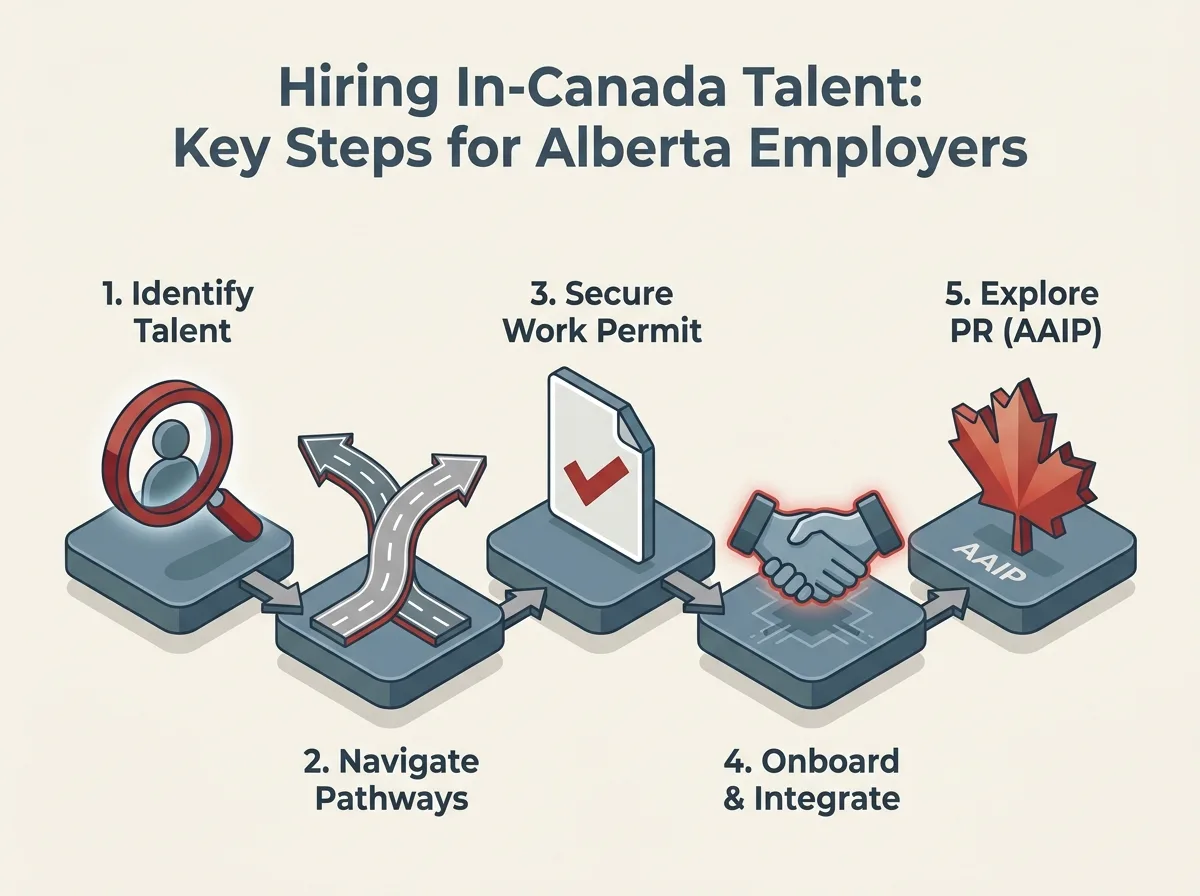
Your In-Canada Hiring Checklist for Alberta Employers
To streamline your process, follow this structured approach when considering a foreign national already in Canada for a role. This checklist, presented in prose, outlines the critical steps from verification to long-term planning.
Step 1: Verify Current Status and Work Authorization
Your first action must always be to ask for and verify the candidate’s current immigration document. Is it a work permit, a study permit, or visitor status? If it’s a work permit, is it open or employer-specific? Confirm the expiry date. This initial verification determines the viability of the candidate and the next steps required.
Step 2: Identify the Correct Work Permit Pathway
Based on their current status, determine the correct path forward. If they have an open work permit, no immigration action is needed from you. If their permit is expiring or they need to switch employers, you must identify the correct application, whether it’s an LMIA-exempt employer-specific permit or another stream. This is a critical decision point where professional advice from a source like TopNation can prevent costly mistakes.
Step 3: Prepare the Job Offer and Employment Contract
Draft a comprehensive job offer and employment contract that meets all provincial and immigration requirements. Ensure the wage is at or above the median for the occupation and location, the duties align with the chosen NOC code, and the offer is genuine. This document is the foundation of any employer-supported application.
Step 4: Submit via the Employer Portal and Support the Application
If an employer-specific permit is required, you must submit the offer of employment via the IRCC Employer Portal and pay the compliance fee. Provide the offer of employment number to the applicant, which they will need for their work permit application. Be prepared to provide any supporting documents if requested.
Step 5: Plan the Permanent Residence Transition
From day one, discuss long-term goals. If the employee is a good fit and retention is a priority, begin planning their transition to permanent residence through a program like the AAIP. This demonstrates your commitment and integrates immigration strategy with your talent management process. For any questions, it is always best to contact a licensed RCIC for guidance.
Hire Faster and Smarter in Alberta.
Let our RCIC team assess your hiring needs and build a compliant, efficient strategy for securing in-Canada foreign talent.
| Call 587-400-0077 | Request a Free Employer Assessment |
RCIC Licensed | Serving All of Alberta
Last updated: June 2026. This guide reflects IRCC and AAIP policies as of the publication date. Immigration rules change frequently — consult a licensed RCIC (R513508) for advice specific to your situation.