Targeted Invitations Now Prioritize In-Demand Skills
Immigration, Refugees and Citizenship Canada (IRCC) has fundamentally shifted how it selects skilled workers. The new category-based selection system now targets candidates in 6 specific sectors and those with French-language proficiency, often inviting them at lower CRS scores than general draws.
CATEGORY-BASED SELECTION 2026
For years, the Express Entry system operated on a simple principle: the highest Comprehensive Ranking System (CRS) score receives an Invitation to Apply (ITA) for permanent residence. While effective, this model didn’t always align with Canada’s most pressing economic needs. In response, IRCC has introduced a more nuanced approach: category-based selection. This guide provides a comprehensive overview of this new system, designed for skilled workers in targeted occupations or with strong French skills. We will explore each of the six categories in detail, explain the specific eligibility criteria you must meet, and outline how this system can provide a direct pathway to Canadian permanent residence, even if your CRS score isn’t at the very top of the pool.

What is Express Entry Category-Based Selection?
Category-based selection is a targeted invitation model within the Express Entry system that allows Immigration, Refugees and Citizenship Canada (IRCC) to prioritize candidates with specific skills, work experience, or language abilities. Rather than inviting only those with the highest CRS scores from the entire pool, IRCC can now conduct draws that specifically target profiles matching Canada’s most critical labour market shortages and demographic goals. This authority was granted through changes to the Immigration and Refugee Protection Act, enabling the Minister of Immigration to establish categories that support national economic objectives.
The core purpose of this system is to make Canada’s immigration intake more responsive and strategic. While the CRS score remains a vital component of the Express Entry profile, category-based selection acknowledges that a high score alone doesn’t guarantee a candidate’s skills align with the jobs that are currently in high demand across the country. By focusing on sectors like healthcare, STEM, and skilled trades, the government can more effectively fill workforce gaps, support key industries, and strengthen French-speaking communities outside of Quebec. For applicants, this means that your specific occupation or language ability can now be a primary factor in receiving an ITA, creating new opportunities for skilled workers who might have previously been overlooked in highly competitive general draws.
How Category-Based Draws Differ from General Draws
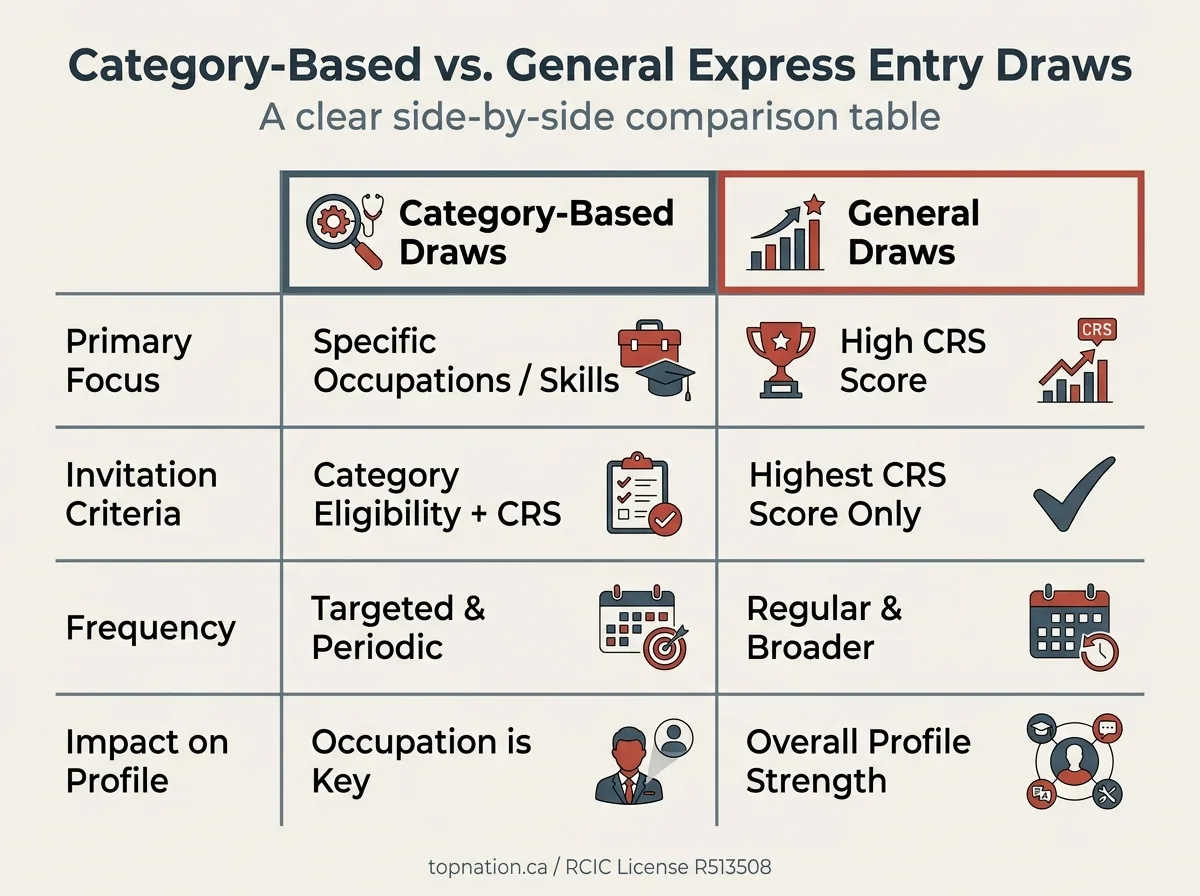
Understanding the distinction between category-based draws and general (or all-program) draws is crucial for any Express Entry candidate. While both operate under the Express Entry umbrella and result in an ITA for permanent residence, their selection mechanisms are fundamentally different. General draws are the traditional model where candidates from all three federal high-skilled programs—the Federal Skilled Worker Program (FSW), the Canadian Experience Class (CEC), and the Federal Skilled Trades Program (FSTP)—are ranked solely by their CRS score. In these rounds, IRCC issues ITAs to the highest-scoring candidates, regardless of their occupation or field of work.
Category-based draws add a new layer of criteria. To be invited in a category-based draw, a candidate must first have an active Express Entry profile and meet the minimum requirements of one of the three programs. However, they must *also* meet the specific eligibility requirements for the category being targeted in that particular draw. For example, in a Healthcare occupations draw, only candidates with qualifying work experience in one of the designated healthcare NOC codes will receive an invitation. The CRS score still plays a role, typically as a tie-breaker; IRCC will set a minimum score for the round, and all eligible candidates in that category at or above that score will be invited. This often results in a lower minimum CRS score than in general Express Entry draws, as the pool of eligible candidates is much smaller and more targeted.
| Feature | General Draws (All-Program) | Category-Based Draws |
|---|---|---|
| Primary Selection Criterion | CRS Score Only | Meeting Category Criteria + CRS Score |
| Eligible Candidates | All profiles in the pool (FSW, CEC, FSTP) | Only profiles meeting specific category rules |
| Typical CRS Cut-off | Generally higher due to larger pool | Often lower, as competition is limited |
| Predictability | Relatively predictable based on pool distribution | Depends on IRCC’s announced priorities |

The 6 Targeted Express Entry Categories for 2026
For 2026, IRCC has established six distinct categories to address specific economic and demographic needs across Canada. These categories were selected after extensive consultations with provincial and territorial governments, employers, and other stakeholders to identify the most critical areas of demand. To be eligible for an invitation under one of these categories, a candidate must have accumulated, within the past three years, at least six months of full-time, continuous work experience (or an equivalent amount of part-time work experience) in a single occupation listed for that category. This experience can be from within Canada or abroad. It is essential to note that meeting this work experience requirement is in addition to meeting the requirements of one of the main Express Entry programs.
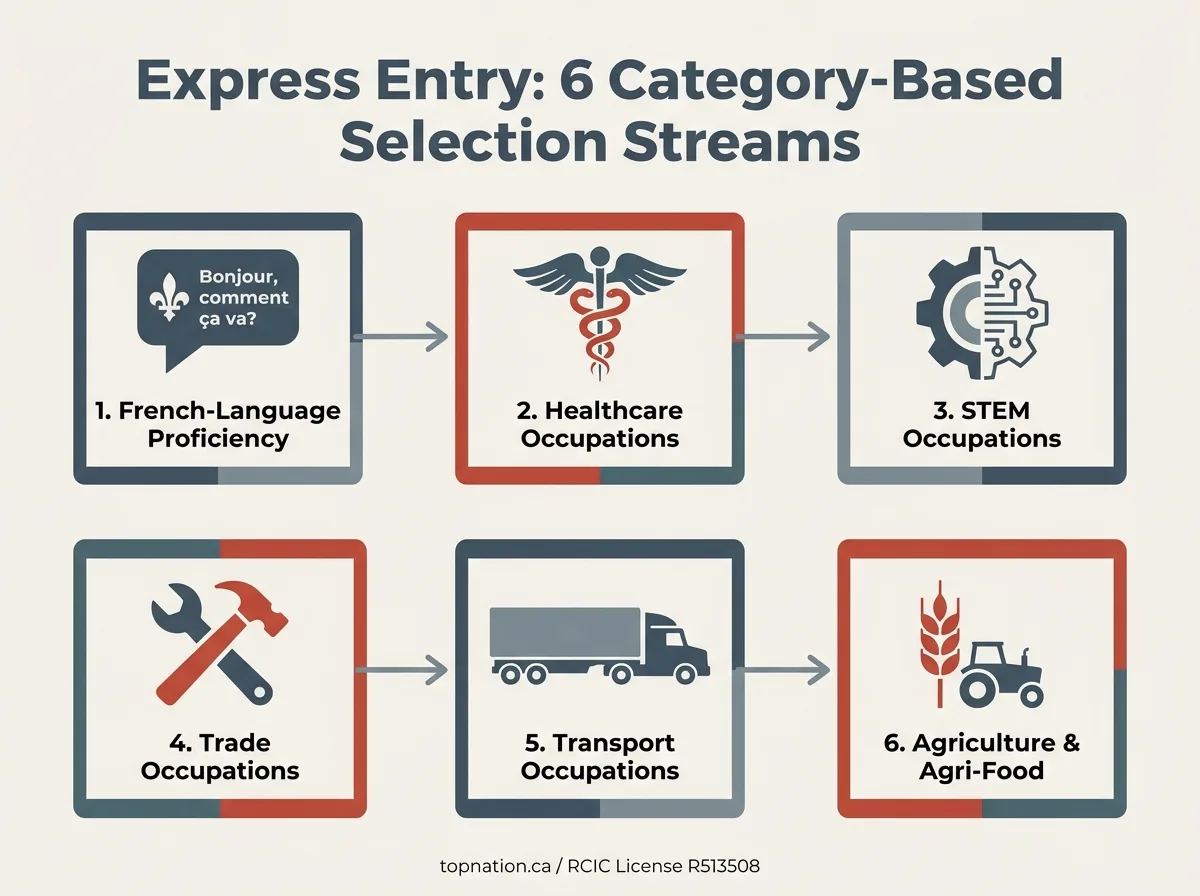
The six categories are:
- French-Language Proficiency: This category targets candidates with strong French language skills, aiming to support the vitality of Francophone communities across Canada.
- Healthcare Occupations: Designed to address chronic shortages in the healthcare sector, this category invites professionals like doctors, nurses, and therapists.
- Science, Technology, Engineering, and Math (STEM) Occupations: This category focuses on attracting talent in high-tech fields to drive innovation and support Canada’s growing technology sector.
- Trade Occupations: Targeting skilled tradespersons such as carpenters, plumbers, and electricians, this category helps fill crucial roles in construction and manufacturing.
- Transport Occupations: This category aims to recruit truck drivers, pilots, and other transport professionals to strengthen Canada’s supply chains.
- Agriculture and Agri-Food Occupations: Focused on supporting the food supply chain, this category invites farm supervisors and specialized livestock workers.
In-Depth: The French-Language Proficiency Category
The French-language proficiency category is unique among the six because it is not based on work experience in a specific occupation. Instead, it targets candidates who can demonstrate a strong command of the French language, regardless of their profession. The primary goal of this category is to increase the number of French-speaking immigrants settling in communities outside of Quebec, thereby supporting the demographic weight and vitality of Francophone minority communities across Canada. This aligns with the government’s long-term commitment to promoting bilingualism and strengthening the nation’s Francophone fabric.
Eligibility for the French-Language Category
To be eligible for an ITA under this category, a candidate must meet a single, clear criterion: achieve a minimum score of 7 in all four language abilities (reading, writing, listening, and speaking) on the Niveaux de compétence linguistique canadiens (NCLC). This score must be from a designated French language test, such as the TEF Canada or TCF Canada. It’s important to note that you must meet this threshold on all four skills; a high score in three abilities cannot compensate for a lower score in the fourth. Candidates who meet this requirement are eligible for category-based draws for French speakers, which have consistently featured some of the lowest CRS cut-off scores since the system’s inception.
Strategic Advantage for Bilingual Candidates
Bilingual candidates have a distinct advantage in the Express Entry pool. Not only can they be selected in French-language category draws, but they also receive significant bonus points in their overall CRS score calculation. Under the skills transferability factors, candidates can earn up to 50 additional points for strong French skills combined with strong English skills. This dual benefit means a bilingual candidate is competitive in both category-based draws and general draws. For anyone with even a moderate ability in French, investing in test preparation to reach the NCLC 7 benchmark can be one of the most effective strategies to improve your overall CRS score and unlock a new pathway to an ITA.
In-Depth: The Healthcare Occupations Category
Canada’s healthcare system is facing significant labour shortages, a challenge that was amplified by the recent global pandemic. The Healthcare occupations category is a direct response to this critical need, designed to fast-track the immigration of qualified healthcare professionals from around the world. By creating a dedicated pathway for these individuals, IRCC aims to fill vacancies in hospitals, clinics, and long-term care facilities, ensuring that Canadians have access to the medical care they need. This category covers a broad range of professions, from frontline workers like nurses and physicians to essential support roles like medical laboratory technologists and therapists.
Who Qualifies for the Healthcare Category?
To be eligible, a candidate must have at least six months of continuous, full-time work experience (or equivalent part-time) in the last three years in one of the designated healthcare occupations. This experience can be from Canada or abroad. It is absolutely critical that the duties you performed in your role align with the lead statement and main duties described in the National Occupational Classification (NOC) for your claimed occupation. A simple job title match is not sufficient; your reference letters must provide detailed proof of your responsibilities. The list of eligible occupations is extensive and is updated based on labour market needs.
Eligible NOCs for Healthcare Occupations
The list of targeted occupations is comprehensive, reflecting the diverse needs of the Canadian healthcare system. Key professions invited under this category include, but are not limited to: Audiologists and Speech-Language Pathologists (NOC 31112), Chiropractors (NOC 31201), Dentists (NOC 31110), Dietitians and Nutritionists (NOC 31121), General practitioners and family physicians (NOC 31102), Kinesiologists and other professional occupations in therapy and assessment (NOC 31204), Licensed practical nurses (NOC 32101), Massage therapists (NOC 32201), Medical laboratory assistants and related technical occupations (NOC 33101), Medical laboratory technologists (NOC 32120), Medical radiation technologists (NOC 32121), Medical sonographers (NOC 32122), Nurse aides, orderlies and patient service associates (NOC 33102), Nurse practitioners (NOC 31302), Nursing co-ordinators and supervisors (NOC 31300), Occupational therapists (NOC 31203), Optometrists (NOC 31111), Paramedical occupations (NOC 32102), Pharmacy technical assistants and pharmacy assistants (NOC 33103), Physician assistants, midwives and allied health professionals (NOC 31303), Physiotherapists (NOC 31202), Psychologists (NOC 31200), Registered nurses and registered psychiatric nurses (NOC 31301), Respiratory therapists, clinical perfusionists and cardiopulmonary technologists (NOC 32103), Specialists in clinical and laboratory medicine (NOC 31100), Specialists in surgery (NOC 31101), Therapists in counselling and related specialized therapies (NOC 41301), Traditional Chinese medicine practitioners and acupuncturists (NOC 32200), and Veterinarians (NOC 31103).
In-Depth: The STEM Occupations Category
The Science, Technology, Engineering, and Math (STEM) category targets professionals who are at the forefront of innovation and technological advancement. Canada’s ambition to be a global leader in the digital economy requires a steady influx of top-tier talent in fields like software development, data science, and engineering. This category is designed to attract these highly skilled individuals, helping Canadian companies compete on the world stage, drive research and development, and build the infrastructure of the future. By prioritizing STEM professionals, IRCC is directly investing in the country’s long-term economic growth and productivity.
Eligibility for the STEM Category
Similar to the healthcare category, eligibility for STEM draws requires at least six months of continuous, full-time work experience in the last three years in one of the designated STEM occupations. The list includes a wide array of tech and engineering roles. Given the specific and technical nature of these jobs, it is imperative that your Express Entry profile and supporting documents accurately reflect your expertise and experience. Your work experience letters must detail the specific technologies, programming languages, and engineering principles you applied in your role, ensuring they match the NOC description precisely. Vague or generic job descriptions can lead to a misrepresentation finding and a refusal.
Eligible NOCs for STEM Occupations
The STEM category includes a diverse range of professions critical to Canada’s tech and industrial sectors. Occupations frequently targeted include: Architects (NOC 21200), Architecture and science managers (NOC 20011), Business systems specialists (NOC 21221), Civil Engineers (NOC 21300), Computer and information systems managers (NOC 20012), Computer engineers (except software engineers and designers) (NOC 21311), Computer systems developers and programmers (NOC 21230), Cybersecurity specialists (NOC 21220), Data scientists (NOC 21211), Database analysts and data administrators (NOC 21223), Electrical and electronics engineers (NOC 21310), Engineering managers (NOC 20010), Industrial and manufacturing engineers (NOC 21321), Information systems specialists (NOC 21222), Land surveyors (NOC 21203), Landscape Architects (NOC 21201), Mathematicians, statisticians and actuaries (NOC 21210), Metallurgical and materials engineers (NOC 21322), Natural and applied science policy researchers, consultants and program officers (NOC 41400), Software developers and programmers (NOC 21232), Software engineers and designers (NOC 21231), Urban and land use planners (NOC 21202), and Web developers and programmers (NOC 21234), and Web designers (NOC 21233). This focus ensures that Canada attracts the talent needed to build its digital infrastructure and innovation ecosystem.

In-Depth: The Trade, Transport, and Agriculture Categories
While STEM and healthcare often dominate the headlines, the backbone of Canada’s economy relies on skilled trades, efficient transportation networks, and a robust agricultural sector. IRCC has created three distinct categories to address labour shortages in these essential areas. These draws target candidates with hands-on skills and experience that are in constant demand across the country, from urban construction sites to rural farms and the highways that connect them.
Trade Occupations
The Trade Occupations category is designed to attract skilled workers who can build and maintain Canada’s infrastructure. With an aging workforce and a booming construction sector, the demand for qualified tradespeople is at an all-time high. This category helps fill critical gaps, ensuring that housing projects, commercial developments, and public works can proceed without delay. Eligibility requires six months of recent experience in a single designated trade occupation. Targeted roles often include: Residential and commercial installers and servicers (NOC 73200), Elevator constructors and mechanics (NOC 72406), Machine fitters (NOC 72405), Heating, refrigeration and air conditioning mechanics (NOC 72402), Construction millwrights and industrial mechanics (NOC 72400), Carpenters (NOC 72310), Plumbers (NOC 72300), Electricians (except industrial and power system) (NOC 72200), Welders and related machine operators (NOC 72106), and Contractors and supervisors in various trades like electrical, construction, and mechanics.
Transport Occupations
Canada’s vast geography makes its transportation and logistics sector absolutely vital. The Transport Occupations category targets professionals who keep the country’s supply chains moving, from long-haul truck drivers to airline pilots. Shortages in this sector can have a cascading effect on the entire economy, leading to delays and increased costs. This targeted stream ensures a steady supply of qualified transport workers. Key occupations include: Aircraft assemblers and aircraft assembly inspectors (NOC 93200), Transport truck drivers (NOC 73300), Railway carmen/women (NOC 72403), Aircraft mechanics and aircraft inspectors (NOC 72404), Air pilots, flight engineers and flying instructors (NOC 72600), Aircraft controllers and other air traffic occupations (NOC 72601), Deck officers, water transport (NOC 72602), Engineer officers, water transport (NOC 72603), and Managers in transportation (NOC 70020).
Agriculture and Agri-Food Occupations
The Agriculture and Agri-food category supports one of Canada’s oldest and most important industries. This stream targets individuals with experience in managing and operating farms and food production facilities. It aims to address labour shortages in the agricultural sector, ensuring Canada’s food security and supporting rural economies. The focus is often on supervisory and specialized roles. Eligible occupations include: Contractors and supervisors, landscaping, grounds maintenance and horticulture services (NOC 82031), Agricultural service contractors and farm supervisors (NOC 82030), and Butchers – retail and wholesale (NOC 63201).
| Category | Core Objective | Key Eligibility Requirement |
|---|---|---|
| French-Language | Support Francophone communities | NCLC 7 in all 4 French language skills |
| Healthcare | Address healthcare worker shortages | 6 months experience in a designated healthcare NOC |
| STEM | Drive innovation and tech growth | 6 months experience in a designated STEM NOC |
| Trades | Fill construction & manufacturing jobs | 6 months experience in a designated trade NOC |
| Transport | Strengthen supply chains | 6 months experience in a designated transport NOC |
| Agriculture | Ensure food security & support rural areas | 6 months experience in a designated agri-food NOC |
Step-by-Step: Positioning Your Profile for a Targeted Invitation
Successfully navigating the category-based selection system requires more than just having the right work experience; it requires a strategic and meticulous approach to building your Express Entry profile. Taking the right steps from the beginning can significantly increase your chances of receiving an ITA in a targeted draw.
Step 1: Confirm Your Foundational Eligibility
Before even considering the categories, you must first be eligible for one of the three core Express Entry programs: the Federal Skilled Worker Program (FSW), the Canadian Experience Class (CEC), or the Federal Skilled Trades Program (FSTP). Each has its own distinct criteria for work experience, language proficiency, and education. Ensure you meet all the requirements for at least one of these programs. This is a non-negotiable first step, as your profile will not be accepted into the pool otherwise.
Step 2: Identify Your Correct NOC Code
This is arguably the most critical step. You must accurately identify the NOC code that corresponds to your work experience. Go to the official NOC website and carefully read the lead statement, main duties, and employment requirements for the occupations you are considering. Your past job duties must be a substantial match to the description listed. Choosing the wrong NOC, even if the job title seems correct, can lead to your application being refused. Document your duties in detail and gather strong reference letters that support your chosen NOC.
Step 3: Gather Proof of Work Experience
Once you’ve identified your NOC, gather the necessary proof. You will need official letters from your past employers for any work experience you claim. These letters must be on company letterhead, signed by a supervisor or HR representative, and include your job title, dates of employment, salary, hours worked per week, and a detailed list of your responsibilities. This documentation is the primary evidence an IRCC officer will use to verify your eligibility for an occupation-based category.
Step 4: Complete Your Language Tests
Schedule and complete your language tests (IELTS or CELPIP for English; TEF or TCF for French) as early as possible. Your results are required to create your Express Entry profile. If you are aiming for the French-language category, your goal is a minimum of NCLC 7 in all four abilities. Even if you are not targeting the French category, strong language scores in either English or French are one of the most powerful ways to boost your CRS score, which remains important as a tie-breaker.
Step 5: Create a Meticulous Express Entry Profile
With all your documents and test results in hand, you can create your Express Entry profile on the IRCC website. Enter all information with extreme care. Any discrepancy between your profile and the documents you later submit can result in a refusal. When you enter your work experience, ensure you use the correct NOC code you identified in Step 2. The system will automatically assess whether you meet the criteria for any of the six categories based on the information you provide.
Frequently Asked Questions about Category-Based Selection
The introduction of category-based selection has generated many questions from prospective immigrants. Here, we address some of the most common inquiries to provide clarity on how the system works.
Can I be eligible for more than one category?
Yes, it is possible to be eligible for multiple categories simultaneously. For example, a software engineer (STEM category) who is also fluent in French (French-language category) would be eligible for draws targeting either group. When IRCC conducts a draw, your profile will be considered if you meet the specific criteria for that round. This can increase your overall chances of being invited, as you are not limited to a single pathway.
Do I need a Canadian job offer to be selected in a category-based draw?
No, a Canadian job offer is not a mandatory requirement for eligibility in any of the six categories. The primary requirement for the five occupation-specific categories is having at least six months of relevant work experience in a designated NOC within the last three years. While a valid job offer can still add significant points to your CRS score, the category-based system is designed to select candidates based on their skills and experience, even without pre-arranged employment in Canada.
What if my CRS score is low but I’m in a targeted category?
This is precisely the scenario where category-based selection can be most beneficial. These draws often have a lower CRS cut-off score than general draws because the pool of eligible candidates is smaller. If your work experience is in a high-demand field like healthcare or trades, you could receive an ITA with a CRS score that might not be competitive in an all-program draw. However, it’s important to remember that the CRS score is still used as the ranking tool *within* the category. If there are more eligible candidates in your category than there are ITAs available, those with higher CRS scores will be invited first.
How often are the categories reviewed or changed?
The Minister of Immigration is required to report annually to Parliament on the categories selected. The categories are based on labour market information and consultations with stakeholders. This means they can be adjusted, added, or removed to reflect Canada’s changing economic needs. While the current six categories are expected to remain for the near future, candidates should stay informed about any potential updates announced by IRCC.
Does a Provincial Nominee Program (PNP) nomination help in these draws?
A Provincial Nominee Program (PNP) nomination remains one of the most powerful tools within Express Entry. If you receive a nomination from a province or territory, you are awarded an additional 600 CRS points. This effectively guarantees you will receive an ITA in the next general draw. While a PNP is not directly part of the federal category-based selection, many provinces have their own targeted streams that align with the federal categories. For example, a province might have a PNP stream specifically for healthcare workers. Securing a provincial nomination is an excellent parallel strategy to pursue while waiting for a federal category-based draw. For those in Alberta, seeking expert guidance from our Edmonton-based immigration consultants can help navigate these provincial options.
Is Your Profile Optimized for Category-Based Selection?
We’ll assess your work experience against the targeted NOC lists to see if you qualify for a category-based draw.
RCIC Licensed | Serving All of Alberta
Last updated: October 2023. This guide reflects the Express Entry category-based selection system as of the last update. Immigration rules change frequently — consult a licensed RCIC for advice specific to your situation.