IRCC Announces New Caps and Priorities
For 2026, Immigration, Refugees and Citizenship Canada (IRCC) has introduced significant changes to the Start-Up Visa program. This includes capping the number of permanent residence applications to those associated with a maximum of 10 start-ups per designated organization and prioritizing applications with significant capital investment.
START-UP VISA PROGRAM — 2026 UPDATE
For global entrepreneurs with an innovative vision, Canada’s Start-Up Visa (SUV) Program has long been a premier pathway to permanent residence. It stands apart from traditional economic immigration by focusing not on points or past experience, but on the potential of a future business to create jobs and compete on a global scale. However, the landscape for 2026 has shifted. New regulations from IRCC introduce application caps and a new system of prioritization, making a strategic, well-prepared application more critical than ever. This guide provides a comprehensive walkthrough of the entire SUV process, tailored for the new 2026 rules.

What is the Canada Start-Up Visa Program?
The Canada Start-Up Visa (SUV) Program is a unique federal business immigration stream designed to attract innovative foreign entrepreneurs who have the potential to build businesses in Canada that are scalable, innovative, and capable of creating jobs for Canadians. Unlike provincial nominee programs for entrepreneurs, the SUV is a direct federal path to permanent residence, meaning successful applicants are not tied to a specific province and can settle anywhere in Canada (outside of Quebec).
The core of the program revolves around a simple but challenging premise: an applicant must secure the support of a Canadian-based, government-approved investment organization. This endorsement, formalized in a Letter of Support, validates the business concept and signals to IRCC that the venture has merit and potential for success within the Canadian ecosystem.
The Core Objective: Attracting Global Innovators
The Canadian government’s goal with the SUV program is not to attract lifestyle businesses or small local shops. Its purpose is to inject high-growth potential ventures into the Canadian economy. The program seeks founders who are working on new technologies, scalable software, advanced manufacturing processes, intellectual property, or any concept that can create a competitive advantage for Canada on the world stage. It’s a forward-looking program that bets on the potential of an idea and the entrepreneurs behind it.
SUV vs. Other Business Immigration Paths
Canada offers several pathways for business-minded individuals, but the SUV is distinct. Traditional investment migration programs often require a significant personal net worth and a large, passive investment. Provincial Nominee Program (PNP) entrepreneur streams typically involve a two-step process where an applicant first operates a business on a work permit and must meet specific performance targets before being nominated for permanent residence. The SUV program, in contrast, offers direct permanent residence without a mandatory net worth requirement and without the need for a preliminary work permit period, although one is available as an option.
Major Changes for the SUV Program in 2026
In a significant policy shift, IRCC has implemented new measures to manage application intake and processing for the Start-Up Visa program, effective for 2026. These changes are designed to reduce backlogs, improve processing times, and focus the program’s resources on the most promising ventures. For prospective applicants, understanding these new rules is the first step toward a successful application.
Understanding the New Application Cap
The most impactful change is the introduction of a cap on the number of applications processed annually. IRCC will now only accept permanent residence applications associated with a total of 10 start-ups per designated organization. This means that each designated venture capital fund, angel investor group, and business incubator can collectively issue Letters of Support that will lead to the processing of applications for only 10 new companies in a given year. Given there are approximately 85 designated organizations, this creates a finite number of slots available across the country. This cap forces both applicants and designated organizations to be more selective, raising the overall quality and competition level within the program.
Prioritized Processing: Who Moves to the Front of the Line?
Alongside the cap, IRCC has introduced a new prioritization system for processing. Not all applications will be treated equally. Two specific categories will receive expedited processing:
- Ventures with Significant Capital Investment: Applications backed by a Letter of Support from a designated Venture Capital fund or Angel Investor group that confirms a substantial financial commitment will be prioritized. While the exact threshold for ‘substantial’ is determined by the fund, this signals to IRCC that the business has undergone rigorous financial due diligence and has the capital to scale.
- Ventures Accepted into Canada’s Tech Accelerators: Applications from entrepreneurs who have been accepted into a recognized tech accelerator or incubator known for its rigorous selection process and successful track record will also be prioritized. This acknowledges that acceptance into these programs is a strong indicator of a venture’s potential.
Applications supported by business incubators without a direct capital investment component, while still eligible, will be processed under the standard, non-prioritized stream. This change creates a clear two-tier system and incentivizes founders to seek out capital-intensive support.
Rationale Behind the Changes: Program Integrity and Economic Impact
These changes are a direct response to the program’s immense popularity, which led to processing times extending to over three years. IRCC’s stated goal is to ensure the program delivers on its economic mandate. By capping intake, the department can manage the inventory and bring processing times down to a more reasonable level. By prioritizing capital-backed ventures, the government is focusing on start-ups that are most likely to have the resources to grow quickly, hire Canadians, and make a tangible economic contribution.
Are You Eligible? The 4 Core Requirements for SUV Applicants
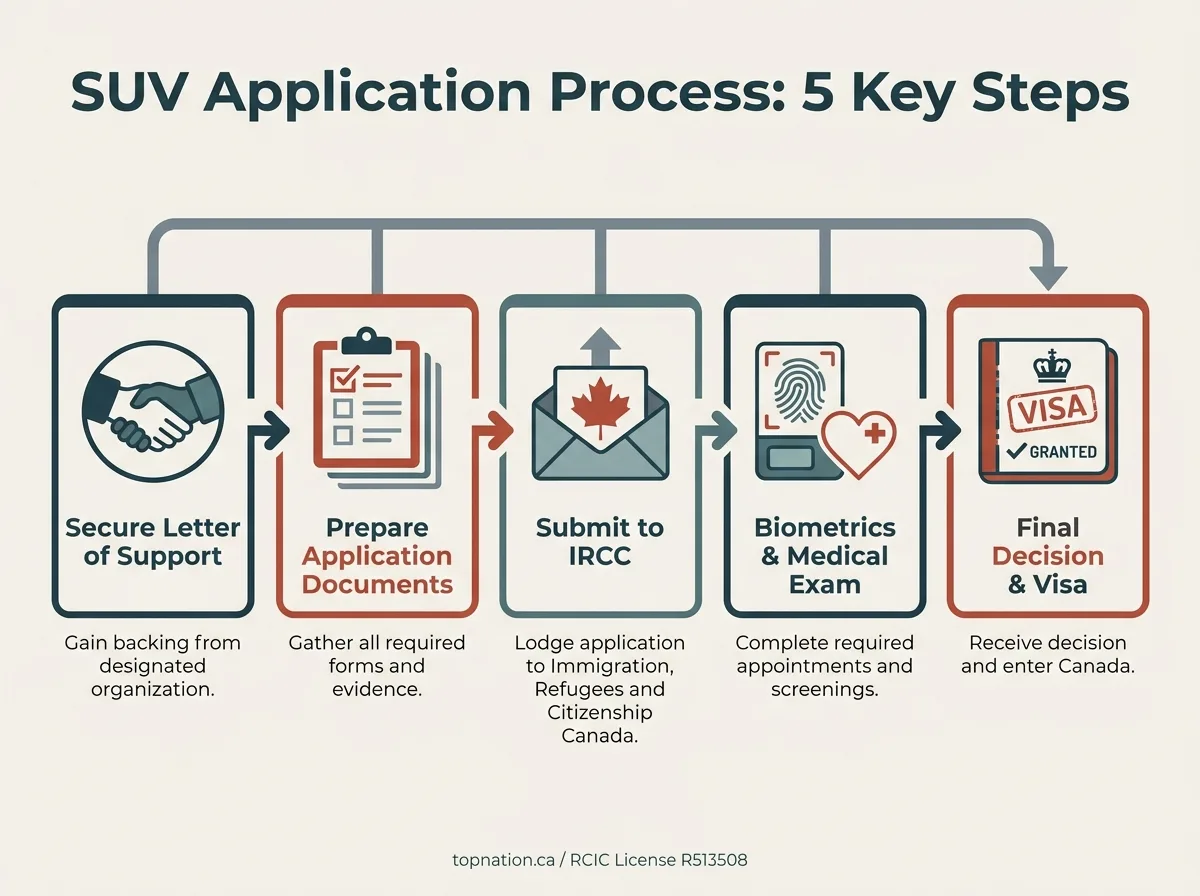
Before diving into the complex process of pitching investors, it’s essential to confirm your personal eligibility for the program. IRCC has four clear, non-negotiable requirements that every single applicant, including all co-founders on a team, must meet independently. Failure to meet any one of these pillars will result in the refusal of the entire application, regardless of the strength of the business idea.
The four pillars of eligibility are:
- Have a Qualifying Business: The enterprise itself must meet specific structural and operational criteria.
- Secure a Letter of Support: You must receive an official endorsement from a government-designated organization.
- Meet Language Requirements: You must prove proficiency in English or French at a minimum level.
- Possess Sufficient Settlement Funds: You must show you have enough money to support yourself and your family upon arrival in Canada.
We will explore each of these requirements in extensive detail in the following sections.
Deep Dive: Requirement 1 – The Qualifying Business
The business itself is the star of the Start-Up Visa application. It’s not enough to simply have an idea; the venture must be structured and conceptualized in a way that aligns with the program’s objectives of innovation and growth. IRCC officers will scrutinize the business to ensure it is genuine and has the potential for success.
What Makes a Business “Innovative”?
Innovation is a subjective term, but in the context of the SUV program, it generally means the business is introducing a new product, service, or process to the market, or is significantly improving an existing one. It often involves proprietary technology, a unique business model, or intellectual property. A standard retail store, restaurant, or local consulting firm, while a perfectly viable business, would typically not be considered innovative enough for the SUV program. The venture should be difficult for others to easily replicate and should be creating new value, not just competing in a saturated market.
Proving Scalability and Global Potential
Scalability refers to the business’s ability to grow revenue at an exponential rate with only a marginal increase in operational costs. This is often a hallmark of tech companies, software-as-a-service (SaaS) platforms, and businesses built on intellectual property. Your business plan must clearly demonstrate how you intend to expand beyond your initial local market to serve a national or international customer base. The goal is to create a company that generates significant revenue and, crucially, creates high-quality jobs for Canadians.
Incorporation Rules: Structuring Your Canadian Company
For a business to be considered qualifying, it must be incorporated in Canada. This is a critical step. At the time you receive your permanent residence, your business must be incorporated federally or provincially in Canada. Furthermore, you, the applicant, must provide active and ongoing management of this business from within Canada. The enterprise’s essential operations must also be happening in Canada. This rule prevents applicants from using the program simply as a means to immigrate while running a business remotely from another country.
Ownership Structure: The Voting Rights Rule
The ownership structure is strictly defined. When you receive the Letter of Support, a specific ownership snapshot is taken:
- Each applicant (up to 5 co-founders are allowed) must hold at least 10% of the voting rights in the newly formed Canadian corporation.
- The applicants and the designated organization, combined, must jointly hold more than 50% of the total voting rights in the corporation.
This ensures that control of the company rests with the founding team and their Canadian investment partners, solidifying the venture’s commitment to operating and growing within Canada.
Deep Dive: Requirement 2 – The Letter of Support (LOS)
The Letter of Support (LOS) is the single most important document in your SUV application. It is the formal endorsement from a designated organization that tells IRCC your business idea is viable and worthy of support. Obtaining this letter is often the longest and most challenging part of the process, as it requires convincing seasoned investors or business experts of your venture’s potential.
The Three Types of Designated Organizations
IRCC has approved three categories of private-sector organizations to participate in the SUV program. Each has a different mandate and investment requirement.
- Venture Capital (VC) Funds: These firms manage large pools of capital and invest in high-growth start-ups in exchange for equity. To issue a Letter of Support, a designated VC fund must commit to investing a minimum of $200,000 into your start-up. They conduct extensive due diligence and typically only invest in ventures with proven traction and massive market potential.
- Angel Investor Groups: These are networks of high-net-worth individuals who pool their resources to invest in early-stage companies. A designated angel investor group must commit to a minimum investment of $75,000. Angels often invest at an earlier stage than VCs and may also provide mentorship and industry connections.
- Business Incubators: These organizations support early-stage companies through mentorship, resources, networking, and structured programs. Unlike VCs and angel groups, incubators are not required to invest money into your business. Instead, they must accept your start-up into their business incubation program. The value they provide is structural and educational, helping you refine your business model and prepare for growth.
How to Craft a Compelling Pitch
Securing an LOS requires a professional and persuasive pitch. You are not just applying for a visa; you are seeking a genuine business partnership. Your pitch should be tailored to the specific organization you are approaching and should include:
- A Clear Problem/Solution: What market pain point are you solving, and how is your solution unique and effective?
- Market Size and Opportunity: Demonstrate that you are targeting a large and growing market.
- Your Team: Highlight the expertise, experience, and commitment of your founding team. Why are you the right people to solve this problem?
- Business Model: How will you make money? What are your revenue streams, pricing strategy, and customer acquisition plan?
- Financial Projections: Provide realistic, data-backed financial forecasts for the next 3-5 years.
- The “Ask”: Clearly state what you are seeking from the organization, whether it’s funding or acceptance into their program.
The Due Diligence Process: What to Expect
Designated Organizations (DOs) have a responsibility to conduct thorough due diligence on every potential start-up. This is not a rubber-stamp process. They are putting their reputation on the line with every Letter of Support they issue. Expect a rigorous evaluation of your business plan, financial model, market research, and the background of your founding team. They need to be convinced that your business is not just a vehicle for immigration but a genuine, high-potential commercial enterprise. This process can take several months and may involve multiple interviews, presentations, and requests for additional information.
Deep Dive: Requirement 3 – Language Proficiency (CLB 5)
Effective communication is fundamental to business success. IRCC requires all Start-Up Visa applicants to demonstrate a minimum level of proficiency in either English or French. This is a mandatory, non-negotiable requirement, and the results must be from a designated testing agency.
What Does CLB 5 Actually Mean?
The language requirement is measured against the Canadian Language Benchmarks (CLB). For the SUV program, you must achieve a minimum of CLB 5 in all four language abilities: speaking, listening, reading, and writing. A CLB 5 level is considered ‘initial intermediate’. It means you can participate in basic, routine conversations on familiar topics, understand simple instructions and questions, read straightforward texts, and write short, simple messages related to everyday matters. While this is not a high level of fluency, it is deemed the minimum necessary to begin navigating the Canadian business environment.
Approved Language Tests and Score Requirements
To prove your language skills, you must take a test from an agency approved by IRCC. The two most common tests are:
- IELTS (International English Language Testing System): You must take the General Training option, not the Academic one.
- CELPIP (Canadian English Language Proficiency Index Program): This is a Canadian-based test.
The scores required to meet CLB 5 are:
| Ability | IELTS (General Training) | CELPIP-General |
|---|---|---|
| Speaking | 5.0 | 5 |
| Listening | 5.0 | 5 |
| Reading | 4.0 | 5 |
| Writing | 5.0 | 5 |
Your test results are valid for two years from the date they are issued and must be valid on the day you submit your permanent residence application.

Deep Dive: Requirement 4 – Proof of Settlement Funds
The Canadian government wants to ensure that newcomers have enough money to support themselves and their families while they get established in Canada. The Start-Up Visa program does not provide any financial support, so applicants must prove they have their own funds available. This money is for your personal living expenses, not for investing in your business.
2026 Settlement Fund Requirements
The amount of money you need is determined by the size of your family, including yourself, your spouse or partner, and any dependent children. The amounts are updated annually by IRCC. The funds must be readily available to you, unencumbered by debts or other obligations.
| Number of Family Members | Required Funds (CAD) – 2026 Estimate |
|---|---|
| 1 | $14,690 |
| 2 | $18,288 |
| 3 | $22,483 |
| 4 | $27,297 |
| 5 | $30,690 |
| For each additional family member | add $3,958 |
Note: These figures are based on the latest available data and are subject to change. Always check the official IRCC website for the most current requirements before applying.
What Counts as Proof of Funds?
You must provide official letters from any banks or financial institutions where you have accounts. These letters must be printed on the institution’s letterhead and include their contact information, your name, and a list of all current bank and investment accounts, along with the current balance of each account and the date it was opened. You will need to show a history of these funds, typically for the six months preceding your application, to prove they were not recently gifted or loaned to you solely for immigration purposes.
The SUV Application Process: A Step-by-Step Walkthrough for 2026
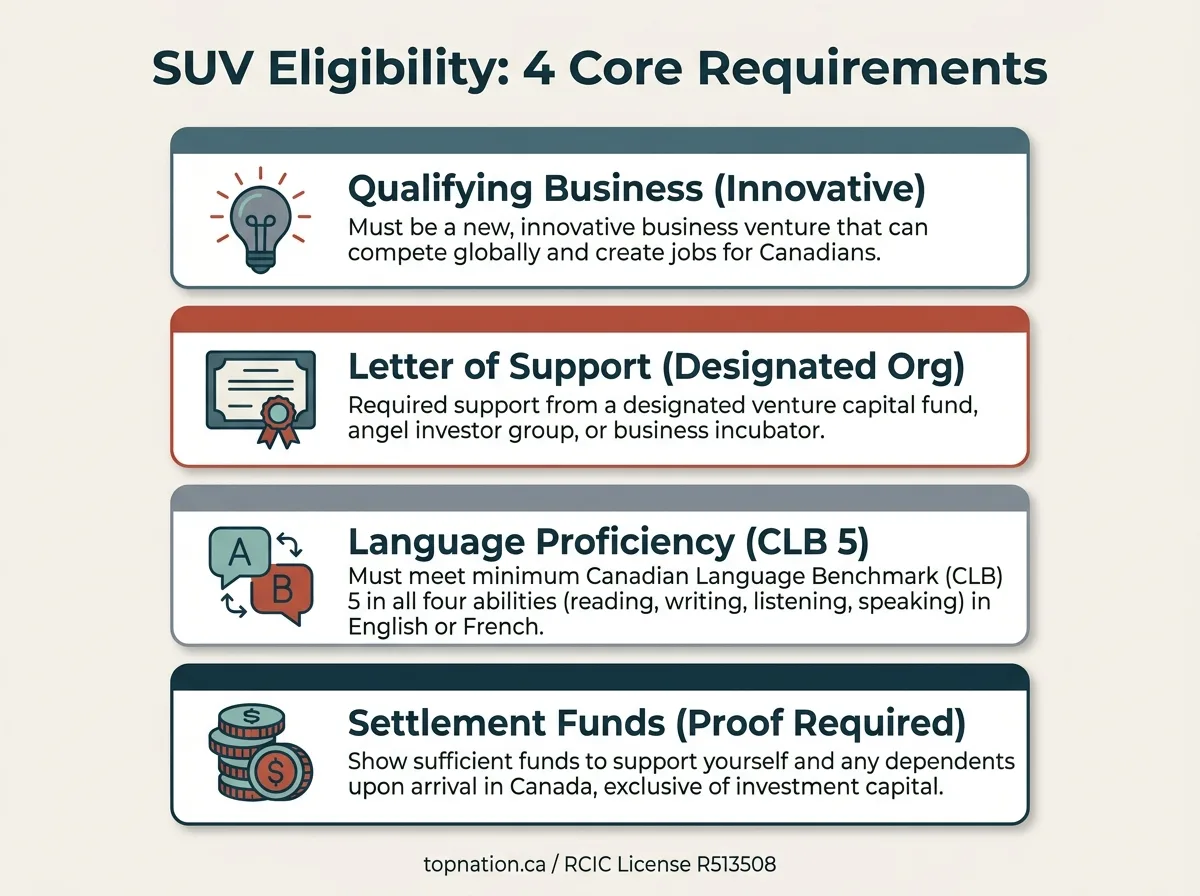
Navigating the Start-Up Visa program is a multi-stage journey that requires careful planning and execution. Here is a high-level overview of the key steps involved.
- Step 1: Validate Your Business Concept. Before approaching any organization, refine your business plan, build a prototype or minimum viable product (MVP), and conduct thorough market research. Ensure your idea is genuinely innovative and scalable.
- Step 2: Secure Your Letter of Support. This is the active pitching phase. Research and identify the most suitable designated organizations for your industry and stage. Tailor your pitch and business plan for each one. This can take anywhere from 6 to 18 months.
- Step 3: Prepare the PR Application Package. Once you have the Letter of Support, you can begin assembling your permanent residence application. This involves completing all required IRCC forms, gathering supporting documents (language tests, proof of funds, police certificates, etc.), and paying the government fees.
- Step 4: Submit to IRCC. Submit the complete application package to the designated IRCC processing office. You will receive an Acknowledgment of Receipt (AOR), which confirms your file has been created.
- Step 5: Apply for a Work Permit (Optional). While your PR application is in process, you can apply for a short-term, LMIA-exempt work permit. This allows you to come to Canada and begin working on your start-up before your permanent residence is finalized.
- Step 6: Medicals, Biometrics, and Background Checks. IRCC will request that you and your family members complete a medical examination and provide biometrics. They will also conduct comprehensive security and background checks.
- Step 7: Confirmation of Permanent Residence (COPR). Once all checks are cleared and your application is approved, you will receive your Confirmation of Permanent Residence (COPR) document and a permanent resident visa.
Start-Up Visa Processing Times and Government Fees
Processing times and costs are major considerations for any applicant. With the new 2026 changes, the timelines are expected to shift significantly.
Understanding IRCC’s Published Processing Times
Historically, SUV processing times have been lengthy, often exceeding 36 months. The new caps and prioritization measures are specifically designed to reduce this. Applicants who receive prioritized processing (i.e., those with significant capital investment) can expect a much faster journey, potentially under 12 months. Those in the standard stream will likely still face longer waits, but the overall reduction in intake should improve times for everyone. It is crucial to monitor the official IRCC website for the most up-to-date processing time estimates as the new system is implemented.
Government Application Fees (2026)
There are several non-refundable government fees associated with the application. These fees must be paid upfront when you submit your application.
- Processing Fee: This covers the cost of processing the application for you and your family members. The principal applicant fee is currently $1,755, with additional fees for a spouse/partner and dependent children.
- Right of Permanent Residence Fee (RPRF): This is a fee that must be paid before you can become a permanent resident. The current fee is $575 per adult.
- Biometrics Fee: This is a fee for collecting fingerprints and a photograph. It is $85 for an individual or $170 for a family of two or more.
These fees are separate from any professional fees you might pay to an immigration consultant or lawyer, and they do not include the costs of language tests, medical exams, or educational credential assessments.
Common Reasons for SUV Refusal and How to Avoid Them
Even with a Letter of Support, an SUV application can be refused. The final decision always rests with the IRCC visa officer, who conducts an independent assessment. Understanding common pitfalls can help you prepare a stronger case.
Refusal Reason 1: The Business Lacks Genuine Potential
The visa officer must be convinced that you intend to establish a genuine, viable business in Canada. If the business plan seems weak, lacks research, or appears to be created solely for the purpose of immigration, the application can be refused on these grounds. This is why a robust, well-defended business plan is critical.
Refusal Reason 2: Insufficient Due Diligence by the Designated Organization
IRCC has established a peer review process to ensure that designated organizations are conducting proper due diligence. If a peer review panel finds that an organization did not adequately assess a start-up’s viability, IRCC can refuse the application. This underscores the importance of working with reputable and experienced designated organizations.
Refusal Reason 3: Inadmissibility or Ineligibility of an Applicant
Every member of the founding team must be admissible to Canada and meet all four eligibility requirements (language, funds, etc.). If even one co-founder fails a medical exam, has a criminal record, or fails to meet the language threshold, the entire group’s application will be refused.
Frequently Asked Questions about the Start-Up Visa Program
Can my family immigrate with me?
Yes. Your spouse or common-law partner and your dependent children can be included in your application for permanent residence. They will receive permanent residence at the same time as you. It’s also important to plan for their future in Canada, which can include sponsoring your spouse or partner for certain benefits or programs once you are established.
What happens if my start-up fails after I get PR?
The Start-Up Visa program grants you unconditional permanent residence. Your PR status is not tied to the success of your business. The government recognizes that start-ups are inherently risky and that many fail. As long as your application was truthful and you entered the program with the genuine intent to build your business, the failure of the venture will not impact your permanent resident status.
How many co-founders can be on one application?
A single start-up venture can support the permanent residence applications for up to five co-founders. Each of the five founders must meet the 10% ownership rule and all other personal eligibility criteria (language, funds, etc.).
Do I need to invest my own money into the business?
The program itself does not have a mandatory personal investment requirement. However, most designated organizations, particularly VCs and angel groups, will expect the founders to have some of their own capital invested (‘skin in the game’) as a sign of their commitment. The settlement funds you are required to show are separate and cannot be used for the business.
How a Regulated Canadian Immigration Consultant (RCIC) Adds Value
The Start-Up Visa program is one of the most complex immigration pathways. The new caps and prioritization rules for 2026 have added another layer of strategic consideration. Working with an experienced and licensed RCIC can provide significant advantages.
A professional consultant can help you navigate the entire process, from assessing your initial eligibility to preparing a compliant and compelling application package. At TopNation, our team, including our licensed immigration consultant in Edmonton, can provide strategic guidance on refining your business plan for a Canadian audience, help you identify and prepare for pitches to suitable designated organizations, and ensure every detail of your application meets IRCC’s stringent requirements. This professional oversight can be the difference between a successful application and a costly refusal in this increasingly competitive program.
The SUV Rules Have Changed. Is Your Strategy Ready for 2026?
With new caps and priorities, a strong application is more critical than ever. We assess your venture’s eligibility for the new SUV landscape.
RCIC Licensed | Serving All of Alberta
Last updated: April 2026. This guide reflects the announced changes to the Start-Up Visa program for 2026. Immigration rules change frequently — consult a licensed RCIC (CICC #R513508) for advice specific to your situation.