CRS Cut-Offs Trending Higher
Recent Express Entry trends from June 2026 show a ‘top-heavy’ candidate pool, with general draws consistently requiring Comprehensive Ranking System (CRS) scores above 510. This leaves candidates in the 450-500 range needing a proactive strategy to secure an Invitation to Apply (ITA).
EXPRESS ENTRY STRATEGY — JUNE 2026
If your Express Entry profile is sitting with a Comprehensive Ranking System (CRS) score between 450 and 500, you are not alone. This range represents a highly competitive bracket of skilled individuals. However, following the draws in mid-2026, it has become clear that relying on general draws alone is no longer a viable strategy for this cohort. The pool has become top-heavy, with a significant volume of candidates scoring over 500. This guide provides a detailed, actionable plan for candidates whose CRS score is too low for current Express Entry cut-offs, focusing on two critical pathways: aggressively increasing your score and strategically leveraging Provincial Nominee Programs (PNPs), particularly the Alberta Advantage Immigration Program (AAIP).

The Evolving Express Entry Landscape: Post-June 2026 Trends
The Express Entry system is dynamic, designed to respond to Canada’s economic needs. In mid-2026, a clear trend emerged: a significant increase in candidates with very high CRS scores, pushing the minimum threshold for general draws well above the 500-point mark. This shift is due to a combination of factors, including a backlog of high-scoring candidates entering the pool and the targeted nature of category-based selections.
Understanding the ‘Top-Heavy’ Pool: Why Scores Under 500 Face Challenges
A ‘top-heavy’ pool means a disproportionate number of candidates occupy the highest score ranges. When Immigration, Refugees and Citizenship Canada (IRCC) conducts a general draw, it invites the highest-scoring candidates first. With more people scoring above 510, 520, or even higher, candidates with scores of 495 are often left waiting. Based on TopNation’s analysis of client files from Q2 2026, candidates with scores of 490-500 received Invitations to Apply (ITAs) primarily through specific category-based draws, while general draws required scores consistently above 515.
Impact of Category-Based Draws and General Draws on Lower CRS Scores
While general draws have become more competitive, category-based draws offer a crucial opportunity. These draws target candidates with specific attributes, such as French-language proficiency or work experience in in-demand sectors like healthcare, STEM, trades, transport, and agriculture. A candidate with a CRS score of 475 but with strong French skills or experience as a welder could receive an ITA in a targeted draw, while a candidate with a score of 505 in a non-targeted occupation might not. The key is that your profile must be optimized to be visible for these specific categories.

Strategy 1: Actionable Steps to Increase Your CRS Score
If you are close to the cut-off, a few strategic improvements can make all the difference. Every single point matters. Focusing on the most impactful areas of the CRS scoring matrix is the most efficient way to improve your chances.
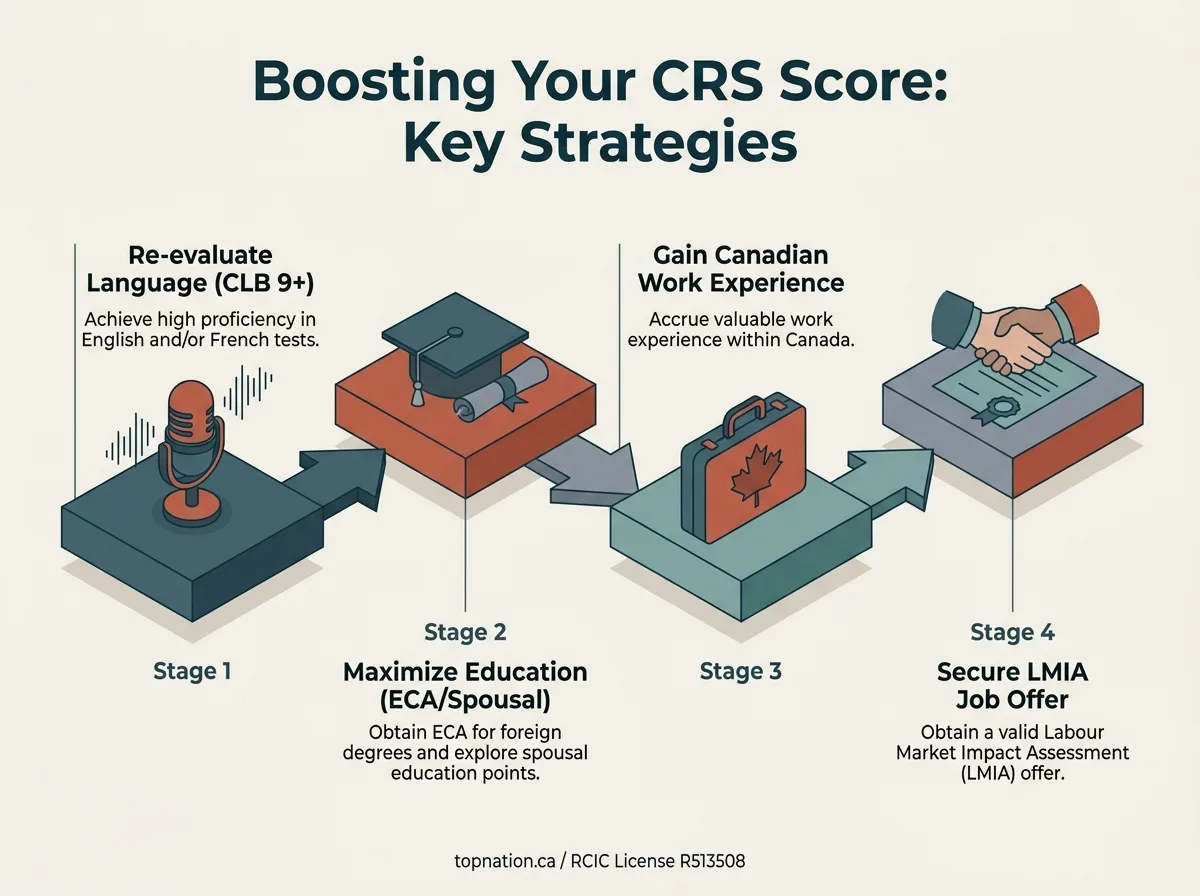
Re-evaluating Language Proficiency: Aiming for CLB 9+
Language proficiency is one of the most valuable factors you can control. Reaching a Canadian Language Benchmark (CLB) level of 9 in all four abilities (reading, writing, listening, speaking) triggers a significant jump in points under the skills transferability factors. The difference between CLB 8 and CLB 9 is substantial, and achieving CLB 10 provides an even greater boost.
| Skill Level | CRS Points (Skills Transferability – with Post-Secondary Degree) | Potential Gain |
|---|---|---|
| CLB 7 in all abilities | 13 points | – |
| CLB 8 in all abilities | 25 points | +12 points |
| CLB 9 in all abilities | 50 points | +25 points |
Maximizing Educational Credentials: Spousal ECAs and Further Education
Ensure your Educational Credential Assessment (ECA) accurately reflects all your post-secondary education. A frequent error we see is candidates not claiming points for a second credential. For example, a Bachelor’s degree and a one-year postgraduate certificate can be claimed as ‘Two or more certificates, diplomas, or degrees,’ which is worth more points than the Bachelor’s alone. If you are applying with a spouse or common-law partner, having them complete an ECA and language tests can also add valuable points to your profile. This is a crucial step often overlooked in a spousal sponsorship context but equally important for Express Entry.
Gaining Canadian Work Experience: A Significant CRS Boost
One year of full-time, skilled Canadian work experience provides a substantial increase in CRS points. For candidates already in Canada on a work permit, completing this one-year milestone is critical. If you are outside Canada, exploring pathways to obtain a work permit, such as through an LMIA-supported job offer or an LMIA-exempt category, can be a long-term strategy to significantly improve your CRS score.
Securing a Valid Job Offer (LMIA-Supported): The 50-200 Point Advantage
A valid job offer supported by a Labour Market Impact Assessment (LMIA) can add 50 or 200 points to your score, depending on the National Occupational Classification (NOC) code. A 50-point boost is available for most skilled positions (TEER 0, 1, 2, or 3), while 200 points are awarded for senior managerial positions (NOC TEER 0 Major Group 00). While obtaining an LMIA is a complex process for an employer, its impact on a CRS score can be game-changing.
Strategy 2: Provincial Nominee Programs (PNPs) as a Strategic Alternative
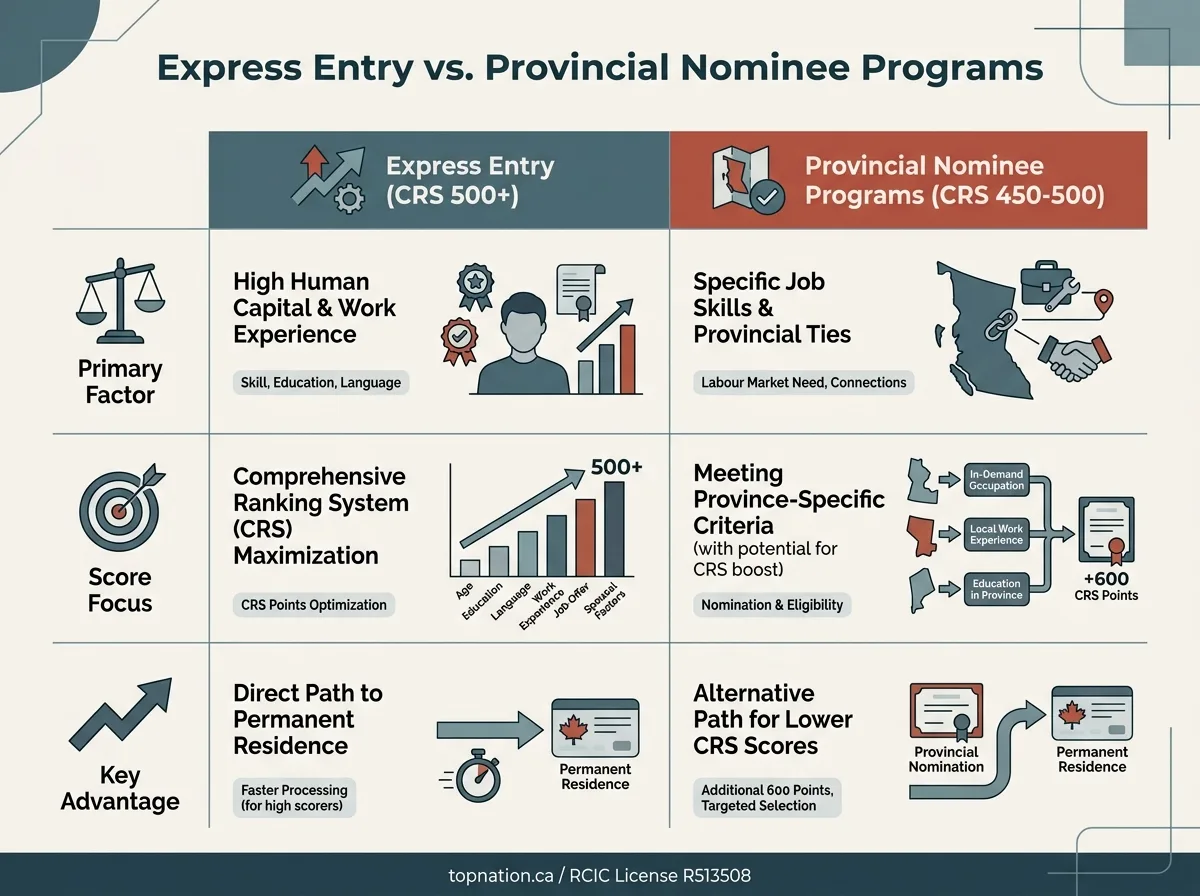
When increasing your CRS score directly isn’t feasible or fast enough, Provincial Nominee Programs (PNPs) offer the single most powerful alternative. A provincial nomination is the golden ticket for many Express Entry candidates.
Why PNPs Are a Lifeline for Lower CRS Scores
PNPs allow provinces and territories to nominate individuals who meet their specific economic and labour market needs. Many PNP streams are linked to the Express Entry system. If you receive a nomination from a province, you are awarded an additional 600 CRS points. This effectively guarantees you will receive an ITA in the next draw.
The 600-Point Nomination Advantage
A candidate with a base CRS score of 460 who receives a provincial nomination will see their score jump to 1060. This is far above any general draw cut-off score seen in the history of Express Entry. Provinces often use their PNP streams to select candidates with lower CRS scores but who have experience in in-demand occupations or ties to the province, such as previous work experience or a job offer.
Deep Dive: The Alberta Advantage Immigration Program (AAIP)
For many skilled workers, Alberta presents a wealth of opportunities. The Alberta Advantage Immigration Program (AAIP) is one of Canada’s most active and accessible PNPs, with several streams that can lead to a provincial nomination. Recent Alberta PNP changes have further refined these streams to target specific labour shortages.
Why Alberta is an Attractive Option
Alberta’s economy is robust and diversified beyond oil and gas, with strong growth in technology, healthcare, construction, and hospitality. The province actively seeks skilled immigrants to fill labour gaps, and its AAIP streams reflect this. For Express Entry candidates, the most relevant stream is the Alberta Express Entry Stream.
AAIP Express Entry Stream: Criteria and Considerations
This stream allows Alberta to nominate a limited number of qualified candidates from IRCC’s Express Entry pool. A key feature is that Alberta may invite candidates with CRS scores as low as 300. While a job offer is not mandatory, the AAIP prioritizes candidates who have a strong connection to Alberta (e.g., work experience or a job offer in the province) or who are working in an in-demand occupation. Simply having a profile in the Express Entry pool is the first step; the next is to receive a Notification of Interest (NOI) from the AAIP.
AAIP Opportunity Stream: For Workers Already in Alberta
This stream is for temporary foreign workers who are already working full-time in Alberta in an eligible occupation. It is not linked to the Express Entry system and has its own set of criteria regarding work experience, job offer, language, and education. For those already in Alberta, this can be a more direct path to nomination without needing to compete in the federal Express Entry pool.

Comparing Key AAIP Streams for Express Entry Candidates
Understanding the differences between the main AAIP streams is crucial for developing a sound immigration strategy. The best path for you depends on whether you are inside or outside Canada and if you have a job offer.
| Feature | AAIP Express Entry Stream | AAIP Opportunity Stream |
|---|---|---|
| Express Entry Profile Required? | Yes | No |
| CRS Score Requirement | Can be as low as 300 (but varies) | Not applicable |
| Job Offer Requirement | Not mandatory, but highly recommended | Yes, must be working for an Alberta employer |
| Nomination Outcome | +600 CRS Points | Nomination for PR (non-Express Entry) |
Beyond the Main AAIP Streams
Alberta offers other specialized streams that may be a fit for certain candidates, providing even more avenues for those who don’t fit neatly into the main Express Entry or Opportunity streams.
AAIP Rural Renewal Stream
This community-driven stream is designed to attract newcomers to smaller, rural Alberta communities. Candidates must have a job offer from an employer in a designated rural community and receive support from that community. It’s an excellent option for those willing to settle outside of major urban centres like Edmonton and Calgary.
Accelerated Tech Pathway
Part of the Alberta Express Entry stream, this pathway provides expedited processing for tech professionals who have a job offer in an in-demand tech occupation with an Alberta-based tech industry employer. This recognizes the critical need for tech talent in the province’s growing innovation sector.
Exploring Other Provincial Nominee Programs
While Alberta is a strong option, nearly every province has PNP streams designed to attract skilled workers. It is wise to explore programs in other provinces where your occupation may be in high demand.
Ontario’s Human Capital Priorities Stream
The Ontario Immigrant Nominee Program (OINP) frequently searches the Express Entry pool for candidates in specific occupations, particularly in tech and healthcare. Like Alberta, it issues NOIs to candidates who meet its criteria, even if their CRS score is not high enough for a federal draw.
Saskatchewan’s International Skilled Worker Stream
Saskatchewan’s Occupation In-Demand and Express Entry sub-categories are popular because they do not require a job offer. Instead, they use an Expression of Interest (EOI) system that ranks candidates based on factors like work experience, education, and connections to the province.
Common Mistakes to Avoid When Your CRS Score is Stagnant
When facing a CRS score that is too low for Express Entry, it is easy to make strategic errors. Avoiding these common pitfalls can keep your permanent residence journey on track.
Mistake #1: Relying Only on General Draws
The biggest mistake is passive waiting. The data from 2026 clearly shows that relying on general draws with a score under 500 is a low-probability strategy. You must actively pursue category-based draws by aligning your NOC with targeted sectors or pivot to a PNP strategy.
Mistake #2: Overlooking Spousal Factors
If you have a spouse or partner, their qualifications are a potential source of points. Failing to get their ECA or language tests done means leaving up to 40 points on the table. A small improvement in their language score can sometimes be the easiest way to boost the overall family score.
Mistake #3: Not Updating Your Profile
Your Express Entry profile is a living document. As you gain more work experience, complete new language tests, or earn another educational credential, you must update your profile immediately. IRCC uses the information in your profile at the time of a draw, so an outdated profile might mean you miss out on an ITA you would have otherwise qualified for.
Navigating Your Immigration Journey with Professional Guidance
The Canadian immigration system is complex, with federal and provincial pathways constantly changing. A CRS score below the current cut-off is not the end of the road; it is a sign that a more nuanced strategy is required. Whether it’s identifying the fastest way to gain 15 more CRS points or determining if the AAIP or OINP is a better fit for your profile, professional advice is invaluable. An experienced Edmonton immigration consultant can assess your complete profile and create a customized roadmap to permanent residence.
Your CRS Score is a Starting Point, Not a Final Destination.
Our RCICs can build a personalized strategy to maximize your points or pivot to a winning PNP pathway.
| Call 587-400-0077 | Book a Strategy Session |
RCIC Licensed | Serving All of Alberta
Last updated: June 2026. This guide reflects Express Entry and PNP trends as of mid-2026. Immigration rules change frequently — consult a licensed RCIC for advice specific to your situation.