Your 2026 Express Entry Guide
The Comprehensive Ranking System (CRS) is more competitive than ever. Securing a Provincial Nomination can add 600 points, while optimizing language skills for CLB 9 can unlock over 100 points. This guide details nine actionable strategies to maximize your score for 2026 draws.
EXPRESS ENTRY STRATEGY — 2026 GUIDE

For skilled professionals dreaming of Canadian permanent residency, the Express Entry system remains the primary pathway. However, success in 2026 hinges on a single, critical metric: your Comprehensive Ranking System (CRS) score. With Invitation to Apply (ITA) cut-offs fluctuating and category-based draws adding a new layer of complexity, a high CRS score is no longer just an advantage—it’s a necessity. This guide is designed for ambitious candidates like you, providing a detailed, data-driven roadmap of nine powerful strategies to significantly boost your CRS score and transform your Canadian immigration prospects from hopeful to successful.
Understanding the Comprehensive Ranking System (CRS) Foundation
Before implementing strategies to increase your score, you must first understand its architecture. The CRS is a dynamic, points-based system used by Immigration, Refugees and Citizenship Canada (IRCC) to assess and rank candidates in the Express Entry pool. The total score available is 1,200 points, meticulously divided across several core and additional factors. A thorough grasp of this breakdown reveals where you can gain the most ground.
Core Human Capital Factors
This is the bedrock of your profile, evaluating your personal attributes that predict economic success in Canada. These factors account for a maximum of 500 points for a single applicant. They include your age, level of education, official language proficiency in English and/or French, and Canadian work experience. Each element is individually scored, but their true power is realized when combined in the skill transferability section.
Spouse or Common-Law Partner Factors
If you are applying with a spouse or common-law partner, their credentials can contribute to your overall score. Their level of education, language proficiency, and Canadian work experience can add up to 40 points to your total. This makes a strategic evaluation of your partner’s qualifications a crucial step in maximizing your combined potential.
Skill Transferability Factors
This section, worth up to 100 points, is where excellence in one area amplifies your score in another. The system awards points for strong combinations of education and language proficiency, Canadian work experience and language proficiency, and foreign work experience combined with language skills. This is why achieving a high Canadian Language Benchmark (CLB) is so critical; it unlocks significant points here that are otherwise inaccessible.
Additional Points
These are the game-changers, offering substantial boosts that can catapult a profile to the top of the pool. This category, worth up to 600 points, includes a provincial nomination (the most valuable at 600 points), a valid job offer (50 or 200 points), Canadian study experience (15 or 30 points), a sibling living in Canada (15 points), and strong French language skills (up to 50 points).

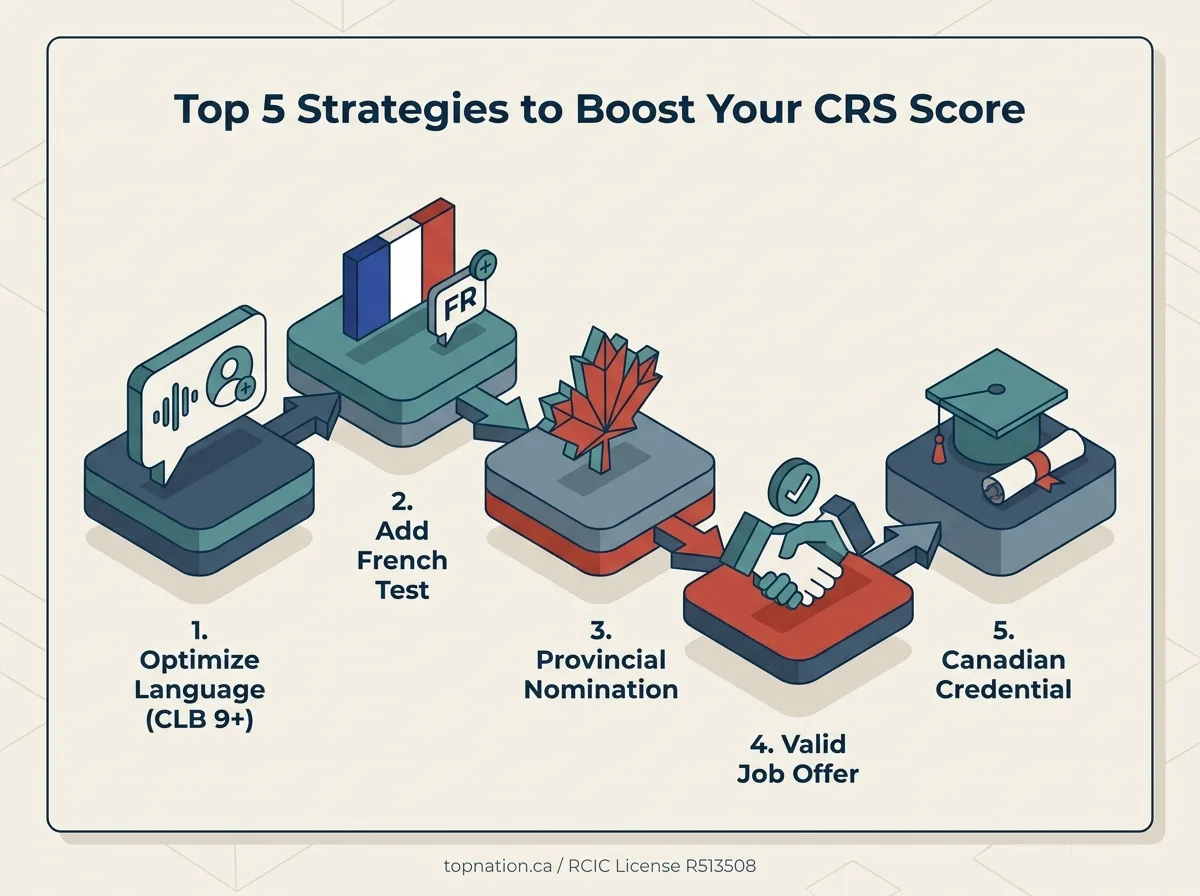
Strategy 1: Optimize Language Proficiency – The CLB 9 Threshold
The single most impactful action a candidate can take, short of securing a provincial nomination, is to maximize their language test scores. While any improvement helps, reaching Canadian Language Benchmark (CLB) Level 9 across all four abilities (reading, writing, listening, speaking) is a critical tipping point that unlocks a cascade of points, particularly in the skill transferability section.
Why CLB 9 is the Gold Standard
At CLB 9, your profile earns the maximum points for language within the skill transferability combinations. For example, with a master’s degree and a CLB 9, you receive the full 50 points for the education/language combination. At CLB 8, that same combination yields only 25 points. This 25-point difference, multiplied across various combinations, can easily result in a total score increase of 50 to 100 points from this one achievement alone. It demonstrates to IRCC a high level of proficiency that strongly correlates with successful integration into the Canadian workforce and society.
Breaking Down Test Score Requirements
Achieving CLB 9 requires specific minimum scores on an approved language test. It is not an average; you must meet the threshold in each of the four skills.
| Ability | IELTS General Training | CELPIP – General Test |
|---|---|---|
| Listening | 8.0 | 9 |
| Reading | 7.0 | 9 |
| Writing | 7.0 | 9 |
| Speaking | 7.0 | 9 |
Practical Preparation for a Higher Score
Many candidates take the language test once and accept the result. A strategic applicant views their first test as a diagnostic. Identify your weakest area—whether it’s the formal writing task or the fast-paced listening section—and invest in targeted preparation. This could involve hiring a tutor, taking a preparation course, or using online simulation tests. The return on investment for a few months of dedicated study can be a score increase that makes the difference between receiving an ITA and waiting another year in the pool.
Strategy 2: Add French for a Significant Francophone Bonus
As Canada continues to promote its bilingual identity, IRCC offers substantial bonus points for candidates proficient in French. This is one of the most underutilized strategies in the Express Entry pool. Even if English is your primary language, demonstrating intermediate French proficiency can add up to 50 additional points to your CRS score.
Unlocking the 25 and 50 Point Bonuses
To qualify for these bonus points, you must take an approved French language test, such as the TEF Canada or TCF Canada. The key threshold is Niveaux de compétence linguistique canadiens (NCLC) 7 in all four French language abilities. If you achieve this level of French proficiency and have an English score of at least CLB 5, you receive an additional 50 CRS points. If your English score is CLB 4 or lower (or you have no English test), you still receive a valuable 25-point bonus for achieving NCLC 7 in French. These points are awarded on top of the standard points you get for your second official language.
Who Should Pursue This Strategy?
This path is not just for fluent French speakers. It is a viable strategy for individuals with a foundational or intermediate knowledge of French from school or work. It also presents a powerful opportunity for candidates who have maximized their scores in other areas and are looking for a new avenue for growth. Committing to a 6-12 month intensive French language program could yield a 50-point increase, a significant boost that few other strategies can offer with the same certainty.
Strategy 3: Gain One Year of Canadian Work Experience
Canadian work experience is highly valued within the CRS because it signals a candidate’s ability to integrate into the local labour market. While any amount of Canadian experience is beneficial, the one-year mark is a major milestone that significantly increases your human capital score and unlocks further points in the skill transferability section.
The Impact of the 12-Month Mark
A candidate with no Canadian work experience receives zero points in this category. Upon completing one full year of skilled work (in a TEER 0, 1, 2, or 3 occupation), a single applicant gains 40 CRS points. Two years of experience increases this to 53 points. This experience also dramatically boosts skill transferability points. For instance, with good language skills (CLB 9+), one year of Canadian experience adds 25 points, which jumps to 50 points after two years. This is a clear and direct path to a higher score.
Pathways to Gaining Canadian Experience
The most common route for international graduates is the Post-Graduation Work Permit (PGWP). For others, securing a work permit is necessary. This often involves an employer obtaining a positive Labour Market Impact Assessment (LMIA), which can be a lengthy process. However, many candidates may qualify for LMIA-exempt routes under international agreements (like CUSMA or CETA) or through programs like the International Mobility Program. Exploring these exemptions with a professional can reveal faster pathways to gaining that critical one year of experience.
The Bridging Open Work Permit (BOWP)
For those who have already submitted a permanent residence application and are awaiting a decision, the Bridging Open Work Permit (BOWP) is an essential tool. It allows you to continue working in Canada after your initial work permit expires, ensuring you can continue accumulating valuable Canadian work experience and maintain your legal status while your application is in process. This prevents a disruptive gap in employment that could affect your eligibility or CRS score.
Strategy 4: Maximize Spousal or Common-Law Partner Factors
For candidates applying with a partner, their profile is a shared asset. Optimizing your partner’s credentials is a collaborative effort that can add up to 40 crucial points to your application. Conversely, a partner with lower qualifications can sometimes reduce the principal applicant’s total score compared to applying alone. A careful strategic analysis is required.
The Strategic Decision: Apply Together or Separately?
The CRS calculator should be used to run both scenarios. First, calculate your score as a single applicant. Second, calculate it with your partner, including their education, language scores, and Canadian experience. If the score is higher when you apply alone, the recommended strategy is for the higher-scoring partner to apply as the principal applicant. Once they receive permanent residence, they can then sponsor their partner through spousal sponsorship. While this involves a two-step process, it can be the fastest route to Canada if it results in an ITA.
Boosting Your Partner’s Credentials
If applying together yields a higher score, focus on maximizing your partner’s contributions. This includes:
Language: Your partner should aim for at least CLB 5 on their language test to contribute up to 5 points. Every band improvement adds value.
Education: Ensure your partner’s foreign credentials have an Educational Credential Assessment (ECA). A bachelor’s degree can add 8 points, while a master’s can add 9 points.
Canadian Work Experience: If your partner can secure work in Canada, even for one year, it can add up to 10 points to your profile. The Spousal Open Work Permit (SOWP), often available to partners of skilled workers or international students, is an excellent vehicle for this.

Strategy 5: Secure a Provincial Nomination – The 600-Point Game Changer
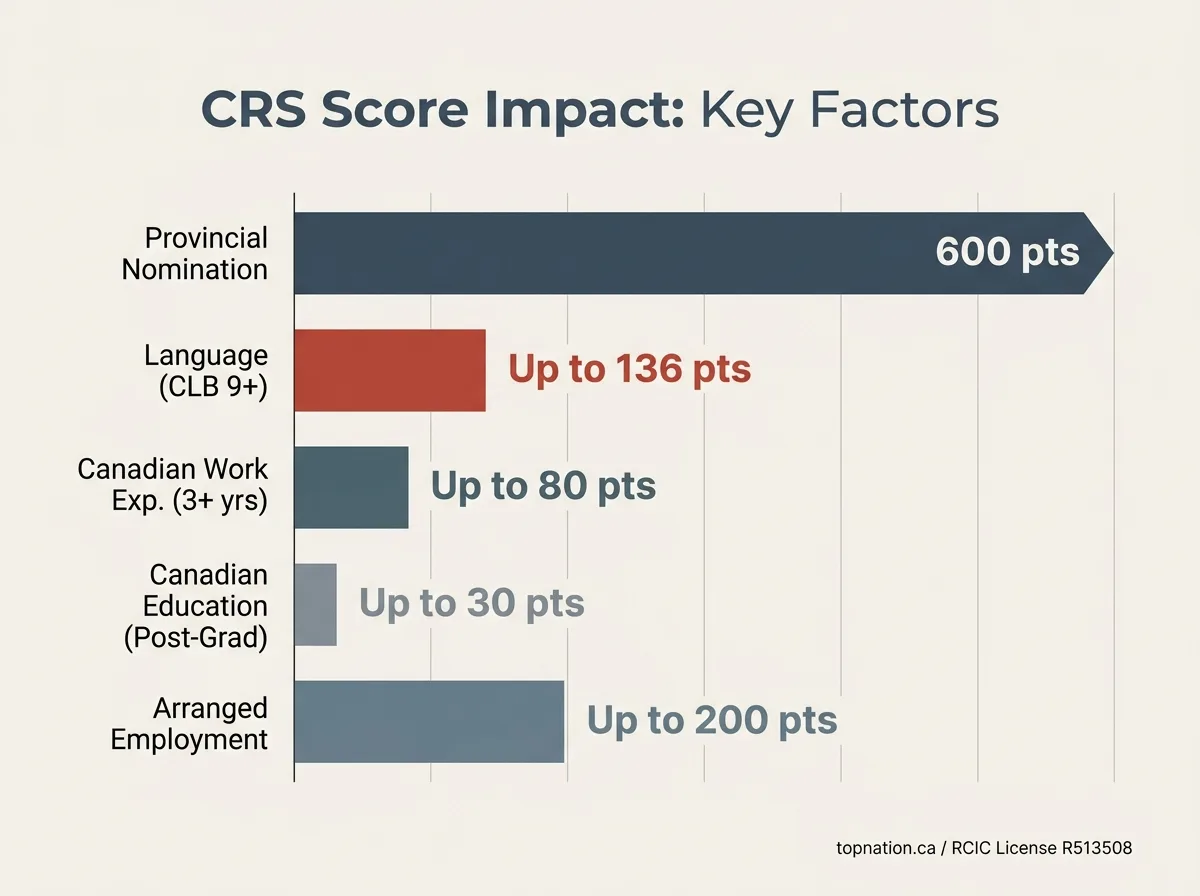
Securing a nomination from a Canadian province or territory is, without question, the single most powerful strategy for Express Entry success. A Provincial Nominee Program (PNP) nomination adds 600 points to your CRS score, effectively guaranteeing you will receive an Invitation to Apply in the next draw.
How Enhanced PNPs Work with Express Entry
Most provinces have “enhanced” PNP streams that are linked to the federal Express Entry system. To be considered, you must first have an active Express Entry profile. Provinces then search the pool for candidates who meet their specific labour market needs. This could be experience in a particular occupation (like tech or healthcare), a connection to the province (such as previous work or study), or strong language skills. If a province identifies you as a suitable candidate, they will issue a “Notification of Interest” (NOI) or invite you to apply directly to their stream. Upon approval, you receive the 600-point nomination in your Express Entry profile.
Proactively Targeting Provincial Streams
Do not wait passively for an invitation. Research the PNP streams of every province. Recent initiatives, like Nova Scotia’s program to connect candidates with employers in priority sectors, highlight the targeted nature of these programs. Some provinces, like Alberta (AAIP) and Ontario (OINP), frequently hold draws for candidates with experience in specific occupations. Others, like Saskatchewan (SINP), use an Expression of Interest system. Creating profiles in these provincial systems and aligning your Express Entry profile with their stated needs (e.g., by listing them as a preferred destination) can significantly increase your chances of being selected.
The Importance of a Targeted Approach
A generic Express Entry profile is not enough. A successful PNP strategy involves tailoring your profile and your job search to the in-demand sectors of specific provinces. If you are a software developer, targeting draws from the Alberta Advantage Immigration Program’s tech pathway or the OINP’s Human Capital Priorities stream makes strategic sense. This targeted approach demonstrates your genuine interest in settling in that province and aligns your skills with their documented economic needs.
Strategy 6: Obtain a Valid Job Offer (Arranged Employment)
While not as powerful as a PNP, a valid Canadian job offer can provide a substantial 50 or 200-point boost to your CRS score. This not only increases your rank but also demonstrates to IRCC that you have secured employment, easing your economic establishment in Canada.
The 50 vs. 200 Point Distinction
The number of points awarded depends on the skill level of the job offer. An offer for a senior management position, classified under Major Group 00 of the National Occupational Classification (NOC), is worth 200 CRS points. All other skilled job offers (TEER 0, 1, 2, or 3) are worth 50 points. For many candidates, the 50-point boost is enough to push them over the ITA threshold.
What Constitutes a ‘Valid’ Job Offer?
For Express Entry purposes, a job offer must meet strict criteria. It must be for full-time, non-seasonal work for at least one year after you receive your permanent resident visa. Crucially, the offer must be supported by a Labour Market Impact Assessment (LMIA), or you must be working in Canada on an LMIA-exempt work permit and meet certain conditions. An offer letter alone is not sufficient; it must be backed by the proper government authorization to be considered valid for CRS points.
The LMIA and LMIA-Exempt Pathways
An LMIA is a document from Employment and Social Development Canada (ESDC) that confirms there is a need for a foreign worker to fill the job. The employer must apply for this, and it can be a complex process. Alternatively, if you are already working in Canada on a work permit issued under the International Mobility Program (e.g., through a free trade agreement or as an intra-company transferee) and have worked for that employer for at least one year, your job offer may be considered valid without a new LMIA. Understanding these nuances is key to claiming these valuable points.
Strategy 7: Acquire a Canadian Educational Credential
Studying in Canada offers a dual advantage for Express Entry candidates. Not only does it provide a direct boost to your CRS score, but it also creates a clear pathway to obtaining the Post-Graduation Work Permit (PGWP), which is the primary vehicle for gaining the highly-valued Canadian work experience.
Direct Points for Canadian Study
IRCC awards additional points specifically for completing a recognized post-secondary program in Canada. A one or two-year diploma or certificate will add 15 points to your CRS score. A program of three years or longer, such as a bachelor’s degree, master’s degree, or PhD, will add a more significant 30 points. These points are awarded in addition to the standard human capital points you receive for your overall level of education.
The Strategic Value of the PGWP
Perhaps more important than the direct points is the access a Canadian education provides to the PGWP. This open work permit allows graduates of eligible programs to work for any employer in Canada for a period of up to three years, depending on the length of their study program. This is the most straightforward route to accumulating the one to two years of skilled Canadian work experience needed to dramatically increase your CRS score and improve your eligibility for various immigration programs, including the Canadian Experience Class (CEC).
Is a Second Credential a Good Strategy?
For candidates already holding a bachelor’s or master’s degree from their home country, pursuing a one-year post-graduate certificate in a high-demand field in Canada can be a very effective strategy. The cost of tuition and living expenses must be weighed against the potential gain of 15 CRS points for the credential itself, plus the points gained from the subsequent one to two years of Canadian work experience obtained via the PGWP. For many, this investment is what ultimately leads to a successful permanent residency application.
Strategy 8: Leverage Other High-Impact Factors
Beyond the major strategies, several smaller but significant factors can provide the final push your profile needs to be competitive. Overlooking these can mean leaving valuable points on the table.
Sibling in Canada (15 Points)
If you or your spouse have a sibling who is a Canadian citizen or permanent resident, is 18 years or older, and is currently residing in Canada, you can claim an additional 15 CRS points. A sibling is defined as being related by blood, adoption, marriage, or common-law partnership. You will need to provide proof of the relationship (e.g., birth certificates) and proof of their status and residency in Canada.
Strategic Age Planning
Age is a factor where points can only be lost, not gained. Candidates receive the maximum 110 points (if single) between the ages of 20 and 29. Starting on your 30th birthday, you lose 5-6 points each year, with the points dropping to zero by age 45. While you cannot reverse aging, you can be strategic. If you are approaching your 30th birthday, it creates urgency to implement other score-boosting strategies as quickly as possible to offset the inevitable annual point reduction.
| Age | Points (with a spouse) | Points (without a spouse) |
|---|---|---|
| 20-29 years | 100 | 110 |
| 30 years | 95 | 105 |
| 35 years | 68 | 75 |
| 40 years | 45 | 50 |
Educational Credential Assessments (ECAs)
This is not a strategy to gain points, but a mandatory step to avoid losing them. All foreign education credentials must be assessed by a designated organization (like WES or ICAS) to determine their Canadian equivalency. Do this early in your process. A common mistake is assuming a degree will be assessed at a certain level. If your four-year degree is assessed as a three-year diploma, it could cost you valuable points. Furthermore, claiming points for a second credential requires that you have an ECA for both credentials. Ensuring every degree, diploma, and certificate is properly assessed is foundational to building an accurate and maximized profile.
CRS in Action: A Candidate’s Score Progression
To illustrate the power of these strategies, let’s consider a case study of a fictional candidate, Anika.
Anika’s Initial Profile: CRS Score 469
Anika is 29 years old, single, and holds a Master’s degree from her home country (with an ECA). She has three years of skilled work experience as a software developer outside Canada. She took the IELTS test and scored CLB 8 across all bands. Her initial CRS score is a respectable 469, but in many recent all-program draws, this would not be high enough for an ITA.
Applying Strategy 1: The Language Boost (New Score: 494)
Anika spends three months focusing on improving her IELTS score. She retakes the test and achieves CLB 9 in all four categories. This single action increases her language points and, more importantly, maximizes her skill transferability points for her education and work experience. Her score jumps by 25 points to 494, placing her in a much more competitive position.
Applying Strategy 5: The Provincial Nomination (New Score: 1094)
While her score of 494 is strong, Anika wants certainty. She researches PNPs and finds that the Alberta Advantage Immigration Program (AAIP) frequently holds draws for tech occupations. She ensures her Express Entry profile indicates her interest in moving to Alberta. A few months later, she receives a Notification of Interest from Alberta. She applies to their stream, is approved, and receives a provincial nomination. 600 points are added to her profile, bringing her score to an unbeatable 1094. She receives an Invitation to Apply in the very next draw.
Consulting an RCIC for a Personalized Express Entry Strategy
While this guide provides a comprehensive overview of CRS-boosting strategies, the Express Entry system is complex and its rules are constantly evolving. Each candidate’s profile is unique, and the optimal strategy for one person may not be the best for another. Working with a Regulated Canadian Immigration Consultant (RCIC) provides a critical advantage.
Navigating Complex Program Criteria
An experienced immigration professional can analyze your profile in detail, identifying your greatest strengths and areas for improvement. They possess in-depth knowledge of the nuances of over 80 different PNP streams, helping you target the programs where you have the highest probability of success. An experienced immigration consultant can turn a hopeful application into a strategic one.
Ensuring a Perfect Application
Receiving an ITA is only half the battle. You then have just 60 days to submit a complete and accurate application with all supporting documents. A small error, a missing form, or an incorrectly formatted document can lead to a refusal, forcing you to start the entire process over again. An RCIC ensures your application is flawless, meticulously checking every detail to maximize your chances of a smooth and successful outcome.
Your CRS Score Defines Your Future. Let’s Build It Strategically.
Our licensed consultants will build a personalized CRS optimization plan to maximize your points for 2026 draws.
RCIC Licensed | Serving All of Alberta
Last updated: October 2023. This guide reflects the Express Entry Comprehensive Ranking System criteria as of the publication date. Immigration rules change frequently — consult a licensed RCIC (R513508) for advice specific to your situation.