Is a Canadian Job Offer Required for Express Entry?
Contrary to a common misconception, a Canadian job offer is not mandatory to receive an Invitation to Apply (ITA) for permanent residence through Express Entry. Pathways like the Federal Skilled Worker Program and category-based draws are specifically designed for qualified candidates applying from abroad.
EXPRESS ENTRY GUIDE — 2026
For skilled professionals worldwide dreaming of a life in Canada, the Express Entry system often seems like the primary gateway. However, a persistent myth surrounds it: that a Canadian job offer is an absolute prerequisite for success. This guide is designed to dismantle that myth and provide a clear, data-driven roadmap for applicants who wish to secure permanent residency through Express Entry in 2026 without pre-arranged employment. By focusing on the Federal Skilled Worker Program (FSWP), maximizing your Comprehensive Ranking System (CRS) score, and strategically leveraging category-based draws and Provincial Nominee Programs (PNPs), a successful application from abroad is not just possible—it’s a viable and well-trodden path.

The Federal Skilled Worker Program (FSWP): Your Primary Path
The Federal Skilled Worker Program is the cornerstone for most Express Entry candidates applying from outside Canada without a job offer. Before you can even enter the Express Entry pool, you must first qualify for one of the managed programs, and FSWP is the most common. It operates on a distinct, two-stage evaluation process. The first is a pass/fail eligibility grid, and the second is the competitive CRS score ranking within the pool itself.
Stage 1: The FSWP 67-Point Eligibility Grid
To be eligible to create an Express Entry profile under the FSWP, you must score a minimum of 67 out of 100 points on a unique selection grid. This grid assesses your potential to establish yourself economically in Canada. It is crucial to understand that these points are entirely separate from your CRS score. Passing this threshold simply gets you into the Express Entry pool; it does not guarantee an Invitation to Apply (ITA).
The six selection factors are:
- Language Skills (Maximum 28 points): Your proficiency in English and/or French is the most heavily weighted factor.
- Education (Maximum 25 points): Points are awarded based on your level of education, with higher points for Master’s degrees and PhDs.
- Work Experience (Maximum 15 points): You need at least one year of continuous, full-time (or equivalent part-time) paid work experience in a skilled occupation (NOC TEER 0, 1, 2, or 3) within the last 10 years.
- Age (Maximum 12 points): Maximum points are awarded to candidates between 18 and 35 years of age.
- Arranged Employment (Maximum 10 points): While this guide focuses on applying without a job offer, if you do have one supported by a Labour Market Impact Assessment (LMIA), you can claim these points. For most reading this, this score will be zero.
- Adaptability (Maximum 10 points): Points can be earned for factors like your spouse’s language skills, past study or work in Canada, or having relatives in Canada.
Successfully scoring 67 or more points allows you to build your Express Entry profile. Once in the pool, the focus shifts entirely to your CRS score, which determines your rank against all other candidates.

Understanding the Comprehensive Ranking System (CRS) Without a Job Offer
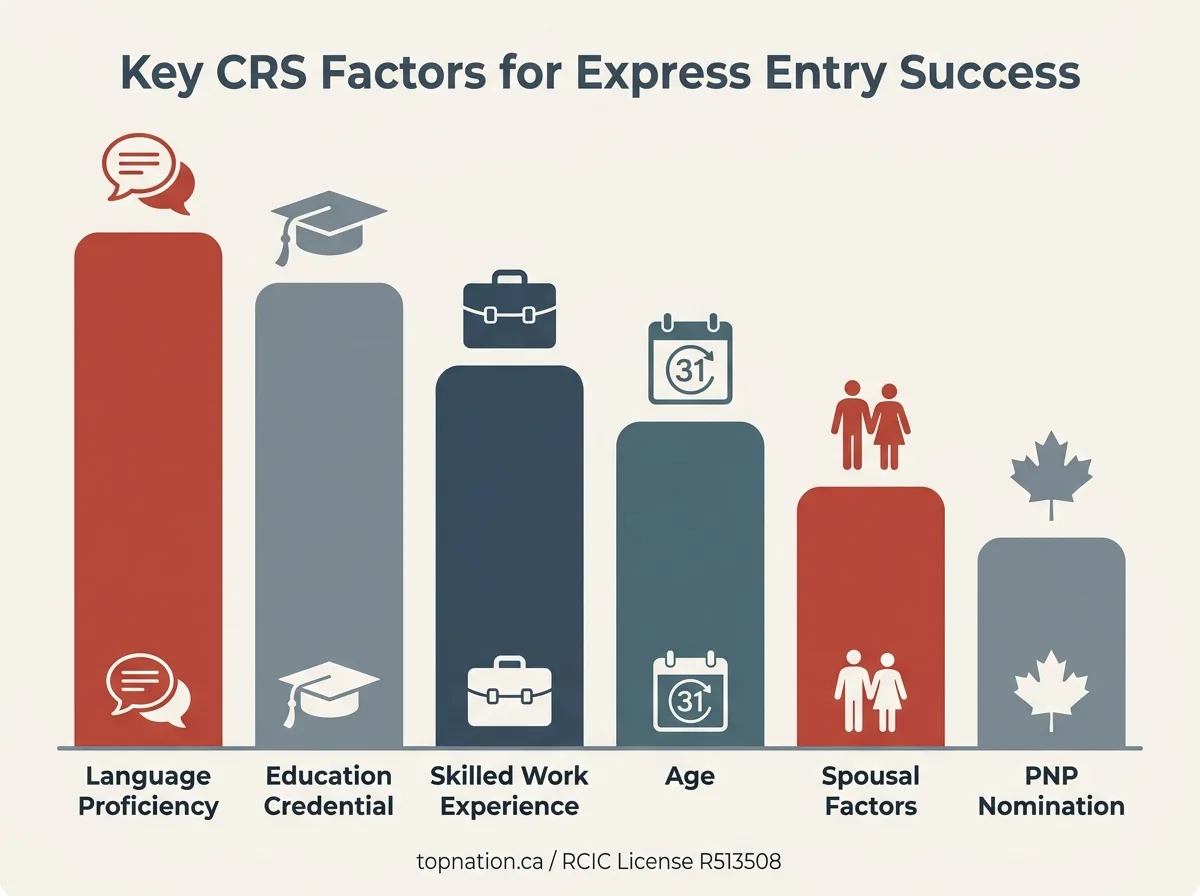
The Comprehensive Ranking System is the dynamic scoring mechanism that ranks you in the Express Entry pool. Your CRS score, out of a possible 1200, dictates your likelihood of receiving an ITA in a given draw. While having a valid job offer can add 50 or 200 points, thousands of candidates receive ITAs without these points. Their success hinges on maximizing scores in other areas, primarily the Core / Human Capital factors.
Core / Human Capital Factors (Maximum 500 points with spouse)
This is where your personal attributes translate directly into points. For a candidate without a job offer, this section is the most critical battleground for accumulating a competitive score.
- Age: You can receive up to 110 points.
- Level of Education: A PhD can earn you up to 150 points.
- Official Language Proficiency: This is a massive contributor, with up to 160 points available for your first official language.
- Canadian Work Experience: While applicants abroad won’t have this, it’s a key factor for those applying from within Canada.
Spouse or Common-Law Partner Factors (Maximum 40 points)
If you are applying with a spouse or partner, their qualifications can add valuable points to your total. Their level of education, language proficiency, and any Canadian work experience they might have can contribute up to 40 points. This makes it essential to evaluate both partners’ profiles to determine who should be the principal applicant.
Skill Transferability Factors (Maximum 100 points)
This section is where your qualifications are combined to award bonus points. It recognizes that strong language skills combined with a high level of education, or foreign work experience paired with excellent language scores, make for a highly adaptable immigrant. For example, having a post-secondary degree and a high language score (CLB 9 or higher) can grant you up to 50 additional points. This is a key area where overseas applicants can shine.
Additional Points (Maximum 600 points)
This section includes points for a job offer (which we are excluding), but most importantly, it includes the 600 points awarded for a Provincial Nomination, which we will discuss in detail later as a primary strategy for success.
Key Strategies to Maximize Your CRS Score
Without the 50-200 points from a job offer, every other point in your profile matters immensely. A strategic approach to building your profile is non-negotiable. This involves focusing on the factors you can control and optimizing them to their highest potential.
Language Proficiency: The Cornerstone of Your Application
Your language test results are the single most influential factor you can improve. The points awarded for language proficiency increase exponentially at higher levels, particularly at Canadian Language Benchmark (CLB) level 9 and above. Reaching CLB 9 in all four abilities (reading, writing, listening, speaking) triggers a significant jump in both the core language points and the skill transferability combinations.
Consider this: improving from CLB 8 to CLB 9 across the board can add over 50 CRS points to your profile. This alone can be the difference between waiting indefinitely and receiving an ITA. We strongly advise clients to invest in professional language test preparation and to retake the test if their initial scores are below CLB 9. The return on investment is unparalleled in the CRS system. Furthermore, proficiency in both English and French can add substantial bonus points, making it a powerful advantage.
| CLB Level | Points per Ability (with spouse) | Points per Ability (without spouse) |
|---|---|---|
| CLB 7 | 16 | 17 |
| CLB 8 | 22 | 23 |
| CLB 9 | 29 | 31 |
| CLB 10 and above | 32 | 34 |
Education Credential Assessment (ECA): Essential for Foreign Degrees
To claim points for education obtained outside Canada, you must have your credentials assessed by a designated organization like WES, ICAS, or CES. An ECA report confirms that your foreign degree, diploma, or certificate is valid and equal to a Canadian one. Maximizing your education points might involve assessing all post-secondary credentials. For instance, if you have two or more post-secondary credentials (e.g., a three-year bachelor’s degree and a one-year postgraduate diploma), you may be eligible for more points than with just the bachelor’s degree alone. Ensure your ECA is completed before you create your Express Entry profile, as it is a mandatory document.
Work Experience: Quality, Quantity, and Relevance
You must have at least one year of skilled work experience to qualify for FSWP, but more experience translates to more points. The CRS awards points for up to three years or more of foreign work experience. Ensure your experience is properly documented with detailed reference letters that list your job duties, aligning them with the lead statements and main duties of the correct National Occupational Classification (NOC) code. Choosing the wrong NOC code is a common and critical error that can lead to application refusal. If your duties span multiple NOCs, it’s wise to contact a licensed RCIC to determine the best fit.
Age Factor: Understanding its Impact on Your CRS Score
The CRS awards the maximum 110 points (for a single applicant) to candidates aged 20-29. After age 29, you begin to lose 5-6 points per year, with the points dropping to zero by age 45. While you cannot change your age, understanding its impact is crucial for timing your application. If you are approaching your 30th birthday, it is advantageous to enter the pool as soon as possible to lock in the maximum points for this factor.
Spousal or Common-Law Partner Factors
If applying with a partner, their profile is an asset that must be optimized. Ensure they also complete a language test and an ECA. Their language scores and education level can add up to 20 and 10 points, respectively. In some cases, if your spouse has a stronger profile (e.g., higher education, better language skills, or is younger), it may be strategically beneficial for them to be the principal applicant.
Category-Based Express Entry Draws: A New Avenue for Success
In 2023, Immigration, Refugees and Citizenship Canada (IRCC) introduced category-based selection draws. This was a monumental shift in how Express Entry works. Instead of inviting only the highest-ranking candidates in general draws, IRCC now also holds targeted draws for candidates with specific attributes that fill urgent labour market gaps or support governmental priorities. For applicants without a job offer, these draws are a golden opportunity.
If your work experience falls into one of the targeted categories, or if you have strong French language skills, you could be invited with a CRS score significantly lower than the cut-off in a general draw. This effectively makes your specialized experience or language ability a substitute for the points from a Canadian job offer.
The Targeted Categories for 2026
IRCC has identified several key areas of focus. To be eligible for these draws, you must have accumulated, within the past 3 years, at least 6 months of full-time, continuous work experience in one of the targeted occupations.
- French-Language Proficiency: Candidates with a Niveaux de compétence linguistique canadiens (NCLC) score of 7 or higher in all four French language skills. This is a major priority for the Canadian government.
- Healthcare Occupations: This category includes doctors, nurses, dentists, physiotherapists, and many other healthcare professionals.
- Science, Technology, Engineering, and Math (STEM) Occupations: This broad category covers software developers, data scientists, engineers, and other tech-related roles.
- Trade Occupations: Includes carpenters, plumbers, electricians, welders, and other skilled trades.
- Transport Occupations: Truck drivers, pilots, and aircraft mechanics are among the in-demand roles in this category.
- Agriculture and Agri-food Occupations: Covers roles like agricultural service contractors and farm supervisors.
If your profile aligns with one of these categories, your strategy should be to ensure your work experience is perfectly documented and your NOC code selection is impeccable. Your chances of receiving an ITA are dramatically increased, irrespective of not having a job offer.
The Role of Provincial Nominee Programs (PNPs) in Bridging the CRS Gap
Provincial Nominee Programs are arguably the most powerful tool for an Express Entry candidate with a competitive but not top-tier CRS score. Each province and territory (except Quebec and Nunavut) operates its own PNP streams, many of which are aligned with the federal Express Entry system.
The 600-Point Advantage
If you receive a nomination from an Express Entry-aligned PNP stream, you are awarded an additional 600 CRS points. This massive bonus effectively guarantees you will receive an ITA in the next draw. Many of these streams are designed specifically to attract skilled workers from abroad and do not require a Canadian job offer.
PNP Streams for Overseas Applicants Without a Job Offer
Provinces use these streams to target candidates whose work experience aligns with their specific local labour market needs. Some popular examples include:
- Saskatchewan Immigrant Nominee Program (SINP) – International Skilled Worker: Occupation In-Demand: This stream invites candidates with experience in one of Saskatchewan’s in-demand occupations. A job offer is not required.
- Ontario Immigrant Nominee Program (OINP) – Human Capital Priorities Stream: Ontario regularly searches the Express Entry pool and invites candidates with specific work experience (often in tech or healthcare) or other attributes like French language proficiency to apply for nomination.
- Alberta Advantage Immigration Program (AAIP): While many Alberta streams require a job offer, the Express Entry stream can issue Notifications of Interest to candidates in the federal pool who have strong ties to the province or work experience in a priority sector. Keeping an eye on recent Alberta PNP changes is crucial.
- Nova Scotia Nominee Program (NSNP) – Labour Market Priorities: Similar to Ontario, Nova Scotia issues invitations to Express Entry candidates who meet specific labour market needs identified by the province.
To leverage PNPs, you must indicate your interest in specific provinces when creating your Express Entry profile. Then, you must actively monitor the PNP draw results and criteria for each province, as they can change frequently.

Settlement Funds Requirement: A Non-Negotiable Factor
For applicants applying under the Federal Skilled Worker Program (and the Federal Skilled Trades Program), demonstrating sufficient settlement funds is a mandatory and non-negotiable requirement. You are exempt only if you are authorized to work in Canada and have a valid Canadian job offer. Since this guide is for those without a job offer, proof of funds is a critical component of your application.
What Are Settlement Funds?
These are funds that you must prove you have available to support yourself and your family after you arrive in Canada. The amount required is determined by the size of your family, including your spouse or partner and any dependent children, even if they are not immigrating with you. These funds must be readily available, unencumbered by debts or other obligations, and in your name or the name of your accompanying spouse.
Required Funds for 2026 (Subject to Annual Updates)
The Government of Canada updates these figures annually. It is essential to check the official IRCC website for the most current amounts before submitting your application. Below is a table based on the latest available data.
| Number of Family Members | Required Funds (in CAD) |
|---|---|
| 1 | $14,690 |
| 2 | $18,288 |
| 3 | $22,483 |
| 4 | $27,297 |
| 5 | $30,690 |
| For each additional family member | Add $3,706 |
Proof is typically provided through official letters from financial institutions where you keep your money. These letters must be printed on the institution’s letterhead and include specific details about your accounts. Failure to provide adequate proof of funds will result in the refusal of your application.
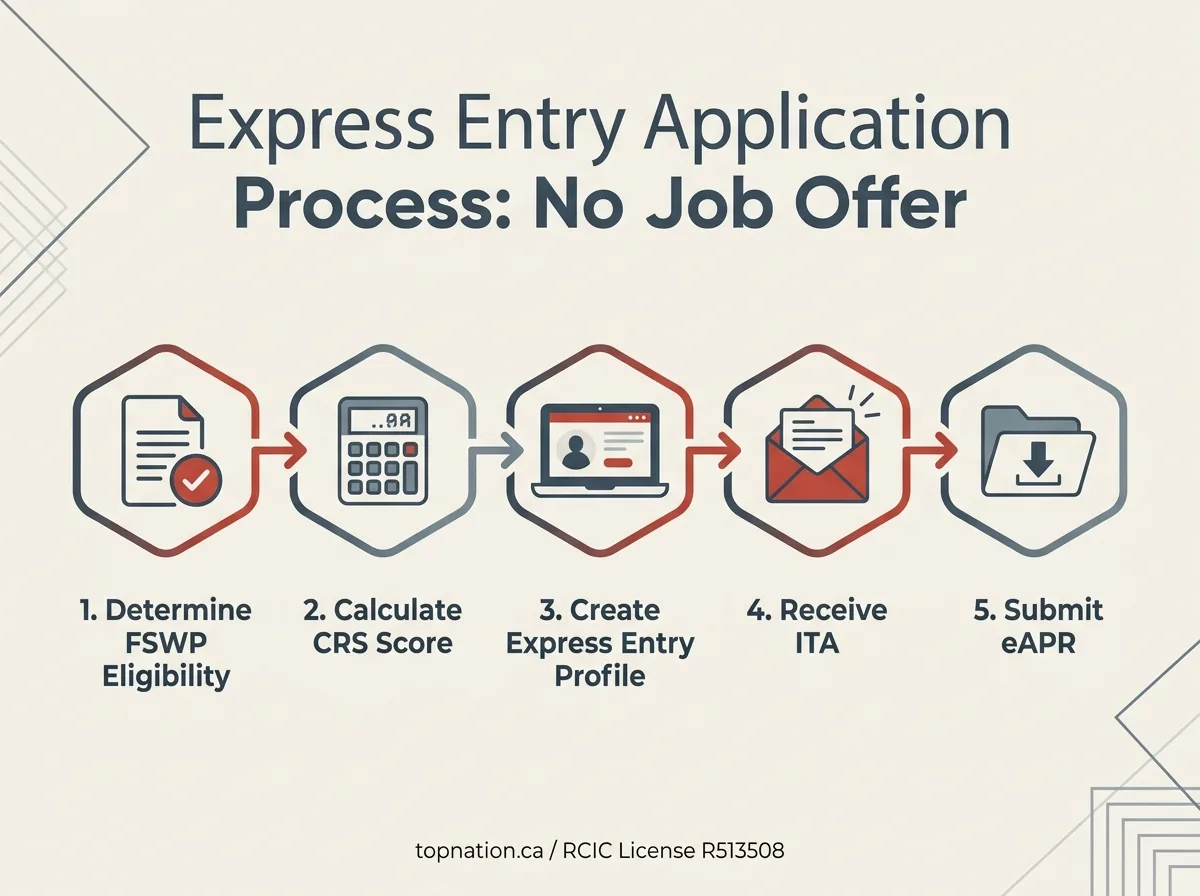
Step-by-Step Application Process from Abroad
Navigating the Express Entry system without a job offer follows a structured process. Understanding these steps can demystify the journey and help you prepare effectively.
- Determine Eligibility: First, use the FSWP 67-point grid to confirm you are eligible to create a profile. Do not proceed until you are confident you meet this threshold.
- Gather Essential Documents: This is the most time-consuming phase. You must obtain your language test results (IELTS, CELPIP, TEF, or TCF) and your Educational Credential Assessment (ECA) report. These documents are mandatory for profile creation.
- Create Your Express Entry Profile: Once you have your documents, you can create your online profile on the IRCC website. You will input information about your age, education, work experience, and language skills. This will generate your CRS score and place you in the pool.
- Monitor Draws and Improve Your Profile: Once in the pool, your profile is valid for 12 months. During this time, monitor the ITA draw results for both general and category-based rounds. Use this time to improve your score by, for example, retaking a language test or gaining more work experience.
- Receive an Invitation to Apply (ITA): If your CRS score is high enough, or if you are selected in a category-based or PNP draw, you will receive an ITA.
- Submit Your Application for Permanent Residence: After receiving an ITA, you have 60 days to submit a complete application. This includes all supporting documents, such as reference letters, police certificates, medical examination results, and proof of funds.
- Application Processing: An IRCC officer will review your application to ensure all information is accurate and complete. You may be asked for additional information or to complete biometrics.
- Receive Confirmation of Permanent Residence (CoPR): If your application is approved, you will receive a CoPR document and a permanent resident visa. You can then make plans to land in Canada.
Common Challenges and How to Overcome Them
Applying from abroad without the safety net of a job offer presents unique challenges. Proactive planning and a clear understanding of these hurdles are key to a successful outcome.
Challenge 1: A Competitive but Insufficient CRS Score
Many candidates find their score is just below the typical draw cut-offs. It can be frustrating to be so close yet not receive an ITA.
Solution: Adopt a multi-pronged improvement strategy. Relentlessly focus on improving your language score to achieve CLB 9 or 10. Explore short, one-year postgraduate certificate programs (if financially viable) to claim points for two or more credentials. Actively research and target PNP streams that align with your occupation, as the 600-point bonus is the ultimate score booster.
Challenge 2: Inaccurate or Incomplete Documentation
A significant number of applications are refused not due to ineligibility, but due to simple administrative errors, such as a poorly written reference letter or a missing document.
Solution: Be meticulous. Start gathering your documents long before you plan to create your profile. For work experience, provide each former employer with a template for the reference letter that explicitly includes all IRCC-required information: job title, duties, salary, hours per week, and employment dates. Double-check that your ECA and language tests are valid for the entire application period.
Challenge 3: Misinterpreting Your NOC Code
Choosing a National Occupational Classification (NOC) code that doesn’t accurately reflect your job duties is a critical error. The visa officer will compare your reference letter against the official NOC description, and any significant mismatch can lead to refusal.
Solution: Do not just rely on your job title. Carefully read the lead statement and the list of main duties for the NOC code you think applies to you. If your role is complex or hybrid, seeking professional guidance from an Edmonton immigration consultant can prevent a costly mistake. They can help you analyze your experience and select the most appropriate NOC.
Frequently Asked Questions for Applicants Without a Job Offer
Q1: How long is my Express Entry profile valid in the pool?
Your Express Entry profile is valid for 12 months from the date you submit it. If you do not receive an Invitation to Apply (ITA) within that year, your profile will expire. You can, however, create and submit a new profile to re-enter the pool, provided you still meet the eligibility criteria.
Q2: Can I improve my CRS score after I’ve submitted my profile?
Absolutely. You can and should update your profile at any time to reflect changes that could increase your score. This includes improved language test results, completion of a new educational credential, or gaining another year of work experience. Keeping your profile current is essential.
Q3: Is there an age limit for the Federal Skilled Worker Program?
There is no strict age limit to be eligible for the FSWP. However, the Comprehensive Ranking System (CRS) awards points for age, with the maximum points given to candidates between 20 and 29. After age 29, the points awarded for age begin to decrease, reaching zero at age 45. While you can still apply after this age, you will need a very high score in other areas to be competitive.
Q4: What is the difference between being eligible for FSWP and being in the Express Entry pool?
Think of it as a two-step process. First, you must prove you are eligible for one of the federal economic immigration programs, such as the Federal Skilled Worker Program (FSWP). This involves meeting the 67/100 point pass mark on the FSWP grid. Once you pass this stage, you can create a profile and enter the Express Entry pool. Being in the pool means you are now ranked against other candidates based on your CRS score, waiting for an invitation.
Q5: Is it worth hiring an immigration consultant if I don’t have a job offer?
While you can apply on your own, the complexity of the system means a Regulated Canadian Immigration Consultant (RCIC) can provide significant value. For applicants without a job offer, every point matters. An RCIC can help you build a long-term strategy, identify the optimal NOC code, navigate complex PNP streams, and ensure your final application is flawless, maximizing your chances of success in a highly competitive environment. They provide professional oversight to prevent common but costly errors.
Your Express Entry Profile is More Than Just a Number.
Let our licensed experts conduct a comprehensive review of your profile to find every possible point and build a winning strategy.
RCIC Licensed | Serving All of Alberta
Last updated: May 2024. This guide reflects the Express Entry system and requirements for applicants without a job offer as of its publication date. Immigration rules change frequently — consult a licensed RCIC for advice specific to your situation.