Backlog Cleared, Opportunity Ahead
Immigration, Refugees and Citizenship Canada (IRCC) has successfully reduced the Express Entry application backlog to its pre-pandemic service standard of six months. This significant operational improvement signals a more predictable and streamlined processing environment for future Canadian Experience Class (CEC) applicants in 2026, creating a prime opportunity for those with Canadian work experience to pursue permanent residency.
CANADIAN EXPERIENCE CLASS — 2026 GUIDE
For temporary foreign workers and international graduates already contributing to Canada’s economy and society, the path to permanent residency can seem complex. Yet, one program is specifically designed to recognize your valuable in-Canada experience: the Canadian Experience Class (CEC). As a cornerstone of the Express Entry system, the CEC provides a streamlined and often faster route to securing your future in this country. This comprehensive guide details the specific requirements, strategic advantages, and application process for the CEC stream, offering a forward-looking analysis of 2026 trends to help you successfully transition from temporary resident to permanent resident of Canada.

Understanding the Canadian Experience Class (CEC)
The Canadian Experience Class is not just another immigration program; it’s a strategic initiative by the Canadian government to retain skilled individuals who have already demonstrated their ability to integrate into the Canadian labour market. It operates under the Express Entry application management system, alongside the Federal Skilled Worker Program (FSWP) and the Federal Skilled Trades Program (FSTP). Unlike the other programs that assess foreign experience, the CEC’s primary focus is on the skilled work experience you have gained right here in Canada.
The Core Philosophy: Rewarding Proven Integration
The logic behind the CEC is simple and powerful: individuals who have already worked in Canada for at least one year have proven their economic establishment. They have navigated the Canadian workplace, paid Canadian taxes, and built connections within their communities. IRCC views this as a strong indicator of long-term success as a permanent resident. This philosophy translates into more accessible requirements compared to other federal programs, such as the absence of a settlement funds requirement and, in many cases, a lower Comprehensive Ranking System (CRS) score needed for an Invitation to Apply (ITA).
CEC within the Express Entry Ecosystem
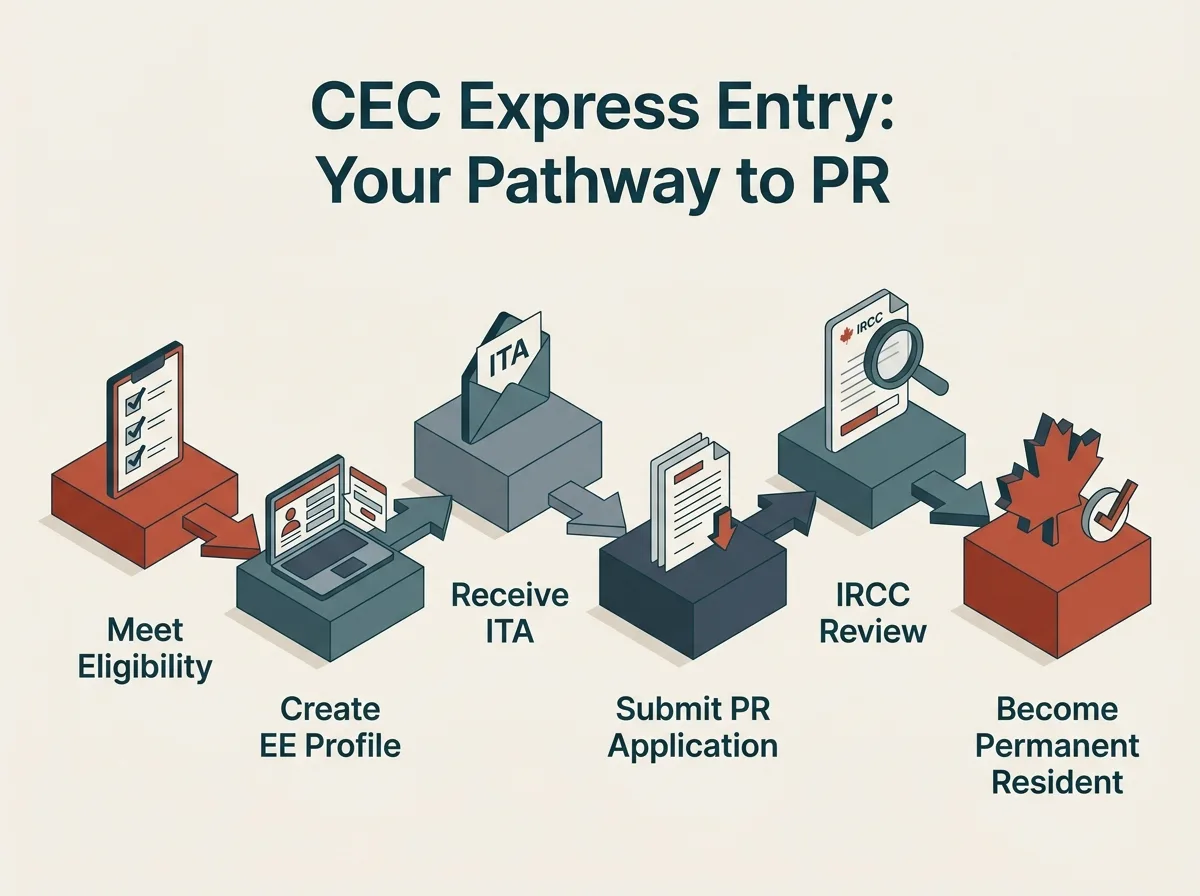
Express Entry is the electronic system used to manage applications for permanent residence from skilled workers. When you create an Express Entry profile, you are not applying to the CEC directly. Instead, you provide information about your skills, work experience, language ability, and education. The system then automatically assesses which program(s) you are eligible for—CEC, FSWP, or FSTP. If you meet the CEC criteria, you are placed into the Express Entry pool as a CEC candidate, where you are ranked against others based on your CRS score. IRCC then holds regular draws, inviting the highest-ranking candidates to apply for permanent residence.
CEC vs. FSWP vs. FSTP: A Key Comparison
Understanding the differences between the three main Express Entry programs is crucial for any applicant. While all lead to permanent residency, their eligibility criteria are tailored to different types of candidates. The CEC is specifically for those with recent Canadian work experience, making it the default choice for most temporary foreign workers and post-graduate work permit holders.
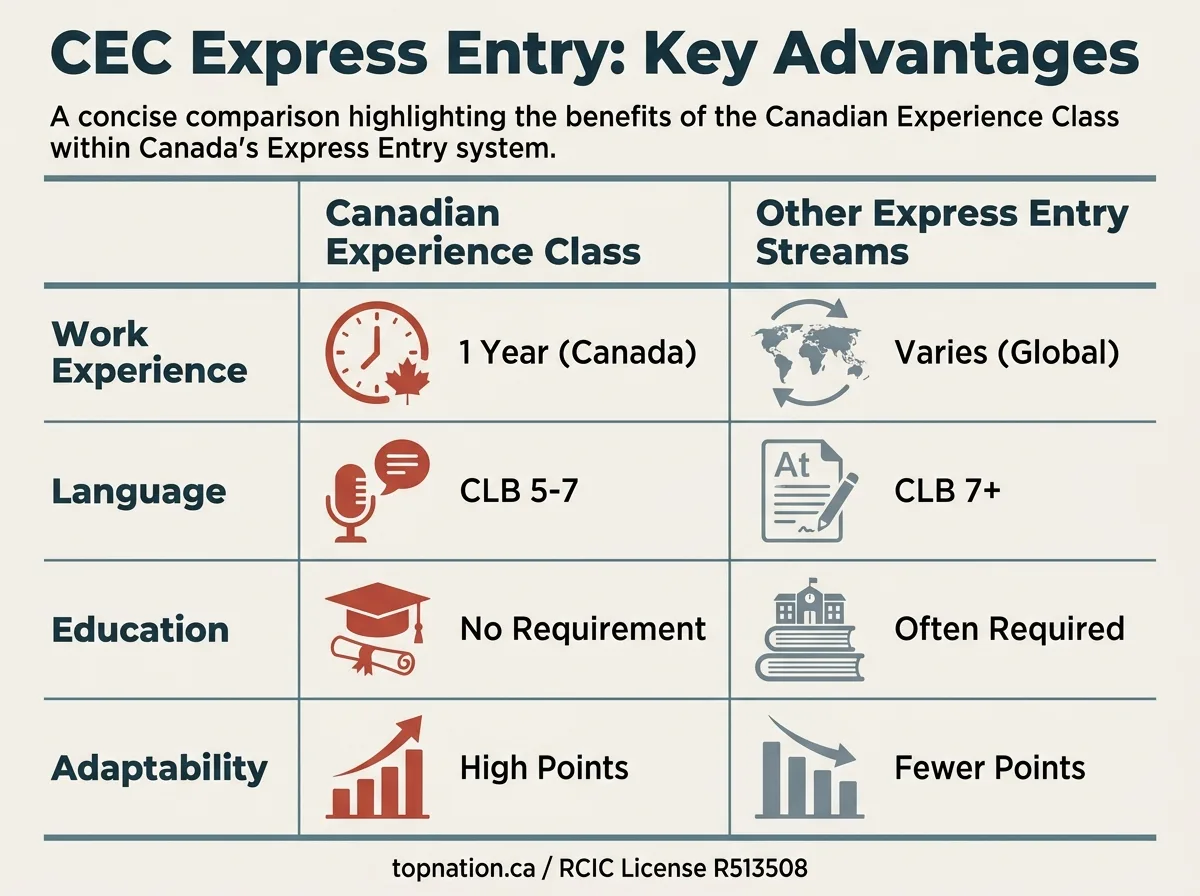
| Criteria | Canadian Experience Class (CEC) | Federal Skilled Worker (FSWP) | Federal Skilled Trades (FSTP) |
|---|---|---|---|
| Work Experience | 1 year skilled work in Canada | 1 year continuous skilled work (Canada or abroad) | 2 years in a skilled trade (Canada or abroad) |
| Education | Not required (but adds CRS points) | Required (Canadian credential or ECA) | Not required (but adds CRS points) |
| Settlement Funds | Not required | Required (unless you have a valid job offer) | Required (unless you have a valid job offer) |
| Job Offer | Not required | Not required (but adds CRS points) | Required (or certificate of qualification) |
Core Eligibility Requirements for CEC in 2026
To qualify for the Canadian Experience Class, you must meet a set of specific minimum requirements. These criteria are non-negotiable and form the foundation of your eligibility. Failing to meet even one of these can render you ineligible for the program, so careful attention to detail is paramount.
The Three Pillars of CEC Eligibility
At its heart, CEC eligibility rests on three main pillars: skilled work experience, language proficiency, and admissibility. You must have acquired at least one year of skilled, professional, or technical work experience in Canada within the last three years. You must also meet or exceed the minimum language threshold for your occupation’s skill level. Finally, you must be admissible to Canada, meaning you have no serious criminal, security, or medical issues that would prevent you from being granted permanent residence.
Work Experience: The 12-Month Rule Explained
The cornerstone of the CEC is the work experience requirement. You must have at least 12 months of full-time (or an equal amount in part-time) skilled work experience in Canada in the three years before you apply. Full-time is defined as at least 30 hours per week. This experience must have been gained while you had temporary resident status with authorization to work. It’s critical to note that this experience must be in one or more occupations listed under the National Occupational Classification (NOC) TEER categories 0, 1, 2, or 3.
Language Proficiency: The CLB Benchmark
Your ability to communicate in English or French is a key factor in your ability to integrate economically and socially. For CEC, the required proficiency level depends on the skill level of your Canadian work experience. If your qualifying work experience is in a TEER 0 or TEER 1 occupation (managerial or professional roles), you must demonstrate a Canadian Language Benchmark (CLB) level of 7 in all four abilities: reading, writing, listening, and speaking. If your experience is in a TEER 2 or TEER 3 occupation (technical jobs, skilled trades, or administrative roles), the requirement is a more accessible CLB 5 in all four abilities.
Admissibility to Canada: The Non-Negotiable Foundation
Beyond work and language, every applicant for permanent residence must be admissible to Canada. This is a standard requirement across all immigration programs. Inadmissibility can be based on several factors, including criminality (e.g., a DUI conviction), security risks, health grounds (if your condition is likely to be a danger to public health or safety, or cause excessive demand on health services), or misrepresentation on a previous immigration application. It is crucial to be truthful and complete in all your declarations to IRCC. If you have any concerns about your admissibility, it is highly recommended to contact a licensed RCIC before submitting a profile.

Deep Dive: Qualifying Canadian Work Experience
The one-year work experience requirement is the most critical element of the CEC program, and it is also where many applicants make mistakes. Understanding the nuances of what IRCC considers “qualifying” experience is essential for a successful application. It’s not just about working for 12 months; it’s about the right kind of work, under the right conditions, and properly documented.
What Counts as “Skilled Work”? Understanding NOC TEER
Canadian immigration defines “skilled work” using the National Occupational Classification (NOC) system, which categorizes jobs based on their Training, Education, Experience, and Responsibilities (TEER). For CEC eligibility, your work experience must fall under one of these four categories:
- TEER 0: Management occupations (e.g., restaurant managers, construction managers).
- TEER 1: Occupations that usually require a university degree (e.g., software engineers, financial analysts).
- TEER 2: Occupations that usually require a college diploma, apprenticeship training of 2 or more years, or supervisory roles (e.g., web technicians, medical laboratory technologists).
- TEER 3: Occupations that usually require a college diploma, apprenticeship training of less than 2 years, or more than 6 months of on-the-job training (e.g., administrative assistants, dental assistants).
Experience in TEER 4 or 5 occupations (typically requiring high school education or short on-the-job training) does not count towards CEC eligibility.
Calculating Your 12 Months: Full-Time vs. Part-Time
IRCC provides flexibility in how you accumulate your 12 months of experience. You can meet the requirement in two ways:
- Full-Time: Working a minimum of 30 hours per week for 12 months, totaling 1,560 hours. Any hours worked above 30 per week do not count towards accumulating your experience faster.
- Part-Time Equivalent: You can work multiple part-time jobs or work part-time in one job. For example, working 15 hours per week for 24 months would equal 1,560 hours and satisfy the requirement. The key is reaching the total of 1,560 hours of skilled work within the last three years.
The experience does not need to be continuous. You can have gaps in employment, as long as the total qualifying experience adds up to the required amount within the three-year window.
The “Lawfully Acquired” Clause: Importance of a Valid Work Permit
This is a critical, non-negotiable point. All work experience claimed for the CEC must have been acquired legally. This means you must have held a valid temporary resident status in Canada with authorization to work during the entire period of employment you are claiming. This typically includes work performed on a Post-Graduation Work Permit (PGWP), an LMIA-based work permit, an open work permit (such as those for spousal sponsorship applicants), or other forms of LMIA-exempt work permits. Unauthorized work, or work performed while on implied status that was later refused, will not be counted.
Work Experience That Does NOT Count for CEC
IRCC is very specific about certain types of work experience that are ineligible for the Canadian Experience Class, even if the work was skilled and performed in Canada. These are common pitfalls for applicants:
- Self-Employment: Any period where you were self-employed or an independent contractor does not count. You must have been an employee with a T4 slip and deductions at source.
- Work Experience Gained Without Status: Any work performed while you did not have valid temporary resident status in Canada is ineligible.
- Co-op Terms and Internships: Work experience gained as part of a study program, such as a co-op or internship, cannot be counted towards the CEC minimum requirement. Your qualifying work experience must begin after you have completed your program of study and are on a valid work permit, like a PGWP.
Navigating the National Occupational Classification (NOC) TEER System
Correctly identifying your occupation under the NOC TEER system is fundamental to your CEC application. A mismatch between your claimed NOC code and your actual job duties as described in your reference letters is one of the most common reasons for refusal. You must ensure that the main duties listed in your employment records align with the lead statement and main duties for the NOC code you select.
Breakdown of TEER Categories and Language Requirements
The TEER category of your job not only determines if your experience is “skilled” but also sets your minimum language requirement. This direct link makes understanding the TEER system doubly important for your Express Entry strategy.
| NOC TEER Category | Description & Examples | Minimum CLB for CEC |
|---|---|---|
| TEER 0 | Management Occupations (e.g., Marketing Manager, Project Manager) | CLB 7 |
| TEER 1 | Professional Occupations (e.g., Software Developer, Accountant) | CLB 7 |
| TEER 2 | Technical/Skilled Trades (e.g., Computer Network Technician, Chef) | CLB 5 |
| TEER 3 | Skilled Trades/Para-professional (e.g., Baker, Dental Assistant) | CLB 5 |
How to Find Your Correct NOC Code
To find your NOC code, use the official NOC website provided by the Government of Canada. Do not rely solely on your job title. Search for your occupation using keywords related to your duties. Once you find a potential match, carefully read the lead statement, which gives a general description of the occupation. Most importantly, compare the list of “main duties” under that NOC code to the tasks you perform in your job. A substantial number of your duties must match those listed for the NOC to be considered accurate.
Common Pitfalls: Mismatched Job Titles vs. Actual Duties
A common error is selecting a NOC based on a job title that sounds prestigious but doesn’t reflect the work performed. For example, a “Marketing Manager” (TEER 0) who primarily performs the duties of a “Marketing Coordinator” (TEER 1) or an “Administrative Assistant” (TEER 3) will have their application refused. The IRCC officer will scrutinize your employment reference letter, which must list your job duties in detail. If these duties do not align with the NOC code you’ve claimed, the officer will conclude that you do not have the qualifying experience. It is always better to choose a lower TEER code that accurately reflects your duties than a higher one that does not.
Mastering the Language Proficiency Requirements
While the minimum language scores for CEC can seem straightforward, they play a dual role. First, they are a pass/fail eligibility requirement. Second, they are one of the most significant contributors to your CRS score. Simply meeting the minimum is often not enough to receive an Invitation to Apply. A strategic approach to your language tests is essential.
CLB 7 for TEER 0 & 1: Decoding the Scores
A Canadian Language Benchmark (CLB) level of 7 is the minimum for those with work experience in management and professional roles. This is considered an “adequate intermediate proficiency.” To achieve a CLB 7, you need the following minimum scores on an approved language test:
- IELTS (General Training): 6.0 in Reading, 6.0 in Writing, 6.0 in Listening, and 6.0 in Speaking.
- CELPIP (General Test): 7 in Reading, 7 in Writing, 7 in Listening, and 7 in Speaking.
Achieving these scores across all four bands is required to be eligible. A score of 5.5 in any one band on the IELTS, for example, would make you ineligible if your qualifying experience is in TEER 0 or 1.
CLB 5 for TEER 2 & 3: Understanding the Lower Threshold
For technical, administrative, and skilled trades occupations, the language requirement is a more accessible CLB 5, which represents a “modest proficiency.” The minimum test scores for CLB 5 are:
- IELTS (General Training): 4.0 in Reading, 5.0 in Writing, 5.0 in Listening, and 5.0 in Speaking.
- CELPIP (General Test): 5 in Reading, 5 in Writing, 5 in Listening, and 5 in Speaking.
This lower requirement makes the CEC pathway accessible to a broader range of skilled workers who may not have advanced English or French proficiency but are highly skilled in their respective trades.
The Strategic Importance of Exceeding Minimum Language Scores
Meeting the minimum CLB level only gets you into the pool. To get an invitation, you need a competitive CRS score. Language proficiency is the single area where you have the most control to significantly boost your points. For example, moving from a CLB 8 to a CLB 9 (e.g., scoring 8.0 in Listening and 7.0 in the other IELTS bands) can add a substantial number of points to your profile, both directly for language and through the skills transferability factors when combined with your education and work experience. Many candidates retake their language tests multiple times to achieve the highest possible scores, as it can be the deciding factor in receiving an ITA.
The CEC Advantage: No Proof of Funds or Education Requirement
Two of the most significant advantages of the Canadian Experience Class are the exemptions from the proof of settlement funds and the mandatory education requirement. These features distinguish the CEC from the Federal Skilled Worker Program and make it a more straightforward pathway for those already established in Canada.
Why CEC is Unique: The “No Settlement Funds” Rule Explained
Most federal economic immigration programs require applicants to show they have enough money to support themselves and their family upon arrival in Canada. This is known as proof of funds. The amount required depends on the size of your family and is updated annually. However, candidates applying under the CEC are exempt from this requirement. The rationale is that since you are already working in Canada and have a history of Canadian employment, you have demonstrated your ability to support yourself financially. This removes a significant financial barrier that many applicants to other programs face.
The Education Nuance: Not Required, but Highly Recommended
Unlike the Federal Skilled Worker Program, the CEC has no minimum education requirement for eligibility. You do not need a high school diploma, a college certificate, or a university degree to qualify for the program, as long as you meet the work experience and language requirements. This makes the program accessible to skilled workers and tradespeople who may have learned their profession through apprenticeships or on-the-job training rather than formal academic studies.
How an Educational Credential Assessment (ECA) Maximizes Your CRS Score
While education is not an eligibility requirement for CEC, it is a critical component of your CRS score. To claim points for any education obtained outside of Canada, you must have it assessed by a designated organization, such as WES, ICAS, or IQAS. This process, known as an Educational Credential Assessment (ECA), verifies that your foreign degree, diploma, or certificate is valid and equal to a Canadian one. Forgoing an ECA means leaving a significant number of points on the table, which could be the difference between receiving an ITA and remaining in the pool. Therefore, for almost all CEC candidates with post-secondary education, obtaining an ECA is a crucial strategic step to maximize their chances of success.

Creating Your Express Entry Profile as a CEC Candidate
Once you are confident that you meet the minimum eligibility requirements for the Canadian Experience Class, the next step is to formally enter the competition by creating an online Express Entry profile. This process involves providing detailed information about your background, which IRCC will use to calculate your CRS score and rank you in the pool.
Step 1: Gathering Your Foundational Documents
Before you even start the online form, you should gather key documents. While you don’t upload them at this stage, you will need the information from them. The two most important are your language test results (IELTS, CELPIP, TEF, or TCF) and your Educational Credential Assessment (ECA) report if you have foreign education. Your language test must be less than two years old. You will also need your passport or travel document. Having this information ready will make the profile creation process smooth and accurate.
Step 2: The Online Questionnaire and Profile Creation
You will create your profile through your secure IRCC online account. The system will guide you through a questionnaire covering your identity, contact information, education history, work experience, language abilities, and family details. It is critical to be 100% accurate and truthful in your answers. Any discrepancy, even an unintentional one, can be considered misrepresentation, which has severe consequences. Based on your answers, the system will determine if you are eligible for one of the Express Entry programs. If you meet the CEC criteria, you can proceed to submit your profile.
Step 3: Entering the Express Entry Pool and Receiving Your CRS Score
Upon successful submission, you will receive a message confirming your entry into the Express Entry pool and detailing your Comprehensive Ranking System (CRS) score. Your profile will be valid for 12 months. During this time, you are ranked against every other candidate in the pool. It is a dynamic environment; your rank can change as new candidates enter and others are invited. You can and should update your profile if your circumstances change—for example, if you gain more work experience, improve your language scores, or complete another educational credential. Keeping your profile up-to-date is your responsibility.
Analyzing CEC Draws and CRS Score Trends for 2026
The ultimate goal of entering the Express Entry pool is to receive an Invitation to Apply (ITA). These invitations are issued during regular draws, where IRCC sets a minimum CRS score cutoff. Understanding draw patterns and trends can help you manage expectations and develop a strategy to improve your score if needed.
The History of CEC-Specific Draws
Historically, IRCC has often conducted program-specific draws, including rounds of invitations exclusively for CEC candidates. During the pandemic, these draws were the primary method of issuing ITAs, as CEC candidates were already in Canada and less affected by travel restrictions. These CEC-specific draws often featured significantly lower CRS cutoff scores compared to all-program draws, providing a major advantage to those with Canadian experience. While IRCC has returned to more all-program draws, the possibility of CEC-specific rounds remains, particularly if domestic labour market needs warrant it.
Why CEC Cutoffs Are Often Lower
In both CEC-specific and all-program draws, CEC candidates often have a competitive edge. Because they have Canadian work experience, they receive additional CRS points that overseas candidates do not. Furthermore, many CEC candidates are younger and have high language proficiency from working and living in Canada, further boosting their scores. In program-specific draws, the competition is limited to only those eligible for CEC, which naturally tends to lower the required score compared to a draw that includes high-scoring FSWP candidates from around the world.
The Impact of Category-Based Selection
A significant development in Express Entry is the introduction of category-based selection. In addition to general draws, IRCC now conducts targeted draws for candidates who have specific attributes, such as strong French language skills or work experience in in-demand sectors like healthcare, STEM, trades, transport, and agriculture. Many CEC candidates, by virtue of their Canadian work experience, will find themselves eligible for these categories. For example, a software developer with one year of Canadian experience could be invited in a general draw, a CEC-specific draw, or a STEM-category draw, tripling their opportunities to receive an ITA. Understanding which categories you may qualify for is a key part of the 2026 strategy.
Projecting 2026 Trends: What to Expect
With the application backlog managed and immigration targets remaining high, 2026 is expected to be a robust year for Express Entry. We anticipate a continuation of both all-program draws and category-based rounds. The CRS scores will likely remain competitive, emphasizing the need for candidates to maximize every possible point. For CEC candidates, the key will be to not just meet the minimums, but to excel, particularly in language scores. Those in targeted occupations should ensure their NOC code and work experience are perfectly aligned to benefit from category-based selection. For those seeking guidance on their specific profile, consulting an immigration consultant in Edmonton can provide a tailored strategy.
From ITA to PR: The Post-Invitation Application Process
Receiving an Invitation to Apply is a major milestone, but it is not the end of the journey. It marks the beginning of the most document-intensive phase: submitting your electronic Application for Permanent Residence (e-APR). You have a strict deadline, and the application requires meticulous preparation.
Receiving Your ITA: The 60-Day Countdown
When you are selected from the pool, you will receive an ITA in your IRCC account. From the date the ITA is issued, you have exactly 60 days to submit a complete and accurate e-APR with all required supporting documents. This is a firm deadline, and extensions are rarely granted. Given the time it can take to gather some documents, such as police certificates from other countries, it is wise to begin preparing them even before you receive an ITA if you have a competitive CRS score.
Compiling Your e-APR: Key Documents and Common Errors
The e-APR requires you to upload digital copies of numerous documents to prove the claims you made in your Express Entry profile. Key documents include:
- Passports and Travel Documents: For you and all accompanying family members.
- Language Test Results: The same test you used for your profile.
- Educational Credential Assessment (ECA) Report: If applicable.
- Employment Reference Letters: Detailed letters from all employers for the work experience you are claiming. These must be on company letterhead and include your job title, dates of employment, salary, hours per week, and a detailed list of your duties. This is the most critical document for CEC.
- Proof of Funds: Not required for CEC, but if you were also eligible for FSWP, the system may ask for it. You must provide a letter of explanation stating you are applying under CEC.
- Police Certificates: From your country of citizenship and any country where you have lived for 6 months or more in a row since the age of 18.
- Upfront Medical Exam: Proof that you have completed a medical examination with a panel physician.
- Digital Photo: Meeting IRCC’s specifications.
Common errors include incomplete reference letters, expired police certificates, and failing to declare all family members. Any mistake can lead to a refusal.
Maintaining Status While Your CEC Application is Processing
One of the most critical aspects for CEC applicants is maintaining legal status to continue working in Canada while their permanent residence application is being processed. A lapse in status can jeopardize your entire immigration plan.
The Importance of a Bridging Open Work Permit (BOWP)
The Bridging Open Work Permit (BOWP) is a lifeline for many CEC applicants. It is a specific type of work permit that allows you to continue working for any employer in Canada while you await the final decision on your PR application. This prevents a situation where your current work permit expires, forcing you to stop working or leave Canada while your application is still in progress. Our LMIA Exemption Guide provides more context on work permits that bridge the gap to PR.
Eligibility for a BOWP: Key Criteria
To be eligible to apply for a BOWP, you must meet several conditions. You must be in Canada, have valid status on a work permit that is set to expire within the next four months, and have received a positive eligibility assessment on your PR application (the Acknowledgment of Receipt, or AOR, for your e-APR). You cannot apply for a BOWP until you have submitted your PR application and received the AOR. Applying at the right time is crucial to ensure a seamless transition between permits.
What Happens if Your Work Permit Expires? Implied Status vs. Restoration
If you apply for a BOWP before your current work permit expires, you will benefit from “implied status.” This allows you to continue working under the same conditions as your original permit until a decision is made on your BOWP application. If you fail to apply before your permit expires, you will lose your status and must stop working immediately. You will then have 90 days to apply to restore your status, a more complex and uncertain process. Proactive planning is the best way to avoid this stressful situation.
Your Canadian Experience is Valuable. Let’s Secure Your PR.
We help temporary workers and graduates navigate the CEC process to maximize their CRS score and submit a flawless application.
RCIC Licensed | Serving All of Alberta
Last updated: October 2023. This guide reflects the Canadian Experience Class requirements and Express Entry trends as of the publication date. Immigration rules change frequently — consult a licensed RCIC (R513508) for advice specific to your situation.