
PGP Suspended for 2026 — Super Visa Is Your Best Option
Canada will not accept any new Parent and Grandparent Program (PGP) applications in 2026. If you were planning to sponsor your parents for permanent residence, the Super Visa is now the recommended alternative. It allows your parents to stay in Canada for up to 5 years per visit while the PGP remains closed. See our full PGP vs Super Visa comparison below →
What Is the Super Visa for Parents and Grandparents?
The Super Visa is a multi-entry visitor visa that allows parents and grandparents of Canadian citizens and permanent residents to stay in Canada for up to five years per entry, with a total visa validity of up to 10 years. Unlike a standard visitor visa — which typically allows stays of only six months — the Super Visa provides significantly longer stays without requiring renewals or extensions.
Introduced in 2011 and enhanced in 2022, the Super Visa has become an essential tool for family reunification in Canada. It allows families to spend meaningful time together without the complexity and long wait times associated with permanent immigration programs.
However, the Super Visa does not grant permanent residence. Your parents remain visitors in Canada — they cannot work, access provincial healthcare, or apply for citizenship through this visa. For permanent options, the Parent and Grandparent Sponsorship Program is the typical route, though it is currently suspended for 2026.
Key Takeaway
The Super Visa lets your parents stay in Canada for up to 5 years at a time — 10 times longer than a regular visitor visa. With PGP frozen in 2026, this is currently the most practical way to reunite with your parents in Canada.

Who Can Apply for a Super Visa in 2026?
The Super Visa is specifically designed for the parents and grandparents of Canadian citizens or permanent residents. Both the applicant (your parent or grandparent abroad) and the host (you, in Canada) must meet specific eligibility requirements.
Requirements for the Applicant (Parent or Grandparent)
Your parent or grandparent must meet the following conditions to be eligible:
- Be the parent or grandparent of a Canadian citizen or permanent resident
- Have a signed letter of invitation from their child or grandchild in Canada
- Complete an immigration medical examination with an IRCC-designated panel physician
- Have valid Canadian medical insurance covering at least $100,000 for a minimum of one year from a Canadian company authorized by OSFI
- Not be inadmissible to Canada on criminal, security, or health grounds
- Satisfy the visa officer that they will leave Canada at the end of their authorized stay
Requirements for the Host (Child or Grandchild in Canada)
As the host inviting your parents, you must demonstrate:
- Canadian citizenship or permanent resident status — you must provide proof of your status
- Meeting the Minimum Necessary Income (MNI) based on the LICO threshold and your family size
- A written and signed invitation letter that includes your contact details, the number of people in your household, and a commitment to financially support your parents during their stay
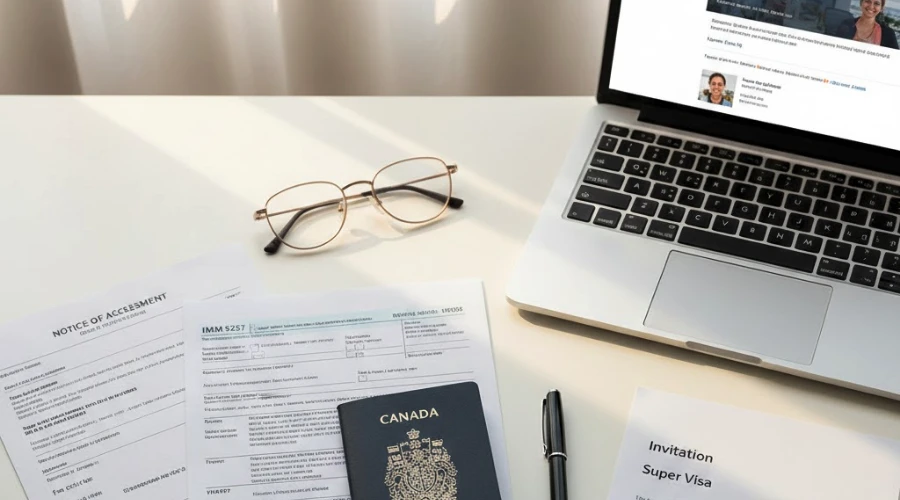
- Financial documentation including your most recent Notice of Assessment (NOA) from CRA, T4/T1 tax documents, employment letter, pay stubs, and bank statements
Spouse Can Co-Sign
If your individual income does not meet the LICO threshold, your spouse or common-law partner can co-sign the invitation letter. Both incomes will be combined when assessing eligibility. Both signers must provide their own financial documentation.
Super Visa Income Requirements & LICO Table 2025-2026
One of the most critical aspects of the Super Visa application is meeting the Minimum Necessary Income (MNI) requirement. This is based on the Low Income Cut-Off (LICO) table published by Statistics Canada and updated annually by IRCC. Your income as the host must meet or exceed the threshold for your total family size.
How to Calculate Your Family Size
Your family size for LICO purposes includes more people than you might expect. You must count:
- Yourself (the host child or grandchild in Canada)
- Your spouse or common-law partner (including separated spouse)
- Your dependent children and those of your spouse — regardless of custody arrangements
- The Super Visa applicant(s) — your parent(s) or grandparent(s) being invited
- Any previously sponsored individuals still under an active sponsorship undertaking
- Any existing Super Visa holders you previously invited who are still covered under a prior letter of invitation
LICO-Based Minimum Necessary Income Table (Effective July 2025)
| Family Size | Minimum Income (CAD) | Common Example |
|---|---|---|
| 2 persons | $38,002 | Single host + 1 parent |
| 3 persons | $46,720 | Single host + 2 parents |
| 4 persons | $56,724 | Host + spouse + 2 parents |
| 5 persons | $64,336 | Host + spouse + 1 child + 2 parents |
| 6 persons | $72,560 | Host + spouse + 2 children + 2 parents |
| 7+ persons | $80,784 | Larger families — add ~$8,200 per person |
Note: These figures reflect the LICO amounts effective July 29, 2025. IRCC typically updates these annually. Always verify current amounts on the official IRCC website before applying.
What Documents Prove Your Income?
IRCC accepts several types of documentation to verify your income. Providing multiple documents strengthens your application:
- Notice of Assessment (NOA) — most recent from CRA (Line 15000 - total income)
- T4 or T1 tax slips — official documents for the latest tax year
- Employment letter — on company letterhead stating job title, start date, and annual salary
- Recent pay stubs — covering the past 3 to 6 months
- Bank statements — showing consistent salary deposits and financial stability
- Accountant's letter — for self-employed individuals, confirming annual income
- Pension or investment income statements — if applicable
Not Sure If You Meet the Income Requirement?
Our RCIC-certified consultants can review your financial situation and calculate your exact LICO eligibility before you apply.
Check Your Eligibility Free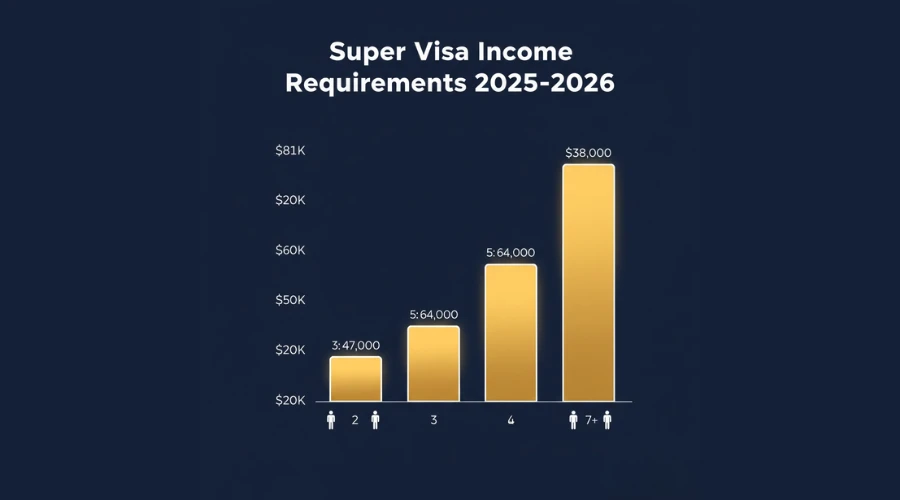
Super Visa vs Parent Sponsorship (PGP): Which Is Right for Your Family?
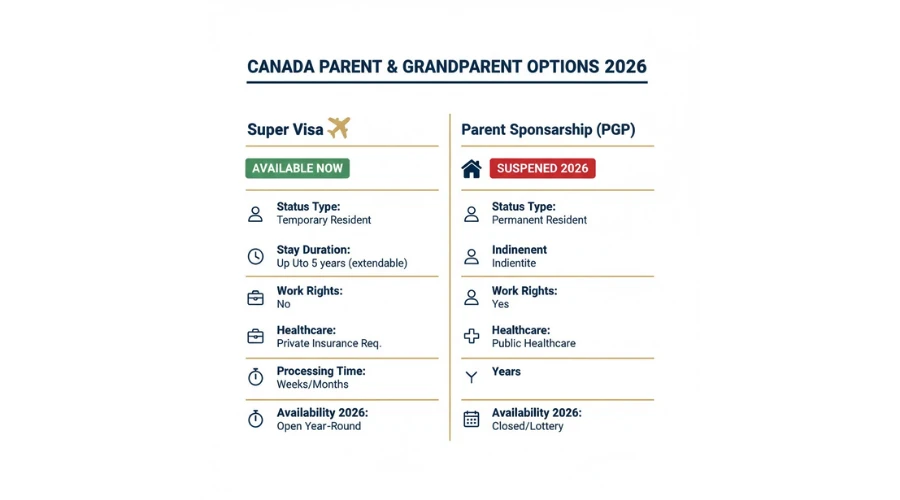
With the PGP frozen for 2026, many families in Edmonton and across Canada are weighing their options. Understanding the differences between these two programs helps you make the best decision for your family's situation — both now and when the PGP eventually reopens.
| Feature | Super Visa | Parent Sponsorship (PGP) |
|---|---|---|
| Status Granted | Visitor (temporary) | Permanent Resident |
| Stay Duration | Up to 5 years per entry | Unlimited (permanent) |
| Visa Validity | Up to 10 years (multiple entries) | N/A — permanent status |
| Work Rights | No | Yes — full work authorization |
| Healthcare Access | Private insurance required | Provincial healthcare (after waiting period) |
| Path to Citizenship | No | Yes |
| Income Requirement | LICO for current year only | LICO + 30% for 3 consecutive tax years |
| Availability in 2026 | Open — apply anytime | Suspended — no intake |
| Processing Time | 2-6 months | 24-36 months (when open) |
| Sponsor Undertaking | During visit only | 20 years financial responsibility |
| Application Method | Direct application year-round | Lottery-based annual intake |
When the Super Visa Makes More Sense
Choose Super Visa If...
- PGP is suspended and you want your parents here soon
- Your parents prefer maintaining ties to their home country
- You don't meet LICO + 30% for three consecutive years
- Your parents want flexibility to travel between countries
- You want a faster, more predictable process
- Your parents have healthcare coverage in their home country
Choose PGP When It Reopens If...
- Your parents want to live in Canada permanently
- They need access to provincial healthcare long-term
- They want to work in Canada
- You can meet income requirements for 3 years
- Your parents want to eventually become citizens
- You're comfortable with a 20-year financial undertaking
Smart Strategy for 2026
Many families apply for the Super Visa now to bring their parents to Canada immediately, while preparing documentation for the PGP whenever it reopens. This way, your parents are already here spending time with family instead of waiting years for the PGP lottery.
Super Visa Insurance Requirements: What You Need to Know
Medical insurance is a mandatory requirement for the Super Visa — and one of the most common areas where applications face problems. Unlike a regular visitor visa, the Super Visa has specific insurance standards that must be met or the application will be refused.
Minimum Insurance Requirements
- Coverage amount: Minimum $100,000 CAD
- Validity period: At least one year from the date of entry
- Provider: A Canadian insurance company authorized by OSFI under the Insurance Companies Act
- Coverage scope: Must include hospitalization, healthcare services, and repatriation
- Payment: Must be paid in full or proof of paid premium provided at time of application
What Does Super Visa Insurance Typically Cost?
| Applicant Age | Estimated Annual Cost | Notes |
|---|---|---|
| 40-54 years | $1,200 - $1,800 | Standard rates, no pre-existing conditions |
| 55-64 years | $1,800 - $2,800 | Rates vary by health status |
| 65-69 years | $2,500 - $3,500 | Pre-existing conditions may increase cost |
| 70-79 years | $3,200 - $4,500+ | Higher premiums, medical questionnaire required |
| 80+ years | $4,500 - $6,000+ | Limited provider options, some restrictions |
Note: These are estimated ranges. Actual premiums depend on the applicant's health history, coverage level, and insurance company. Get quotes from multiple OSFI-authorized providers before purchasing.
Common Insurance Mistakes to Avoid
- Buying from a non-OSFI authorized company — insurance brokers and administrators are not the same as insurance companies. The insurer (underwriter) must appear on OSFI's list
- Coverage gaps — if your parent's insurance expires while they are still in Canada, they must renew before the expiry date
- Insufficient coverage amount — some policies technically meet $100,000 but have sub-limits on specific treatments. Review the policy details carefully
- Pre-existing condition exclusions — many policies exclude pre-existing conditions. If your parent has health issues, look for policies with pre-existing condition coverage (at a higher premium)

How to Apply for a Super Visa: Step-by-Step Process
The Super Visa application process involves coordination between you (the host in Canada) and your parent or grandparent (the applicant abroad). Here is the complete process from start to finish:
Confirm Eligibility & Calculate Family Size
Before starting, verify that you meet the LICO income requirement for your total family size. Count all household members including the parent(s) being invited. If your income is borderline, consider having your spouse co-sign or consult with an immigration professional.
Gather Host Documents (You in Canada)
Prepare your financial proof: most recent NOA from CRA, T4/T1 tax forms, employer letter with salary, 3-6 months of pay stubs, and bank statements. Write and sign a formal invitation letter addressed to your parent(s) with your address, household details, and commitment to financial support.
Purchase Medical Insurance
Your parent must obtain Canadian medical insurance with minimum $100,000 coverage for at least one year. The insurance must be from an OSFI-authorized Canadian company. Purchase the policy and obtain proof of paid premium before submitting the application.
Complete the Immigration Medical Exam
Your parent must undergo a medical examination with an IRCC-designated panel physician in their country. Results are sent directly to IRCC. The medical exam is valid for 12 months — schedule it early but ensure results won't expire during processing.
Complete & Submit the Application
Your parent submits the Super Visa application online or at the visa office in their country. Include all supporting documents: passport, photos, invitation letter, host's financial proof, medical insurance proof, medical exam confirmation, and country-specific documents.
Provide Biometrics
After the application is received, IRCC will request biometrics (fingerprints and photo) from the applicant. This must be completed at a designated biometric collection service point. Biometrics are valid for 10 years once provided.
Wait for Processing & Decision
Processing times vary by country — generally 2 to 6 months. IRCC may request additional documents or an interview. Once approved, a Super Visa sticker is placed in your parent's passport, valid for up to 10 years with multiple entries.
Arrival in Canada
Upon arrival, your parent presents their passport with the Super Visa and proof of valid medical insurance to a border services officer. The officer determines the length of authorized stay — up to 5 years per entry.
Visa-Exempt Countries
If your parent is from a visa-exempt country, they can still apply for a Super Visa to get the extended 5-year stay benefit. If approved, they receive a letter to present at the border. They may also need to apply separately for an Electronic Travel Authorization (eTA) for air travel to Canada.
Need Help With Your Super Visa Application?
Our RCIC-certified consultants in Edmonton have helped hundreds of families navigate the Super Visa process. We handle the paperwork so you can focus on preparing for your parents' arrival.
Book Free Consultation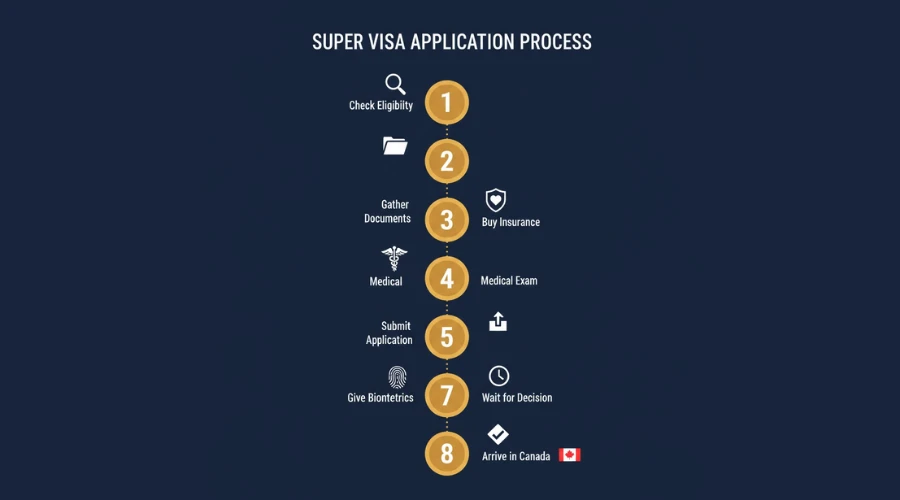
Super Visa Processing Times in 2026
Processing times for the Super Visa vary significantly depending on which country your parent applies from. With the PGP suspended, IRCC has noted increased demand for Super Visas — which may affect processing times at some visa offices.
Estimated Processing Times by Region
| Region / Country | Estimated Processing Time | Notes |
|---|---|---|
| India (New Delhi, Chandigarh) | 90-180 days | Highest volume — longer waits |
| China (Beijing, Shanghai) | 60-150 days | Variable based on office workload |
| Philippines (Manila) | 60-120 days | Relatively faster processing |
| Pakistan (Islamabad) | 90-160 days | Background checks may extend timelines |
| Middle East (various) | 60-120 days | Varies by specific visa office |
| Europe / UK | 30-90 days | Generally faster processing |
| Africa (various) | 90-180 days | Limited visa offices may extend times |
Note: These are estimates based on recent processing data. Actual times vary. Check IRCC's online processing time tool for your specific visa office. Biometrics processing time is additional.
Factors That Speed Up or Delay Your Application
- Complete applications process faster — missing documents trigger Procedural Fairness Letters and add months
- Medical exam timing matters — schedule early but ensure results don't expire during processing
- Background check complexity — applicants who have lived in multiple countries may face longer security checks
- Visa office workload — some offices process more applications, especially during peak travel seasons
- PGP suspension ripple effect — increased Super Visa applications in 2026 may create higher volumes
Common Super Visa Mistakes That Lead to Refusal
Avoiding these common errors can save you months of delays and the stress of a refused application:
Mistake 1: Incorrect Family Size Calculation
Many applicants forget to include previously sponsored individuals or existing Super Visa holders in their family size count. This leads to an income figure that appears to meet the threshold but actually falls short when IRCC calculates correctly. Double-check your count against the official IRCC criteria.
Mistake 2: Insurance From Non-OSFI Company
Purchasing insurance from a broker or an unauthorized provider is one of the most common refusal reasons. Always verify that the underwriter (not the broker) appears on OSFI's list of federally regulated financial institutions.
Mistake 3: Outdated Financial Documents
Submitting a Notice of Assessment that is two or three years old, or pay stubs that are several months old, raises concerns about your current financial situation. Provide the most recent documents available — ideally from the current or most recent tax year.
Mistake 4: Weak Invitation Letter
A vague or incomplete invitation letter does not demonstrate your commitment to supporting your parents. Include specific details: your full name and contact information, proof of status, household composition, how long you are inviting them, and a clear statement of financial support.
Mistake 5: Not Addressing Ties to Home Country
The visa officer must be satisfied your parents will leave Canada when required. Including evidence of property ownership, pension income, family remaining in the home country, and other ties helps demonstrate that they intend to return home.
Avoid Costly Mistakes — Get Professional Review
A refused Super Visa wastes months and money. Our consultants review every detail before submission.
Get Expert Application Review
Frequently Asked Questions About the Super Visa
Answers to the most common questions Edmonton families ask about the Super Visa program for parents and grandparents in 2026.
What is the Super Visa for parents and grandparents in Canada?
The Super Visa is a multi-entry visitor visa that allows parents and grandparents of Canadian citizens or permanent residents to stay in Canada for up to 5 years per visit, with a visa validity of up to 10 years. Unlike a regular visitor visa (which allows stays of 6 months), the Super Visa provides extended stay rights without granting permanent residence. It was introduced in 2011 and enhanced in 2022 to extend the per-entry stay from 2 years to 5 years.
What is the income requirement for Super Visa in 2025-2026?
Income requirements are based on the LICO (Low Income Cut-Off) table and depend on your total family size. For 2025-2026, the minimum necessary income starts at $38,002 for a family of 2 and increases to $80,784 for a family of 7 or more. Your spouse or common-law partner can co-sign to combine both incomes if your individual income falls short of the threshold.
Is the Parent and Grandparent Program (PGP) open in 2026?
No. Canada has suspended the Parent and Grandparent Program for 2026, with zero new applications being accepted. This decision stems from processing backlogs and resource reallocation. The Super Visa remains the primary pathway for parents and grandparents to visit Canada for extended periods. The PGP may reopen in 2027, but IRCC has not provided guarantees.
How much does Super Visa medical insurance cost?
Super Visa insurance must provide at least $100,000 in coverage and be valid for at least one year from a Canadian insurance company authorized by OSFI. Annual costs typically range from $1,200 to $4,500+ depending on the applicant's age, health conditions, and coverage level. Applicants over 70 generally pay higher premiums. Compare quotes from multiple OSFI-authorized providers before purchasing.
How long does it take to process a Super Visa application?
Processing times vary by country but generally range from 60 to 180 days (approximately 2 to 6 months). Applications from high-volume countries like India may take longer. Processing times do not include time needed for biometrics. Submitting a complete application helps avoid delays from additional information requests.
Can my parents work in Canada on a Super Visa?
No. Super Visa holders are visitors and do not have work authorization in Canada. They cannot work for any Canadian employer or be self-employed. If your parents need to work in Canada, they would need a separate work permit or permanent residence through the PGP when it reopens.
Can I combine my income with my spouse to meet the LICO requirement?
Yes. If your individual income does not meet the LICO threshold, your spouse or common-law partner can co-sign the invitation letter. Both incomes are then combined when IRCC assesses your financial eligibility. Both co-signers must provide their own financial documentation including NOAs, T4s, employment letters, and pay stubs.
What documents does the host need to provide?
The host in Canada must provide: a signed letter of invitation, most recent Notice of Assessment from CRA (Line 15000 total income), T4 or T1 tax documents, an employment letter with salary details, recent pay stubs (3-6 months), bank statements, proof of Canadian citizenship or permanent residence, and proof of relationship to the applicant.
Can my parents extend their stay beyond 5 years?
Super Visa holders can stay up to 5 years per entry. Before the authorized stay expires, they can apply for a visitor record extension to remain longer. They must maintain valid medical insurance throughout their stay. They can also leave and re-enter Canada multiple times during the 10-year visa validity, receiving a new 5-year stay each time they enter.
What's the difference between a Super Visa and a regular visitor visa?
A regular visitor visa typically allows stays of 6 months, while the Super Visa allows stays of up to 5 years per entry. The Super Visa also requires proof of medical insurance ($100,000 minimum for 1 year), the host must meet LICO income requirements, and a medical exam is mandatory. Regular visitor visas do not have these additional requirements but offer much shorter stay periods.
Related Resources
Continue exploring our family sponsorship and immigration guides:

TopNation Immigration Consultant
RCIC-certified immigration consultants based in Edmonton, Alberta. Specializing in family sponsorship, Express Entry, and provincial nominee programs. Over 2,500 families helped since 2014. Licensed by the College of Immigration and Citizenship Consultants (CICC) — License #R513508