Current Express Entry Processing Times at a Glance (June 2026)
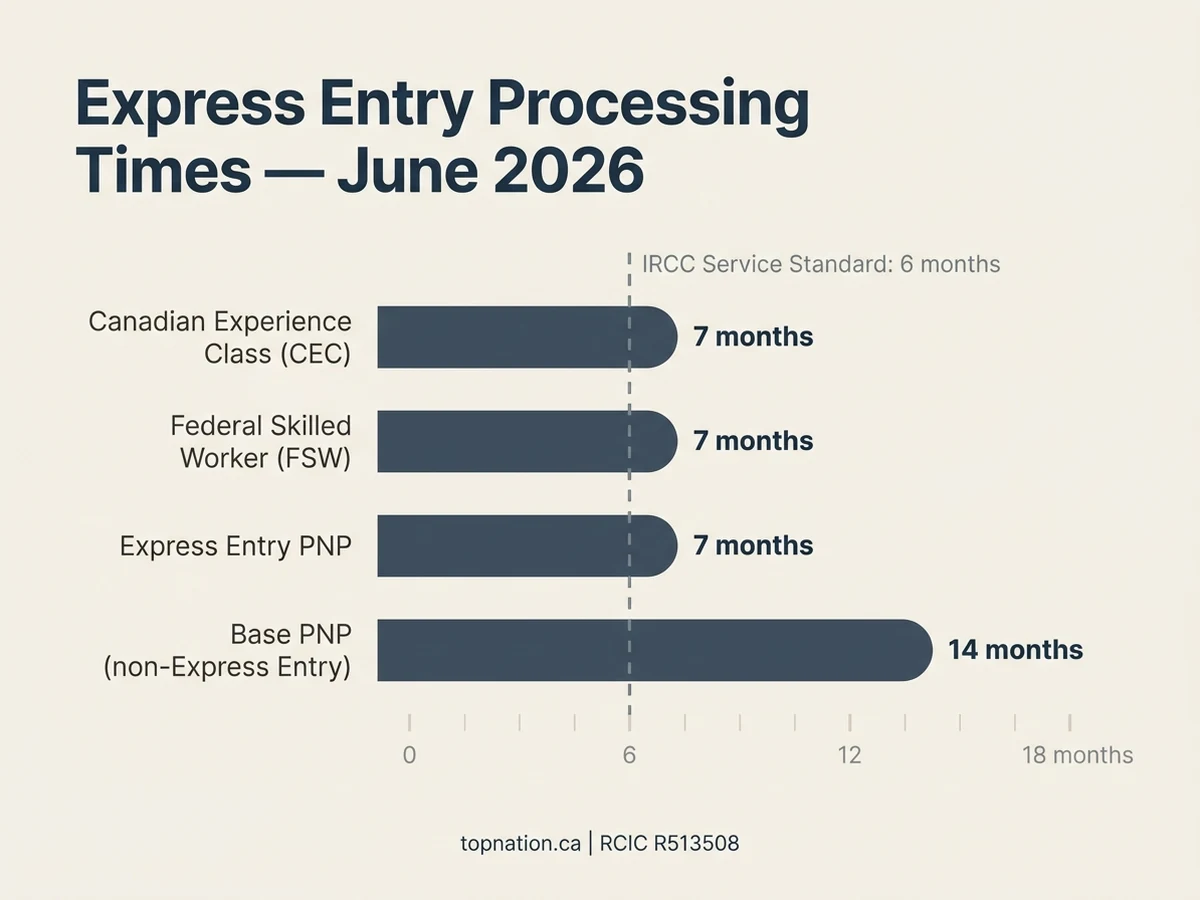
Express Entry processing time 2026 — IRCC’s latest published figures:
- Canadian Experience Class (CEC): 7 months (service standard 6) — unchanged.
- Federal Skilled Worker (FSW/FSWP): 7 months (service standard 6) — up 1 month.
- Federal Skilled Trades (FSTP): Insufficient IRCC data — no reliable published figure.
- Express Entry PNP (Enhanced): 7 months (service standard 6) — unchanged.
- Non-Express-Entry Base PNP (for contrast): 14 months (service standard 11) — up 1 month.
Figures reflect the latest published IRCC service standards (IRCC data as of May 12, 2026). Trend: climbing. Always re-verify on the official IRCC check-processing-times tool the day you submit.
Express Entry Processing Times 2026
Last updated: June 2026. Figures reflect the latest published IRCC service standards (IRCC data as of May 12, 2026). Reviewed by a Regulated Canadian Immigration Consultant (RCIC #R513508) · Last reviewed June 2026.
The single most-asked question in any Express Entry initial consultation is the same: how long will this actually take? The Express Entry processing time in 2026 has crept upward across most programs, with backlogs growing in every federal stream except the Federal Skilled Trades Program (where IRCC currently has insufficient data to publish a service standard). This guide walks through the current Express Entry processing time figures for the Canadian Experience Class (CEC), Federal Skilled Worker (FSW/FSWP), Federal Skilled Trades (FSTP), and the Express Entry-linked Provincial Nominee Program (Enhanced PNP), with a direct comparison against the slower non-Express-Entry Base PNP track. We update these numbers as IRCC publishes new service-standard reports.
Understanding Express Entry Processing Times in 2026
“Express Entry processing time” is a measurement IRCC publishes for each economic-class program. The official figure reflects the time within which 80% of complete applications are finalized — not the time within which every file finalizes. In other words, 20% of files routinely take longer than the published figure, and a complete file at submission is the single biggest predictor of staying inside the 80% window.
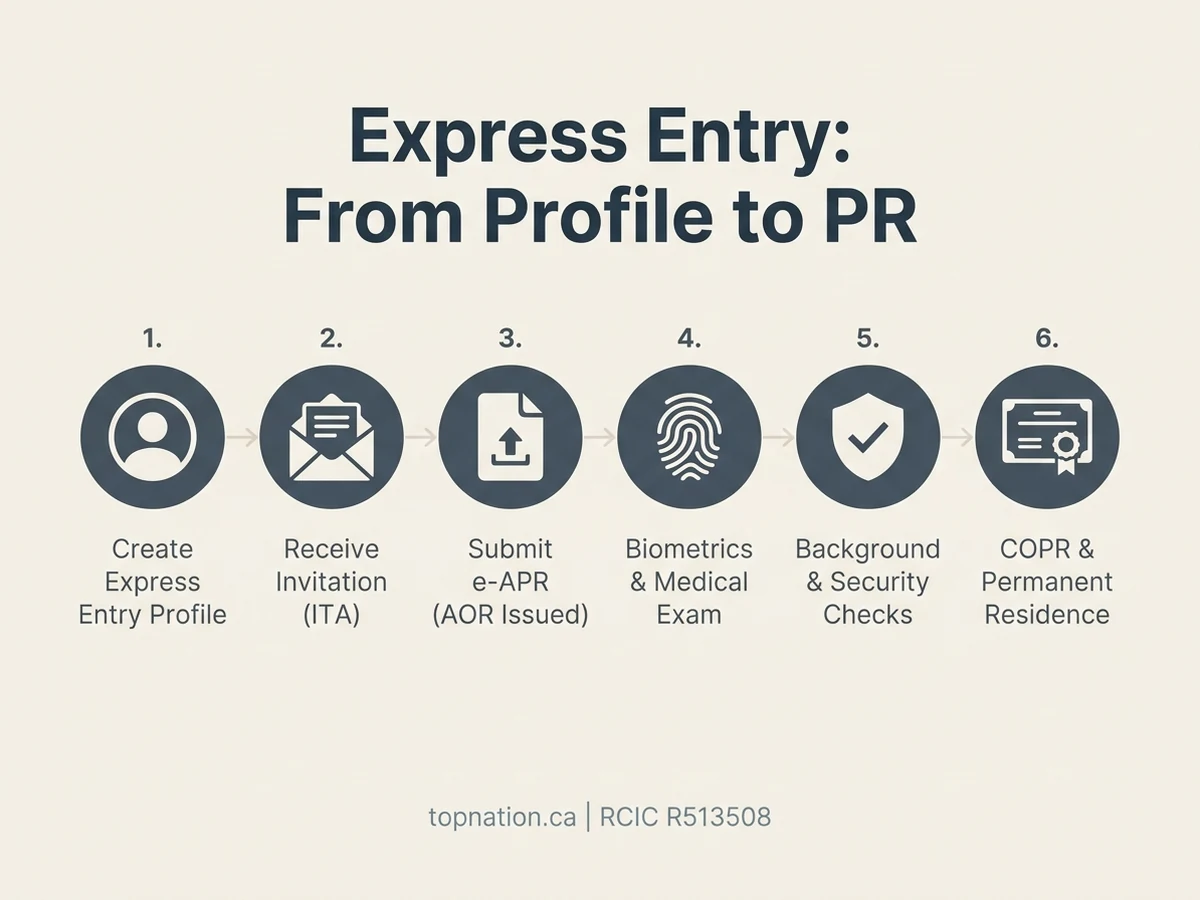
The clock starts the day IRCC issues your Acknowledgement of Receipt (AOR) after you submit a complete Application for Permanent Residence (APR) following your Invitation to Apply. AOR is the official trigger; the application is not considered “in queue” until it lands. The clock stops the day IRCC issues your Confirmation of Permanent Residence (COPR), which is the document that lets you land as a permanent resident or be issued a permanent resident visa abroad.
Between AOR and COPR, your file moves through several IRCC stages — eligibility review, medical and background checks, security screening, and final decision. Each stage has its own internal timeline; if any stage flags an issue, the file goes into a hold state and exits the published service standard. Understanding what counts inside the published figure (and what doesn’t) is the first step to setting realistic expectations.
One important nuance: the published Express Entry processing time covers the post-ITA federal permanent residence step only. It does not include the time you spent in the federal Express Entry pool waiting for an Invitation to Apply, nor any provincial-nomination step if you went the Express Entry PNP route. We compare end-to-end pathway timing further down.
Express Entry Processing Time by Program — Current 2026 Service Standards
The table below summarizes the current Express Entry processing time figures published by IRCC for each economic-class program, plus the non-Express-Entry Base PNP track for contrast. These figures reflect the latest IRCC dataset as of May 12, 2026; we will refresh as IRCC publishes new monthly data.
| Stream | Current Time | Service Standard | Direction | Notes |
|---|---|---|---|---|
| Canadian Experience Class (CEC) | 7 months | 6 months | → unchanged | Queue ~60,900 (+6,300) |
| Federal Skilled Worker (FSW/FSWP) | 7 months | 6 months | ↑ +1 month | Queue ~52,000 (+7,900) |
| Federal Skilled Trades (FSTP) | Insufficient data | 6 months | n/a | IRCC reports too few files to publish a reliable figure |
| Express Entry PNP (Enhanced) | 7 months | 6 months | → unchanged | Queue ~14,000 (+300) |
| Non-EE Base PNP (contrast) | 14 months | 11 months | ↑ +1 month | Queue ~110,200 — paper-based |
Source: IRCC monthly service-standard dataset, as of May 12, 2026. Re-verify on the official IRCC check-processing-times tool before submitting.
Canadian Experience Class (CEC) Processing Time 2026
The Canadian Experience Class is the workhorse of Express Entry — the program most foreign workers already inside Canada use to convert work-permit time into permanent residence. How long does CEC take in 2026? IRCC’s current published figure is 7 months from AOR to final decision, against a 6-month service standard. The 7-month figure has held steady through the first half of 2026, despite the CEC queue growing to roughly 60,900 files (up by about 6,300 since the prior period). Volume is the pressure here — not a change in IRCC’s underlying processing capacity.
Why CEC tends to track close to the service standard even when volume climbs: CEC eligibility relies on work and tax records already inside the Canadian system, which makes the eligibility review faster than for overseas applicants. IRCC officers can verify Canadian work history through CRA records, ROEs, and T4s directly — no foreign reference letters to translate, no overseas employer compliance to chase. The trade-off is that CEC files are more likely to be checked against CRA tax-filing data, so any gap between your declared employment and your tax record is a common reason for an “additional documents requested” letter.
If you are weighing CEC vs FSW processing time in 2026, CEC has the structural advantage at the eligibility-review stage but no longer has a clear time advantage at the headline service-standard level — both programs are now sitting at 7 months. The real difference is variance: CEC files inside the 80% window cluster tightly around 6–7 months, while FSW files have a wider spread depending on overseas verification steps. Read our complete Canadian Experience Class guide for the eligibility breakdown and document checklist.
Federal Skilled Worker (FSW/FSWP) Processing Time 2026
The Federal Skilled Worker Program is the legacy overseas pathway — the program used by candidates with foreign work experience and no Canadian work history. The federal skilled worker processing time in 2026 has moved to 7 months from AOR to final decision, against the same 6-month service standard, after climbing by 1 month in the latest IRCC update. The FSW queue grew to roughly 52,000 files (up by about 7,900), which is the biggest absolute queue growth across the Express Entry-linked programs.
Why FSW files take longer than the headline suggests: every overseas work-experience claim requires reference letters, pay records, and often employer verification calls placed by IRCC’s visa offices abroad. Translations of reference letters into English or French add a step. Educational credential assessments (ECAs) need to match the program declared, and the issuing body must be IRCC-approved. Any mismatch — an ECA showing a different field than the NOC on the profile, a reference letter without weekly hours stated, a missing tax record — pushes the file outside the 80% window.
FSW vs CEC processing time 2026 is now a near-tie at the headline level. But end-to-end, FSW remains slower because the overseas medical exam, the police certificates from every country where you’ve lived 6+ months since age 18, and the biometrics appointment at a visa application centre all add real calendar time before AOR is even issued. Plan 60–90 days for documentation gathering before you press submit on the post-ITA application.
Federal Skilled Trades (FSTP) Processing Time 2026
The Federal Skilled Trades Program is the smallest of the three federal Express Entry economic programs, and in 2026 IRCC publishes no reliable processing time for it — the official tool returns “insufficient data”. The service standard remains 6 months, but the actual experienced timeline is not transparent.
What that means in practice: FSTP files do get processed, but volume is low enough that IRCC cannot calculate a statistically meaningful 80% figure month over month. Our practice observation across the small handful of FSTP files we file each year is that complete files with an LMIA-supported job offer or a certificate of qualification from a Canadian province typically land inside 8–12 months from AOR — longer than CEC or FSW at the same point. Without a published service standard, you cannot use the “30-days-past-standard” webform request to escalate, which removes one tool from your timeline-management toolkit.
For most skilled-trades candidates, the strategic answer in 2026 is to apply through an Express Entry PNP stream (which targets trades occupations explicitly in several provinces) rather than FSTP directly. The provincial path adds a step but produces a published service standard, a 600-point CRS bonus, and a more predictable timeline.
Express Entry PNP (Enhanced) Processing Time 2026
The Express Entry-linked Provincial Nominee Program — also called the “Enhanced” PNP — is the fastest route to PR for candidates whose underlying CRS score sits below recent general-draw cut-offs. The Express Entry PNP processing time 2026 is 7 months from AOR to final decision, against the 6-month service standard, unchanged in the latest dataset. The queue is the smallest of the federal Express Entry tracks at roughly 14,000 files (up by just 300).
The key distinction is that the 7-month figure covers only the federal step after the Express Entry profile is updated with the provincial nomination and the candidate receives an ITA. Before that, you need a provincial nomination — which carries its own processing timeline that varies by province (typically 2–6 months for Express Entry-linked streams). End-to-end, the Express Entry PNP pathway runs roughly 9–13 months from provincial submission to PR landing.
This pathway is structurally faster than the non-Express-Entry Base PNP route because the federal step uses the 6-month Express Entry-linked service standard rather than the 11-month paper-based PNP service standard. The Base PNP track currently sits at 14 months federally — double the federal step of the Enhanced track. If your provincial nominee program offers both an Express Entry-linked stream and a base stream, the Express Entry-linked option is almost always the strategic choice.
What Actually Slows Down Your Express Entry Application
The published service standards above assume your post-ITA application is complete on submission and that no eligibility or admissibility flags trigger during processing. In practice, files routinely sit beyond the 6-month standard because of avoidable issues that add weeks or months. Below are the four most common delays we see in our Edmonton practice.
1. Documentation Gaps at Submission
If IRCC requests additional documents after submission, your file goes into a hold state until you respond — and the response itself adds 4–8 weeks to re-queue back into active processing. The most common gaps are reference letters missing required elements (weekly hours, gross salary, job duties matching the declared NOC), educational credential assessments from non-approved bodies, and incomplete proof of funds for FSW files. The fix is straightforward: file complete the first time. We run every post-ITA file through a pre-submission checklist of 35+ mandatory documents per program.
2. Wrong NOC or Program Classification
If your declared NOC code doesn’t match the documented job duties in your employer reference letter, the eligibility officer typically returns the file for clarification. For CEC files, this also affects the work-experience hour count. For FSW files, it can affect the points awarded for skilled work experience. Picking the wrong NOC is the single most common reason for negative eligibility decisions after ITA, and a re-issuance request can take months. We spend significant strategy time at the front of every file selecting the strongest defensible NOC.
3. Language Test Validity Expiring Mid-Process
IELTS and CELPIP results are valid for 2 years from the test date for Express Entry purposes. If your test expires while your post-ITA application is in progress, IRCC will require a new test result before issuing COPR — which means rescheduling, sitting the test again, and waiting for the new score to upload. We time language tests to the post-ITA application submission to maximize remaining validity, ideally with at least 12 months of validity left at the point of AOR.
4. Completeness and Eligibility Flags
Beyond document gaps, the most common eligibility flags are tax-record mismatches for CEC files (declared Canadian work hours not matching CRA records), under-stated periods of foreign residency that affect police-certificate requirements, and missing previous-marriage records for principal applicants who do not declare them upfront. IRCC’s eligibility review is more thorough in 2026 than it was three years ago — declare everything, document everything, and front-foot the file with an honest, well-sequenced application package.
Express Entry vs AAIP Timing — Side-by-Side
For Alberta-based candidates eligible for both direct Federal Express Entry and the Alberta Advantage Immigration Program (AAIP), the timing trade-off matters. Direct Federal Express Entry through a general draw — without provincial nomination — can complete in roughly 9–10 months from profile creation to PR landing if your CRS score clears the draw cut-off (and assuming you sit at the 7-month CEC service standard once AOR is issued). The AAIP Express Entry Stream adds a 2–4 month provincial step but provides the 600-point CRS bonus, which essentially guarantees an Invitation to Apply regardless of underlying CRS score.
The decision rule: if your federal CRS is already above the recent draw cut-off (typically 510+ for general draws in 2026), direct Express Entry is faster and simpler. If your CRS sits below the cut-off and you have an Alberta job offer or tie-in, the AAIP Express Entry Stream is the strategic choice — you trade a few additional months for near-certain selection. For a full breakdown of every AAIP stream’s processing time and federal-step pairing, see our AAIP Processing Times 2026 guide.
For context on the wider Express Entry program in 2026 (CRS draws, category-based selection, French-language draws), see our Express Entry Canada 2026 overview. If you are working with a job offer that requires an LMIA, also factor in the LMIA processing times 2026, which run in parallel with the Express Entry pool wait.

What to Do While You Wait
The AOR-to-PPR timeline of 6–9 months for most Express Entry files in 2026 is long enough that you will likely have status decisions to make while you wait. The most strategic moves during this window:
- Maintain valid temporary status — if you are inside Canada on a work or study permit, ensure it is renewed at least 90 days before expiration. Bridging Open Work Permits (BOWPs) are available to many post-ITA applicants who hold a valid work permit at the time of post-ITA submission — can I work while Express Entry is processing? Yes, generally, if you already hold a valid work permit or qualify for a BOWP.
- Keep your language test current — renew IELTS or CELPIP results before expiration, particularly if your AOR was issued more than 12 months ago.
- Document continuous employment — save pay stubs, T4s, and employer letters confirming continuous work in your declared occupation. IRCC sometimes requests updated employment proof during the final months of processing.
- Avoid extended foreign travel — brief trips are fine, but long absences can affect CEC eligibility recalculation if IRCC reviews your file mid-process. For FSW applicants outside Canada, ensure you can attend the visa-application centre biometrics appointment promptly when called.
- Update your file promptly — report any change of address, employer, marital status, or family composition to IRCC immediately. Undeclared changes are a common eligibility-flag trigger.
- Watch for the medical-exam request — if you didn’t complete an upfront medical, IRCC will request one mid-process. Book promptly with a panel physician to avoid adding weeks.
Express Entry · June 2026
Get Inside the 80% Window
A complete first-time post-ITA submission is the single biggest predictor of staying inside the 6-month service standard. Talk to our Edmonton team about your file before you press submit.
| Book a Consultation → | Call 587-400-0077 |
Frequently Asked Questions
Last updated: June 2026. Figures reflect the latest published IRCC service standards (IRCC data as of May 12, 2026). Reviewed by a Regulated Canadian Immigration Consultant (RCIC #R513508) · Last reviewed June 2026. Individual file timing varies; consult a licensed RCIC for case-specific guidance.
RCIC #R513508 · Edmonton, Alberta
Plan Your Express Entry File With Confidence
Our Edmonton team files Express Entry post-ITA applications inside the 80% window. Book a consultation to map your timeline before AOR is issued.
| Book a Consultation → | Call 587-400-0077 |