Current Canadian Citizenship Processing Times at a Glance (June 2026)
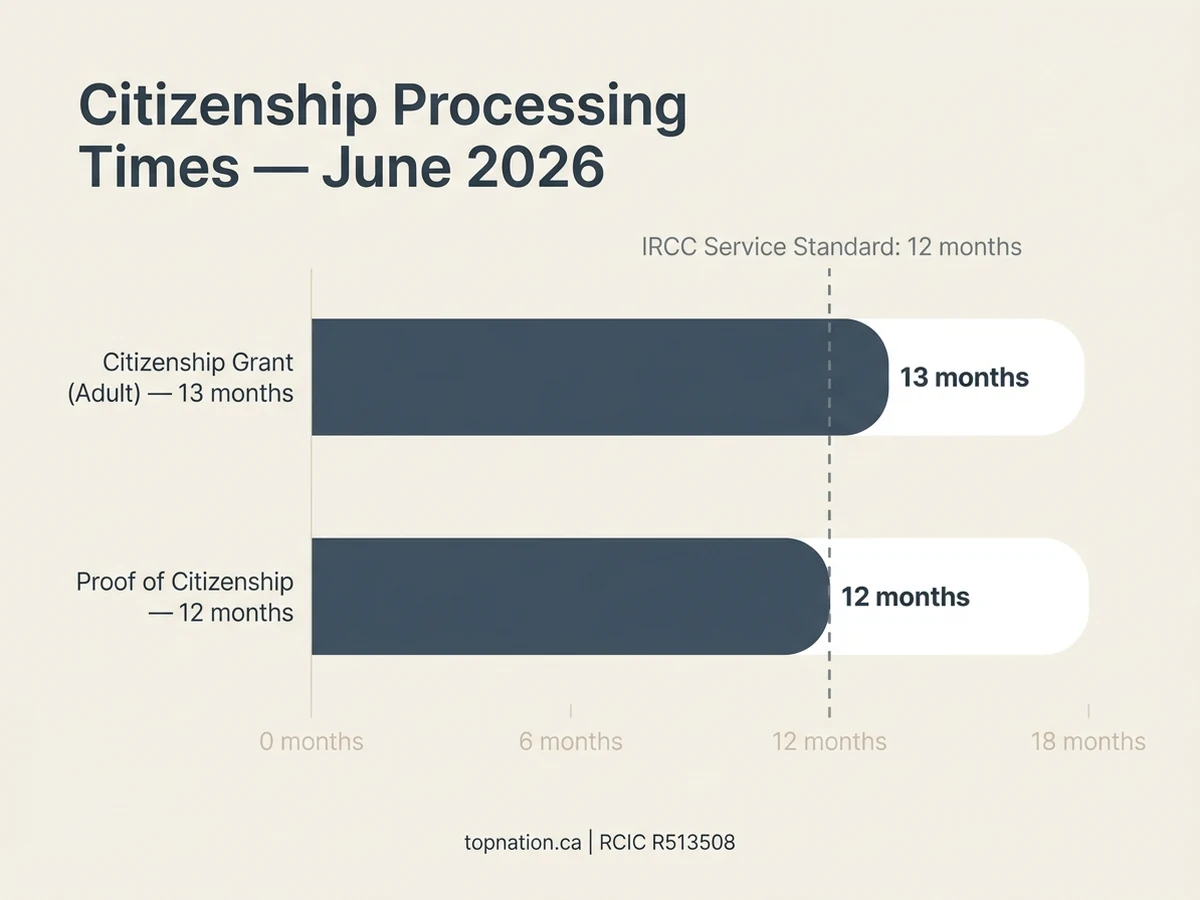
Citizenship grant for adults — 13 months from receipt of a complete application to oath ceremony. Proof of citizenship (citizenship certificate) — 12 months and rising, driven by a surge in citizenship-by-descent applications. The citizenship test and interview are typically scheduled 4 to 7 months into the file. The oath ceremony follows the test by roughly 2 to 4 months. Routine files without complications complete in 8 to 11 months; files flagged for residence, tax, or fingerprint review add 3 to 6 months.
CANADIAN CITIZENSHIP PROCESSING TIMES 2026
Reviewed by a Regulated Canadian Immigration Consultant (RCIC #R513508) · Last reviewed June 2026.
Canadian citizenship processing times 2026 sit at the longest sustained level IRCC has reported in five years. The current 13-month citizenship grant timeline is one month above the published service standard of 12 months, and the proof-of-citizenship queue has surged sharply on the back of the C-71 citizenship-by-descent restoration. If you have applied for citizenship in 2026 or you are planning to file before the end of the year, you need to know what IRCC is actually delivering — not just what the service standard says. This guide walks through every stage of the citizenship process with current Canadian citizenship processing times 2026 broken out by application type, the queues IRCC is sitting on, and what is actually slowing files down.
How Canadian Citizenship Processing Works in 2026
Canadian citizenship processing times 2026 are best understood by breaking the file into stages. The headline “13-month” figure IRCC publishes is the total time from application receipt to the day a new citizen takes the oath. Understanding the canadian citizenship processing times 2026 stage by stage is critical, because the bottleneck moves depending on your file profile, where you live, and whether your residence calculation triggers a closer review.
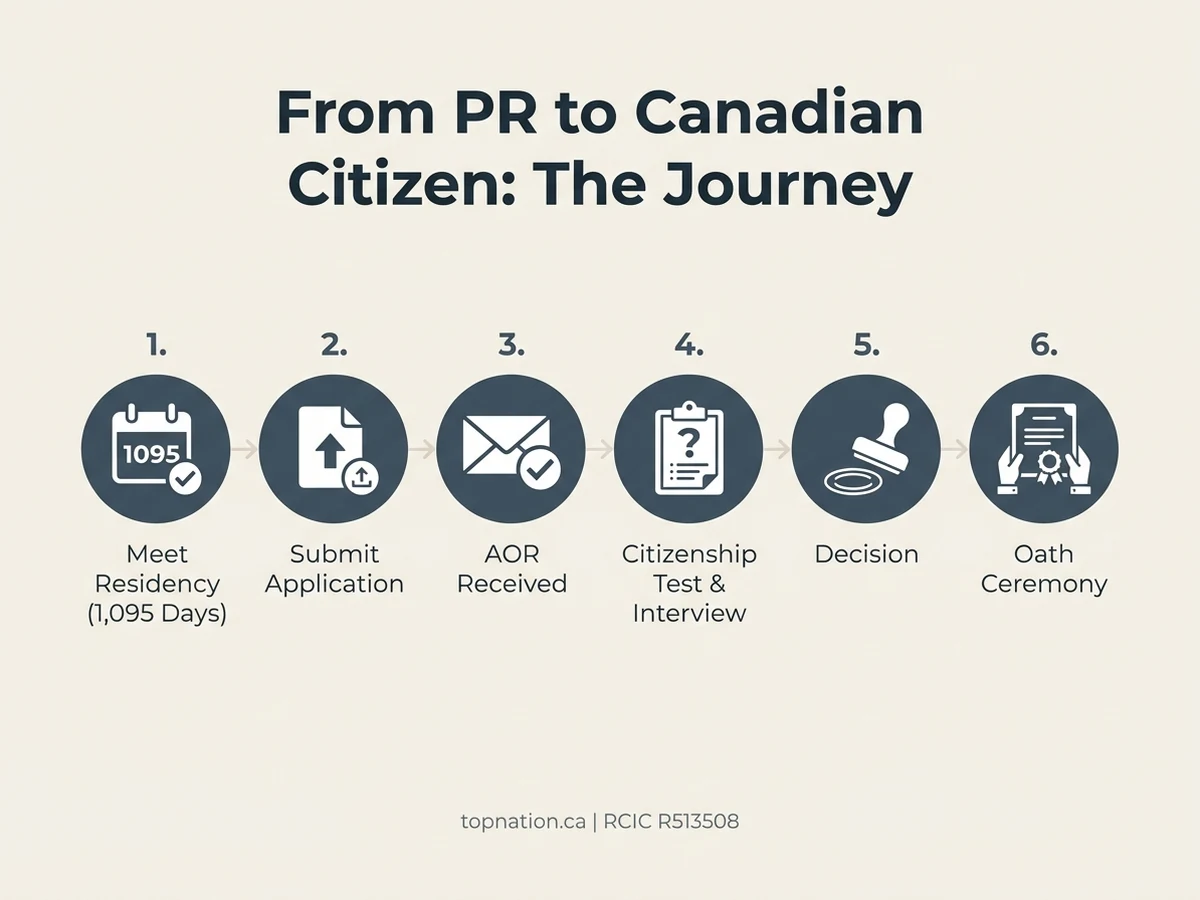
The grant process starts when a permanent resident submits the citizenship application (form CIT 0002 plus supporting documents, fee paid). IRCC issues an Acknowledgement of Receipt (AOR) by mail and email roughly 6 to 12 weeks after intake — the AOR-issuance lag has stretched in 2026, with files submitted in late December 2025 only now receiving AOR in early summer. Once the AOR is issued, the file enters the eligibility-review queue. The case officer verifies physical presence (the 1,095-day-of-5-years residence test), tax-filing history with CRA, prohibitions, and language requirement (CLB 4+ for applicants 18 to 54).
If the eligibility review passes, IRCC schedules the citizenship test and interview — typically 4 to 7 months after AOR. After the test, the file moves to decision, then to oath ceremony scheduling. The oath itself is the final step. The 13-month figure is calculated from application receipt to oath, averaged across files completed in the most recent reporting window.
Canadian Citizenship Processing Times by Application Type — June 2026
The table below summarizes the current Canadian citizenship processing times 2026 for each application type, as of May 12, 2026 (the most recent IRCC operational data). Direction shows the month-over-month trend. Notes flag the queue size and what is driving each timeline.
| Application Type | Current Time | Service Standard | Direction | Notes |
|---|---|---|---|---|
| Citizenship Grant (Adult) | 13 months | 12 months | ↑ +1 month | Queue 321,100 files (+7,900 month-over-month) |
| Proof of Citizenship | 12 months | 5 months | ↑ +2 months | Queue 70,400 files (+14,100 — surging on C-71 by-descent) |
| Citizenship Test / Interview Stage | Scheduled 4–7 months in | Not published separately | Stable | Online test invitation by email; in-person interview if flagged |
| Oath Ceremony Stage | 2–4 months after test | Not published separately | Stable | Virtual or in-person depending on region; cadence varies |
| Citizenship by Descent (Proof) | 12 months (and rising) | 5 months | ↑ surge | Driving the proof-of-citizenship intake spike |
Citizenship Grant for Adults — The 13-Month Window
The citizenship grant for adult permanent residents is the headline application type and the one most TopNation clients are watching. The headline figure in Canadian citizenship processing times 2026 for an adult grant is 13 months from application receipt to oath ceremony, sitting one month above the 12-month published service standard. The queue at the end of the most recent reporting window contained 321,100 applications — an increase of 7,900 files month-over-month, indicating intake continues to outpace decisions.
The grant pathway breaks into roughly three operational phases. The first phase — from receipt to AOR — runs 6 to 12 weeks in 2026. The second phase — eligibility review, residence verification, test scheduling — runs 4 to 7 months. The third phase — test, decision, oath — runs the remaining 4 to 6 months. Routine files (no residence calculation issues, complete tax filing, no fingerprint flag) complete at the faster end of the range, often in 8 to 11 months. Files flagged for closer review — missing tax years, residence calculation borderline at 1,095 days, fingerprint or background-check delay — add 3 to 6 months to the headline 13-month figure.
If you are planning to apply for citizenship grant in late 2026 or 2027, build your timeline assumption around 13 to 18 months total, then budget an additional 3 to 6 months of buffer if your file profile carries any review-trigger risk. Do not plan international travel or passport-dependent commitments inside the test-to-oath window without confirmed dates from IRCC.
Proof of Citizenship — The Citizenship-by-Descent Surge
Proof of citizenship — the citizenship certificate issued to people who are already Canadian citizens by birth or descent but need official documentation — has seen the sharpest deterioration of any IRCC application line in 2026. Within Canadian citizenship processing times 2026, proof of citizenship now sits at 12 months, against a service standard of 5 months — more than double the target. The queue grew by 14,100 files in the most recent month alone, finishing at 70,400 pending applications.
The driver is citizenship by descent. Bill C-71, which restored Canadian citizenship to descendants previously excluded by the first-generation limit (the “lost Canadians” cohort), triggered a surge of proof applications from adults outside Canada who learned they had a citizenship claim through a parent or grandparent. These applications require complex documentary evidence — civil records from multiple countries, parental citizenship documents, sometimes notarized translations — and IRCC’s proof-of-citizenship office is processing them with the same staffing it had before the surge.
If you are filing a proof of citizenship application in 2026, plan for the full 12-month wait. Apply early relative to any travel or passport milestone you are planning. Keep copies of every document submitted — if IRCC requests additional information, your same-day response keeps the file moving rather than parking it in a re-queue state.
The Citizenship Test and Interview Stage
For applicants aged 18 to 54, the citizenship test is mandatory and is typically scheduled 4 to 7 months after AOR for a grant application. The test invitation arrives by email from IRCC, with a specific date, time, and a link to the online test environment. The test is 30 questions, 20 of which must be answered correctly to pass, drawn from the official study guide “Discover Canada”. Most test takers can sit the test from home on a computer with a webcam.
If your test session is flagged for verification reasons — identity confirmation, document review, language assessment — you may be required to attend an in-person interview at a local IRCC office instead of (or in addition to) the test. Interview scheduling typically adds 4 to 8 weeks because of local office availability. Applicants over 54 are exempt from the test, which often shortens the timeline by 2 to 3 months.
The test itself is the moment IRCC validates eligibility. If you pass and no other flags exist on the file, the decision phase moves quickly — sometimes within a few weeks — and oath ceremony scheduling begins. If the test surfaces an issue (failure to attend, failure to pass, identity question) the file can pause for months while it is resolved.
The Oath Ceremony Stage
The citizenship oath is the final step. After your file passes the test and decision phase, IRCC schedules an oath ceremony. The cadence between test and oath is typically 2 to 4 months, though this varies considerably by region and by whether you are scheduled for a virtual or in-person ceremony. Virtual ceremonies have higher throughput and are scheduled more frequently. In-person ceremonies, including any ceremony presided over by a citizenship judge, run on a slower cadence linked to judge availability and venue scheduling.
The oath invitation arrives by email roughly 2 to 6 weeks before the ceremony date. After you take the oath, your citizenship certificate is mailed within 4 to 8 weeks. You are a Canadian citizen the moment the oath is administered — not when the certificate arrives — but you cannot apply for a Canadian passport until you have the certificate in hand. Plan passport applications accordingly if you have international travel scheduled.
Citizenship by Descent — The Driver of the Proof Surge
Citizenship by descent is the policy story behind the proof-of-citizenship queue surge. Bill C-71, which received royal assent in 2025 and is now being implemented, restored Canadian citizenship to descendants of Canadians who lost their claim under the first-generation limit. The cohort affected is estimated at hundreds of thousands of people worldwide — primarily adult children of Canadian-born parents who grew up outside Canada and were previously cut off from claiming citizenship.
The mechanism is a proof of citizenship application. The applicant submits parental (and sometimes grandparental) birth certificates, marriage certificates, and Canadian citizenship documentation, along with their own identity documents. IRCC reviews the chain of descent, confirms eligibility under the restored rules, and issues a citizenship certificate. The applicant is then a Canadian citizen and can apply for a Canadian passport.
Because each file requires document review across multiple jurisdictions and sometimes translation verification, the per-file workload is heavier than a routine domestic proof application. This is why the proof queue has expanded so quickly in 2026 even as IRCC has not changed its proof intake significantly.
What Actually Slows Down a Citizenship Application
The 13-month figure assumes a routine file without complications. In practice, four categories of issues account for nearly every file that exceeds the standard. Below are the four most common delays we see in our Edmonton practice.
1. Residence and Physical-Presence Calculation Issues
Citizenship requires 1,095 days of physical presence in Canada within the 5 years before application. The calculation must include every day — partial days count as full days for presence, time as a temporary resident before becoming a permanent resident counts at half-day value, and any day outside Canada is subtracted. Files where the calculation lands between 1,095 and 1,150 days routinely trigger a closer review because IRCC verifies travel history against CBSA entry-exit records. Any inconsistency between your declared travel history and the CBSA record adds weeks to months to the file. Run the calculation conservatively before filing; if you are below 1,100 days, wait another month or two before submitting.
2. Tax-Filing History and CRA Verification
Adult applicants must have met any tax-filing requirement under the Income Tax Act in 3 of the 5 years before application. IRCC verifies this directly with CRA. The most common issue is applicants who were physically present but did not file taxes for one or two years because they had no employment income. CRA does not have a tax record for those years, which triggers an IRCC information request. Filing nil returns for any missing year before submitting the citizenship application solves the problem at the front end rather than waiting for IRCC to find it.
3. Incomplete or Inconsistent Travel History
The application requires every absence from Canada in the relevant 5-year period to be declared with departure and return dates, destination, and reason. Applicants who travel frequently for work routinely under-report short trips. IRCC cross-references the declared history against the CBSA entry-exit record, and any unexplained mismatch becomes a verification request. We rebuild every client’s travel history from passport stamps, boarding passes, and CBSA records before submission to ensure the file is internally consistent.
4. Fingerprint and Background Check Delays
If the file requires biometrics for any reason — identity verification, name match on a security database, or a country-of-origin check — the biometric collection and clearance step can add 2 to 6 months. This is not a frequent flag, but when it triggers, it sits outside IRCC’s normal processing flow and is not subject to the same service standard. Files involving applicants from countries with sensitive security review profiles can stay in background-check hold for the longer end of the range.
From PR to Citizen: Timeline Overview
The full timeline from arriving in Canada as a permanent resident to taking the citizenship oath is the sum of two windows: the residence period (1,095 days of physical presence within 5 years) plus the citizenship processing time itself. For a permanent resident who arrives in Canada and stays continuously, the earliest eligible filing date is roughly 3 years after PR landing. Add the current 13-month processing time, and the realistic end-to-end window from PR to citizen runs 4 to 5 years.
If you arrived through Express Entry, the foundation for citizenship eligibility is already in place — see our Express Entry Canada 2026 guide for the front end of that timeline. Permanent residents who need to renew their PR card before citizenship is granted — either because the card is approaching expiration or because they need ID for travel — should plan that renewal early; see our PR card renewal Canada guide for current timelines. For Alberta applicants who came through AAIP, our AAIP processing times 2026 tracker covers the PR-step front end. For a complete overview of what to look for in a consultant if you are choosing representation for your citizenship file, see our best immigration consultant in Edmonton 2026 guide.

What to Do While You Wait
The 13-month headline of Canadian citizenship processing times 2026 is long enough that you will have status decisions to make while you wait. The most strategic moves during this period:
- Maintain valid permanent resident status — ensure your PR card is valid through the expected oath date, or renew well in advance. If you do not maintain residency obligations during the wait (2 years of physical presence in any 5-year window), your underlying PR status — and therefore your citizenship eligibility — is at risk.
- Travel as a permanent resident — you can leave and re-enter Canada throughout the citizenship process, but every day outside Canada after application may be verified later. Keep your travel history documented.
- Update your file — report any change of address, name, or marital status to IRCC promptly. Missed updates are a frequent reason oath invitations are not delivered on time.
- Check status — the IRCC Secure Account shows file status. Update frequency is usually one to two weeks, sometimes longer between phases. Avoid daily checking.
- Plan around the test window — keep your calendar flexible for the 4-to-7-month window after AOR when the test invitation arrives. The test is scheduled with limited lead time.
Frequently Asked Questions
Citizenship Filing Support
File Your Citizenship Application With a Licensed RCIC
Our Edmonton team has filed citizenship grant applications since 2013. We run the 1,095-day residence calculation, verify tax filing with CRA records, rebuild your travel history from passport and CBSA records, and shepherd your file through every milestone from AOR to oath.
| Book a Consultation → | Call 587-400-0077 |
RCIC Licensed CICC R513508 | Edmonton, Alberta | Citizenship grant filings since 2013
Last updated: June 2026. IRCC data as of May 12, 2026. Processing times reflect IRCC published operational data; individual file timing varies. Consult a licensed RCIC for case-specific guidance.