Last updated: June 2026. IRCC processing-time data current as of May 12, 2026.
Current Spousal Sponsorship Processing Times at a Glance (June 2026)
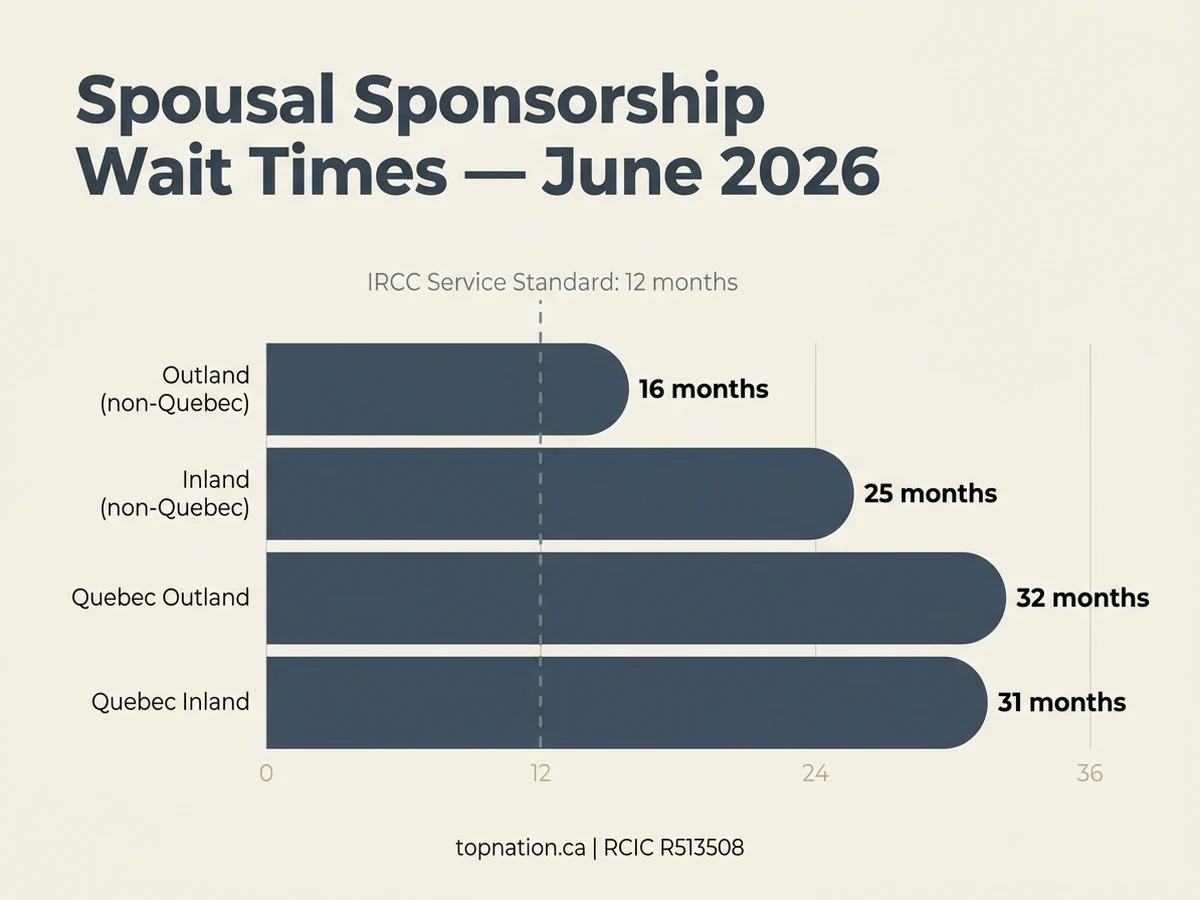
Outland (non-Quebec) — 16 months. Inland (non-Quebec) — 25 months. Outland Quebec — 32 months. Inland Quebec — 31 months. Inland Open Work Permit (OWP) — approximately 4 to 8 months from submission. IRCC service standard for both Outland and Inland (non-Quebec) remains 12 months — current actuals run 4 to 13 months above standard.
Spousal Sponsorship Processing Time 2026
If you are planning a spousal sponsorship application to bring a partner or spouse to Canada, the single most pressing question is the same one we hear in every initial consultation: how long will this actually take? In June 2026 the answer depends on three variables — whether you file Outland or Inland, whether the sponsored partner will live in Quebec, and whether you intend to apply for an Open Work Permit at the same time. This guide walks through the current spousal sponsorship processing time for each combination, explains why Inland files are now running 9 months longer than Outland files, and highlights what actually slows a file down in 2026 IRCC inventory conditions.
How Spousal Sponsorship Processing Times Work in 2026
IRCC publishes spousal sponsorship processing times as the time it takes to finish processing 80 percent of applications received in the recent past. The clock starts the day IRCC receives a complete application package — not the day you mail it, and not the day you start preparing. Files that are returned as incomplete do not start the clock; they re-enter the queue only after a complete resubmission. This is the single most misunderstood mechanic in spousal sponsorship processing time tracking.
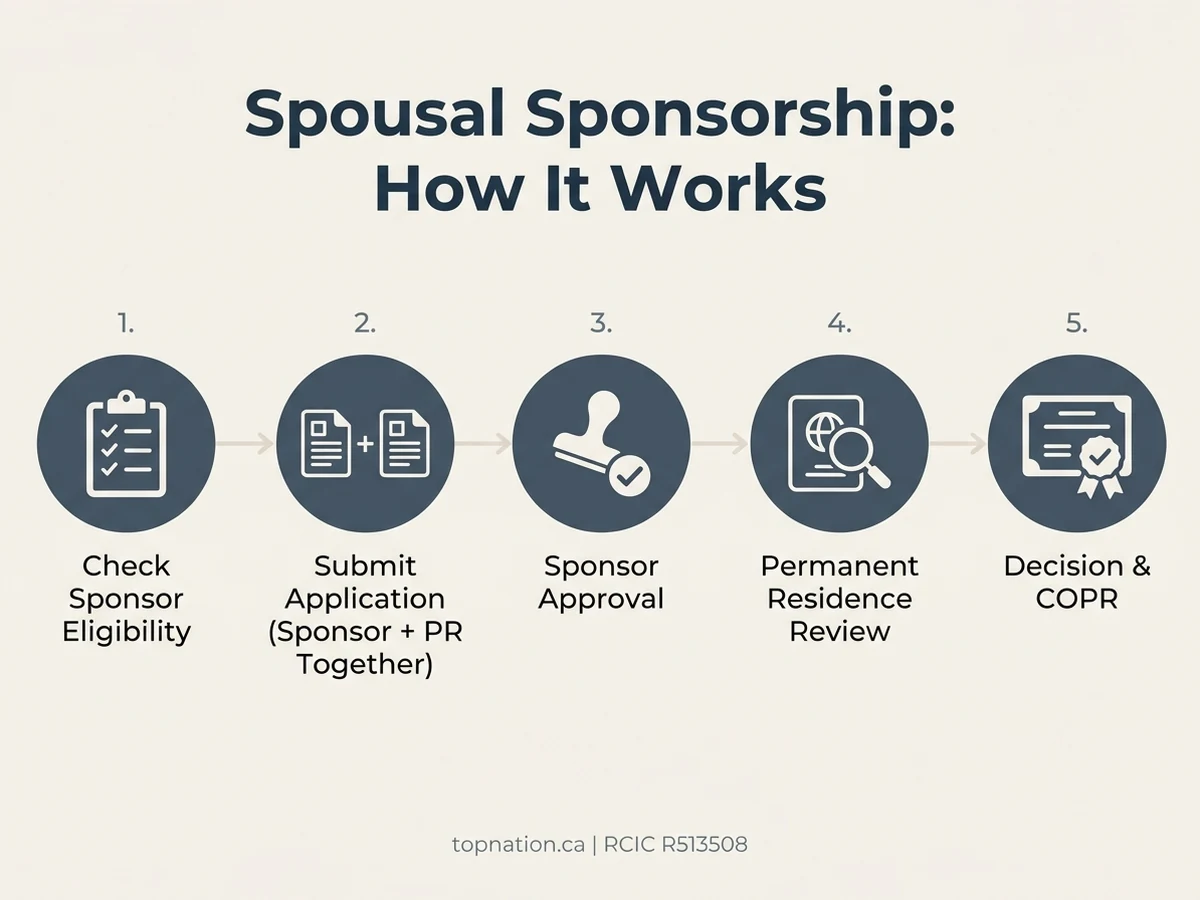
Spousal sponsorship is a two-step assessment under IRCC’s family class. First, IRCC assesses the sponsor’s eligibility — Canadian citizen or permanent resident status, income (where applicable), no undertaking defaults, no inadmissibility. Then IRCC assesses the foreign partner’s permanent residence application — relationship genuineness, medical exam, police certificates, biometrics, and security screening. Both phases run inside the published processing time, but the relationship-genuineness review is where most delays accumulate, because officers can request additional evidence at any point without putting the file on formal hold.
Outland and Inland are two different procedural tracks for the same family-class category. Outland files are processed by the IRCC visa office responsible for the foreign partner’s country of residence (or by the centralized Sydney office in some cases). Inland files are processed in Canada for partners who are already physically present in the country at submission. The procedural differences explain most of the gap in current processing times, as the next section shows.
Spousal Sponsorship Processing Time by Stream — June 2026 IRCC Data
The table below summarises IRCC’s published spousal sponsorship processing time for each active stream as of the May 12, 2026 IRCC update. Quebec figures reflect both the federal sponsor-eligibility step and the Quebec MIFI undertaking step. The service standard column shows IRCC’s target — current actuals are running above standard in every stream.
| Stream | Current Time | Service Standard | Direction | Notes |
|---|---|---|---|---|
| Outland (non-Quebec) | 16 months | 12 months | +1 month vs prior update | Inventory ~51,300 (+2,100) |
| Inland (non-Quebec) | 25 months | 12 months | +1 month vs prior update | Inventory ~55,200 (+1,300) |
| Outland (Quebec) | 32 months | N/A (MIFI step) | Unchanged | Includes MIFI undertaking step |
| Inland (Quebec) | 31 months | N/A (MIFI step) | Unchanged | Includes MIFI undertaking step |
| Inland Open Work Permit (OWP) | ~4–8 months | N/A | Variable | Filed concurrently with Inland PR |
Source: IRCC processing-time tool, data updated May 12, 2026. Inventory figures reflect IRCC monthly reporting. Individual files routinely complete faster or slower than the 80th-percentile published time.
Important note for Quebec applicants
Quebec’s Ministry of Immigration, Francisation and Integration (MIFI) has reportedly paused acceptance of new spousal undertakings for a portion of 2026, subject to specific exemptions. Reopen dates and exemption categories are subject to change. Confirm the current MIFI intake status with a licensed RCIC before submitting a Quebec-destined spousal sponsorship file — a wrong submission month can mean the file is returned, costing several months of queue time.
Outland Spousal Sponsorship (non-Quebec) Processing Time
Outland is the procedural track used when the foreign partner is processed through an IRCC visa office for their country of residence (or via centralized handling at Case Processing Centre Sydney for many countries). In June 2026, Outland files for non-Quebec destinations are running at 16 months from complete submission to permanent residence decision — one month longer than the prior update, and four months above the published 12-month service standard. Inventory for this stream now sits at approximately 51,300 files in queue.
Outland remains the faster of the two non-Quebec tracks for one structural reason: the visa office decision flow is more standardized than the Inland flow. The sponsor eligibility step is completed centrally; the foreign-partner permanent-residence step happens at a single visa office without the back-and-forth that characterises Inland Open Work Permit assessments. Outland files also benefit from a clean separation of roles — the sponsor is in Canada and the principal applicant is abroad, which simplifies relationship-genuineness evidence collection (you produce one bundle, you submit it once).
The Outland trade-off is travel risk. Outland applicants can typically travel between countries while the file is pending, but a denied visitor visa to Canada during the processing window can affect the relationship-genuineness narrative. For couples already living together in Canada, Outland is still legal — the partner can be physically in Canada during Outland processing — but the standard advice is to choose the track that matches your actual living situation, because misalignment between facts and procedural choice raises officer questions.
Inland Spousal Sponsorship (non-Quebec) Processing Time
Inland is the procedural track used when the foreign partner is already physically in Canada (typically on a work permit, study permit, or visitor record) at the time of submission. In June 2026, Inland files for non-Quebec destinations are running at 25 months — nine months longer than the comparable Outland file, one month longer than the prior IRCC update, and thirteen months above the published 12-month service standard. Inventory sits at approximately 55,200 files in queue.
The 9-month Outland-to-Inland gap is the headline number that drives the strategic decision for many couples in 2026. The gap comes from three structural factors. First, Inland files have a concurrent Open Work Permit assessment that runs in parallel with the permanent residence assessment — that adds an internal review layer. Second, Inland sponsors and applicants frequently respond to evidence requests through Canadian addresses, which means correspondence ping-pong adds weeks per round. Third, the Inland queue is structurally older — files that started during the 2022 pandemic backlog are still being processed, while the Outland queue has been turning over faster.
Inland is still the right choice for couples already cohabiting in Canada where the foreign partner has work permit status that will expire during the processing window. The Open Work Permit you file concurrently gives the partner authorization to work for any employer in Canada once issued — valuable financially and emotionally. But the 25-month timeline is real — you should plan your work, lease, and family decisions around that horizon rather than the 12-month service standard.
Quebec Outland Spousal Sponsorship Processing Time
Spousal sponsorship to Quebec is procedurally different from sponsorship to the rest of Canada. The sponsor must file a federal sponsorship application with IRCC AND a separate provincial undertaking with Quebec’s MIFI. Both files must be approved before the foreign partner can be issued the Quebec selection certificate (CSQ) and proceed to permanent residence. In June 2026, Outland files for Quebec destinations are running at 32 months — unchanged from the prior update — reflecting both the federal step and the MIFI step.
The Quebec Outland timeline is dominated by the MIFI step. Quebec processes provincial undertakings on its own queue, on its own service standards, and those standards have not aligned with IRCC’s federal targets. For couples where the sponsor lives in Quebec and the foreign partner lives abroad, the realistic 2026 expectation is a 30-to-34-month total file. Plan finances, leases, and career decisions accordingly.
The MIFI intake status is itself a moving target. Quebec has, in recent years, periodically paused new spousal undertaking intake to manage inventory. Before any Quebec-destined spousal file is submitted in 2026, confirm with a licensed RCIC that MIFI is currently accepting new undertakings for your specific situation. A file submitted during a pause can be returned, costing several months of queue time before you can refile.
Quebec Inland Spousal Sponsorship Processing Time
Inland Quebec files are running at 31 months in June 2026, also unchanged from the prior update. The structural mechanics are similar to Outland Quebec — federal IRCC step plus MIFI step — but the federal step is the Inland procedural track. The one-month difference between Quebec Outland (32 months) and Quebec Inland (31 months) is operationally insignificant — couples should choose Inland vs Outland based on where the partner currently lives, not on the marginal one-month timing differential.
For Inland Quebec files where the partner has work permit status expiring during the long processing window, the federal Open Work Permit you can file concurrently is critical. Without it, the partner can lose work authorisation between work-permit expiry and PR landing — a gap that can stretch many months. The OWP is therefore not optional for most Inland Quebec couples; it is the bridge that keeps the household solvent during the wait.
Inland + Open Work Permit (OWP) Processing Time
The Open Work Permit available to Inland spousal sponsorship applicants is one of the most useful procedural tools in Canadian family-class immigration. Filed concurrently with the Inland PR application, the OWP authorizes the foreign partner to work for any employer in Canada once issued. In 2026, IRCC has been processing these OWP applications at approximately 4 to 8 months from submission to decision — though individual files vary significantly based on whether the partner is in maintained status, biometrics turnaround, and concurrent application screening.
The OWP cannot be filed alone — it must accompany an Inland spousal PR application that is itself complete and properly filed. If the Inland PR file is returned as incomplete, the OWP application is returned with it. For couples planning to file in 2026, the workflow is: assemble the complete Inland PR package (sponsor eligibility, partner PR application, relationship evidence, medicals, police certs, biometrics, fees), file with the OWP request attached, and expect the work permit decision well before the PR decision.
Note: the 4-to-8-month OWP range is our practice observation for 2026 files. Confirm current IRCC published OWP processing time at submission — the figure can shift between IRCC updates.

What Actually Slows Down a Spousal Sponsorship Application
The published spousal sponsorship processing time assumes a complete file with no officer-side concerns. In practice, files routinely stretch beyond the published number for reasons that are largely avoidable. Below are the four most common causes of delay we see in our Edmonton practice.
1. Relationship-Genuineness Evidence Gaps
Relationship genuineness is the single most scrutinised dimension of any spousal sponsorship file. Officers look for a coherent narrative supported by communication records (chat logs, call logs, emails across the relationship timeline), shared finances (joint accounts, shared lease or mortgage, beneficiary designations), photo evidence across multiple events and dates, and third-party affidavits from family and friends. Thin evidence, photos from a single trip, or chat logs that start only after the wedding date are flags that trigger evidence requests — and each evidence request typically adds 2 to 4 months to the timeline.
2. Incomplete Sponsor Eligibility or Financial Documents
For most spousal files there is no minimum income requirement (unlike parental sponsorship), but the sponsor must still demonstrate eligibility — Canadian citizenship or permanent residence, no undertaking defaults, no inadmissibility. Missing Notices of Assessment, missing proof of status, or a confused declaration of past sponsorships can pause the file. For sponsors who recently received PR or citizenship, double-check that the supporting documents prove current status as of the submission date.
3. Police Certificate and Medical Exam Timing
Police certificates are valid for varying periods depending on issuing country, and IRCC medical exams are valid for 12 months. If your file sits in the queue for 16 to 25 months, those documents will expire before the decision — and IRCC will request new ones. The fix: time your medicals to the back end of the file (after the sponsor eligibility step) when possible, and refresh police certificates from countries where validity is short.
4. Inconsistencies Between Forms
The spousal sponsorship package contains many forms — the IMM 1344, IMM 5532, IMM 0008, schedules, financial annexes, and partner-specific forms. Names spelled differently across forms, dates that don’t reconcile across the relationship timeline, employment history that conflicts between the sponsor’s and the partner’s declarations — these all generate officer questions. The fix is a single-source-of-truth document set, signed-off by both partners, used as the reference for every form.
Outland vs Inland: Which Is Faster — and Which Is Right for You?
The 9-month gap between Outland (16 months) and Inland (25 months) in June 2026 is the single biggest variable inside your control. In principle, couples can choose either track regardless of where the partner currently lives. In practice the choice should match the household’s actual situation, because misaligned procedural choices generate officer questions that slow the file down further.
Choose Outland when the foreign partner is currently living abroad, or when the couple can manage the partner being outside Canada for the duration of the file. Outland is faster, the queue is shorter, and the decision flow is cleaner. Re-entry into Canada after a positive decision is straightforward with the Confirmation of Permanent Residence document.
Choose Inland when the partner is already cohabiting with the sponsor in Canada and the partner has temporary status that will expire during the processing window. The concurrent Open Work Permit is the critical advantage here — the partner can keep working, the household stays financially stable, and the family does not have to split for a year-plus while a PR decision is rendered abroad. The trade-off is the 25-month timeline.
For couples weighing the broader family-sponsorship landscape, our pillar guide on family sponsorship in Canada covers the full set of eligibility, financial, and procedural rules across spousal, parental, and dependent-child files. Couples planning specifically the spousal application should also review our spousal sponsorship Canada guide for the document checklist and the relationship-genuineness evidence bundle.
What to Do While You Wait
The 16-to-32-month timeline for a spousal sponsorship application is long enough that practical status decisions need to be made during the wait. The most strategic moves during this period:
- Maintain valid status — for Inland applicants, ensure the partner’s current work permit, study permit, or visitor record stays valid through the processing window. Apply for extensions at least 30 days before expiry to enter maintained status.
- File the Open Work Permit concurrently — Inland applicants should always file the concurrent OWP. Once issued, the partner can work for any employer in Canada.
- Plan visitor entries carefully — Outland applicants can visit Canada during processing under dual intent, but each entry must be planned with the officer’s discretion in mind. Carry evidence of ties abroad and the pending sponsorship application file number.
- Keep police certificates and medicals current — if you submitted older police certificates or a medical exam more than 12 months before the file is reviewed, expect a refresh request. Plan ahead so the refresh does not bottleneck the decision.
- Update IRCC promptly — address changes, employer changes, contact-information updates, or changes in family composition should be reported through the IRCC web form or applicable portal within 30 days.
Frequently Asked Questions
Spousal Sponsorship 2026
File Right the First Time — Talk to a Licensed RCIC
Our Edmonton team files complete spousal sponsorship packages the first time — the single biggest predictor of staying within IRCC service standards. We map Outland vs Inland to your real living situation, build the relationship-genuineness bundle, and steward your file through every officer touchpoint to your partner’s permanent residence landing.
| Book a Consultation → | Call 587-400-0077 |
Plan Your File Around the Real 2026 Numbers
Spousal sponsorship processing time in 2026 is materially longer than the published service standard. Outland (non-Quebec) runs 16 months — four months over standard. Inland (non-Quebec) runs 25 months — thirteen months over standard. Quebec files run 31 to 32 months. Plan your financial, work, and family decisions around the actual numbers, not the published standard. File complete the first time, choose the procedural track that matches your real living situation, and stay current with IRCC’s monthly processing-time updates — the May 12, 2026 figures are the most recent at the time of this guide, and the next IRCC update will move the needle again.
For related reading, see our AAIP processing times for 2026 for Alberta-specific PNP timelines, and our PR card renewal guide for the next step after a successful spousal sponsorship landing.
Reviewed by a Regulated Canadian Immigration Consultant (RCIC #R513508) · Last reviewed June 2026.
Last updated: June 2026. IRCC data as of May 12, 2026. Processing times reflect the latest published IRCC service standards; individual file timing varies. Consult a licensed RCIC for case-specific guidance.